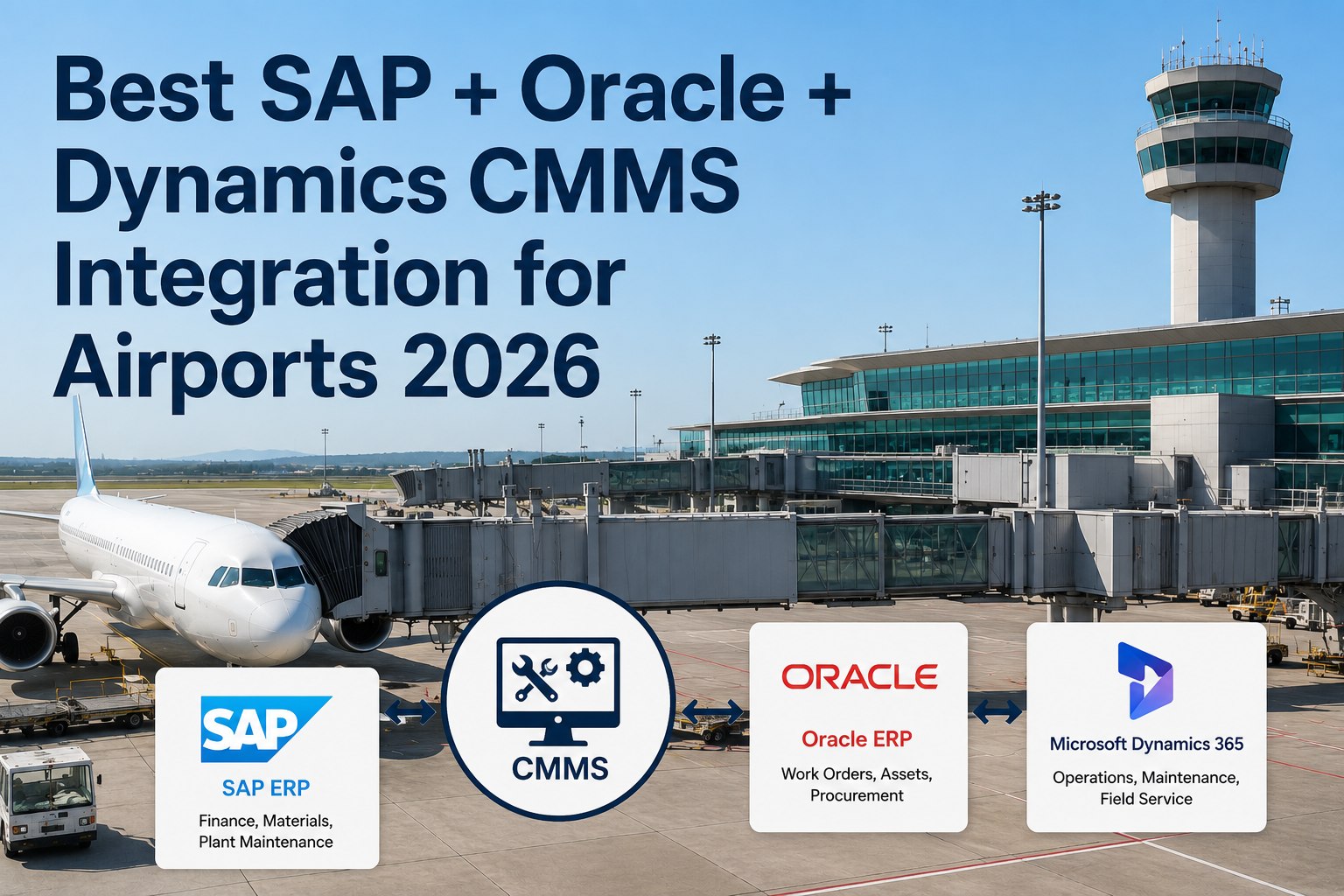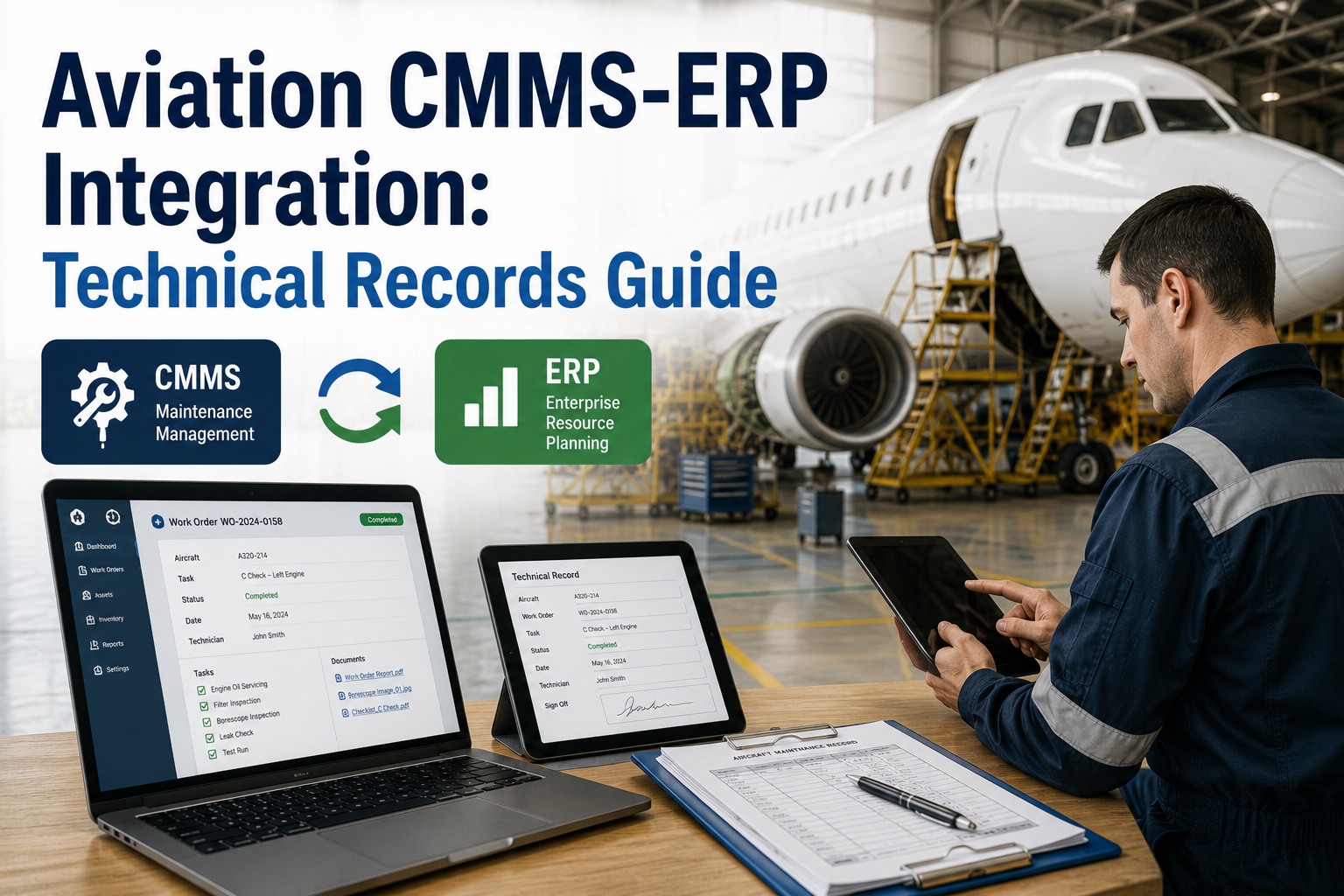
Aviation CMMS-ERP integration is the technical bridge that determines whether your maintenance, finance, and procurement teams operate from a single source of truth or constantly reconcile conflicting spreadsheets. When technical records systems, parts procurement platforms, and engineering order management tools are properly connected via API, airlines and MROs eliminate dual data entry, synchronize life-limited parts (LLP) tracking, and automate warranty claims without manual cross-referencing. This guide breaks down how to scope and deploy a successful aviation system integration that keeps financial ledgers perfectly aligned with maintenance execution. To see how a modern AI-powered platform handles this natively, you can Start Free Trial and connect your systems today.
Is Your CMMS Talking to Your ERP — Or Just Creating More Spreadsheets?
Most aviation integrations fail because they only sync purchase orders, leaving technical records, cost accruals, and life-limit data stranded in disconnected silos. Close the loop between maintenance execution and financial truth.
Why Aviation CMMS-ERP Integration Gets Scoped Badly
A successful aviation data integration requires synchronizing over 15 distinct data streams, yet 70% of MROs scope their projects around only two: purchase orders and inventory receipts. This leaves critical workflows like cost accrual, warranty triggers, and life-limit sync completely manual. When a technical records clerk has to cross-reference a paper logbook against an SAP or Oracle financial ledger to verify an AOG (Aircraft on Ground) parts swap, you are bleeding maintenance margins.
Siloed Technical Records
Without API sync, life-limited parts (LLP) hours and cycles live in the CMMS, while procurement costs sit in the ERP. This disconnect causes catastrophic audit failures and regulatory fines.
Manual Cost Accruals
Finance teams spend 15-20 days a month matching paper work orders to ERP invoices. If a $45K rotor blade swap isn't accrued in real-time, quarterly financials are fundamentally inaccurate.
Missed Warranty Claims
When CMMS technical records don't trigger automated alerts to the ERP procurement module, airlines miss 12-18% of available OEM warranty reimbursements on repaired components.
The True Cost of Disconnected Systems: A 180-Asset Airline Scenario
Consider a regional operator with 180 aircraft spending roughly $42K annually on manual data entry and reconciliation staff. Because their CMMS technical records are not synced to their ERP, engineers manually key component serial numbers into both systems. During a recent C-check, a typo in the ERP system caused a $120K engine module to be expensed rather than capitalized, distorting the balance sheet.
Example Output: (1,800 hrs × $55) + $65,000 + $120,000 − $28,000 = $256,000 Net Annual Savings
How to Execute CMMS Technical Records Integration in 5 Phases
Deploying a robust aviation integration guide requires a phased approach. Rushing the API mapping between engineering order management tools and financial ledgers is the number one cause of post-launch data corruption. Follow this 5-month timeline to ensure life-limit sync and parts procurement workflows function flawlessly.
Data Mapping & API Architecture
Define the exact JSON schemas for syncing aircraft tail numbers, serial numbers, and ATA chapters between the CMMS and ERP. Establish secure REST API endpoints.
Parts & PO Flow Synchronization
Connect spare-parts inventory. When a mechanic consumes a part on a work order, the ERP automatically generates a depletion record and triggers a reorder point.
Cost Accrual & Finance Sync
Map internal labor and external vendor costs to specific GL accounts in real-time. Eliminate month-end batch processing and manual invoice matching.
Life-Limit & Warranty Triggers
Automate the push of life-limited parts (LLP) tracking data to the ERP. Configure triggers that automatically generate warranty claims when components fail before their expected service life.
Audit, Reconciliation & Go-Live
Run parallel systems for 14 days. Validate that every work order in the CMMS has a matching financial transaction in the ERP with zero manual dual entry.
Aviation System Integration: Before vs. After API Connectivity
The shift from fragmented databases to a unified technical records CMMS fundamentally changes how maintenance and finance teams interact. Here is what changes when you implement true ERP aircraft integration.
| Workflow Capability | Disconnected Systems (Before) | Integrated CMMS-ERP (After) |
|---|---|---|
| Parts Procurement | Manual PO creation; 24-48 hr delay for AOG parts | Auto-generated POs triggered by work order consumption |
| Cost Accrual | 15-20 days month-end manual reconciliation | Real-time cost tracking; zero batch processing |
| Technical Records | Dual data entry; 4-7% error rate on serial numbers | Single source of truth via API; <0.5% error rate |
| Warranty Management | Manual log review; 15% missed claim rate | Automated OEM triggers; 98% claim capture rate |
| Audit Readiness | 2-3 weeks to compile compliance data | Instant compliance reporting via unified dashboard |
How OxMaint Powers Seamless CMMS API Aviation Integration
OxMaint is built specifically to bridge the gap between hangar-floor maintenance execution and corporate financial systems. Our AI-powered platform eliminates the friction of ERP technical records synchronization, ensuring your reliability teams and finance directors look at the exact same data in real-time.
Automated Parts & PO Flows
OxMaint monitors work order status and automatically triggers ERP purchase orders when spare-parts inventory drops below safety stock. Outcome: Cut AOG procurement delays by 40%.
Real-Time Cost Accrual Sync
Push internal labor and external MRO costs directly to your ERP's general ledger instantly. Outcome: Eliminate 15 days of month-end reconciliation and ensure 100% financial accuracy.
Life-Limit & Warranty Automation
Sync life-limited parts (LLP) hours and cycles to procurement for proactive replacement. Outcome: Recover 95% of missed OEM warranty claims automatically.
Predictive Maintenance Analytics
Use AI-driven analytics to predict component failures before they happen, feeding capital expenditure forecasts directly into your ERP. Outcome: Reduce unplanned downtime by 30-50%.
See OxMaint on Your Assets — Book a 30-Min Demo
Stop reconciling spreadsheets and start syncing technical records with your ERP in real-time. Discover how aviation leaders cut integration timelines from months to weeks.
Aviation CMMS ERP Integration: Key Questions Answered
What is aviation CMMS-ERP integration?
Aviation CMMS-ERP integration is the process of connecting your Computerized Maintenance Management System (CMMS) with your Enterprise Resource Planning (ERP) software via API. This allows technical records, work orders, and parts procurement data to flow seamlessly between maintenance and finance teams, eliminating dual data entry and ensuring a single source of truth. You can Start Free Trial to see this live.
How does CMMS technical records integration improve compliance?
By syncing life-limited parts (LLP) tracking and engineering order management directly with financial ledgers, integration ensures that every maintenance action is backed by a traceable financial record. This eliminates the audit gaps caused by manual data entry, reducing compliance compilation time from weeks to seconds.
How long does an aviation system integration take to deploy?
A properly scoped aviation data integration typically takes 4 to 5 months. This includes API architecture, parts and PO flow synchronization, cost accrual mapping, and life-limit trigger configuration. Rushing this timeline often results in post-launch data corruption and failed reconciliations.
Can OxMaint integrate with existing legacy ERP systems?
Yes, OxMaint uses flexible REST API endpoints that can connect with both modern cloud ERPs and legacy on-premise systems. To discuss your specific architecture, Book a Demo with our integration specialists.
What is the ROI of connecting technical records to an ERP?
The ROI comes from three main areas: eliminating 15-20 days of manual month-end reconciliation, capturing 95%+ of missed OEM warranty claims, and reducing AOG procurement delays by up to 40%. Most operators see a net annual savings of over $250,000.
Ready to Unify Your Maintenance and Finance Data?
Join the aviation reliability teams using OxMaint to automate parts procurement, sync technical records, and predict failures before they happen.
Free 14-day trial · No credit card required