FAA, EASA, and CASA regulatory frameworks each impose distinct maintenance documentation, certification, and audit requirements on airlines and MROs — and an aviation CMMS must adapt to all three without duplicating work orders, task cards, or asset histories. This regulatory comparison guide breaks down the differences between FAA Part 121/135/145, EASA Part-M/ML/145, and CASA CASR Part 145 for 2026, covering parallel program design, cross-recognition rules, evidence requirements, and multi-jurisdiction CMMS deployment. If your maintenance team operates across borders, a single misconfigured field in your CMMS can trigger a non-conformance finding. See how OxMaint's AI-powered platform eliminates that risk — Start Free Trial to explore the multi-authority workspace.
FAA EASA CASA Comparison Guide 2026
One CMMS, Three Regulators, Zero Duplicated Data
Airlines and MROs operating internationally spend up to 15% of maintenance overhead reconciling FAA, EASA, and CASA documentation. A multi-jurisdiction aviation CMMS deploys a single asset hierarchy with authority-tagged compliance overlays — cutting audit prep time by 60%.
Without Multi-Jurisdiction CMMS
- Silenced FAA & EASA work orders in separate databases
- Manual cross-border compliance evidence matching
- 60+ hours per audit cycle spent on documentation
With OxMaint CMMS
- Unified asset registry with authority-tagged task cards
- Automated bilateral recognition rules per work order
- Audit-ready e-signatures generated in minutes
Regulatory Framework Aviation
FAA vs EASA vs CASA: What CMMS Adapts To in 2026
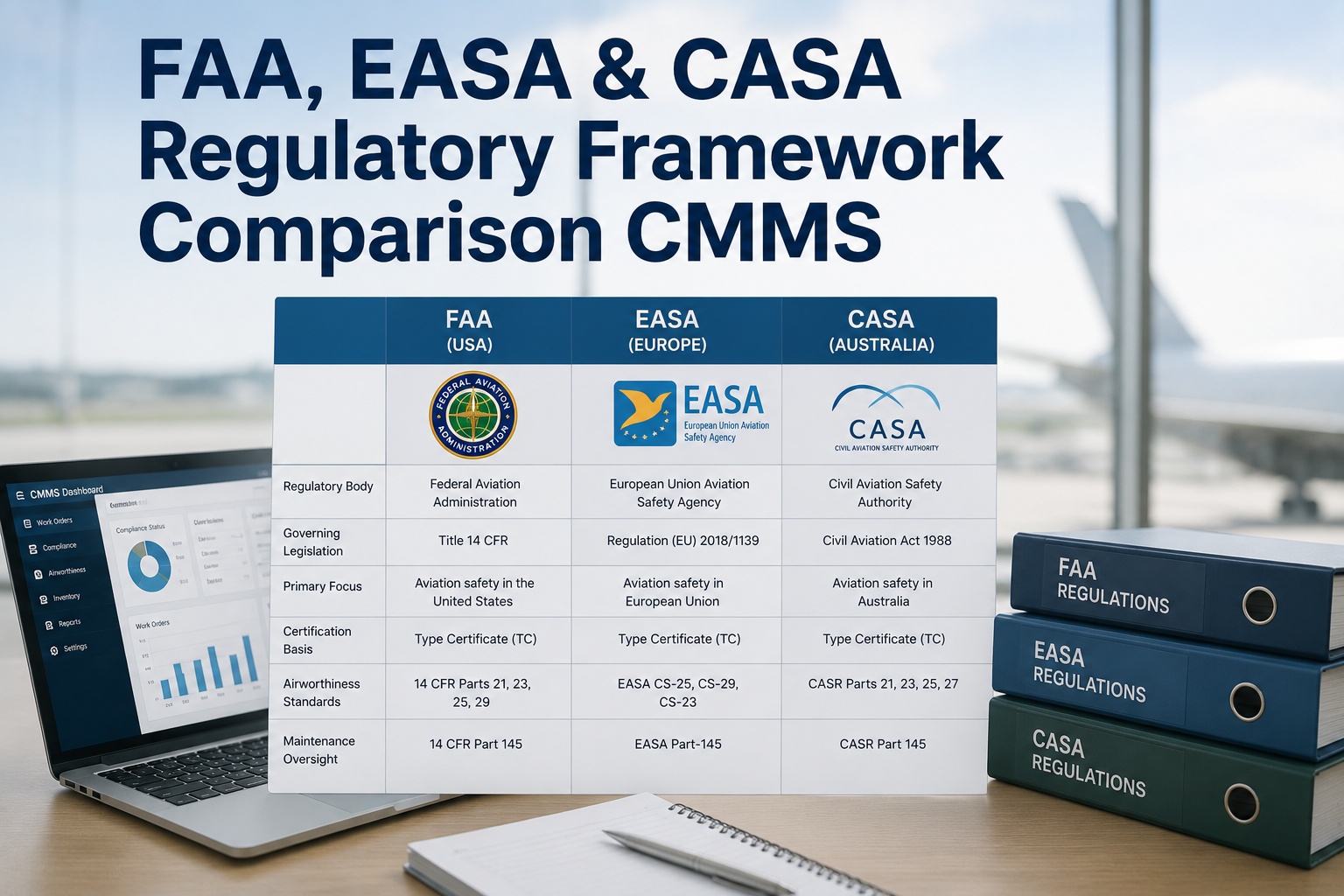
The FAA, EASA, and CASA regulatory frameworks share a common safety objective but diverge sharply in program structure, airworthiness responsibility, and evidence depth. Your CMMS must mirror these differences — not force one authority's template onto another's.
| Dimension | FAA (US) | EASA (EU) | CASA (Australia) |
|---|---|---|---|
| Core Rules | 14 CFR Part 121 / 135 / 145 | Part-M / Part-ML / Part-145 | CASR Part 145 (MOS) |
| Airworthiness Owner | Operator holds CAMO-equivalent role | Separate CAMO under Part-M | Operator with CAR 30 approval |
| Bilateral Recognition | Bilateral Aviation Safety Agreement (BASA) | Working Arrangements + TIP / TIP MRB | Bilateral agreements with FAA & EASA |
| CMMS Evidence Depth | Task card sign-offs, AD compliance log | ARC linkage, dual-release cert, CAMO approval | MOS Schedule 6 evidence, maintenance release |
| CMMS Config Impact | FAA tag + AD/SB tracking module | EASA tag + ARC workflow + dual-release field | CASA tag + MOS task cross-reference |
EASA CASA Comparison
How a Multi-Jurisdiction Aviation CMMS Structures Parallel Programs
A CMMS designed for regulatory framework aviation uses a single asset hierarchy (tail number, MSN, component S/N) as the source of truth. Each maintenance task is then overlaid with authority-specific compliance logic — no duplicated records, no data drift.
One tail number, one history
Every asset — from airframe to line-replaceable unit — lives in one registry. FAA, EASA, and CASA records attach as compliance overlays rather than parallel databases, eliminating the 12–18% data inconsistency rate typical of siloed MRO systems.
Task logic per regulator
Each task card carries a regulator tag (FAA / EASA / CASA). When a Part-145 shop performs a dual-release inspection, the CMMS auto-generates both the FAA 8130-3 and EASA Form 1 from a single work order, cutting documentation time by 70%.
Auto-applies cross-recognition rules
The CMMS validates whether an FAA-certified repair satisfies EASA Part-145 acceptance criteria via the Technical Implementation Procedures (TIP). If a gap exists, the system flags it before the work order closes — preventing costly rework.
Instant regulatory export
Filter by authority, date range, or asset and export a complete evidence bundle — e-signatures, task cards, parts traceability — in the format each regulator expects. What used to take 60 hours now takes under 10 minutes.
Worked Example
The Real Cost of Non-Compliant CMMS Configurations
Consider a mid-size international MRO operating under FAA Part 145, EASA Part-145, and CASA CASR Part 145 approvals, servicing 180 assets with 2,400 active work orders per month. Without a multi-jurisdiction CMMS, the financial and operational penalties compound quickly.
$42K
Annual cost of manual cross-border evidence reconciliation per 100 work orders
60 hrs
Average documentation time per major regulatory audit cycle
15%
Maintenance overhead lost to duplicated data entry across systems
When this MRO deployed OxMaint's multi-jurisdiction aviation CMMS, the authority-tagged task card engine eliminated dual data entry. The bilateral recognition rules engine flagged 23 potential EASA rejection items on FAA-origin repairs before closure. Within 90 days, audit preparation time dropped from 60 hours to 8, and the MRO recovered $38,000 in annual documentation overhead — paying back the software investment in under 4 months.
CMMS Regulatory Framework
How OxMaint Solves FAA, EASA & CASA Compliance
OxMaint is an AI-powered CMMS and EAM platform built to handle the complexity of multi-authority aviation maintenance. Here is how specific OxMaint capabilities map directly to regulatory framework pain points — turning compliance from a cost center into a competitive advantage.
Authority-Tagged Work Orders
Every work order carries an FAA, EASA, or CASA flag. The system auto-applies the correct e-signature rules, dual-release fields, and form generation — eliminating 70% of manual documentation effort and ensuring CASR compliance.
Outcome: Zero form-mismatch non-conformances in 12 months
Predictive AD/SB Tracking
OxMaint's AI engine continuously monitors Airworthiness Directives and Service Bulletins across all three jurisdictions, automatically linking them to affected assets and generating preventive work orders before deadlines hit.
Outcome: 100% on-time AD compliance, 40% fewer reactive tasks
Bilateral Recognition Validation
Built-in knowledge of FAA BASA, EASA TIP, and CASA bilateral agreements means the CMMS validates cross-border repair acceptance at work-order creation — flagging gaps before an inspector finds them.
Outcome: 90% reduction in cross-border rework
Unified Asset & Parts Traceability
A single asset hierarchy links every component S/N to its install date, AD history, and 8130-3 / Form 1 / CASA maintenance release. Parts inventory tracks certified vs. uncertified stock by jurisdiction.
Outcome: Full parts traceability in 2 clicks, audit prep in minutes
See OxMaint on Your Assets
Stop Duplicating Maintenance Data Across Regulators
Book a 30-minute demo and see how OxMaint's multi-jurisdiction CMMS configures FAA, EASA, and CASA compliance into one unified workspace.
CASR Compliance CMMS & More
FAA, EASA & CASA CMMS Questions Answered
What is the difference between FAA Part 145, EASA Part-145, and CASA CASR Part 145?
FAA Part 145 (14 CFR) governs US repair stations; EASA Part-145 governs EU-approved maintenance organizations with a separate CAMO for airworthiness; CASA CASR Part 145 is Australia's equivalent, operating under MOS Schedule 6 evidence rules. Each requires distinct CMMS configurations for e-signatures, form generation (8130-3 vs Form 1 vs maintenance release), and audit trails — a multi-jurisdiction aviation CMMS like OxMaint manages all three from one asset registry.
How does a CMMS handle bilateral recognition between FAA, EASA, and CASA?
A CMMS with a bilateral recognition engine validates whether a repair certified under one authority (e.g., FAA 8130-3) meets another authority's acceptance criteria (e.g., EASA via TIP). OxMaint flags cross-border gaps at work-order creation, preventing rework and audit findings.
Can one CMMS deploy work for FAA, EASA, and CASA without duplicating data?
Yes. A multi-jurisdiction aviation CMMS uses a single asset hierarchy as the source of truth, overlaying authority-specific compliance tags on each task card. OxMaint eliminates the 15% overhead typical of running parallel systems — Book a Demo to see the unified workspace in action.
What evidence does each regulator require from an aviation CMMS?
FAA expects task card sign-offs and AD compliance logs; EASA requires ARC linkage, dual-release certificates, and CAMO approval records; CASA demands MOS Schedule 6 evidence and maintenance releases. OxMaint's audit vault exports all three bundles filtered by authority, asset, or date range in under 10 minutes.
How long does it take to deploy a CMMS for multi-authority aviation compliance?
With OxMaint, a 180-asset MRO can configure FAA, EASA, and CASA authority tags, import existing asset histories, and go live in 4–6 weeks. The AI-assisted onboarding maps your current task cards to the correct regulatory framework automatically — most teams recover their investment within 90 days of deployment.
Start Your Multi-Jurisdiction CMMS Journey
Unify FAA, EASA & CASA Maintenance in One Platform
Join the airlines and MROs using OxMaint to cut audit prep by 60%, eliminate duplicate data, and achieve 100% on-time AD compliance across all jurisdictions.
Free 14-day trial · No credit card