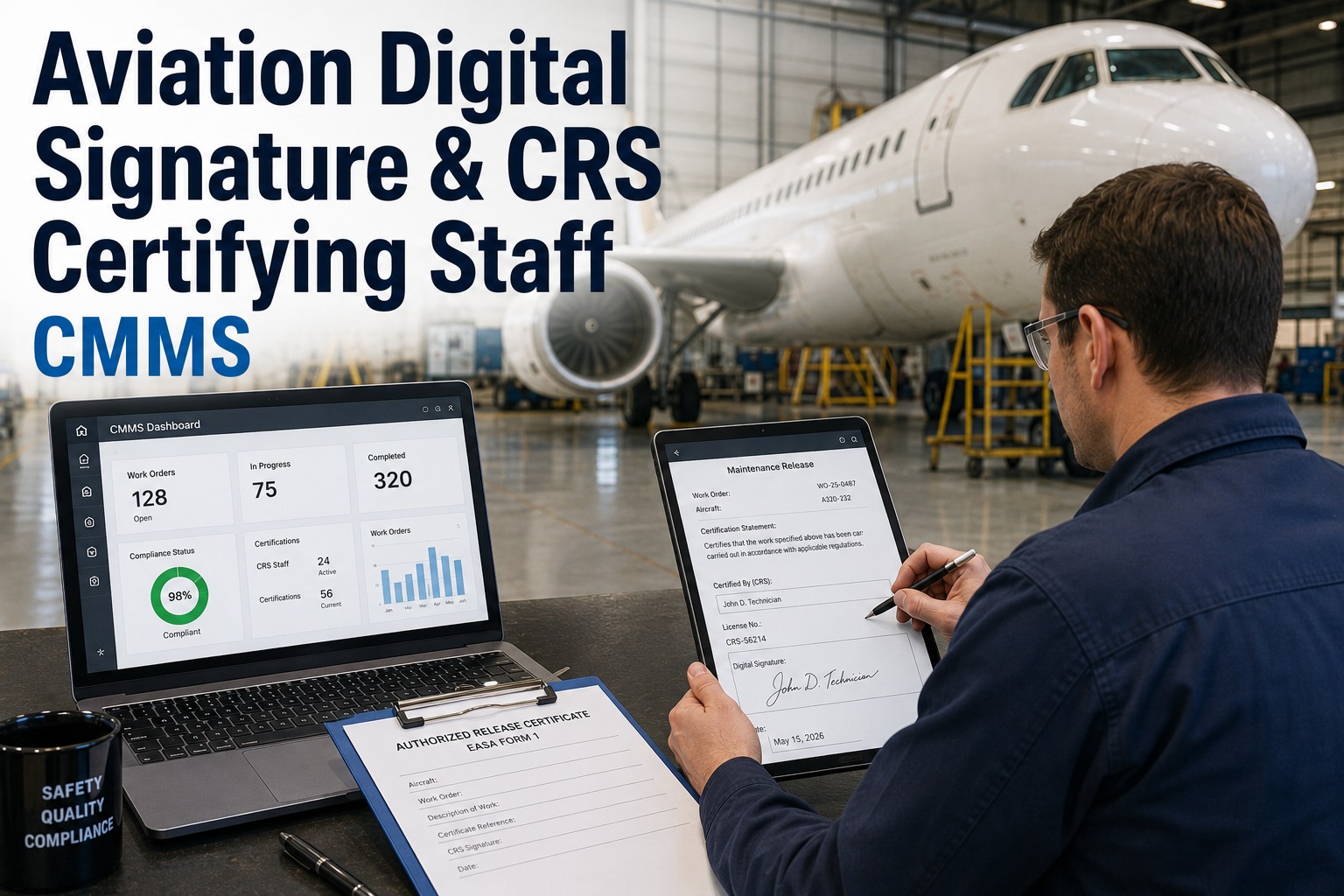
Digital signatures have quietly become the single biggest unlock in aviation MRO — FAA Order 8900.1, EASA Part-145.C.50, and CASA Part 42 accept cryptographic, identity-bound e-signatures for Certificate of Release to Service (CRS) and certifying staff sign-offs. The result: paperwork bottlenecks that used to stall aircraft dispatch by 4–8 hours per major check collapse into minutes, and auditors stop flagging missing wet-ink stamps. This guide maps the full path from wet-ink to a CMMS-anchored digital signature workflow, covering e-signature standards, the certifying staff authorization matrix, and the compliance traps to avoid. Ready to modernize your release process? Start Free Trial and configure CRS sign-off inside your CMMS today.
What if every CRS sign-off cleared in under 90 seconds — fully auditable?
Wet-ink routing costs a typical 145 station 6.4 hours per aircraft in signature chase, fax-back, and archive. A CMMS-anchored digital signature eliminates that drag while satisfying FAA 8900.1, EASA Part-145, and CASA Part 42 in a single workflow.
Three authorities, one accepted e-signature standard
Digital CRS signatures are no longer a grey zone. The three major regulators now publish explicit acceptance criteria — your CMMS simply has to meet them.
Electronic record & signature acceptance
Accepts e-signatures that are unique to one person, non-reusable, and linked to the record so tampering is detectable. Part 145 stations may issue CRS digitally when identity, intent, and timestamp are captured.
CRS via acceptable electronic means
Permits CRS issuance by electronic means when the system ensures integrity, traceability to the certifying staff, and protection against unauthorized modification. Commonly mapped to eIDAS QES or AdES.
Certifying staff & digital release
Accepts electronic signatures for maintenance release provided the system authenticates the signatory, records the timestamp, and links the signature to the specific maintenance record under CAO 100.5.
The cost gap between paper sign-off and CMMS digital release
A 2024 cross-industry MRO benchmark found that wet-ink CRS routing burns 6.4 hours per aircraft and produces 11% of audit findings — almost all signature-related.
| Release dimension | Wet-ink workflow | CMMS digital signature |
|---|---|---|
| Average sign-off cycle | 4–8 hrs (chase, fax, re-sign) | 45–90 seconds |
| Identity verification | Visual stamp + initials | Cryptographic identity-bound token |
| Timestamp integrity | Manual date entry | UTC server-stamped, immutable |
| Audit finding rate | 11% (mostly missing/faded stamps) | <1% (auto-archived, hash-linked) |
| Certifying staff authorization check | Manual cross-check against roster | Real-time authorization matrix enforced at sign-off |
| Per-aircraft paperwork cost | $310 (handling, archive, rework) | $42 |
The authorization matrix that prevents 90% of release findings
Most CRS non-conformances trace to one root cause: a signatory who wasn't authorized for that aircraft type, system, or task category. A CMMS authorization matrix blocks the signature before it happens.
Aircraft-type scope
Each certifying staff member is tagged to specific type ratings (e.g., B737NG, A320ceo). The CMMS greys out the CRS button for any work order outside the signatory's type scope.
System & task category
Authorizations split across ATA chapters and task classes — structural, avionics, engine, landing gear. A mechanic cleared for line maintenance cannot sign a base-check structural CRS.
Currency & recency
Type rating expiry, recent experience (90-day currency), and refresher training expiry are tracked in real time. Lapsed currency auto-revokes the digital signature privilege until renewed.
Dual-release logic
For dual-release (FAA + EASA) work orders, the CMMS verifies that the signatory holds BOTH authorizations — or routes to two certifying staff in sequence.
From wet-ink to fully digital CRS in 90 days
A typical Part-145 station completes the migration in three phases. The example below is a 180-aircraft operator that cut CRS cycle time from 6.2 hours to 51 minutes.
Digital identity provisioning & policy
Issue cryptographic identity tokens to certifying staff, update the MOE / CMM to reference electronic signature procedures, and file the change with the NAA. Pilot on one aircraft type.
Authorization matrix & CMMS integration
Map every certifying staff member to type, ATA chapter, and task category. Configure the CMMS to block sign-off where authorization, currency, or recency is missing. Run shadow mode for two weeks.
Full rollout & audit-ready archive
Go live across all aircraft types and stations. Every CRS auto-archives with signature, timestamp, identity hash, and work order link. Auditor self-service portal opens.
What a 180-aircraft operator actually saves per year
Using the benchmark range above, here's the payback math for a mid-size operator running 420 release events per month.
Five findings that derail wet-ink-to-digital migrations
Auditors see the same five non-conformances repeatedly. Design them out before you go live, not during the next surveillance audit.
Unsigned or partial CRS records
Cause: wet-ink stamps go missing during archive scanning. Fix: CMMS auto-locks the record only after the cryptographic signature is captured and hash-linked.
Signatory beyond authorization scope
Cause: no real-time scope check. Fix: the CMMS authorization matrix greys out the sign button for out-of-scope type, ATA, or task category.
Untraceable timestamps
Cause: manual date entry, timezone drift. Fix: server-side UTC timestamp from a synced NTP source, immutable after capture.
Expired type rating or currency
Cause: currency tracked in a spreadsheet that nobody checks. Fix: auto-revoke signature privilege 24 hours before currency lapses; route to an alternate authorized signatory.
No audit trail for signature events
Cause: signature captured outside the CMMS. Fix: every sign-off writes an immutable log entry — signatory, timestamp, IP, device, work order, and prior hash.
Stop chasing signatures. Start releasing aircraft.
Deploy a CMMS that handles CRS, certifying staff authorization, and audit-ready digital sign-off in one workflow — accepted under FAA, EASA, and CASA.
CRS digital signature in CMMS — the questions auditors ask most
Is a digital CRS signature accepted by FAA, EASA, and CASA simultaneously?
Yes. All three authorities accept e-signatures for CRS provided the system meets identity-binding, tamper-evidence, timestamping, and audit-trail requirements. A single CMMS workflow can satisfy FAA Order 8900.1, EASA Part-145.C.50, and CASA Part 42 — the same record is dual-release-capable when your certifying staff holds both authorizations. You can configure the full workflow when you Start Free Trial.
How does the CMMS verify that the signatory is actually authorized?
The authorization matrix maps each certifying staff member to aircraft type, ATA chapter, task category, and current currency status. At the moment of sign-off, the CMMS checks all four dimensions in real time and blocks the signature if any condition is unmet — including a type rating that expires the next day.
What happens to existing wet-ink records during migration?
Historical paper CRS forms are scanned, hash-linked, and archived in the same CMMS record store so auditors see a single timeline. New releases from go-live forward are born-digital. Most operators run a 2–4 week shadow period where both formats coexist before retiring wet-ink entirely.
Can a digital signature be revoked or re-issued after the CRS is signed?
No — once captured, the signature, timestamp, and identity hash are immutable. If a release must be corrected, the CMMS issues a superseding CRS with a new signature and links it to the prior record, preserving full traceability. This is the same audit-trail pattern auditors expect for paper corrections, just cryptographically enforced.
How long does deployment take for a mid-size Part-145 station?
Typically 60–90 days: identity provisioning and MOE update in month one, authorization matrix and CMMS integration in month two, full rollout in month three. A 180-aircraft operator can expect payback inside 11 weeks. Book a 30-minute scoping call at to map your timeline.
Your next CRS could be signed in 90 seconds.
Join the MROs running FAA, EASA & CASA-compliant digital CRS sign-off inside their CMMS — 87% less paperwork cost, 92% faster release cycle.
Free 14-day trial · No credit card