Aviation insurance audits increasingly hinge on the quality of your maintenance documentation, not just the condition of your aircraft. Underwriters assessing machinery breakdown, hull, and liability coverage now expect CMMS-backed evidence of preventive maintenance compliance, condition monitoring, and incident history before pricing a policy. A structured aviation insurance audit trail built inside a modern CMMS can reduce premium loadings, accelerate claim approvals, and cut audit prep from weeks to hours. This guide maps exactly what underwriters look for in 2026 and how OxMaint helps you deliver it — ready to Start Free Trial and build your audit package today.
Can your maintenance records survive a machinery breakdown insurance audit?
Aviation underwriters are tightening risk assessment for 2026 policy renewals. Spreadsheets and paper logbooks no longer meet the evidentiary bar for machinery breakdown coverage. A CMMS-based insurance audit trail gives you defensible, time-stamped proof of every PM, inspection, and corrective action — exactly what underwriters need to validate risk and process claims.
What aviation underwriters expect from your CMMS in 2026
A documented maintenance programme aligned to ISO 55000 asset management principles is now the baseline. Underwriters expect four core evidence streams — each verifiable, time-stamped, and electronically signed inside your CMMS.
Preventive Maintenance Compliance
Underwriters want a PM completion rate above 90% with auditable records showing task, technician, timestamp, and result. Gaps in recurring inspections — engine borescopes, gear box checks, hydraulic fluid analysis — signal elevated breakdown risk and trigger premium surcharges of 15–25%.
Condition Monitoring Records
Vibration analysis, oil debris monitoring, thermography, and HUMS data must be logged against the specific asset serial number. Underwriters use trend data to confirm early-warning thresholds are acted on — not just recorded — before machinery failure escalates.
Incident & Corrective Action History
Every breakdown event, root-cause analysis, and corrective work order must trace to the originating asset. A closed-loop record — fault detected, work order raised, part replaced, sign-off captured — proves operational discipline and directly supports claim validity.
Spare-Parts & Inventory Traceability
Certified parts with batch numbers, certificates of conformance, and installation records are mandatory for aviation machinery breakdown claims. Your CMMS must link each replaced component to the work order and the originating asset history with no manual gaps.
How to prepare a CMMS-backed insurance audit package
A defensible insurance audit package is built continuously, not in the 48 hours before renewal. Follow this 5-month timeline to transform scattered maintenance data into an underwriter-ready dossier.
Asset Register Validation
Confirm every aviation asset — from APU and landing gear to baggage-handling conveyors and refuelers — is logged with serial number, criticality rating, and insurance asset tag. OxMaint auto-imports existing registers so nothing is missed.
PM Schedule Reconciliation
Cross-check every PM trigger against OEM intervals and regulatory requirements. Flag overdue tasks. A CMMS machinery breakdown defence depends on showing that PM schedules are not only defined but actively enforced.
Condition Monitoring Integration
Connect sensor feeds — vibration, temperature, oil quality — to asset records so threshold breaches auto-generate work orders. This proves to underwriters that predictive maintenance is operational, not aspirational.
Incident History Compilation
Pull 24 months of breakdown events, MTTR, MTBF, and root-cause documentation. OxMaint exports this as a structured report with asset-level traceability, directly mapped to insurance claim categories.
Audit Dossier Generation
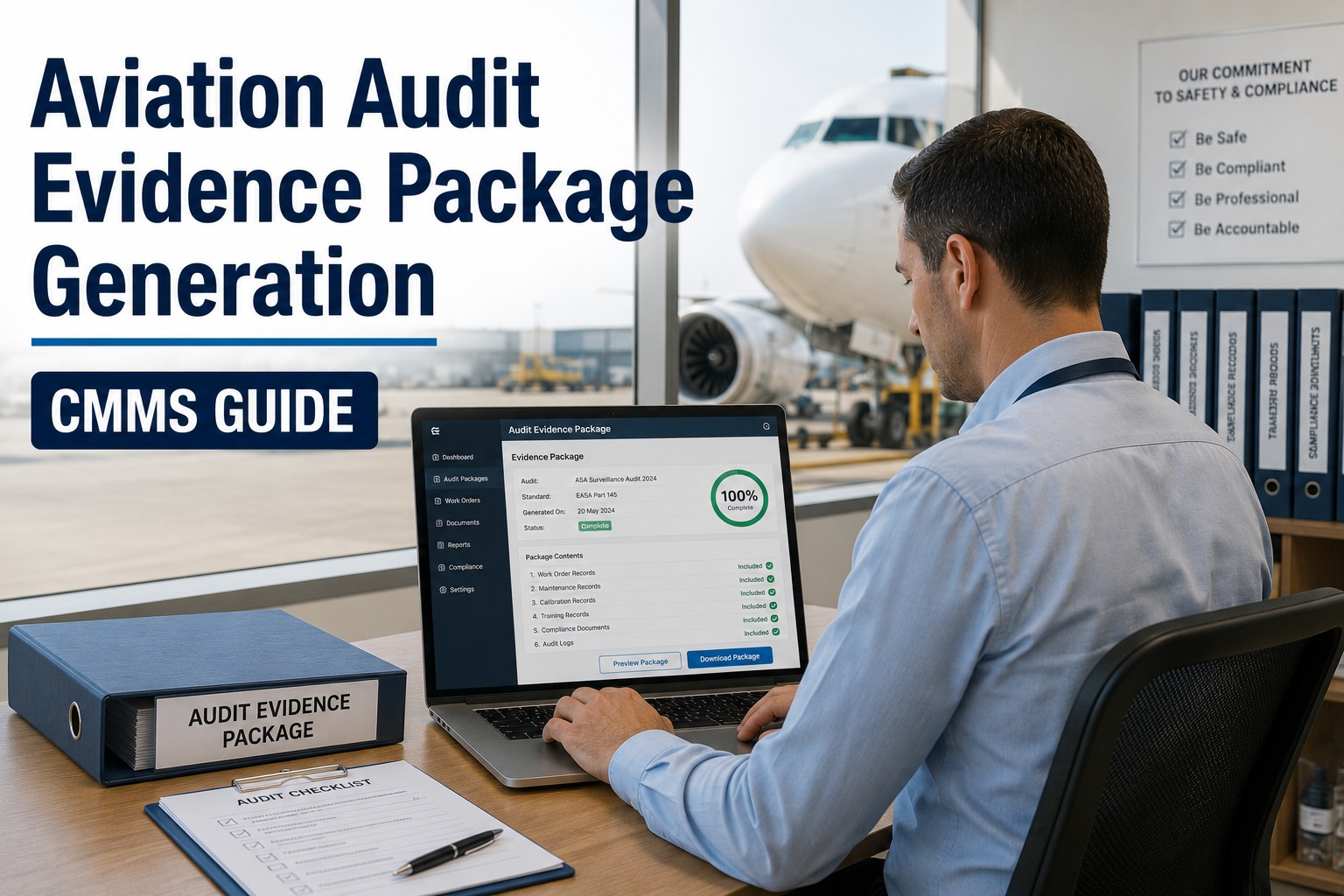
Produce the final insurance trail: PM compliance summary, condition monitoring trends, incident logs, parts certificates, and technician sign-offs — exported as a single, time-stamped, underwriter-ready package.
Aviation insurance CMMS vs spreadsheet documentation
Many operators still rely on spreadsheets and paper logbooks for underwriter documentation. Here is what that costs you at renewal — and what a CMMS insurance trail delivers instead.
| Audit Criterion | Spreadsheets & Paper | OxMaint CMMS |
|---|---|---|
| PM compliance evidence | Manual entry, gaps common, no timestamps | Auto-stamped, 95%+ completion visibility |
| Condition monitoring linkage | Separate systems, no asset traceability | Sensor data tied to serial-level asset record |
| Incident root-cause trail | Free-text notes, difficult to retrieve | Structured RCA linked to work order & asset |
| Parts certification | Filing cabinets, manual cross-reference | Digital CoC attached to work order & inventory |
| Audit package generation | 2–3 weeks of manual compilation | One-click structured export in minutes |
| Underwriter confidence | Low — data integrity questioned | High — defensible, tamper-evident records |
How OxMaint strengthens your aviation insurance audit trail
OxMaint turns maintenance execution into underwriter-grade documentation automatically. Every capability below maps directly to an evidence stream aviation underwriters demand — with measurable impact on audit prep time, claim speed, and premium negotiation.
Automated PM Compliance Tracking
Every preventive maintenance task — from engine borescope inspections to gear oil changes — is scheduled, assigned, and time-stamped automatically. OxMaint flags overdue PMs in real time, helping operators sustain 95%+ completion rates and giving underwriters immediate, defensible compliance evidence.
Predictive Condition Monitoring
OxMaint ingests vibration, temperature, and oil-analysis data, then uses AI to predict failures before they happen. Threshold breaches auto-generate work orders, proving to underwriters that your condition-based maintenance programme is active — not just documented on paper.
Closed-Loop Work Order History
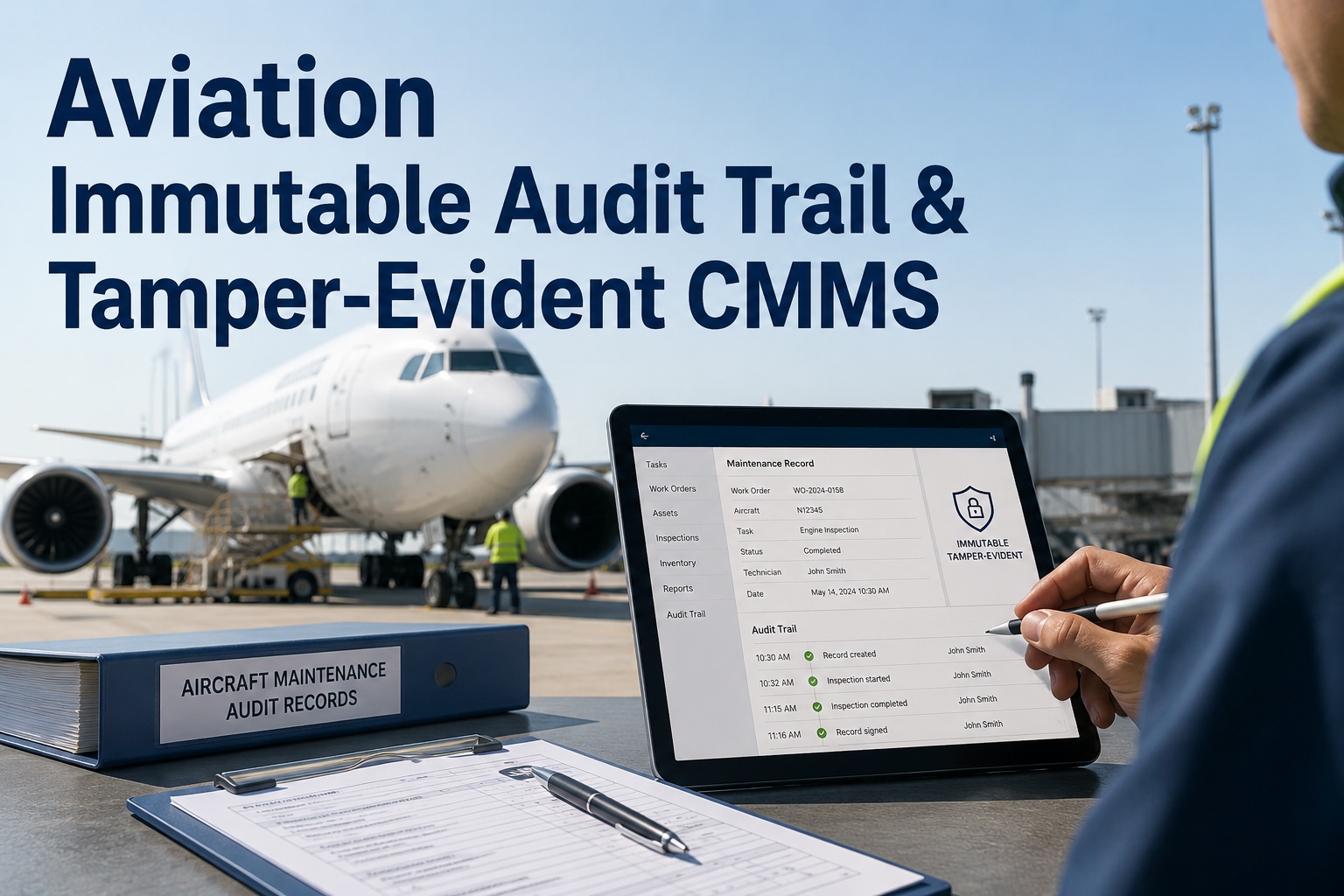
Every work order — from fault detection through root-cause analysis, parts replacement, and technician sign-off — is captured in a single, tamper-evident chain. OxMaint links each record to the originating asset serial number, creating the exact audit trail underwriters need for claim validation.
Certified Parts Inventory
OxMaint tracks every spare part by batch, certificate of conformance, and installation date — linked directly to the asset and work order. When an underwriter asks for proof that a certified component was used in a repair, the documentation is one click away.
The cost of poor documentation — and the payback of fixing it
A regional operator with 220 assets managed maintenance on spreadsheets. At machinery breakdown renewal, the underwriter requested 24 months of PM compliance and incident data. Compilation took 3 weeks, records had gaps, and the claim for a gearbox failure was delayed 5 months due to missing parts certification.
The same operator deployed OxMaint, auto-imported their asset register, and within 60 days had a complete CMMS insurance trail. At the next renewal, the underwriter received a structured audit package in minutes. PM compliance was visible at 96%, condition monitoring was live, and every part had a digital CoC.
See your aviation insurance audit trail built live — in 30 minutes
Book a demo and we will map your asset register, PM schedules, and documentation gaps to a CMMS-backed insurance package that underwriters trust.
Aviation insurance audit and CMMS — your questions answered
What is an aviation insurance audit and why does it matter for machinery breakdown coverage?
An aviation insurance audit is the process by which underwriters review your maintenance documentation to assess risk exposure before pricing or renewing machinery breakdown coverage. It evaluates PM compliance, condition monitoring, incident history, and parts traceability. Poor documentation leads to premium loadings, coverage exclusions, or delayed claims — while a CMMS-based audit trail strengthens your negotiating position and speeds up claim approvals.
How does a CMMS support aviation underwriter documentation requirements?
A CMMS provides time-stamped, tamper-evident records for every maintenance action — preventive tasks, inspections, corrective work orders, and parts replacements. It links each record to the specific asset serial number, giving underwriters verifiable evidence that maintenance is performed on schedule and to standard. OxMaint extends this with predictive analytics and one-click audit dossier exports, which you can see by booking a demo.
What PM compliance rate do aviation underwriters expect during an insurance audit?
Most aviation underwriters look for a preventive maintenance completion rate of 90% or higher, supported by auditable records showing the task, technician, timestamp, and outcome. Rates below this threshold signal elevated breakdown risk and typically trigger premium surcharges of 15–25%. OxMaint helps operators sustain 95%+ compliance through automated scheduling, real-time overdue alerts, and digital sign-off capture.
Can CMMS records speed up machinery breakdown claim submissions?
Yes. When a breakdown occurs, underwriters and claims adjusters need the full maintenance history of the affected asset — PM records, condition monitoring trends, prior incidents, and parts certification. A CMMS like OxMaint compiles this into a structured, asset-level report in minutes rather than weeks, reducing claim processing delays by up to 40% and improving the likelihood of full claim approval.
How long does it take to implement OxMaint for insurance audit readiness?
Most aviation operators can import their asset register, configure PM schedules, and begin generating audit-ready documentation within 30–60 days. OxMaint offers auto-import tools for existing spreadsheets and integrates with common condition monitoring sensors. You can start building your insurance trail immediately with a Start Free Trial or guided onboarding via a 30-minute demo.
Build an insurance audit trail that underwriters trust
Join aviation operators using OxMaint to turn maintenance execution into defensible, CMMS-backed documentation — reducing premiums, accelerating claims, and eliminating audit prep stress.
Free 14-day trial · No credit card