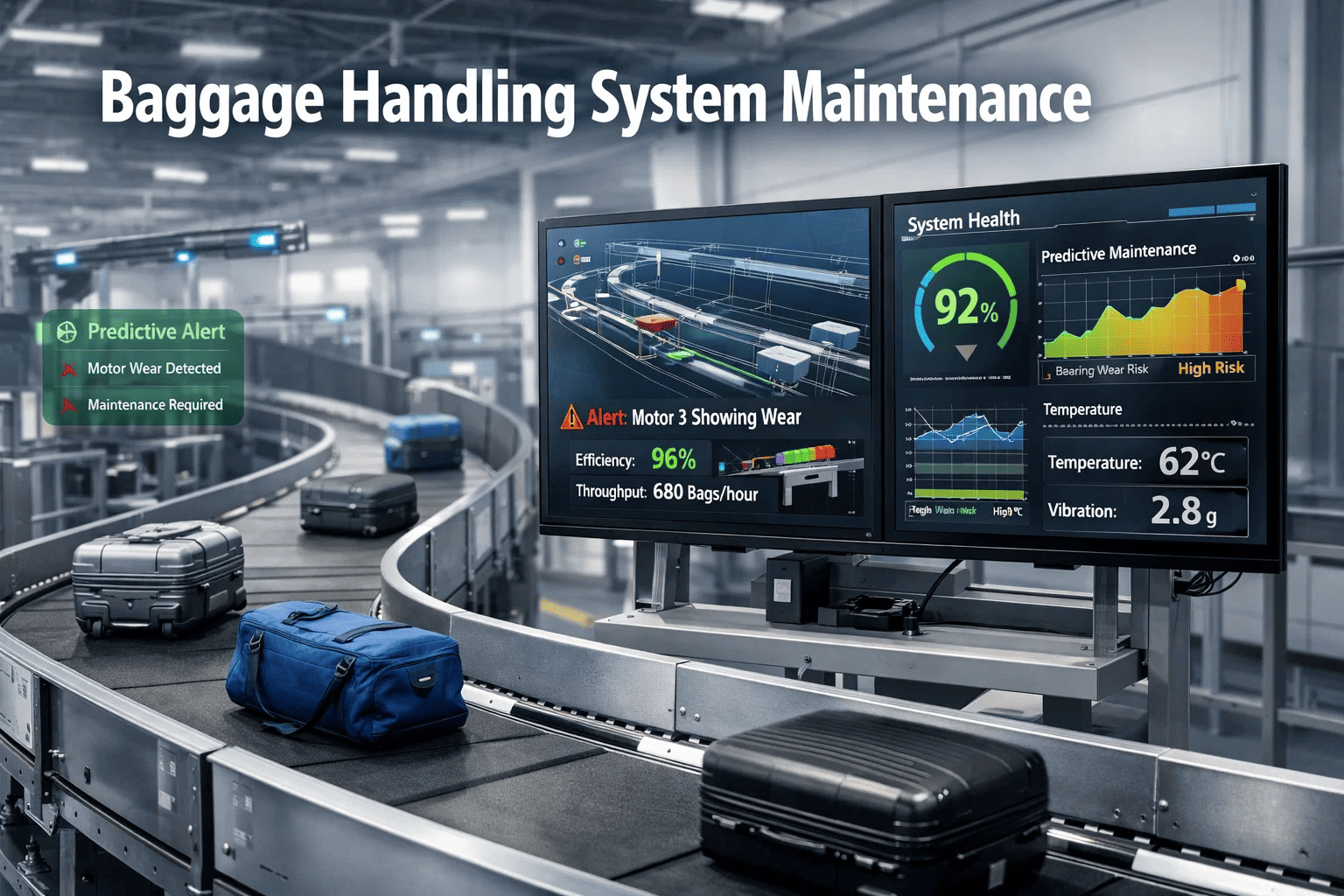
Every year, airports handle billions of bags through complex conveyor networks spanning miles of belts, motors, and sortation systems. When a single motor fails or a belt snaps, the ripple effect cascades through the entire terminal—delayed flights, stranded luggage, and frustrated passengers. Start your free AI-CMMS trial and discover how predictive maintenance sensors can detect equipment failures weeks before they happen, reducing your BHS downtime by up to 60%.
PREDICTIVE MAINTENANCE FOR AVIATION
BHS Predictive Maintenance Sensors
AI-Powered Monitoring for Conveyor Belts, Motors & Sortation Systems
60%
Downtime Reduction
24/7
Real-Time Monitoring
4-6 Weeks
Early Detection
The Hidden Cost of BHS Failures
Baggage handling systems are the lifeline of airport operations—complex networks that can span over 34,000 meters with 7,000+ assets working in perfect synchronization. When one component fails, the entire system grinds to a halt. Major international airports process over 150,000 bags daily through intricate networks of conveyors, scanners, and automated sorters. A single unplanned failure can create a domino effect that impacts thousands of passengers, airlines, and ground operations within minutes.
$5B
Industry Loss in 2024
Due to baggage mishandling, delays, and system failures globally
33.4M
Bags Mishandled Annually
$1,600
Cost Per Delayed Bag
Hours to Days
Typical Repair Time
Global BHS Infrastructure at Scale
3,800+
Commercial Airports Worldwide
4.5B
Bags Handled Annually
50-100km
Conveyor Length Per Major Hub
$250M+
Average BHS Installation Cost
Bearing Wear Begins
Invisible degradation starts—no alerts, no warnings
Vibration Increases
Technicians can't detect micro-vibrations manually
Temperature Rises
Heat builds up—still no visible symptoms
Catastrophic Failure
Motor seizes. Conveyor stops. Bags pile up. Flights delayed.
87%
Of BHS failures are preventable with predictive monitoring
3-12 hours
Average downtime per critical failure event
$75K-$200K
Cost per hour of major BHS system outage
15-25
Flight delays caused by single conveyor failure
How Predictive Sensors Change Everything
Sensors Detect
Vibration, temperature, current anomalies
AI Analyzes
Pattern recognition identifies degradation
Alert Triggers
4-6 weeks before failure occurs
Scheduled Fix
Maintenance during off-peak hours
Advanced Sensor Technology Capabilities
Sampling Rate
Up to 25.6 kHz
Captures subtle vibration signatures that manual inspections miss
Temperature Range
-40°C to 125°C
Monitors extreme conditions in all climate zones
Wireless Range
Up to 400 meters
Covers entire terminal without complex cabling
Data Processing
Edge AI + Cloud
Real-time analysis with historical trend learning
Monitors:
Bearing wear, motor imbalance, belt misalignment, roller degradation
Monitors:
Motor overheating, gearbox friction, belt stress, electrical faults
Monitors:
Motor load changes, belt slip, drive system problems, power anomalies
Critical BHS Components We Monitor
Conveyor Belts
Tracking issues, splice deterioration, edge damage, material buildup
Monitored
Drive Motors
Bearing failure, winding faults, overheating, imbalance
Monitored
Gearboxes
Lubricant degradation, gear wear, seal failures, temperature spikes
Monitored
Sortation Systems
Diverter malfunctions, timing errors, sensor misalignment
Monitored
Comprehensive Asset Coverage
Our predictive maintenance platform monitors every critical asset in your BHS infrastructure. From high-speed tilt-tray sorters processing 9,000 bags per hour to individual transfer points and merge conveyors, no component goes unwatched. Each sensor deployment is customized based on asset criticality, failure history, and operational impact to maximize your ROI.
10,000+
Assets monitored per major airport
50+
Failure modes detected automatically
99.7%
Prediction accuracy for critical failures
See Your BHS Health in Real-Time
Get a free assessment of your baggage handling system's maintenance needs.
ROI Calculator: What You'll Save
Without Predictive Maintenance
Unplanned Downtime
15+ hours/month
Emergency Repairs
$50K+/incident
Maintenance Approach
Reactive
Failure Detection
After breakdown
VS
With OxMaint Predictive Sensors
Unplanned Downtime
2-3 hours/month
Emergency Repairs
Rare occurrence
Maintenance Approach
Predictive
Failure Detection
4-6 weeks early
Annual Savings Potential
40%
Lower Maintenance Costs
Projected Annual Savings with Predictive Maintenance:
$1.2M - $3.5M
Downtime cost reduction (60% less unplanned outages)
$200K - $800K
Maintenance cost savings (40% reduction in reactive repairs)
18-24 months
Typical payback period for sensor deployment
Trusted by Leading Airports
500+
Airports Using Predictive Tech
70M+
Bags Monitored Annually
99.2%
System Uptime Achieved
Industry-Wide Transformation
Predictive maintenance is rapidly becoming the standard for airport BHS operations worldwide. Leading aviation hubs in North America, Europe, Middle East, and Asia-Pacific have adopted sensor-based monitoring to meet growing passenger volumes while maintaining operational excellence. The technology has proven its value across diverse environments—from high-traffic international hubs processing 100+ million passengers annually to regional airports managing seasonal demand fluctuations.
73%
Of top 100 airports have implemented or piloted predictive maintenance systems
2.8B
IoT sensor market for aviation maintenance by 2028
85%
Reduction in catastrophic equipment failures with continuous monitoring
Frequently Asked Questions
How quickly can sensors be deployed on existing BHS equipment?
Most deployments complete within 2-3 days per terminal. Our wireless sensors mount directly on motors, gearboxes, and conveyor components without requiring system downtime or modifications to existing equipment. Installation can be scheduled during off-peak hours or maintenance windows to minimize operational impact.
What's the battery life of wireless vibration sensors?
Our sensors operate for 2-5 years on a single battery, depending on monitoring frequency. High-criticality assets can be monitored every 15 minutes while standard conveyors check every 4-12 hours to optimize battery life. The system automatically alerts you when battery levels drop below 20%, allowing for proactive replacement during scheduled maintenance.
How does the system integrate with our existing CMMS?
OxMaint integrates via REST APIs with all major CMMS platforms including SAP, Maximo, and custom systems. Alerts automatically generate work orders with diagnostic data, recommended actions, and priority levels. Integration typically takes 1-2 weeks and includes bi-directional data flow for complete maintenance lifecycle management.
Can predictive maintenance really detect failures weeks in advance?
Yes. Vibration pattern analysis and machine learning algorithms identify degradation signatures 4-6 weeks before failure. Temperature anomalies and current changes provide additional early warning indicators, giving your team ample time to schedule repairs during off-peak hours. Our AI models are trained on millions of data points from similar BHS equipment worldwide, continuously improving detection accuracy.
What happens if our internet connection fails?
Sensors store data locally for up to 30 days and automatically sync when connectivity is restored. Critical alerts can be configured to send via multiple channels including SMS, email, and local network protocols. Edge processing capabilities mean anomaly detection continues even during network outages.
How many sensors do we need for a typical BHS installation?
A medium-sized airport typically requires 150-300 sensors to cover critical assets. Large international hubs may deploy 800-1,500+ sensors across their entire BHS network. Our deployment team conducts a criticality analysis to identify high-impact assets and optimize sensor placement for maximum ROI. You can start with a pilot program on your most critical equipment and expand incrementally.
Stop Reacting. Start Predicting.
Join airports worldwide using AI-powered predictive maintenance to eliminate BHS surprises.