A single conveyor failure can cascade into thousands of delayed bags, frustrated passengers, and airline penalties that hit your budget hard. With baggage mishandling costing the aviation industry $5 billion in 2024 alone, reactive maintenance is no longer sustainable. Large airports operate 10,000 to 30,000 conveyors—far too many for manual inspections to catch problems before they cause operational chaos. Start your free AI-CMMS trial and transform your baggage handling operations with machine learning that predicts failures before they disrupt your passengers.
AI-POWERED PREDICTIVE MAINTENANCE
Stop Baggage System Failures Before They Start
Machine Learning for Conveyors, Motors & Sortation Systems
The Hidden Cost of Reactive Baggage Maintenance
When conveyors fail without warning, the damage extends far beyond repair costs. Flight delays, missed connections, passenger compensation claims, and airline penalties create a cascade of expenses that dwarf the original equipment failure.
$5 Billion
Annual Industry Loss
Baggage mishandling costs including delays, courier services, claims processing, and customer compensation
33.4 Million
Mishandled Bags (2024)
Despite technology improvements, rising passenger volumes continue to strain aging infrastructure
41%
Transfer Failures
The largest cause of mishandling—tight connections where conveyor downtime is catastrophic
50%
Unplanned Work
Half of maintenance is reactive or rescheduled—clear evidence of insufficient predictive capability
Why Traditional Maintenance Fails Baggage Systems
Large airports can have 10,000 to 30,000 conveyors with hundreds of hidden components—bearings, gearboxes, motors, belts—that degrade silently until catastrophic failure. Time-based maintenance either replaces parts too early (wasting money) or too late (causing delays).
01
Daily Inspections Can't Scale
Technicians physically inspect conveyors for "signs of deterioration and abnormal noise"—but with thousands of assets, critical warning signs go unnoticed between rounds.
02
Hidden Components Fail Silently
Bearings, gearboxes, and internal motor components can't be assessed visually. By the time you hear abnormal noise, failure is imminent.
03
Yearly Overhauls Waste Budget
Replacing belts and bearings "regardless of condition" during annual overhauls means paying for parts that had months of useful life remaining.
04
Run-to-Failure Is Inevitable
Even with stringent maintenance regimes, the strategy "degenerates into run-to-failure" causing unexpected breakdowns and severe passenger disruption.
Tired of Emergency Conveyor Repairs?
See how AI-powered predictive maintenance catches failures weeks before they cause delays.
How AI Predictive Maintenance Works
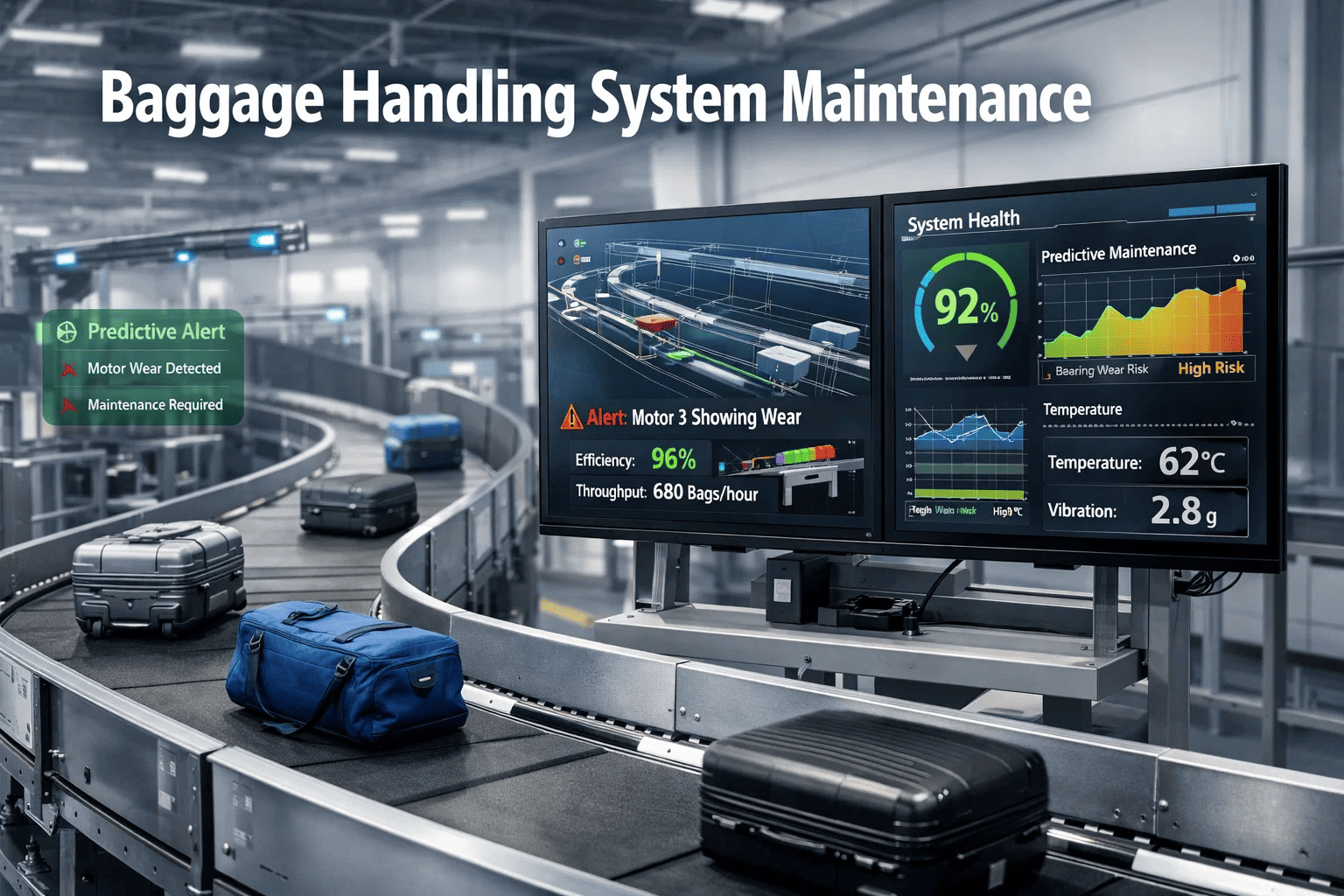
Machine learning algorithms analyze real-time sensor data to detect the subtle patterns that precede equipment failure—weeks before human inspectors could notice anything wrong.
1
Continuous Monitoring
IoT sensors capture vibration, temperature, current, and acoustic data from motors, bearings, gearboxes, and belt systems 24/7
2
Pattern Recognition
ML algorithms learn each asset's unique operational signature and detect deviations that indicate developing faults
3
Failure Prediction
AI predicts remaining useful life and identifies specific failure modes—bearing wear, motor degradation, belt misalignment
4
Automated Response
CMMS automatically generates prioritized work orders with specific repair instructions before failure occurs
Critical Failure Modes AI Detects
Drive motors power every conveyor section. AI monitors current draw, temperature patterns, and vibration signatures to detect winding degradation, bearing wear, and alignment issues weeks before failure.
Monitored: Current, Temperature, Vibration
Rollers, idlers, and drive shafts all rely on bearings that wear over time. Vibration analysis detects characteristic frequencies of inner race, outer race, and ball defects in early stages.
Monitored: Vibration Spectrum, Acoustic
Belt tracking problems, splice deterioration, and tension issues cause jams and bag damage. AI correlates motor load, belt speed, and position sensors to predict misalignment before bags derail.
Monitored: Speed, Tension, Position
Gearbox failures cause complete conveyor shutdown. AI detects gear tooth wear, lubrication breakdown, and shaft alignment issues through vibration pattern changes and temperature anomalies.
Monitored: Vibration, Temperature, Oil
Cross-belt sorters and tilt-tray systems require precise timing. AI monitors diverter mechanisms, photo-eye sensors, and pneumatic actuators to prevent sorting failures that misdirect bags.
Monitored: Actuator Timing, Pressure
Baggage claim carousels run continuously during arrivals. AI monitors drive chain tension, motor performance, and structural vibration to prevent failures during peak passenger retrieval.
Monitored: Chain Tension, Motor Load
Which Failures Are Hiding in Your System?
Get a free assessment of your baggage handling infrastructure's predictive maintenance potential.
Machine Learning Algorithms at Work
Modern predictive maintenance leverages multiple ML approaches, each suited to different aspects of baggage system monitoring.
Random Forest & Gradient Boosting
These ensemble methods analyze multiple sensor inputs simultaneously to identify subtle deviations from normal operation. Research shows classification accuracy up to 100% for identifying conveyor load states and preset damage conditions.
LSTM Neural Networks
Long Short-Term Memory networks excel at learning temporal patterns in vibration and temperature data, predicting when degradation trends will cross critical thresholds.
Survival Analysis Models
These algorithms estimate Remaining Useful Life (RUL) of components, enabling maintenance scheduling that maximizes asset life while preventing unexpected failures.
Fault Classification
Once an anomaly is detected, classification algorithms identify the specific failure mode—outer race bearing fault, motor imbalance, belt misalignment—enabling targeted repairs.
BHS Components Monitored
Drive Motor Assembly
Motor, Gearbox, Hollow Shaft, Mounting Bracket
Drive Shaft Assembly
Bearings, Pulleys, Drive Chain, Couplings
Tension Shaft Assembly
Tension Bearings, Idler Rollers, Adjustment Mechanism
Idler Shaft Assembly
Idler Bearings, Return Rollers, Belt Support
Proven Results
Downtime Reduction
Early failure detection enables scheduled repairs during low-traffic periods instead of emergency shutdowns
Extended Belt Life
Addressing alignment and tension issues early prevents accelerated wear and premature replacement
Maintenance Cost Savings
Eliminate unnecessary preventive replacements while avoiding costly emergency repairs
Failures Prevented
Comprehensive sensor networks detect the vast majority of potential catastrophic equipment failures
Implementation Timeline
1
Asset Assessment
Week 1-2
Map critical conveyor sections and failure history
Identify high-priority monitoring points
Define sensor placement strategy
2
Sensor Deployment
Week 3-6
Install vibration, temperature, and current sensors
Configure gateway connectivity
Integrate with OxMaint CMMS
3
AI Training
Week 7-10
Collect baseline operational data
Train ML models on normal behavior patterns
Calibrate alert thresholds
4
Predictive Operations
Week 11+
Enable automated work order generation
Continuous model refinement
Scale to additional BHS sections
Frequently Asked Questions
How far in advance can AI predict baggage system failures?
Depending on the failure mode, AI can predict problems weeks to months in advance. Bearing degradation typically shows detectable patterns 4-8 weeks before failure. Motor winding issues can be detected 2-4 weeks ahead. Belt tracking problems often show signs days to weeks before causing jams.
How does the system handle the noise from bags moving on conveyors?
This is a unique challenge in baggage handling systems. Our algorithms include noise-removal preprocessing that filters out the random vibration signatures caused by luggage movement, isolating the underlying equipment condition data. Research has validated this approach for live baggage handling environments.
Can sensors be installed without shutting down the baggage system?
Yes. Wireless IoT sensors are designed for non-invasive installation. Most can be mounted on motor housings, bearing blocks, and conveyor frames during normal operations or brief maintenance windows. No rewiring or system modifications are required.
What's the ROI timeline for baggage handling predictive maintenance?
Most airports see positive ROI within 12-18 months. The first prevented emergency failure often pays for multiple sensors. With baggage delays costing airlines $1,600+ per passenger in compensation potential and airports facing back-charges for delays, even one prevented incident delivers significant value.
How does this integrate with our existing BHS control system?
OxMaint's AI platform operates as an overlay to your existing BHS controls. It doesn't interfere with PLC logic or sortation software. Sensor data flows through dedicated IoT gateways to the cloud, where analysis occurs. Work orders and alerts integrate with your CMMS and can feed status back to operations dashboards.
Stop Baggage Delays Before They Start
Join airports achieving 70% delay reduction with AI-powered predictive maintenance for baggage handling systems.