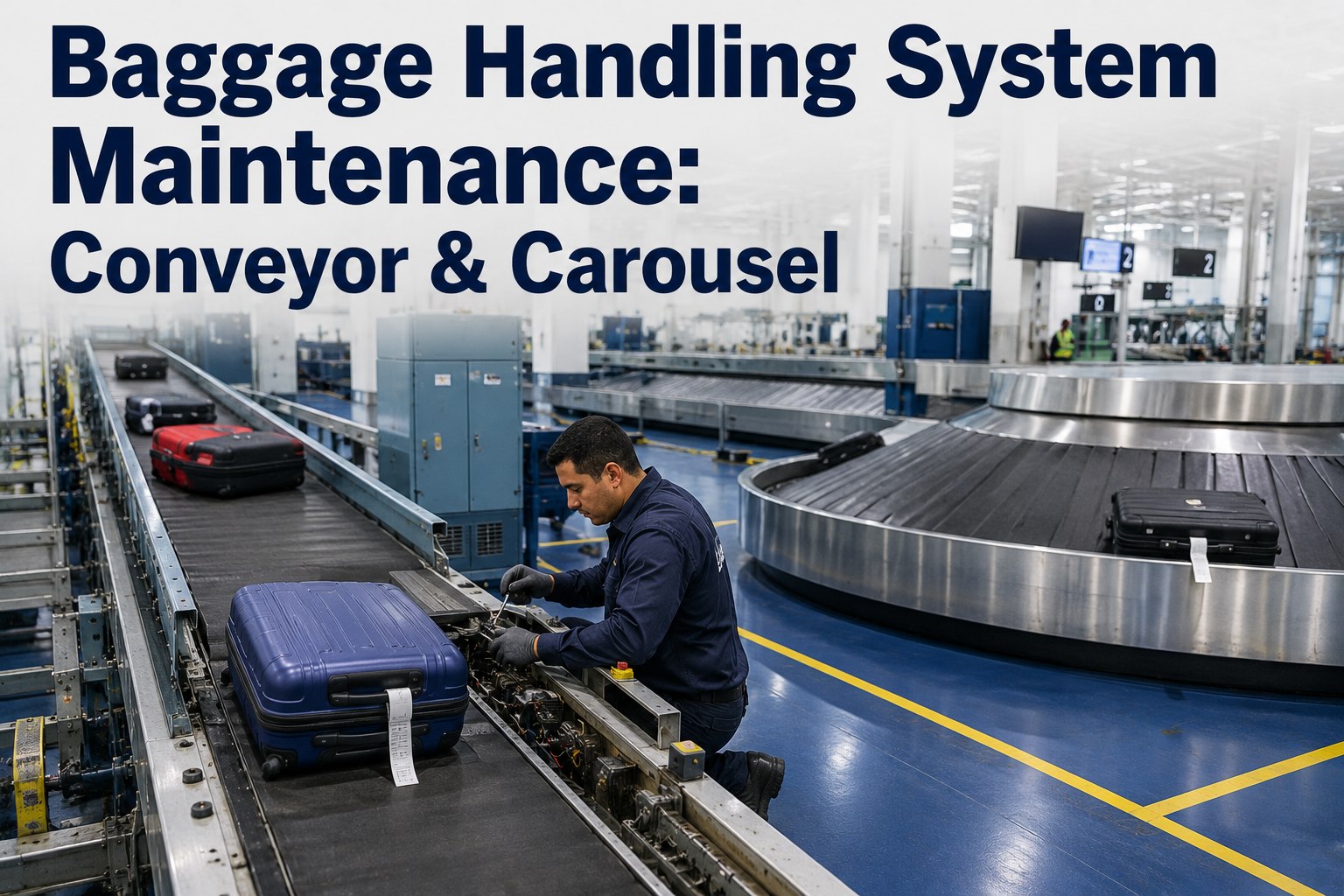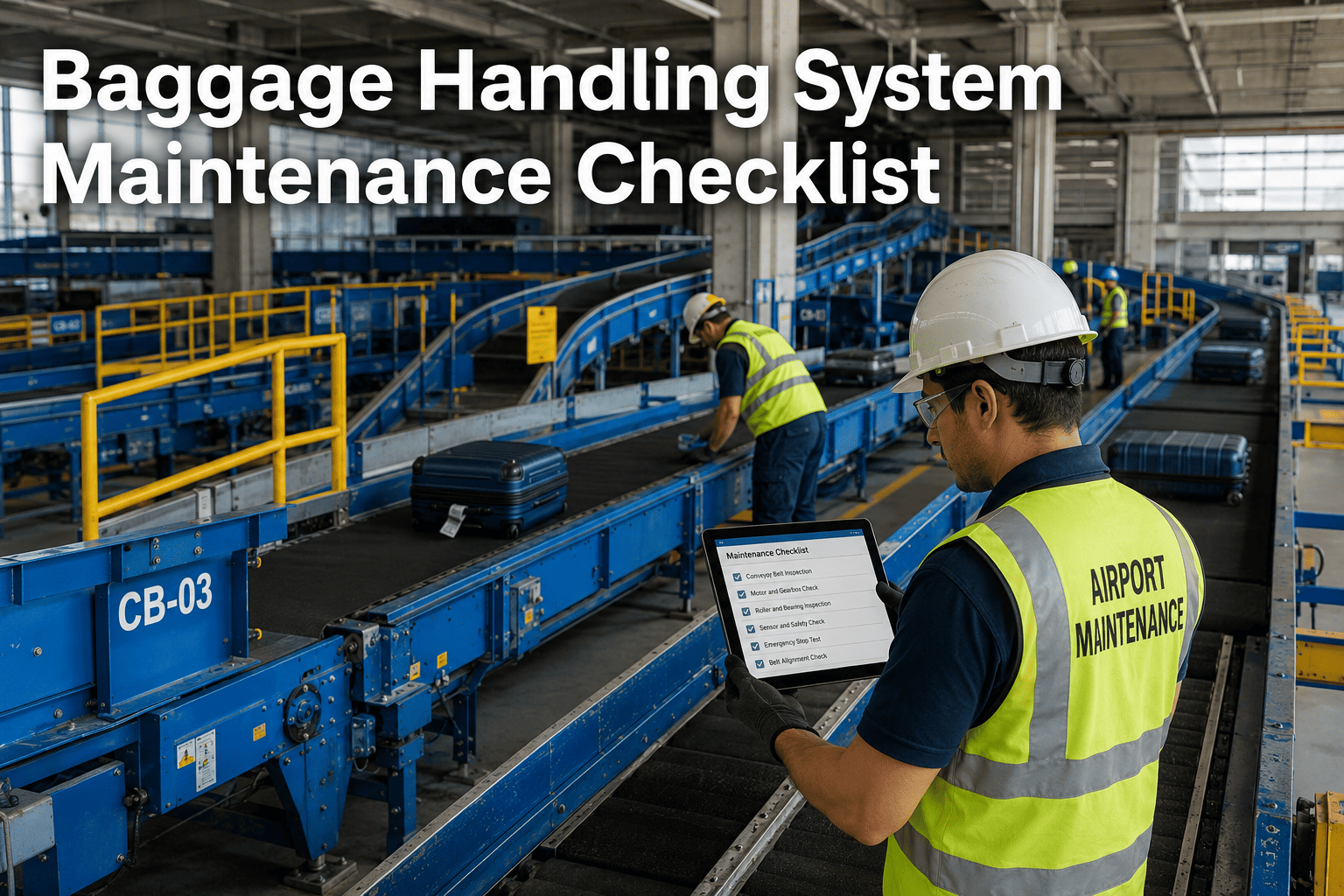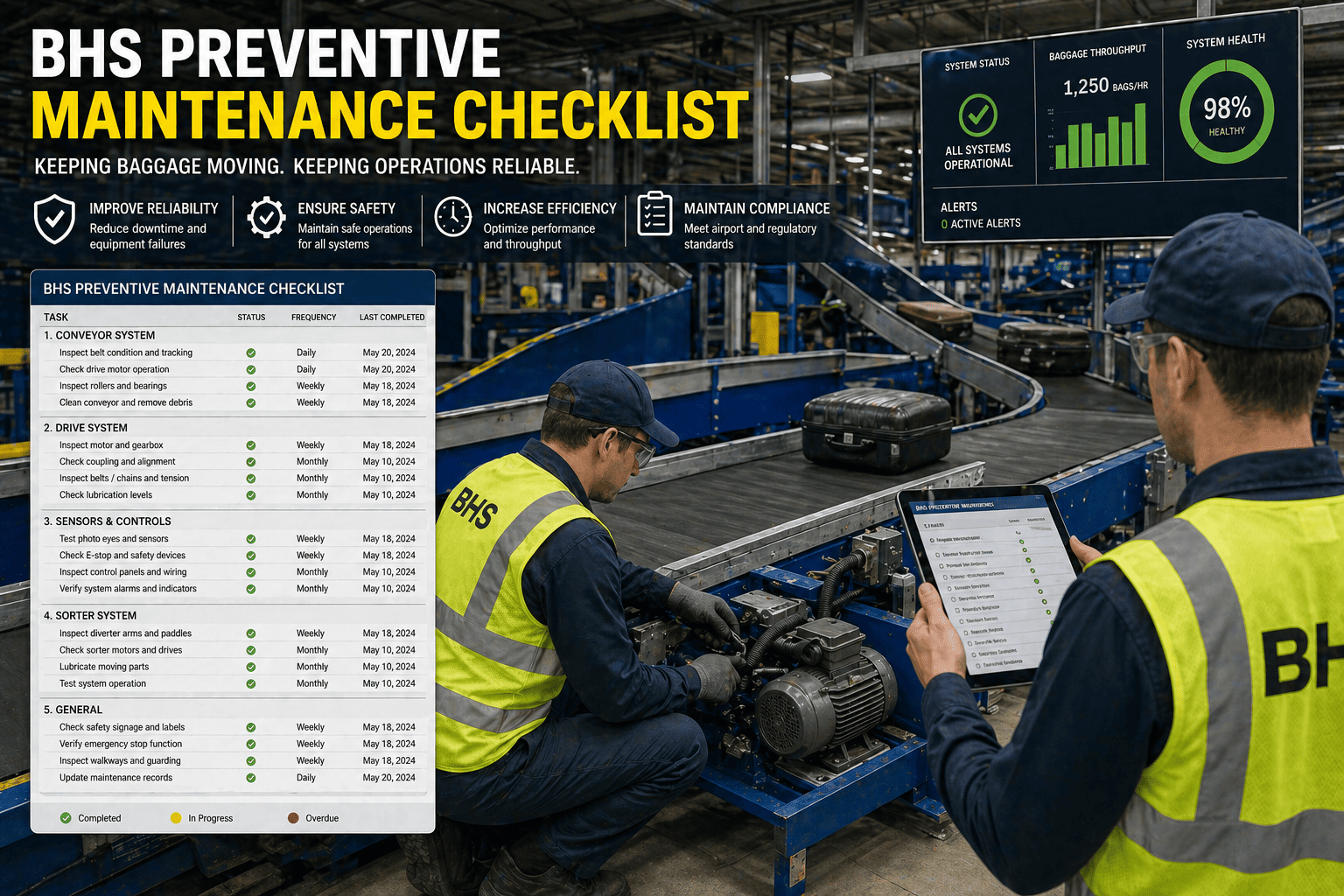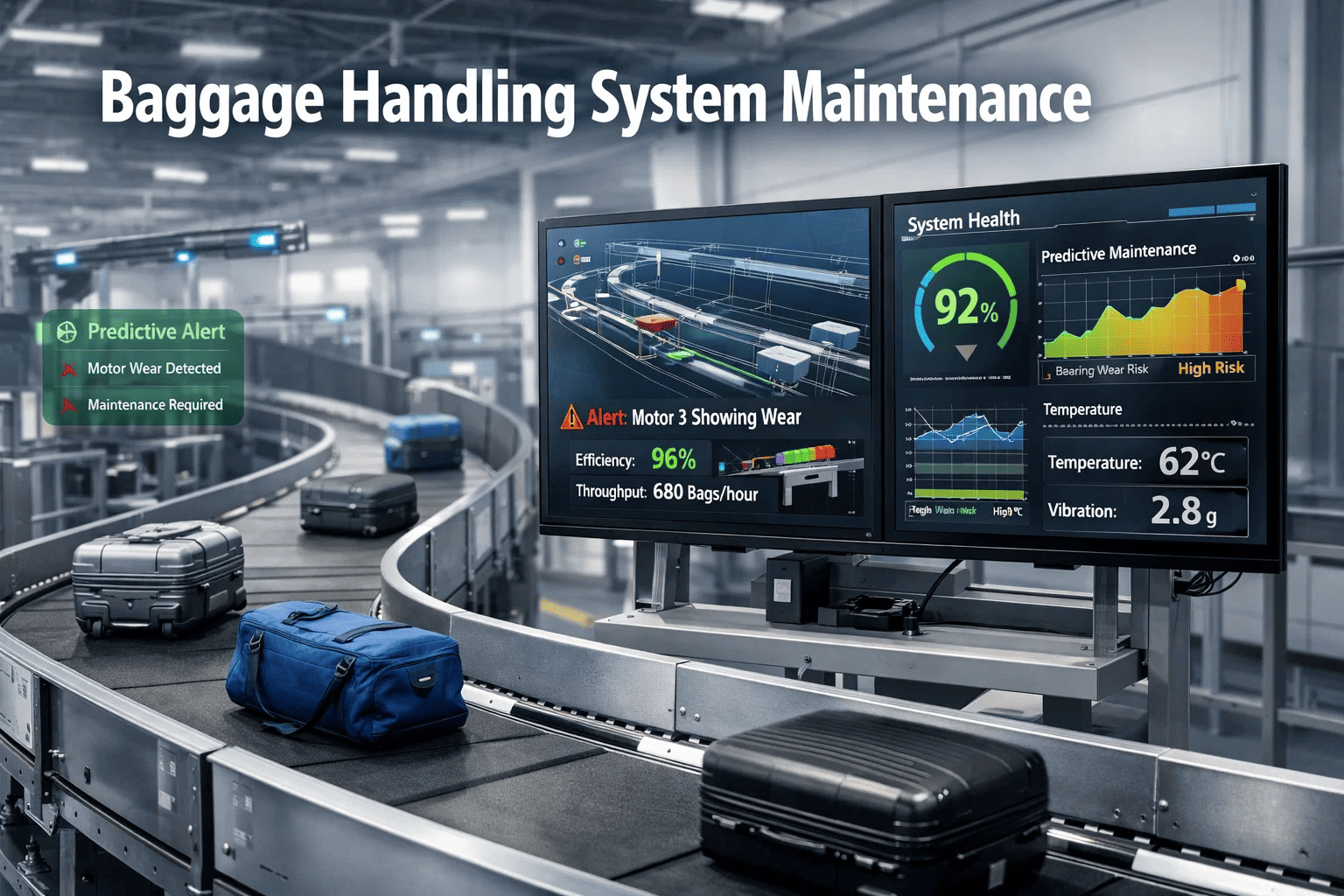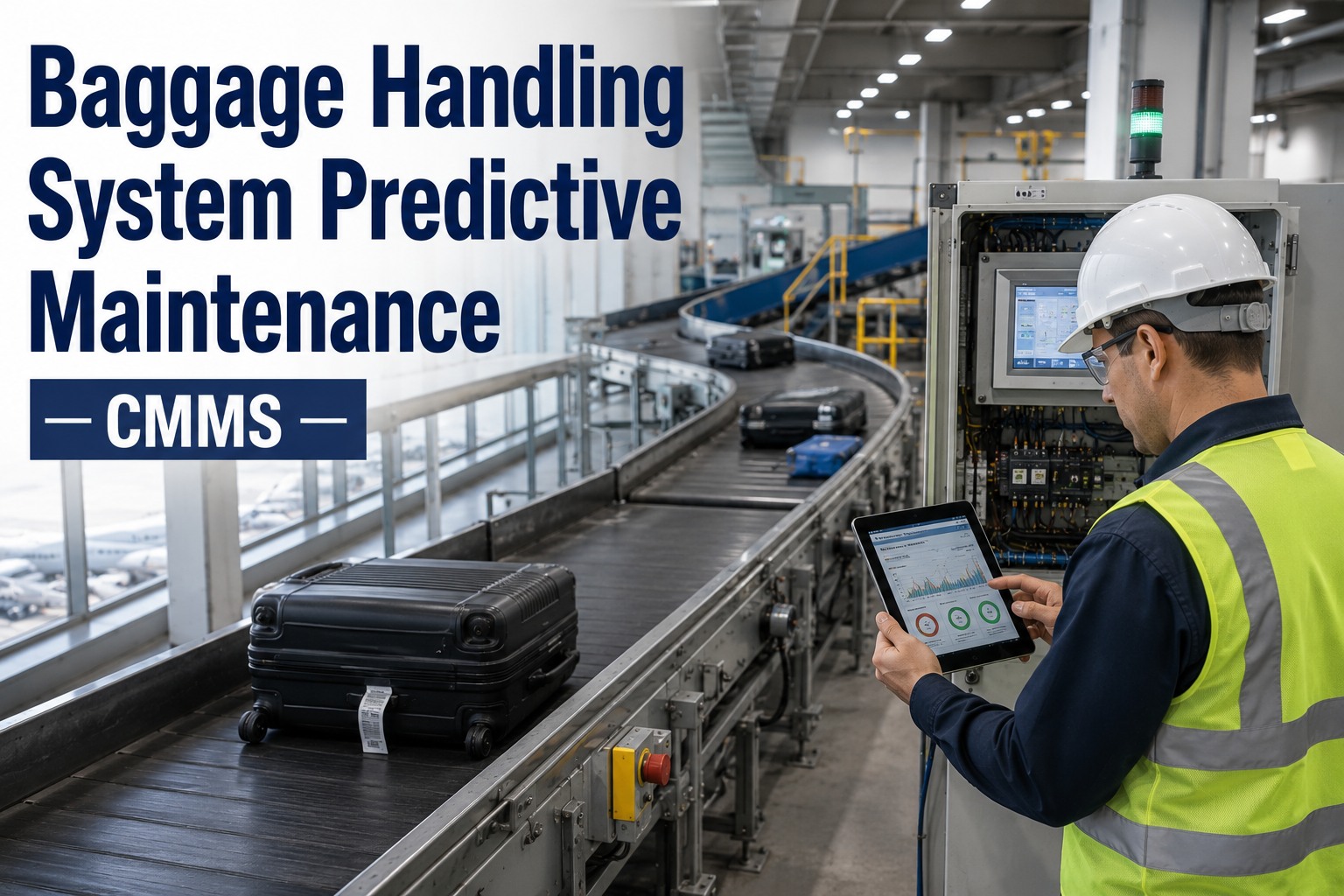
Baggage handling system predictive maintenance is the practice of using sensor data, motor current signature analysis, and AI-driven CMMS alerts to detect conveyor motor degradation and sortation diverter failures before they disrupt airport operations. Modern BHS predictive maintenance strategies can push system availability above 99% year-round by catching belt slippage, bearing wear, and jam conditions in their earliest stages — turning unplanned outages into scheduled fixes. This CMMS BHS predictive guide covers the technologies, workflows, and ROI benchmarks maintenance teams need to implement a data-driven BHS reliability program. See how OxMaint makes it easy to operationalize these strategies when you Start Free Trial today.
BHS PREDICTIVE MAINTENANCE GUIDE
Can your baggage handling system predict its own failures before they ground flights?
Most BHS failures give early warning signs — motor current shifts, belt tension drops, diverter cycle times drift. A predictive CMMS catches those signals 2–6 weeks before breakdown, keeping availability above 99% and protecting airline SLAs. OxMaint turns sensor data into PLC-driven work orders automatically.
FAILURE MODES & DETECTION
Where BHS predictive maintenance delivers the fastest payback
Over 60% of unplanned BHS downtime traces to just four failure modes — all detectable weeks in advance with the right sensor layer and CMMS analytics.
Conveyor motor degradation
Motor current signature analysis (MCSA) detects rotor bar degradation, stator winding faults, and bearing wear 3–6 weeks before catastrophic failure. Current deviation of just 8–12% from baseline signals imminent breakdown.
Sortation diverter failures
Pneumatic and electric diverters show cycle-time drift and position-error creep before mechanical seizure. Tracking actuator stroke time against baseline catches 85% of impending diverter jams before they occur.
Belt slippage & tracking loss
Speed differential between drive pulley and belt surface, measured via encoder feedback, reveals tension loss and lagging wear. A 2% sustained slip ratio predicts splice failure within 10–14 days.
PLC & sensor communication faults
Networked I/O block failures and PLC scan-time anomalies precede 40% of control-system outages. Continuous monitoring of packet loss and response latency flags degrading nodes before they fault the line.
SENSOR-TO-WORK-ORDER WORKFLOW
How to build a BHS predictive maintenance workflow with CMMS
A mature baggage handling predictive maintenance program moves from raw sensor signal to completed work order in five stages — each automated inside a CMMS like OxMaint.
Continuous condition monitoring
Vibration sensors on conveyor motors, current transducers on drive panels, and encoder feedback from sortation diverters stream into the CMMS at 1–5 second intervals. Baseline signatures are established over a 14–30 day learning period.
AI anomaly detection & degradation tracking
Machine-learning models compare real-time signals against baselines. When motor current deviation exceeds 8% or diverter cycle time drifts beyond 2 standard deviations, the system flags a degradation event and calculates remaining useful life (RUL).
BHS AI alerts & risk scoring
Each anomaly is assigned a risk score from 1–10 based on severity, asset criticality, and operational impact. Scores above 7 trigger immediate BHS AI alerts to the maintenance lead via mobile push, SMS, or email — with recommended action and parts list.
PLC-driven work order auto-generation
High-risk alerts automatically generate a CMMS work order pre-loaded with asset history, safety procedures, required spare parts, and estimated repair time. The work order routes to the qualified technician on shift — no manual entry required.
Verification & baseline reset
After the fix, the CMMS compares post-repair sensor data to the original baseline. If signatures return to normal, the baseline is refreshed. If not, the work order reopens automatically — closing the predictive loop.
ROI & COST IMPACT
What baggage handling predictive maintenance costs — and saves
A mid-sized airport with 12 miles of conveyor, 400+ sortation diverters, and 60 motors typically spends $180K–$250K annually on reactive BHS repairs. Predictive maintenance changes that math fundamentally.
ANNUAL REACTIVE COST (BEFORE)
Unplanned downtime cost + emergency labor premium + expedited parts + SLA penalties
$420K/yr
PREDICTIVE PROGRAM COST (WITH OXMAINT)
CMMS licenses + sensor hardware + integration + training
$95K/yr
WORKED EXAMPLE
A regional hub operating 8 miles of BHS conveyor with 240 diverters was averaging 46 hours of unplanned downtime per year — costing $9,100/hour in delayed flights, missed connections, and SLA penalties. After deploying OxMaint predictive CMMS with motor current sensors and diverter cycle-time monitoring, unplanned downtime dropped to 11 hours/year within 8 months. The $318K annual savings recovered the full deployment cost in under 5 months.
REACTIVE VS. PREDICTIVE BHS MAINTENANCE
Reactive vs. predictive BHS maintenance: the real comparison
The gap between run-to-failure and AI-driven predictive maintenance is not incremental — it is the difference between 94% and 99.5% availability.
| Metric | Reactive / Time-Based | Predictive CMMS (OxMaint) |
|---|---|---|
| BHS availability | 94–96% | 99.2–99.6% |
| Unplanned downtime / year | 40–60 hours | 8–14 hours |
| Failure detection lead time | 0 (at breakdown) | 2–6 weeks before failure |
| Emergency labor premium | 35–45% of labor budget | 8–12% of labor budget |
| Spare parts inventory carry | High (hoarding for emergencies) | 22–30% lower (predicted demand) |
| SLA penalty exposure | $50K–$120K / year | $5K–$15K / year |
| Maintenance cost / conveyor mile | $22K–$28K / year | $11K–$15K / year |
HOW OXMAINT HELPS
How OxMaint powers BHS predictive maintenance end-to-end
OxMaint brings AI-driven CMMS capabilities purpose-built for high-throughput baggage handling environments — from sensor integration to PLC-driven work order triggers.
AI anomaly detection on motor & conveyor data
OxMaint ingests motor current, vibration, and encoder data in real time, applying ML models to detect conveyor motor degradation and belt slippage 2–6 weeks before failure — reducing unplanned BHS downtime by 30–50%.
Outcome: 77% fewer unplanned BHS outages
Automated PLC-driven work order generation
When a sortation diverter exceeds cycle-time thresholds or a motor current anomaly triggers, OxMaint auto-generates a work order with asset history, safety procedure, parts list, and assigned technician — zero manual data entry.
Outcome: 90% faster work order creation
Predictive spare-parts inventory for BHS components
OxMaint links degradation predictions to the parts bill of materials, auto-reserving critical spares (diverter actuators, drive belts, motor bearings) before work orders are dispatched — cutting inventory carry costs 22–30%.
Outcome: $60K+ saved in parts carrying costs
BHS maintenance analytics & SLA dashboards
Real-time dashboards track BHS availability, MTBF, MTTR, and SLA compliance by zone, conveyor segment, and airline tenant — giving maintenance managers and airport operations a shared live view of system health.
Outcome: 99.4% sustained BHS availability
SEE IT ON YOUR ASSETS
Book a 30-minute demo and see OxMaint predict BHS failures on your conveyor data
Walk through a live BHS predictive maintenance scenario — motor degradation alerts, diverter failure prediction, and auto-generated work orders on a real asset hierarchy.
FREQUENTLY ASKED QUESTIONS
BHS predictive maintenance CMMS: top questions answered
What is baggage handling system predictive maintenance?
Baggage handling system predictive maintenance uses sensor data — motor current, vibration, temperature, encoder speed — and AI analytics to detect conveyor motor degradation, belt slippage, and sortation diverter failures 2–6 weeks before they cause unplanned downtime. A CMMS like OxMaint automates the flow from anomaly detection to work order generation, keeping BHS availability above 99%.
How does motor current signature analysis detect conveyor motor degradation?
Motor current signature analysis (MCSA) monitors the electrical current waveform of conveyor drive motors. When rotor bars crack, bearings wear, or stator windings degrade, the current signature develops distinctive frequency sidebands. A sustained 8–12% deviation from the baseline current pattern triggers a BHS AI alert in the CMMS, typically giving 3–6 weeks of lead time before failure. You can see this in action — book a demo to walk through a real motor degradation scenario.
Can a CMMS auto-generate work orders from BHS PLC data?
Yes. OxMaint integrates directly with BHS PLCs and SCADA systems via OPC-UA or MQTT. When a monitored parameter — diverter cycle time, motor current, belt speed differential — crosses a learned threshold, the CMMS automatically generates a work order pre-loaded with asset history, safety procedures, required spare parts, and the qualified technician on shift. No manual entry is needed.
How much does BHS predictive maintenance software cost?
For a mid-sized airport with 400+ diverters and 60+ motors, a complete predictive CMMS deployment — including software licenses, sensor hardware, integration, and training — typically runs $75K–$120K per year. With average savings of $250K–$400K in reduced downtime, emergency labor, and SLA penalties, most programs pay back in 4–6 months. Start a free 14-day trial to evaluate OxMaint on your asset hierarchy.
How long does it take to implement BHS predictive maintenance?
A typical BHS predictive CMMS rollout takes 8–12 weeks: 2–3 weeks for sensor installation and PLC integration, 2–4 weeks for baseline signal learning, and 2–4 weeks for model tuning and technician training. OxMaint's pre-built BHS asset templates and OPC-UA connectors compress this to as little as 6 weeks for standard conveyor and sortation configurations.
START YOUR BHS PREDICTIVE JOURNEY
Stop reacting to BHS failures — start predicting them
Join the airports using OxMaint to push baggage handling availability past 99%, cut unplanned downtime by up to 77%, and eliminate spreadsheet-based maintenance for good.
Free 14-day trial · No credit card