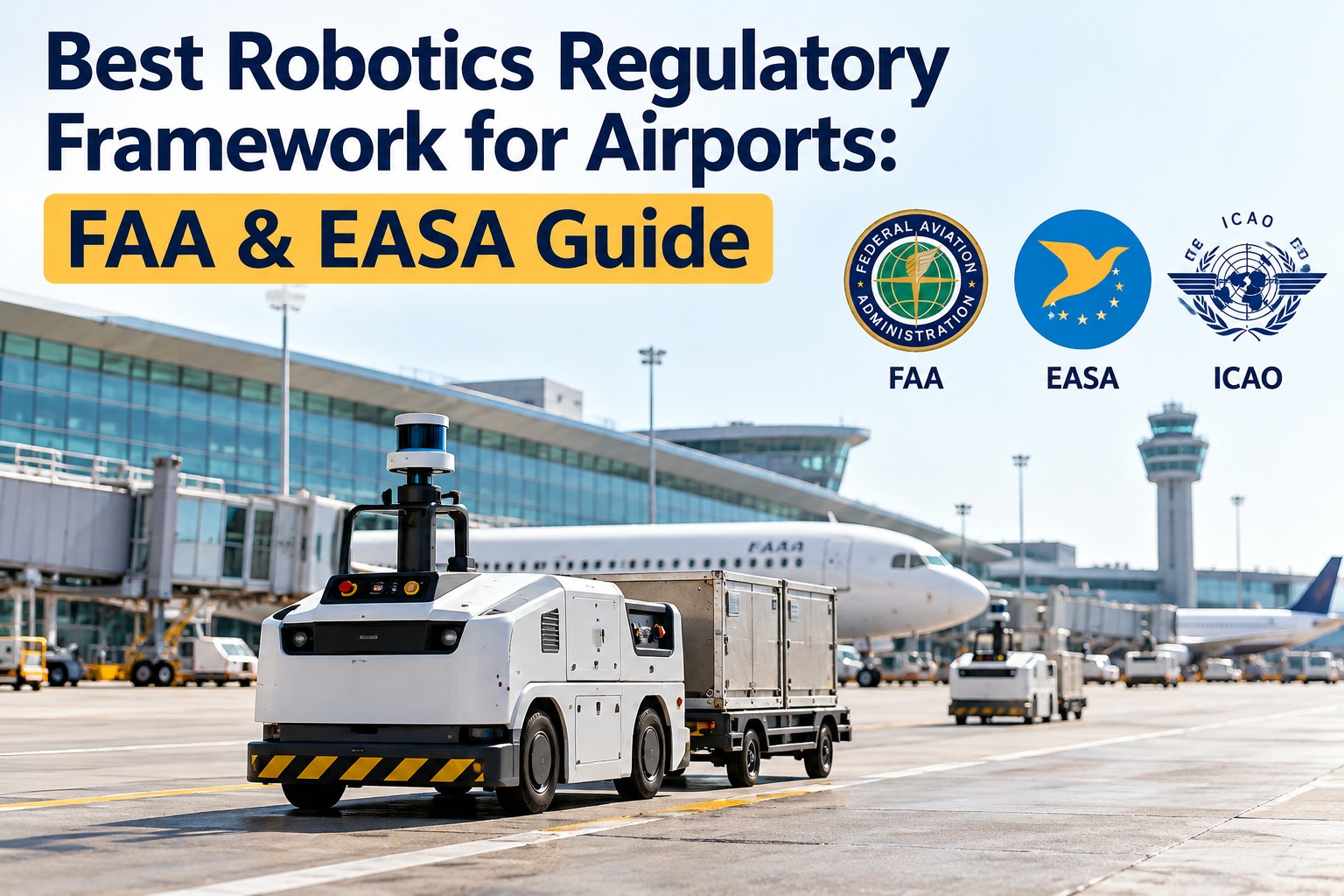
An inspection robot on the airside doesn't get a single stamp of approval — it has to fit a web of authority guidance, early coordination and documented risk assessment before it rolls near a movement area. Get the framework right and deployment is smooth; get it wrong and the airport operating certificate is on the line. This guide maps the robotics regulatory framework for airports across the FAA, EASA and ICAO, and how OXMAINT AI, the AI-powered airport CMMS, holds the compliance documentation together.
Airports & Transport Hubs · Robotics Governance · FAA / EASA / ICAO · 2026
Robotics Regulatory Framework for Airports: FAA & EASA Guide
No single robot licence, a maze of authority guidance, and an operating certificate that doesn't forgive an un-assessed risk near the movement area — airside robotics lives or dies on documentation. OXMAINT AI, the AI-powered CMMS and maintenance management software, keeps the approvals, risk assessments, inspection records and audit trail for every deployed unit in one place.
1Engage early
→
2Risk-assess
→
3Test in closed area
→
4Document
THREE AUTHORITY LAYERS
FAAUS — engage the Part 139 inspector early; closed-area testing
EASAEU — aerodrome rules & safety management for airside ops
ICAOGlobal — Annex 14 aerodrome standards as the baseline
Plus local civil-aviation guidance (e.g. CAAS AC 139-7-7 for airside AVs)
No single licence
airside robots are a coordinated framework, not one permit
Part 139
the US airport operating certificate that governs the field
Engage early
the FAA's first and firmest expectation
Risk-assessed
understood, considered and mitigated before deployment
The Three Authority Layers
Airside robotics sits under layered authority rather than one rulebook: the ICAO baseline, the regional regulator (FAA in the US, EASA in Europe), and local civil-aviation guidance on top. Knowing which layer owns which question is the start of any deployment, and you can book a demo to see multi-authority tracking in OXMAINT AI.
FAA
United States
Governs through the airport operating certificate (14 CFR Part 139). For autonomous ground vehicle systems, the FAA supports testing in a controlled environment and expects sponsors to engage the regional Part 139 Airport Certification and Safety Inspector early. Guidance lives in CertAlert 24-02 and Emerging Entrants Bulletin 25-02.
EASA
Europe · EASA states
Sets aerodrome requirements and safety-management expectations for airside operations across member states. A robot operating on the apron or manoeuvring area falls within the aerodrome's certified safety system and its documented procedures.
ICAO
Global baseline
Annex 14 aerodrome design and operations standards are the international floor that national regulators build on. New vehicle types are expected to fit the aerodrome's existing safety and operational standards, not bypass them.
The Line That Decides Everything: Movement vs Non-Movement
The single most important distinction for an airside robot is where it operates. The movement area — runways, taxiways and their safety areas, under air-traffic control — is the high-stakes zone; the non-movement area and landside are where most early deployment belongs. The FAA points testing toward areas closed to aircraft, and you can start free and map robot operating zones in OXMAINT AI.
Movement area
Runways, taxiways, safety areas · ATC-controlled
Highest scrutiny. Operational testing is pointed at movement areas and safety areas closed to aircraft, with risks understood, considered and mitigated first. Don't close areas exclusively for robot testing in a way that limits other tenants or breaches grant assurances.
Non-movement & landside
Aprons, service roads, terminals, perimeter
Lower-speed, less-congested environments the FAA describes as safer test settings. Most initial airside and facility robotics — terminal, perimeter and apron inspection — starts here while the safety case matures.
The Approval Isn't A Form. It's A Documented Conversation.
Airside robotics clears by early coordination and a defensible risk assessment, not a one-page permit. The authority wants to see the hazards identified and mitigated, the test area controlled, and the records to prove it — which is exactly what a governed system holds.
The FAA Engagement Pathway
For a US airport, the path to deploying an autonomous ground system follows a recognizable sequence — coordinate before you commit hardware, prove the safety case in a controlled area, and keep the regional office in the loop throughout.
01
Engage the regional office early
Contact the Part 139 Airport Certification and Safety Inspector (or the ADO for federally obligated GA airports) at the planning stage, not after procurement.
02
Build the safety risk assessment
Identify the hazards the robot introduces to airside operations and document how each is understood, considered and mitigated.
03
Test in a controlled, closed area
Operate first in movement areas and safety areas closed to aircraft, or in non-movement and landside zones, without blocking other tenants.
04
Protect grant assurances
Coordinate any area closures with the Regional Airports Division or ADO so federal grant assurances are not violated.
05
Notify stakeholders
Once testing is authorized and underway, inform local stakeholders so everyone on the field knows the robot is operating.
06
Document & retain
Keep the risk assessment, authority correspondence, test records and maintenance history as the evidence trail for the deployment.
The Compliance Documentation Stack
Whatever the authority, the deployment stands or falls on its paperwork. Five document sets make up a defensible airside-robotics file — and each needs to be current, retained and producible on request, which is where a CMMS carries the load. You can book a demo to see the compliance file in OXMAINT AI.
Safety risk assessment
The hazard analysis and mitigations that justify operating the robot near airside activity.
Authority correspondence
The record of early engagement and any conditions from the regional office or regulator.
Operating procedures
Where the robot runs, its zone limits, fail-safe behaviour and the human oversight in place.
Maintenance & inspection records
Per-unit PM, calibration and fault history — proof the robot itself is airworthy for its task.
Insurance & liability
Coverage appropriate to airside operation, confirmed before the robot enters service.
SMS integration
The robot folded into the aerodrome safety-management system — hazard register, indicators, reviews.
How OXMAINT AI Holds It Together
A robotics programme spanning several authorities and many documents needs one system of record, not a shared drive. OXMAINT AI tracks approvals, risk assessments, maintenance and the audit trail per unit and rolls them into an authority-ready evidence package, and you can start free and build the robotics compliance file in OXMAINT AI.
◉
Multi-Authority Dashboard
FAA, EASA, ICAO and local obligations tracked in one portfolio view across stations and approvals.
◉
Document & Revision Control
Procedures and expositions versioned, each revision linked to the regulatory change and submission that drove it.
◉
Per-Robot Maintenance History
PM, calibration and fault records on each unit, with mandatory fields that block an incomplete closure.
◉
SMS Evidence
Hazard register, safety-performance indicators and management reviews kept in one place for the safety case.
◉
Calibrated-Tool Register
Expiry alerts on test and calibration gear, flagging the work orders a lapsed tool touched.
◉
Audit Evidence Packages
Timestamped records filtered by authority, date range and station, exported on request for an inspection.
“
The hard part of bringing inspection robots onto the field was never the robot — it was proving to our regional office that we'd thought through the risk and could show the records. Keeping every unit's risk assessment, authority correspondence, maintenance log and SMS entry in one system turned the compliance review from a scramble into an export. When the inspector asks what governs the robot on the apron, we hand over a package instead of hunting through inboxes.
Airside Operations & Compliance Manager · International Airport
Frequently Asked Questions
Is there a single approval to operate a robot at an airport?
No. Airside robotics is governed by a layered framework — ICAO aerodrome standards, the regional regulator (FAA or EASA), and local civil-aviation guidance — not one permit. In the US it runs through the airport operating certificate (14 CFR Part 139) and early coordination with the FAA, with a documented safety risk assessment rather than a one-page licence.
Book a demo to see compliance tracking in OXMAINT AI.
What does the FAA expect from a new entrant?
Engage early. The FAA supports autonomous ground vehicle testing in a controlled environment and asks sponsors to contact the regional Part 139 Airport Certification and Safety Inspector — or the Airports District Office for federally obligated GA airports — at the planning stage, with the risks understood, considered and mitigated. Its guidance is in CertAlert 24-02 and Emerging Entrants Bulletin 25-02.
Why does the movement area matter so much?
Because runways, taxiways and their safety areas are under air-traffic control and carry the highest risk. The FAA points operational testing toward movement and safety areas closed to aircraft, and most early deployment belongs in lower-speed non-movement and landside zones while the safety case matures — without closing areas in a way that limits other tenants or breaches grant assurances.
What documentation should we keep?
A defensible file has the safety risk assessment, the authority correspondence and any conditions, the operating procedures and zone limits, per-unit maintenance and inspection records, insurance and liability confirmation, and the robot's integration into the aerodrome safety-management system — all current, retained and producible on request.
How does a CMMS help with robotics governance?
It becomes the system of record: a multi-authority dashboard for FAA, EASA and ICAO obligations, version-controlled procedures, per-robot maintenance and calibration history, SMS evidence, and audit packages exportable by authority and date. Instead of a shared drive, the whole compliance file lives in one place and produces on demand.
Start free and govern your airport robotics in OXMAINT AI.
Deploy The Robot. Keep The Certificate.
Run airport robotics governance on the OXMAINT AI maintenance management software — FAA, EASA and ICAO obligations on one dashboard, per-unit risk assessments and maintenance history, SMS evidence, and audit packages ready for the regional inspector. Engage early, risk-assess, test in a closed area, and keep the documentation that proves it.