A single undetected bolt on a runway can destroy a jet engine in milliseconds — and foreign object debris costs the aviation industry billions every year. That is why airports are moving from twice-daily FOD walks to autonomous rovers that scan a runway in minutes with AI vision, LiDAR, and thermal imaging. But the robot is only half the system. The detection means nothing if the crack it finds, the faded marking, or the loose bolt never becomes a tracked, closed-out work order. This guide covers the best 2026 robotic runway inspection platforms and — the part most miss — the CMMS layer that turns every autonomous scan into audit-ready Part 139 compliance. Start free on OxMaint to build your airside inspection program, or schedule a demo.
Autonomous Rovers · AI Vision · FOD · Part 139
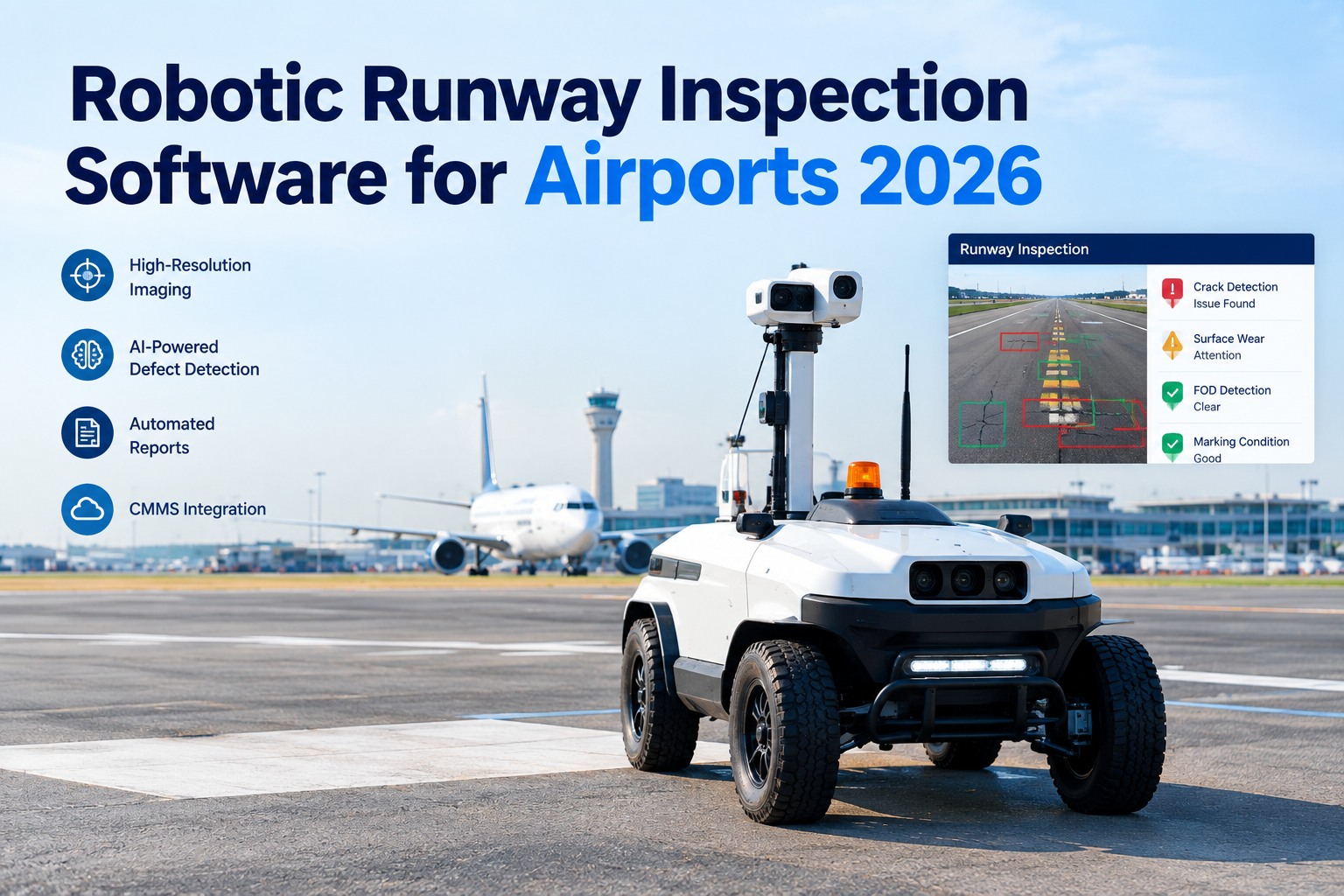
Robotic Runway Inspection Software for Airports 2026
The rover finds the defect. The CMMS closes it. A scan without a work order is just a photo nobody acted on — this is how the two halves connect.
<20 min
To scan a 3,000m runway autonomously — versus 60+ minutes on foot
10×
More FOD detected by robots than human walks in early airport trials
95%+
AI-vision detection accuracy on objects under 5 cm
12 mo
Inspection records Part 139 requires you to retain and produce on demand
The Robot Is Half the System
Autonomous runway inspection is genuinely transformative. A rover or drone covers the full movement area faster, more consistently, and in worse light than any crew on foot — and it never gets tired at 2 a.m. But here is the failure mode nobody markets: a scan produces a detection, and a detection is not a repair. When a rover flags a spalled joint or a burnt-out edge light, that finding has to reach a technician, become a prioritized work order, get closed with photo evidence, and land in a record the FAA can review twelve months later. Break that chain and you have the world's most expensive way to generate an unactioned photo. The best 2026 programs treat the rover and the CMMS as one loop, not two purchases — sign up free and you can wire the first half of that loop into work orders today.
01
Scan
Rover runs the route autonomously, capturing georeferenced imagery of pavement, markings, and lighting.
→
02
Detect
AI vision scores each anomaly — FOD, crack, faded paint — by type and severity.
→
03
Route
Each scored defect maps to its runway asset and opens a work order automatically.
→
04
Close
Technician fixes and closes with photo evidence — creating the audit-ready record.
What the Rover Actually Inspects
Modern airfield robotics have moved well past pure FOD detection. A single autonomous pass now captures four distinct compliance-relevant data layers — each one a category the FAA daily self-inspection expects you to cover and document.
◈
FOD Detection
Rocks, hardware, migrating aggregate, and loose bolts — the debris that ends up in an engine. Type, location, and probable ingress source logged for each find.
▦
Pavement Condition
Cracking, spalling, joint separation, and ravelling captured with GPS precision — feeding a PCI deterioration trend instead of a reactive drive-by.
╪
Marking Legibility
Centerline, hold-position, and edge markings checked against the 70% contrast threshold before rubber buildup drops them below spec.
◉
Lighting & Fixtures
Edge, threshold, and centerline fixtures verified — the failures that only a night pass or thermal sensor reveals before visibility drops.
Turn Every Autonomous Scan Into a Closed Work Order — Free Forever
Ingest georeferenced rover and drone data straight into OxMaint. Every detected defect maps to its runway asset, scores by severity, and becomes a prioritized work order with full image documentation — the closure record Part 139 inspectors verify. No card, no time limit.
How to Compare Platforms in 2026
The rover market is crowded — Roboxi in Norway, FOD-detection robots trialed at Munich and Schiphol, LiDAR track-rovers, and drone-based BVLOS scanners are all real. But the specs that matter for an inspection program aren't the ones in the sales deck. Score any platform against these six — and if you want to see how the CMMS side scores, book a 30-minute demo and we'll walk your shortlist through it.
1
Coverage & Cycle Time
Can it scan the full movement area inside your operational window, repeatedly, without disrupting traffic?
2
Detection Accuracy
Read rate on sub-5cm objects and false-positive rate — a rover that cries wolf gets ignored by the crew.
3
Georeferenced Output
Every detection tagged with precise location, so the defect maps to an asset — not a vague "somewhere on 09L."
4
CMMS API Integration
Standard data protocols that push findings into work orders. Without this, detections die in a vendor dashboard.
5
All-Weather / Night
Thermal and LiDAR layers that keep read rates up when daylight and dry pavement can't be assumed.
6
Audit-Ready Records
Time-stamped, geolocated, technician-attributed logs that survive an FAA certification review.
Why the CMMS Decides Compliance
Part 139.327 doesn't ask whether you own a robot. It asks for daily inspection records retained twelve months, corrective actions tracked to closure, and evidence that unsafe conditions were fixed before the next operation. Across FAA inspectors, the same failure pattern drives most citations — and it's a documentation problem before it's a maintenance one. An inspection that happened but wasn't signed is, to the FAA, a missing record. A defect found Tuesday and closed verbally Friday is an open finding with no timestamp. The rover generates the finding; the CMMS is what makes it defensible. Start a free account to build the closure trail before your next audit — no card, no time limit.
Rover Alone
- Defect flagged in a vendor dashboard
- No link to the runway asset record
- Corrective action closed verbally, if at all
- No timestamp, no signature, no evidence trail
- Open finding on the next FAA audit
Rover + OxMaint
- Detection auto-creates a scored work order
- Mapped to the exact asset and location
- Assigned, deadline-monitored, closed with photos
- Time-stamped and technician-attributed
- Complete deficiency-closure record on demand
How OxMaint Runs the Airside Program
Recurring inspection routes, georeferenced defect logging, auto-created corrective work orders, and audit-ready records aligned to Part 139 or ICAO Annex 14 all live on one platform — so the same discipline you apply to core maintenance runs the airfield, and the airport stays continuously ready for operations and regulator review.
Ingest
Rover & Drone Data
Georeferenced inspection data flows in through standard APIs — every detection landing against its runway asset record.
Score
Severity Triage
Each defect scored by type and severity, so a spalled joint jumps the queue ahead of cosmetic wear.
Create
Auto Work Orders
Findings become prioritized, assigned work orders in minutes — with the image evidence attached from the scan.
Schedule
Recurring Routes
Daily safety inspections, monthly pavement walks, and annual PCI assessments scheduled automatically with missed-inspection alerts.
Execute
Mobile Closeout
Technicians close jobs from a phone at the asset — GPS and photo evidence captured against the work order.
Prove
Audit-Ready Records
Time-stamped, attributed logs aligned to Part 139 and ICAO Annex 14 — produced on demand for any certification review.
Close the Loop Between Detection and Compliance
Free forever plan — no card, no time limit. Connect your rover or drone data, auto-generate scored work orders, and keep an audit-ready record aligned to Part 139 and ICAO Annex 14. Or book 30 minutes and we'll map your airside inspection program onto the platform end to end.
Frequently Asked Questions
Do robotic rovers replace Part 139 self-inspections?
Not by themselves. A rover dramatically improves how much you detect and how fast, but §139.327 compliance is about documented records — daily inspections logged, corrective actions tracked to closure, and evidence retained twelve months. The rover generates the finding; a CMMS turns it into the signed, time-stamped, closed-out record the FAA actually verifies.
What does an autonomous runway rover inspect in one pass?
Modern platforms capture four layers at once: FOD detection, pavement condition (cracks, spalling, joint separation), marking legibility against the 70% contrast threshold, and lighting or fixture faults. Thermal and LiDAR sensors extend this to night and all-weather passes that a human walk can't match.
How does rover data connect to a CMMS?
Through standard APIs and data protocols. OxMaint ingests georeferenced inspection data, maps each detection to its runway asset record, scores it by severity, and converts it into a prioritized work order with full image documentation — so a 2 a.m. detection opens a ticket instead of sitting in a dashboard until dawn.
Book a demo to see the integration mapped to your rover.
Which specs matter most when comparing platforms?
Coverage and cycle time within your operational window, detection accuracy on sub-5cm objects, georeferenced output precise enough to map to an asset, CMMS API integration, all-weather and night capability, and audit-ready record output. The last two decide whether the program survives an FAA review — not the dashboard graphics.
Sign up free to test the audit-ready record output yourself.
How does a CMMS reduce airfield compliance risk?
By collapsing the time between a detection and a closed record. It auto-creates scored work orders from rover findings, schedules recurring inspection routes with missed-inspection alerts, captures mobile closeout with GPS and photo evidence, and stores everything time-stamped and attributed. Open deficiencies without closure records are Part 139 violations — the CMMS is what prevents them.
Start free to put it in place.