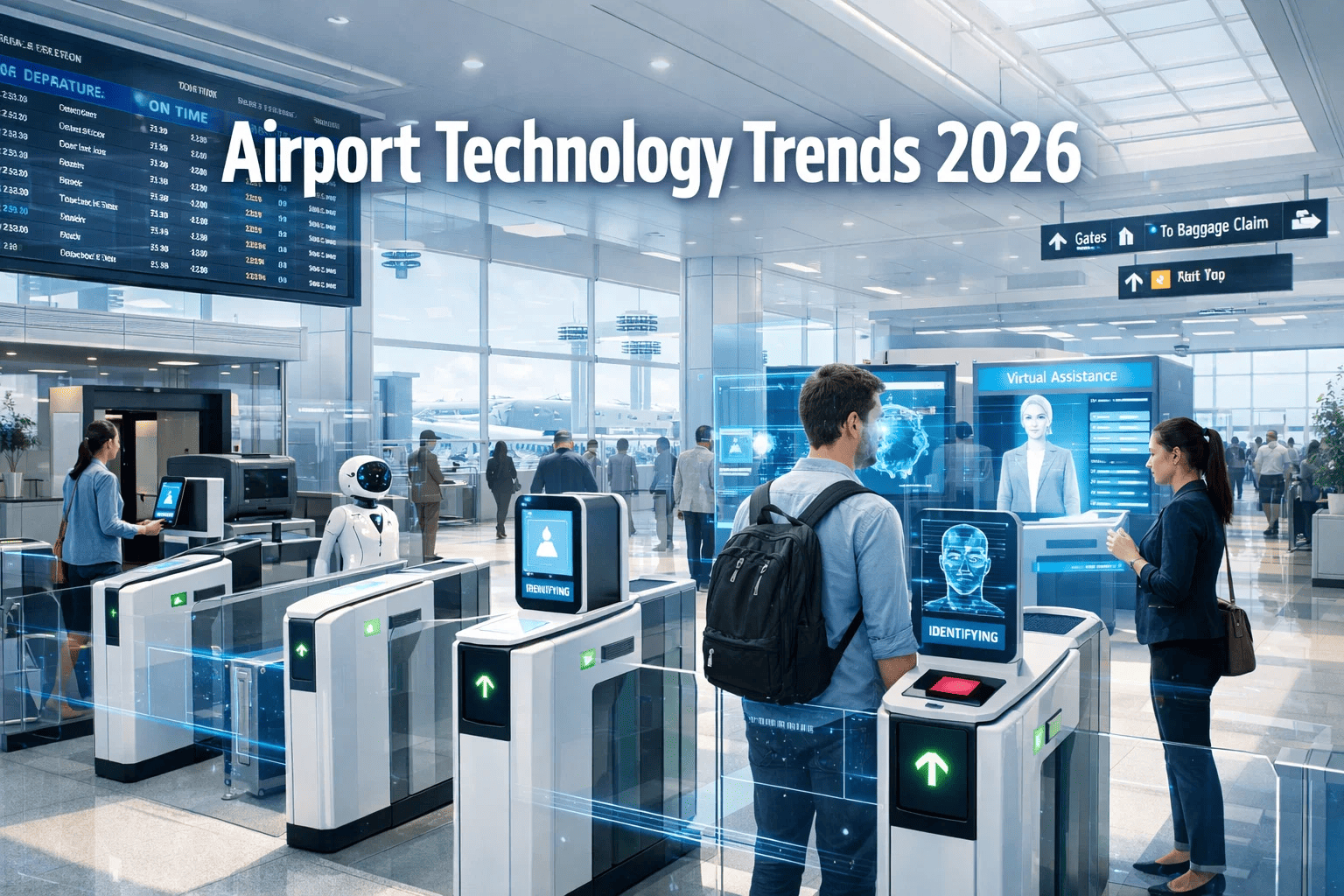
Airports are among the most operationally complex facilities on earth — millions of square feet, thousands of moving parts, and zero tolerance for downtime. The way airports maintain and operate these facilities is changing faster than most managers realise. Autonomous robots and drones are no longer pilot experiments. They are active, measurable parts of airport operations at Frankfurt, Singapore Changi, Munich, Hong Kong, and dozens of other major hubs. The numbers behind the shift are compelling — and the maintenance infrastructure required to sustain it is the conversation the industry needs to be having right now.
From Scheduled Crews to Always-On Machines
Traditional airport maintenance runs on two modes: scheduled rounds and emergency response. Crews clean on fixed intervals. Inspectors check equipment on predetermined cycles. When something breaks, a call is made, a technician is dispatched, and repair time stretches while the asset sits idle. This model was designed for a world where data was slow and labour was cheap. Neither condition holds true in 2026.
Autonomous robots change the operating model fundamentally. A cleaning robot does not take breaks or skip sections when tired. A drone does not need scaffolding or a two-hour setup window to inspect the underside of a boarding bridge. A security patrol robot does not leave a shift gap at 3am. These are not incremental improvements — they are structural changes to what continuous airport operations can look like.
The market reflects this momentum. The global airport robots sector is forecast to grow at 16.6% compound annually through 2035. Singapore Changi's Living Lab already integrates autonomous baggage tractors and food-delivery bots end to end. Frankfurt Airport's 2025 rollout of AI-enabled security scanners shortened checkpoint wait times while holding staffing levels flat. These are not R&D projects — they are production deployments. Start a free 30-day trial with Oxmaint to see how your maintenance data connects to this new operational model, or book a demo with our team.
Six Areas Where Robots Are Already Delivering Results
These are not theoretical applications. Each one has live deployments at named airports with documented outcomes.
Cleaning & Sanitization
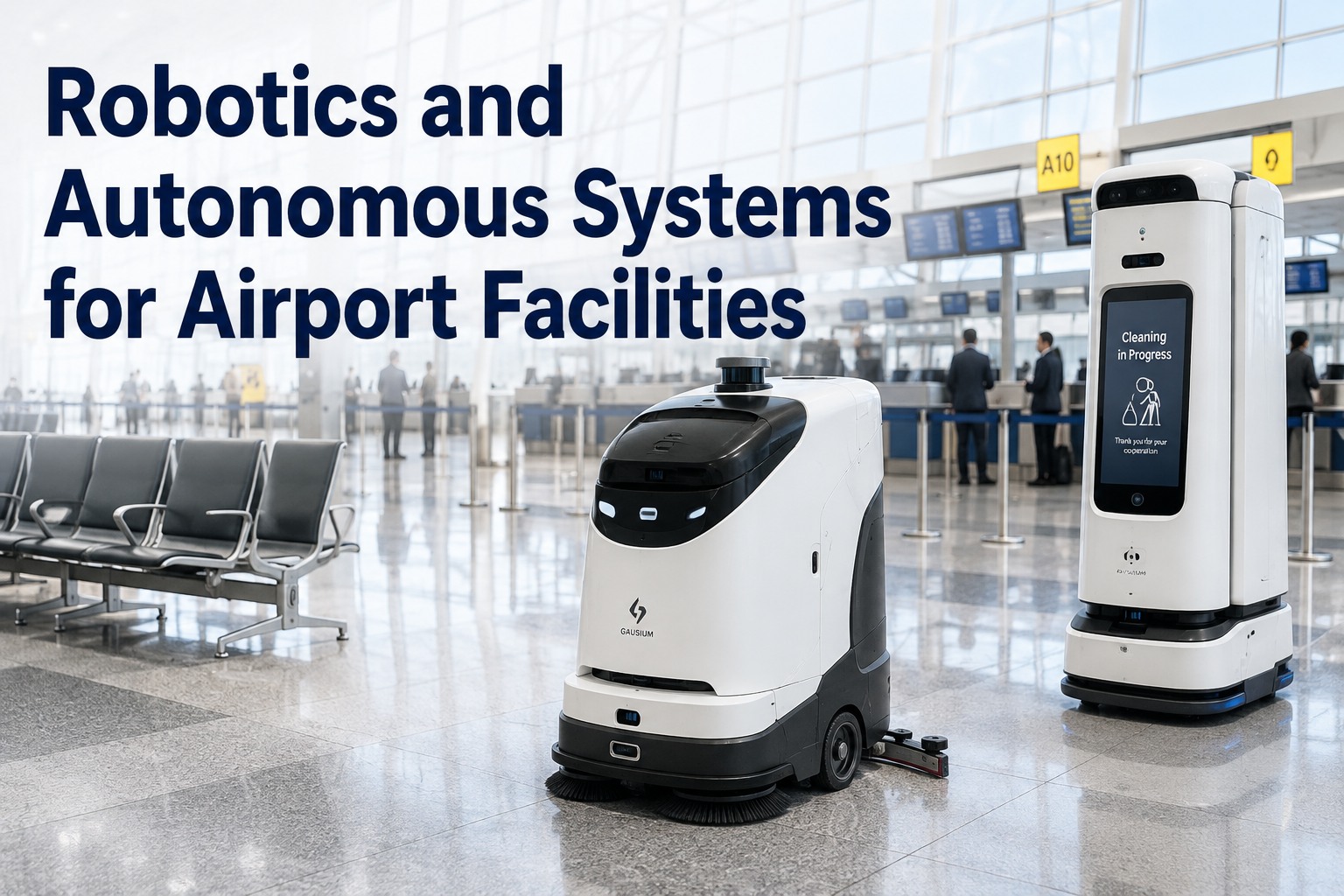
Autonomous floor-scrubbing and UV-C disinfection robots operate during off-peak hours on pre-mapped routes without supervision. Munich Airport launched a full autonomous cleaning robot fleet in March 2025 in collaboration with Gaussian Robotics. Hong Kong International Airport has run 60+ cleaning and disinfection robots since 2021, cutting surface contamination incidents by 45% while reducing labour requirements. UV-C disinfection robots achieve 99.9% pathogen elimination rates in controlled facility tests.
Aircraft & Infrastructure Drone Inspection
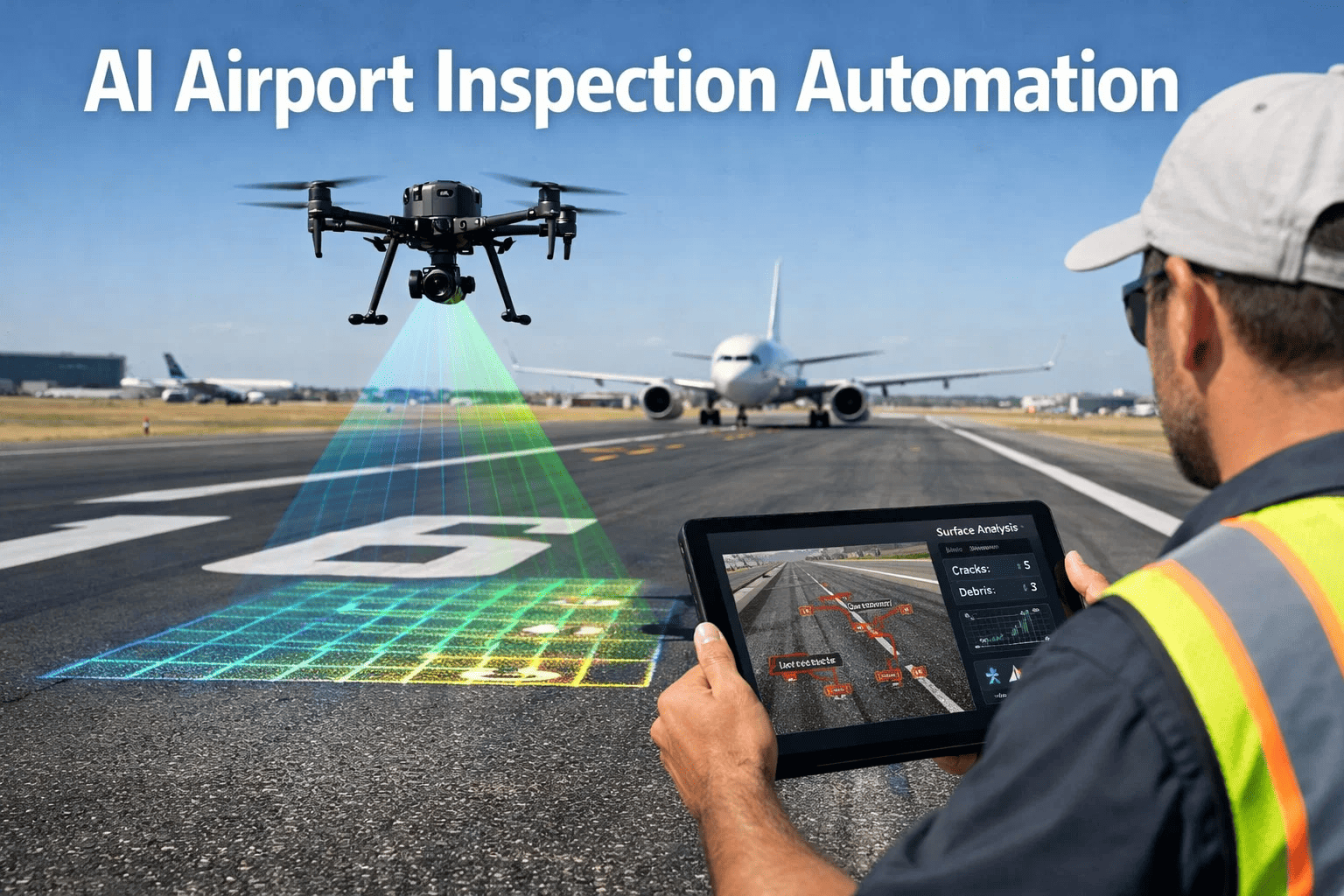
Drone inspection systems scan aircraft exteriors, rooftops, runways, and boarding bridges using thermal and high-resolution optical sensors. Delta Air Lines received FAA authorisation for autonomous drone inspections across its Airbus and Boeing fleet in 2024. Korean Air's four-drone swarm system reduces a widebody visual inspection from 10 hours to 4 hours. Boeing reports that autonomous inspection combined with damage-detection software saves 17 or more hours per aircraft on 737 production lines.
Baggage Handling & Ground Logistics
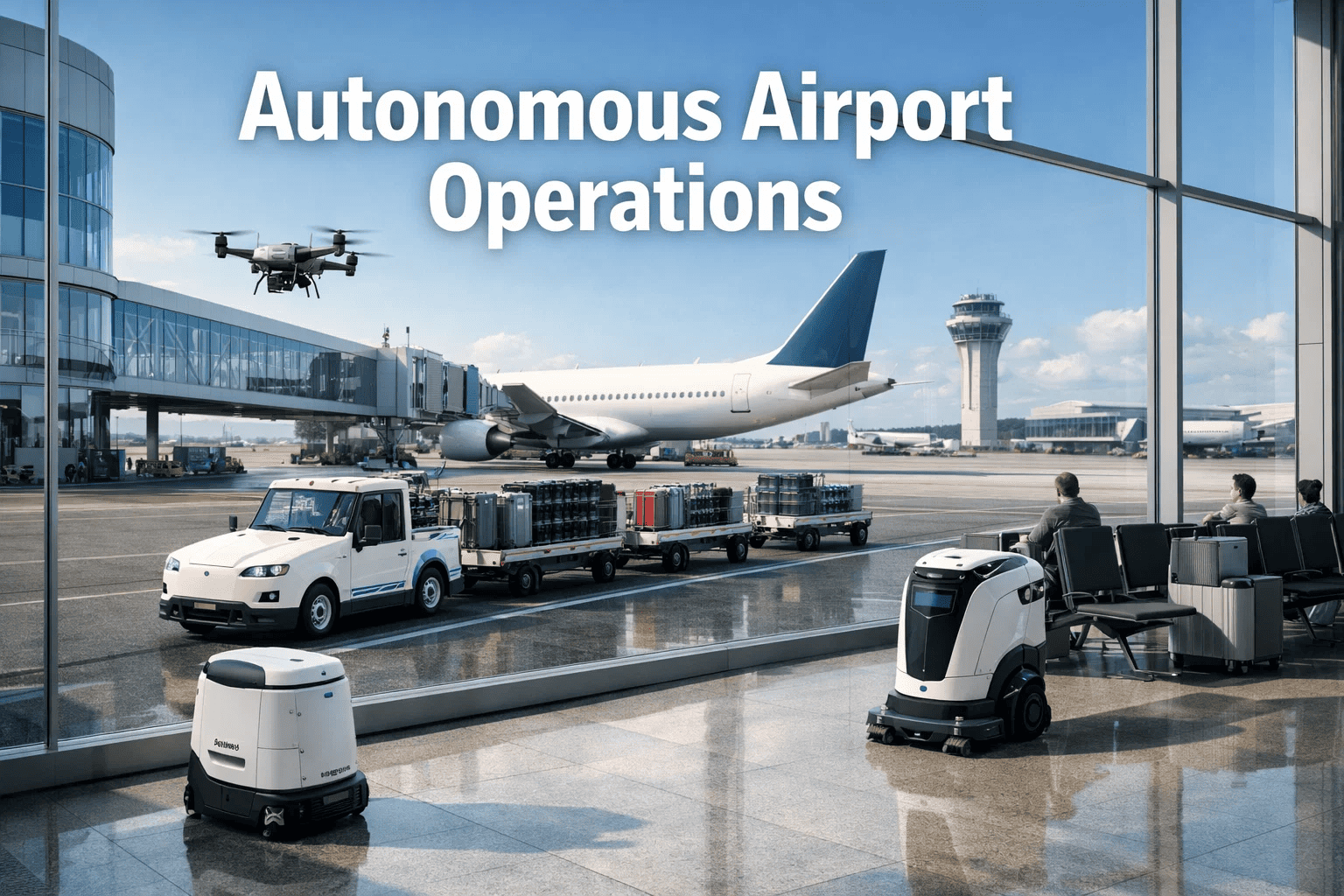
Robotic sorting systems and autonomous guided vehicles move bags faster and with fewer mishandling errors than manual operations. Schiphol Airport is testing autonomous baggage tractor integration. Japan Airlines co-invested in Fox Robotics — a developer of autonomous forklifts — as part of a broader cargo automation strategy. Cobot Lift's partnership with Schiphol tests robots capable of handling up to 90% of baggage to significantly reduce workforce strain.
Security Patrol & Monitoring
Autonomous security robots equipped with 360-degree cameras and AI anomaly detection patrol terminal perimeters and restricted zones without shift gaps. San Antonio Airport deployed the Knightscope K5 autonomous security robot in early 2024. Thermal sensor networks validated at Athens International Airport in April 2025 achieved 100% service reliability and sub-50ms application latency during live passenger-flow monitoring trials.
Passenger Guidance & Assistance
AI-powered guidance robots help travellers navigate terminals, access real-time flight updates, and receive multilingual assistance. LG Electronics expanded its CLOi GuideBot across South Korean and Japanese airports in March 2025. SoftBank Robotics and SITA launched an upgraded Pepper robot for check-in and immigration assistance in February 2025. Passenger satisfaction scores in the Athens International trial exceeded 4.3 out of 5 across all evaluated dimensions.
Runway & Remote Site Inspection
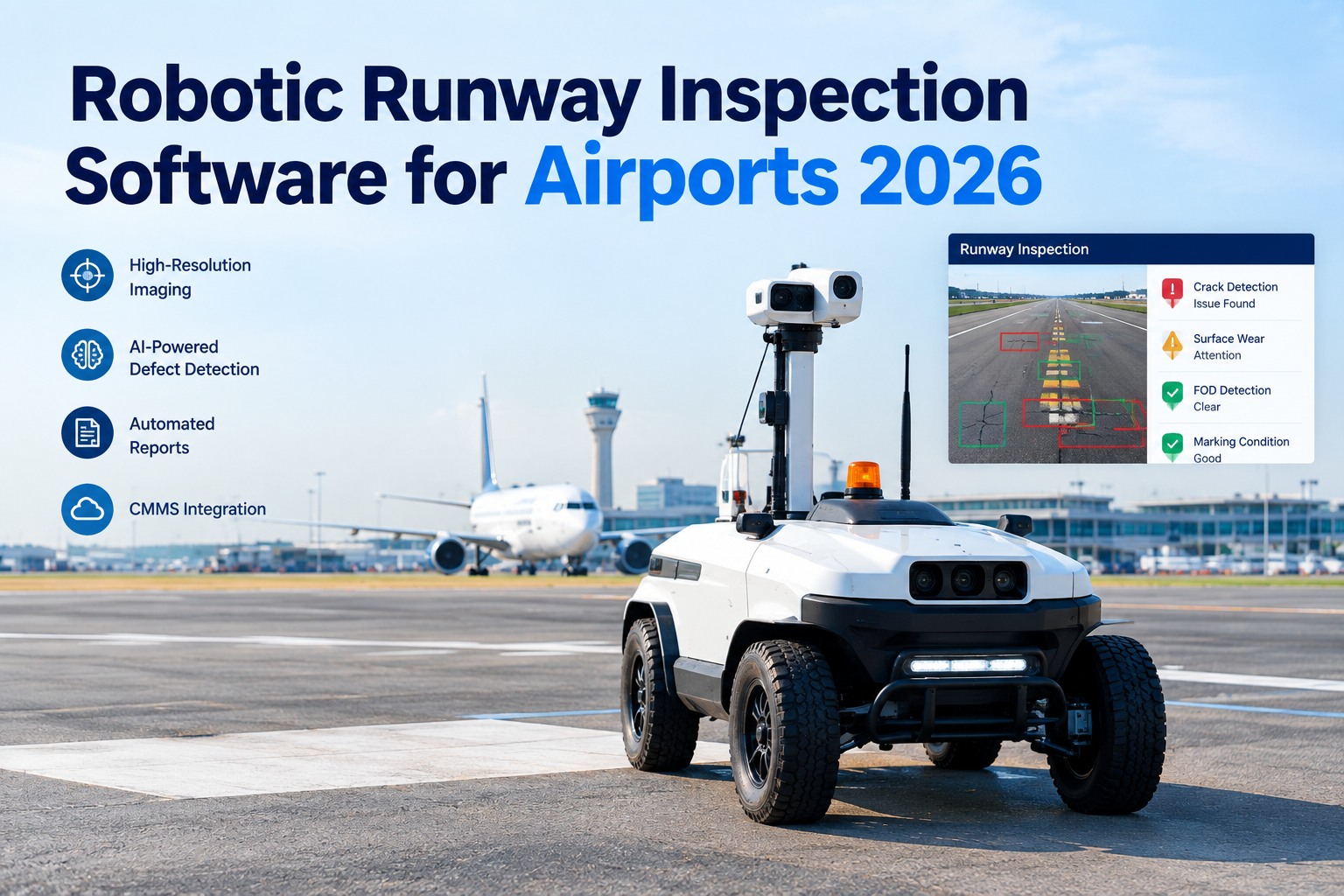
Drones equipped with computer vision detect surface cracks, vegetation encroachment, water pooling, and structural wear on runways and taxiways. A Southern California airport used drone-plus-GIS technology to locate the exact source of a terminal roof leak after a rainstorm — generating a work order that guided maintenance crews directly to the repair point. End-to-end runway defect detection has been validated through deep learning and UAV imagery at multiple facility types including remote gravel runways.
Why Robots Alone Do Not Solve the Maintenance Problem
Here is the part of the conversation technology vendors do not lead with. Robots generate findings. Drones capture images. Sensors flag anomalies. But every single output requires a human decision and a maintenance action to resolve. A drone that detects surface erosion on a taxiway has done its job. Whether that finding becomes a scheduled repair, a parts order, a compliance record, and a closed work order — that depends entirely on what happens next.
Most airport facilities teams are managing robot outputs through email threads, spreadsheets, or verbal handoffs. Findings get missed. Repair timelines drift. Parts are not in stock when the technician arrives. There is no searchable record connecting the drone image to the repair to the cost. When an auditor asks for maintenance evidence, the answer is scattered across four different systems and two inboxes.
| What the Robot Does | Without a CMMS | With Oxmaint |
|---|---|---|
| Detects a surface defect | Flagged in a separate app, emailed to someone | Auto-triggers a digital work order linked to the asset |
| Completes a cleaning cycle | Logged in the robot's own system — isolated | Captured in asset history, feeds PM schedule logic |
| Flags an equipment fault | Reported verbally or via paper ticket with delay | Mobile alert sent to technician with full device history |
| Generates inspection data | Stored in drone software, not connected to repairs | Linked to work orders, parts records, and compliance logs |
| Completes a security patrol | Robot log only — no maintenance system integration | Any anomaly becomes a traceable maintenance event |
The CMMS is not an add-on to a robot program. It is what makes the robot program operationally real. Start a free 30-day trial with Oxmaint to see how your airport's maintenance data becomes a connected, auditable system, or book a demo and walk through a live airport workflow with our team.
The Numbers That Make the Case
What Airport Robotics Looks Like by 2030
IATA projects passenger numbers will double by 2037. Airports are not building twice as many terminals to keep up — they are deploying systems that let existing infrastructure handle more, with fewer failures and lower labour costs. The technology roadmap follows a clear progression.
Isolated but Proven Deployments
Individual robot units operating in defined zones with measurable results. The technology is validated. The remaining challenge is integration — getting robot outputs connected to maintenance systems so findings drive action rather than sitting in siloed apps.
Networked Fleets with Real-Time Data
Multiple robot types — drones, ground cleaners, inspection crawlers, security bots — coordinated by a central platform. 6G-enabled indoor positioning and digital twins updated in real time from sensor data. ST Engineering's 84,000 m² smart hangar in Singapore, designed around this model, opens by end-2026.
Predictive Maintenance at Scale
AI models predict equipment failures days ahead using historical inspection data, sensor streams, and asset usage patterns. Work orders are generated automatically before a technician knows there is an issue. Emergency repairs become rare rather than routine, and the cost premium associated with reactive maintenance largely disappears.
Autonomous Maintenance Cycles
Robots detect, diagnose, and — for defined asset types — initiate repairs. Human experts focus on complex decisions and exception management. Every maintenance event is timestamped, geotagged, and auditable without manual documentation. The smart hangar concept extends to the entire airport campus.
Airports building their maintenance infrastructure now — with digital work orders, live asset registries, and connected inspection workflows — are the ones that will operate efficiently at 2x today's passenger volumes. Everything else means starting from scratch later at a much higher cost. Start a free trial and build that infrastructure today, or book a demo with the Oxmaint aviation and facilities team.
Common Questions
How do autonomous robots reduce airport maintenance costs?
Robots cut costs through three mechanisms: lower labour hours for repetitive tasks, earlier defect detection before failures escalate, and elimination of specialist equipment like scaffolding and aerial lifts for hard-to-access inspections. Emergency repairs cost 4.8x more than planned maintenance — catching issues earlier is the single highest-leverage intervention available. Airports using integrated robot fleets with AI-driven analytics report 15–25% reductions in overall operational costs.
Are drone inspections approved for use inside airport facilities?
Yes — and the regulatory framework is advancing quickly. The FAA authorised Delta Air Lines for autonomous drone inspections across its full fleet in 2024. Donecle's system is listed in both Airbus and Boeing maintenance manuals with FAA and EASA acceptance. Swiss FOCA has approved Jet Aviation and Singapore's CAAS has authorised ST Engineering. Each region has its own approval pathway, but comprehensive production-scale deployment is actively underway through 2026.
What does Oxmaint actually do in an airport robot program?
Oxmaint is the operational layer between robot outputs and actual maintenance execution. Robots generate findings — images, sensor alerts, anomaly flags. Oxmaint converts those into scheduled work orders, assigns the right technician, tracks repair completion, logs parts consumed, and updates asset reliability metrics. It also handles PM scheduling, multi-site portfolio reporting, and audit-ready compliance documentation. Without this layer, robot data sits in silos. With it, every inspection becomes a traceable maintenance event.
How quickly can an airport team get started with Oxmaint?
Oxmaint is designed for fast deployment without heavy implementation fees or long onboarding. Most facilities teams can build their asset registry, configure PM schedules, and start logging work orders within the first week. The platform is mobile-first and multi-site capable from day one. A free 30-day trial gives your team full platform access against your real asset data before committing to anything.
The Robots Are Already Working. Is Your Maintenance System Ready?
Oxmaint gives airport and facilities teams a connected maintenance platform — asset registry, digital work orders, PM scheduling, reliability analytics, and compliance documentation — built for the operational demands of modern, robot-assisted airport environments.