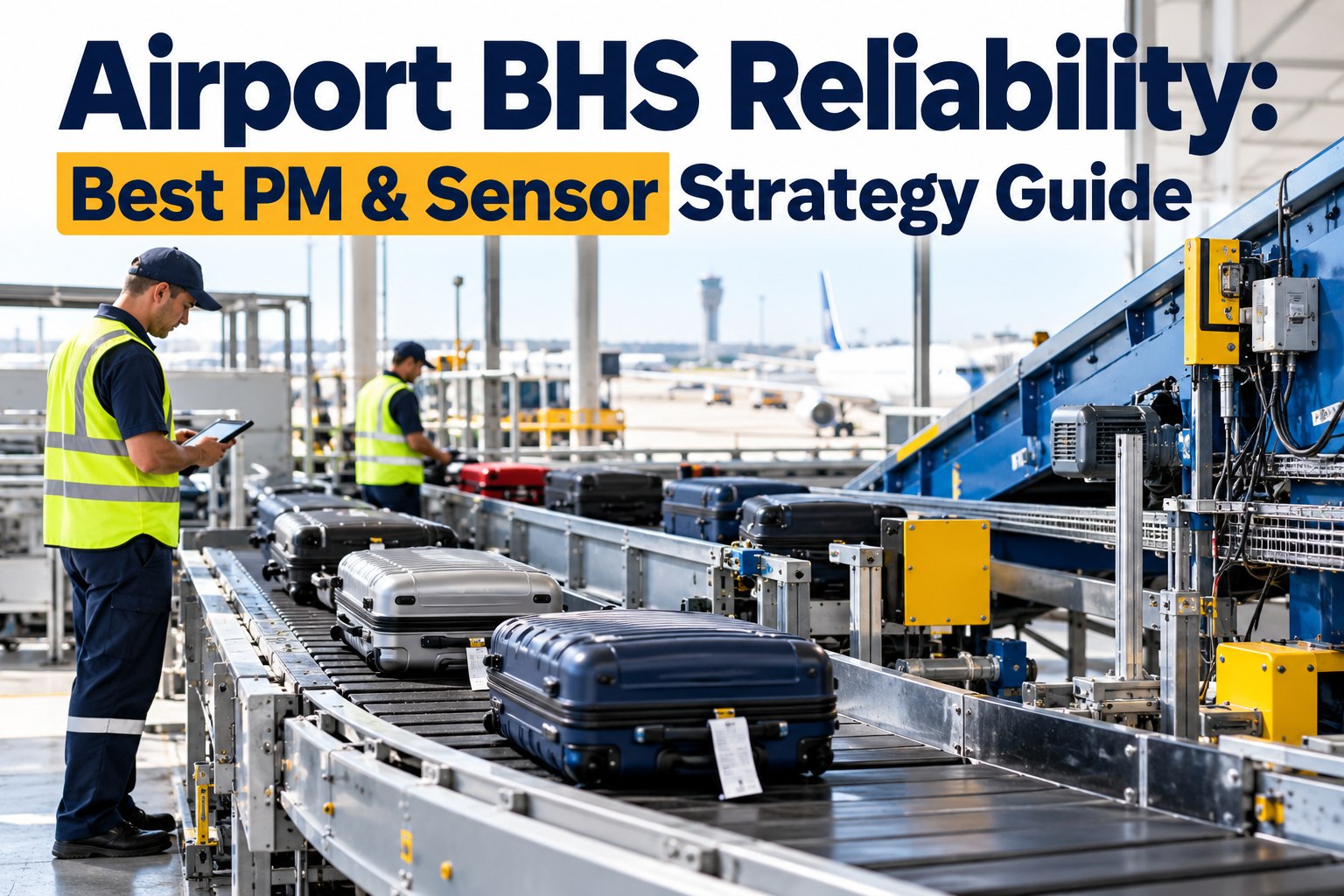
A baggage belt drifts a few millimetres a day. Nobody notices — until the edge is frayed, a guard is rubbed shiny, and a bag wedges at a merge in the middle of a bank. Belt misalignment is the slow failure that turns into a sudden one, and the fix is rarely the thing techs reach for first: cranking tension steers nothing. OXMAINT AI is the AI-powered maintenance management software that keeps belt-walk checks on a route, turns a tracker-camera drift alert into a corrective work order, and holds the alignment spec and torque limits right on the job card.
BHS Belt Alignment · Tracker Cameras · Laser Squaring · Torque Limits · Playbook · 2026
BHS Belt Misalignment: Detect It Early, Correct It in Order
A conveyor tracks toward whatever it touches first — so a belt that's walking is telling you a roller or a frame is out of square, not that it needs more tension. This playbook covers how to catch the drift and correct it in the right sequence, and the OXMAINT AI maintenance management software keeps every check, alert and fix on one record.
1Detect
→
2Diagnose
→
3Correct
→
4Verify
Edge contact
damage starting
3
root causes behind most drift: structure & level, belt or splice defect, off-center loading
A few mm/day
of unchecked drift can fray a belt edge within weeks
1 at a time
adjust a single roller per change, or you can't tell what actually worked
Take-ups ≠ tracking
tension holds the belt — it does not steer it back to center
Why a Belt Walks in the First Place
Mistracking is a symptom, not a cause — and the right fix depends on which of these is really behind it. Rule them out in order and you stop chasing the belt around the frame; book a demo to log each cause against the run in OXMAINT AI.
Frame not level or square
If the structure leans or twists, gravity pulls the belt sideways no matter what the rollers do.
Idlers or pulleys off-square
A roller that sits even slightly crooked steers the belt toward the end it touches first.
Belt or splice defect
A warped belt or an out-of-square splice makes the belt creep — often only as that splice passes a point.
Off-center loading
Bags landing to one side at a merge push the belt over every single cycle until it stays there.
Carryback on pulleys
Debris packed on a pulley or roller builds a high spot that lifts and steers the belt off its line.
Worn edges or guides
Once an edge frays or a guide wears, the belt loses its reference and starts to wander both ways.
THE RULE
A belt moves toward whatever it touches first. You steer it by squaring what it rides on — never by cranking tension.
Five Ways to Catch the Drift Early
The whole game is seeing the walk while it's millimetres, not when it's edge damage. Layer these five and a belt rarely surprises you; start free and put belt-walk checks on a route in OXMAINT AI.
01
The belt walk
A tech walks the run and reads the belt edges against fixed reference marks on the frame — the cheapest, fastest check there is.
02
Tracker cameras
Vision sensors watch edge position continuously and flag drift the moment it trends — ideal for the spots a walk can't reach in a shift.
03
Laser & straightedge
A laser line or a straightedge measures whether idlers and pulleys are square to the belt path — the root most drift traces back to.
04
Edge wear & rub marks
A frayed edge on one side, shiny guards or spillage at a transfer all say the belt has been riding off-line for a while.
05
Sound & vibration
A squeal at a pulley or a rhythmic slap often means the belt is rubbing structure — your ears catch it before your eyes do.
The Correction Sequence, in Order
Order is everything here — square the big things before you touch a single tracker, and change one thing at a time. Rush it and you'll fight the belt for a shift; book a demo to put this sequence on a work card in OXMAINT AI.
01
Lock out, then clean
Isolate and tag the drive first. Then scrape carryback off every pulley and roller — a clean line is the baseline for everything after.
↓
02
Level the frame
Check the structure is level and square end to end. A leaning frame pulls the belt sideways and defeats any roller you adjust.
↓
03
Align the pulleys
Confirm head and tail pulleys are parallel and square to the belt path with a laser or straightedge before moving down the run.
↓
04
Square the idlers
Check each idler against a straightedge and reset any that sit crooked — most drift is cured here, before a tracker is touched.
↓
05
Knock the trackers, one at a time
Pivot a single training idler a small amount toward the way the belt is drifting, run several revolutions, then judge — never two at once.
↓
06
Set tension to spec & verify
Set tension to the belt's spec with a torque wrench — to hold it, not to steer it — then run and confirm it stays centered.
Tracking Is Won on the Route, Not at the Breakdown.
A belt caught drifting is a ten-minute adjustment; a belt caught jammed is a bank-time stoppage. The OXMAINT AI maintenance management software keeps belt-walk checks on a schedule, turns a tracker-camera alert into a corrective work order, and carries the squaring steps and torque limits to the tech's hand.
Symptom, Likely Cause, First Fix
When the clock's running, you need the shortest path from what you see to what you do. Read the symptom, start with the first fix, and only move on if it doesn't hold; start free and keep this chart on every BHS asset in OXMAINT AI.
The Tools That Make Alignment Measurable
Eyes catch a bad belt; instruments catch it early and prove the fix held. A small kit turns tracking from a feel into a number; book a demo to attach tool readings to the work order in OXMAINT AI.
How OXMAINT AI Keeps Alignment on Schedule
A playbook only works if the checks actually happen and the fixes get recorded. That's the part the OXMAINT AI maintenance management software runs, so a drift never waits for the next breakdown to be noticed; start free and build your BHS alignment routine in OXMAINT AI.
Belt-walk routes
Scheduled walk-downs with edge checks per conveyor, so no run goes a week without eyes on it.
Tracker alerts to work orders
A camera drift signal raises a corrective job on its own, routed to the right tech before the edge is touched.
Squaring steps on the card
The correction sequence and the torque limits ride on the work order — the tech works it, not from memory.
Tension & PM intervals
Belt tension checks, splice looks and roller service on calendar- and runtime-based schedules, never missed.
Drift trended over time
Readings logged per belt show which conveyors keep walking back, so you fix the cause, not the symptom again.
Full repair record
Every check, adjustment and tension setting timestamped per belt — history that outlives any one shift's memory.
“
We used to crank the take-up whenever a belt wandered, and it worked for about a day before it was worse. The playbook flipped that — square the idlers, leave the tension alone. The tracker cameras now open the work order before a bag ever jams, and the squaring steps are right there on the tech's phone. Edge-damage replacements are the line that fell the most on our parts spend.
BHS Reliability Lead · International Airport
Frequently Asked Questions
What's the number-one cause of BHS belt misalignment?
Most drift traces back to the structure or a roller being out of square — the belt simply follows what it touches first. Tension and loading matter, but squaring the frame and idlers fixes the majority.
Start free and log the cause per belt.
Why shouldn't I use tension to correct tracking?
Take-ups are there to hold belt tension, not to steer the belt. Using tension to track masks the real cause and usually makes the wander worse once it settles. Square the rollers instead.
How do tracker cameras help?
They watch belt-edge position continuously and flag drift the moment it trends — long before a walk-down would catch it. Tied to the CMMS, that signal becomes a corrective work order on its own.
Book a demo to see the alert flow.
How much should I adjust a training idler at once?
A small amount, one idler at a time, then let the belt run several revolutions before judging. Change two things together and you can't tell which one moved the belt.
How often should belts be checked for alignment?
High-traffic runs and merges earn a weekly belt walk; quieter lines can go longer, with tracker cameras covering the gaps. The right interval is the one that catches drift while it's still millimetres.
Catch the Walk While It's Still Millimetres.
Run the detect-diagnose-correct-verify loop on every BHS belt with the OXMAINT AI maintenance management software — belt-walk routes, tracker-camera alerts straight to a work order, the squaring sequence and torque limits on the card, and the drift trended per conveyor. Fix the cause once, not the edge damage every month.