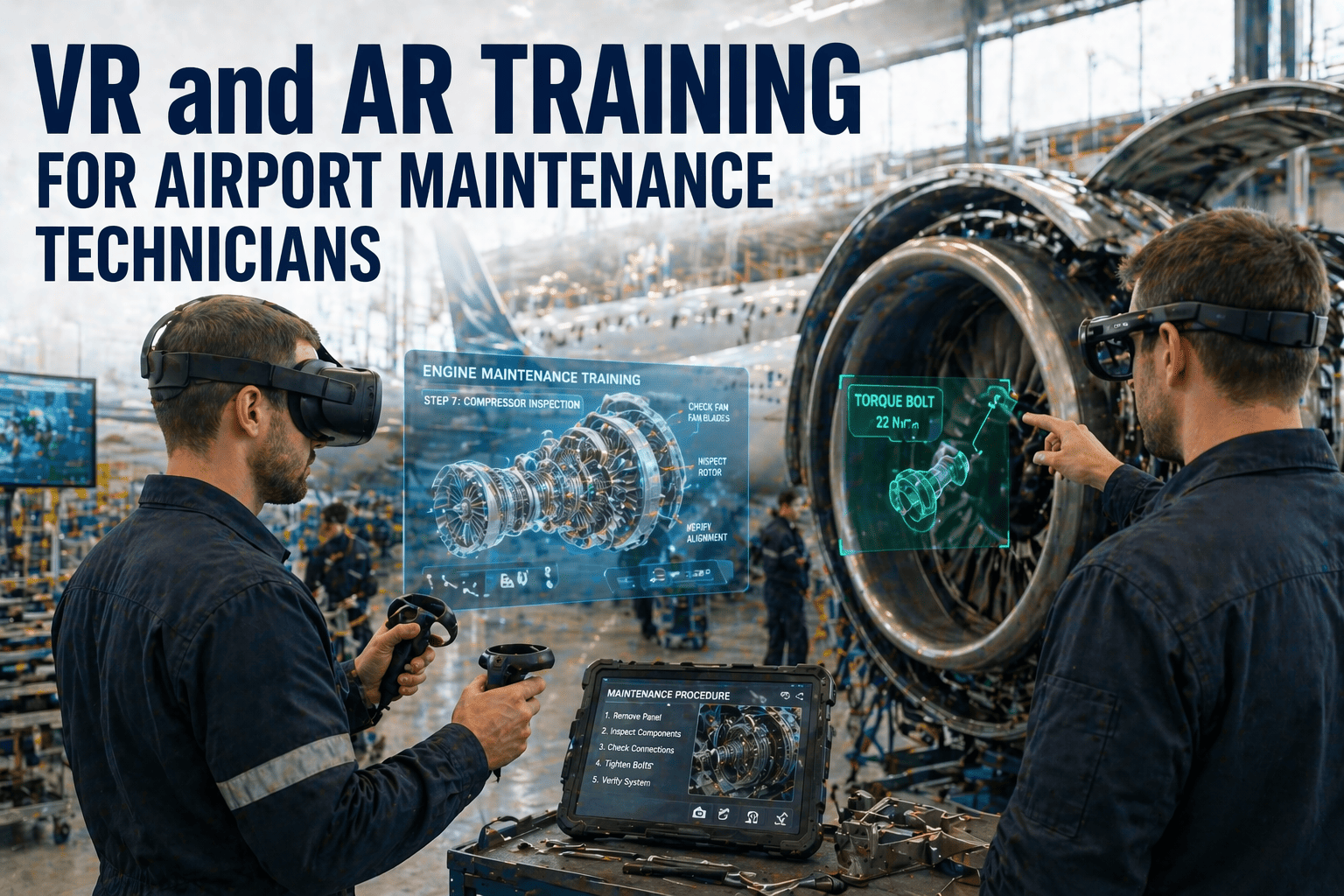
Aviation maintenance technicians carry an extraordinary cognitive load on every shift — diagnosing faults under time pressure, executing multi-step procedures from memory, and signing their name to work that keeps aircraft airworthy. The quality of their training is not a soft metric. It is an operational variable with a direct line to safety records, audit findings, and hangar throughput. Yet the vast majority of MRO organisations still deliver that training through passive slide decks, PDF manuals, and one-way video modules — formats that produce average knowledge retention of just 10 to 20 percent after 30 days. Gamification inverts that outcome. MROs deploying game-based learning are reporting 74 percent higher retention rates, 41 percent faster time-to-task qualification, and measurable reductions in procedural errors at first sign-off. The organisations building the highest-performing maintenance teams in 2026 are not training more — they are training smarter. Start a free 30-day trial with OxMaint and explore how forward-thinking MROs are building high-retention gamified training programs at scale, or book a live demo with our training module team today.
Gamification in Aviation Maintenance Training: How Game-Based Learning Builds Better Technicians
Leading MROs are replacing passive training modules with gamified, scenario-driven learning — boosting retention by 74%, cutting qualification time by 41%, and generating the real-time competency data that quality managers and regulators demand.
OxMaint's Gamified Training Module Connects Learning Data Directly to Maintenance Performance
Passive training content does not build the procedural muscle memory your technicians need on the hangar floor. OxMaint links gamified scenario modules, real-time badge tracking, and live competency dashboards directly to your asset register and work order system — so every training outcome is tied to real maintenance execution. Start a free 30-day trial and configure your first gamified training module in under a week, or book a personalized demo built around your fleet type and training program structure.
What Is Gamification in Aviation Maintenance Training?
Gamification applies the structural mechanics of game design — points, progression, challenges, badges, leaderboards, and immediate performance feedback — to non-game contexts. In aviation maintenance training, this means replacing passive slide-deck modules with scenario-driven exercises where technicians earn points for correct procedure execution, unlock competency badges for task completion, and advance through ranked skill tiers visible to their peers and managers.
The outcome is not entertainment. It is measurably higher retention, faster competency development, and training records that are genuinely audit-ready. Regulators at the FAA, EASA, GCAA, and CASA all require documented evidence of recurrent training completion and competency demonstration. A gamified system generates that evidence automatically — timestamped, signed off, and linked to individual technician records and task authorisation history. If you are ready to see what this looks like inside a live operation, start a free 30-day trial with OxMaint and explore compliant gamified training structures from day one, or book a demo to walk through a live training workflow mapped to your aircraft types.
4 Training Failures Driving MRO Performance Risk
These are documented, recurring failures in conventional aviation maintenance training programs — not edge cases. Each has a measurable cost to quality, compliance, and operational throughput that gamification directly addresses.
The Ebbinghaus Forgetting Curve applies directly to maintenance training. Without active retrieval practice and scenario repetition, technicians lose 80% of training content within a month — and then sign off tasks on that degraded knowledge base.
Passive video and PDF-based modules report completion rates below 60% in most MRO environments. Low engagement is not a personnel problem — it is a format problem. Gamification resolves completion rates by removing the passive delivery model entirely.
IATA Safety Report data links the majority of quality escapes — incorrect installations, missed inspections, documentation errors — to training gaps that existing programs fail to close before technicians receive task authorisation.
Most MRO training management tools produce completion timestamps, not competency data. Managers cannot see which technicians are weak on avionics, which bases are under-qualified for specific types, or where the next quality event is most likely to originate.
How OxMaint's Gamified Training Module Builds Verified Competency at Scale
One connected platform — from training scenario to task sign-off, with every data point feeding the compliance record automatically. Start a free 30-day trial or book a demo and see your first training program configured live in the opening session.
Build decision-tree maintenance scenarios mapped directly to AMM procedures and aircraft systems. Technicians work through fault isolation, tool selection, and documentation steps — earning points for accuracy, sequence, and speed. No aircraft access required.
Training managers see live competency scores per technician, per aircraft system, per site — not just completion timestamps. Identify weak spots before they become quality events. Dashboard refreshes on every module interaction across all connected bases.
Four-tier competency structure — Apprentice, Certified, Advanced, Master — with task-specific badge tracking per aircraft type and system. Badge status links directly to work order authorisation rules, so task assignments reflect each technician's verified scope automatically.
Site, shift, and fleet-wide leaderboards drive self-directed training engagement without mandatory sessions. Team challenges create collaborative learning across bases. Managers set performance targets and track progress in real time — no manual reporting overhead.
Automated recurrency tracking flags expiring qualifications at 60, 30, and 14 days. Gamified refresher modules are assigned automatically by aircraft type, system category, and regulatory requirement — zero manual scheduling overhead for training coordinators.
Every module completion, scenario score, badge award, and recurrency sign-off is stored with timestamp and digital signature. Generate regulatory evidence packages for FAA, EASA, GCAA, and CASA in minutes — not hours of manual document assembly before an audit.
Traditional Training vs. Gamified Training
The difference between conventional LMS delivery and OxMaint's gamified training approach is not marginal — it is structural. Here is what changes at every operational dimension when an MRO moves its program to a game-based, data-connected platform.
| Dimension | Traditional LMS / Classroom | Gamified Training (OxMaint) |
|---|---|---|
| Knowledge Retention (30 days) | 10–20% average across cohorts | 74–90% with active retrieval and scenario practice |
| Module Completion Rate | Below 60% in most MRO environments | 94%+ with progress scoring and peer competition |
| Time to Task Qualification | Standard cohort schedule — 6 to 12 weeks | 41% faster with scenario-driven competency mapping |
| Competency Visibility | Completion certificates only — no gap data | Live dashboards by technician, system, and site |
| Recurrency Management | Manual tracking — high administrative overhead | Automated alerts and module assignment — zero manual scheduling |
| Regulatory Evidence | Paper or PDF records — manual audit assembly | Digital sign-off packages generated in minutes |
| Multi-Site Consistency | Varies by site, trainer, and cohort delivery | Standardised scenarios across all bases and fleet types |
| Technician Engagement | Passive consumption — low self-direction | 82% of technicians self-direct 30+ minutes of daily training |
What Gamified MRO Training Programs Are Actually Delivering
Quantified outcomes from aviation maintenance organisations that have deployed OxMaint's gamified training module — numbers that build the internal business case and close the budget conversation with operations leadership.
Average gain in 30-day knowledge retention versus slide-deck and video LMS formats — the foundational metric that all downstream quality performance depends on at task execution
Combined savings from reduced re-training cost, quality event rework, regulatory finding remediation, and faster new-hire qualification across a mid-size MRO operation
Reduction in first-task procedural errors among technicians completing gamified scenario modules versus those trained exclusively on static LMS content in matched cohort studies
Gamified training modules achieve 3.2 times higher voluntary completion rates than standard LMS video modules in matched MRO technician cohorts across aircraft types
Frequently Asked Questions
Does gamified training meet FAA, EASA, and GCAA regulatory requirements for aviation maintenance recurrent training?
Yes — provided training content is mapped to approved syllabi and records are maintained to the required standard. FAA AC 145-10, EASA Part-147, and equivalent GCAA and CASA frameworks specify training content requirements and record-keeping obligations, not delivery format. OxMaint generates timestamped digital records with technician digital signature for every module completion, scenario result, and badge award — fully compliant with all major regulatory frameworks. Scenario content is configurable to map exactly to your approved training organisation's program, and exports are formatted for direct submission to your accountable manager or regulatory inspector. If you want to see the compliance record structure before committing, start a free 30-day trial or book a demo and walk through a live regulatory evidence package for your jurisdiction.
Can OxMaint integrate with our existing LMS, HRMS, or M&E platform such as AMOS, TRAX, or SAP PM?
OxMaint operates as a standalone gamified training and competency management platform, or integrates via REST API with existing LMS, HRMS, and M&E systems including AMOS, TRAX, and SAP PM. Technician records created in OxMaint push certified badge and completion data back to your system of record at each qualification milestone. For SAP PM operators, a certified connector maps training data to employee master records directly. Standard integration averages three to five weeks with no heavy IT resource requirement and no lengthy onboarding fees. Book a demo for a live integration walkthrough tailored to your stack, or start a free trial and test the API configuration in your own environment.
What types of maintenance tasks and aircraft systems can be gamified within OxMaint?
OxMaint's scenario builder supports any procedural maintenance task that can be mapped to a decision tree or step sequence — line maintenance inspections, avionics troubleshooting, hydraulic system tasks, engine run procedures, cabin maintenance, and ground handling safety. Content builders upload AMM procedure references directly and map scoring rules to step accuracy, tool selection, and sequence. Aircraft type coverage is fully configurable — narrowbody, widebody, turboprop, and rotary all supported. Scenario difficulty tiers allow the same task to serve both Apprentice and Advanced technician cohorts within the same program. Start a free trial and build your first scenario, or book a demo to see a live scenario walk-through mapped to your fleet type.
How long does full implementation of OxMaint's Gamified Training Module take, and what does the process look like?
The standard implementation timeline is two to four weeks from contract signature to first live gamified module. Week one covers data configuration — technician profiles, aircraft types, and competency tier mapping. Week two delivers the first scenario set, badge structure, and dashboard setup. Week three runs a pilot cohort of 10 to 20 technicians and collects structured feedback. Full rollout to all sites and shifts completes by week four. No heavy IT resources, no lengthy vendor onboarding fees. Most MROs see measurable engagement and completion rate data within the first seven days of pilot. Book a demo and walk through a deployment plan built around your operation's size and fleet complexity, or start a free trial and run the first pilot module yourself today.
Stop Losing 80% of Training Investment to Passive Slide Decks That Technicians Forget
Every procedural error that traces back to a training gap is a preventable event. OxMaint's Gamified Training Module gives aviation maintenance teams the infrastructure to build high-retention, scenario-driven training programs — from scenario authoring and badge tier tracking to real-time competency dashboards, automated recurrency management, and audit-ready regulatory records — all connected to your asset register and work order system in one platform.
Trusted by aviation maintenance organisations across the USA, UK, UAE, Australia, and Germany. No lengthy implementation. First gamified scenario live within your first week. No heavy onboarding fees.