Managing a ground support equipment (GSE) fleet at a modern airport is no longer a purely logistical challenge — it is a strategic operations function that directly determines aircraft turnaround speed, airline customer satisfaction, and environmental compliance standing. When a baggage tractor stalls on the apron during a peak turnaround window, when a ground power unit fails to deliver stable voltage at the gate, or when a pushback tug requires unscheduled maintenance in the middle of a high-density departure bank, the cascading effects ripple across the entire terminal operation. Airlines face delay penalties, gate teams scramble for replacement equipment, and ground handlers absorb the labor and fuel costs of disruption. The airports and ground service providers achieving the highest operational efficiency today are deploying AI-driven GSE fleet management platforms — sign up to get started — to predict equipment failures, optimize asset utilization across terminal zones, and accelerate the transition to electrified GSE fleets with data-backed capital planning.
Is your GSE fleet truly optimized for today's airport demands?
Discover how OxMaint's AI-powered platform eliminates unplanned GSE downtime, supports electrification transitions, and keeps your fleet audit-ready around the clock.
The True Cost of GSE Fleet Mismanagement
Airport finance teams typically track direct GSE repair costs — parts, technician labor, vendor callout fees — while systematically underestimating the full operational cost of fleet mismanagement. The complete picture includes aircraft departure delays attributable to unavailable or inoperative equipment, airline penalty fees for missed turnaround windows, overtime labor costs for ground crews working around equipment failures, regulatory non-compliance exposure from out-of-certification assets operating on the apron, and the compounding reputational damage that accrues when service reliability degrades. Industry benchmarking from major hub airports places the total annualized cost of unplanned GSE downtime — inclusive of direct and indirect impacts — between $1.8 million and $2.8 million for mid-sized international terminals, with ramp and airside equipment categories accounting for the greatest concentration of downtime cost.
The operational challenge is further intensified by the expanding size and technical complexity of modern GSE fleets. Ground handlers today manage heterogeneous inventories that span conventional diesel-powered equipment, liquefied natural gas vehicles, and a rapidly growing segment of electric ground support equipment — each with distinct maintenance profiles, energy management requirements, and end-of-life characteristics. Fleet supervisors responsible for 200 to 500 assets across a large airport campus are frequently operating without real-time visibility into where equipment is located, what its current operational status is, or when the next maintenance event is due. The result is a reactive operational model that accepts preventable failures as normal operating conditions.
Why Legacy Fleet Management Approaches Are Failing
Conventional GSE fleet management has historically relied on two operational models: corrective maintenance, which dispatches technicians after equipment has already failed on the apron, and calendar-based preventive maintenance, which schedules service at fixed intervals regardless of actual equipment condition or utilization intensity. Both models generate significant operational and financial inefficiencies that modern AI-driven platforms are specifically designed to eliminate.
Fix After Failure
- Equipment fails during active aircraft turnaround
- Emergency repairs cost 3–5x scheduled service
- No lead time to source replacement units
- Aircraft delays and airline penalty exposure
- Apron safety incidents from failed equipment
- No failure data captured for trend analysis
Fixed Schedule Service
- Service occurs regardless of actual equipment condition
- Resources wasted on unnecessary maintenance events
- Critical failures still occur between intervals
- High-utilization assets fail ahead of schedule
- Low-utilization assets over-serviced inefficiently
- No correlation between service cycle and failure risk
Condition-Based Intelligence
- Failure risk flagged weeks before on-apron failure
- Maintenance scheduled at optimal cost and timing
- Operational disruption minimized through advance planning
- Resources directed only where and when needed
- Continuous learning improves prediction accuracy
- Full audit trail for compliance and lifecycle analysis
How AI-Driven Fleet Management Optimizes GSE Operations
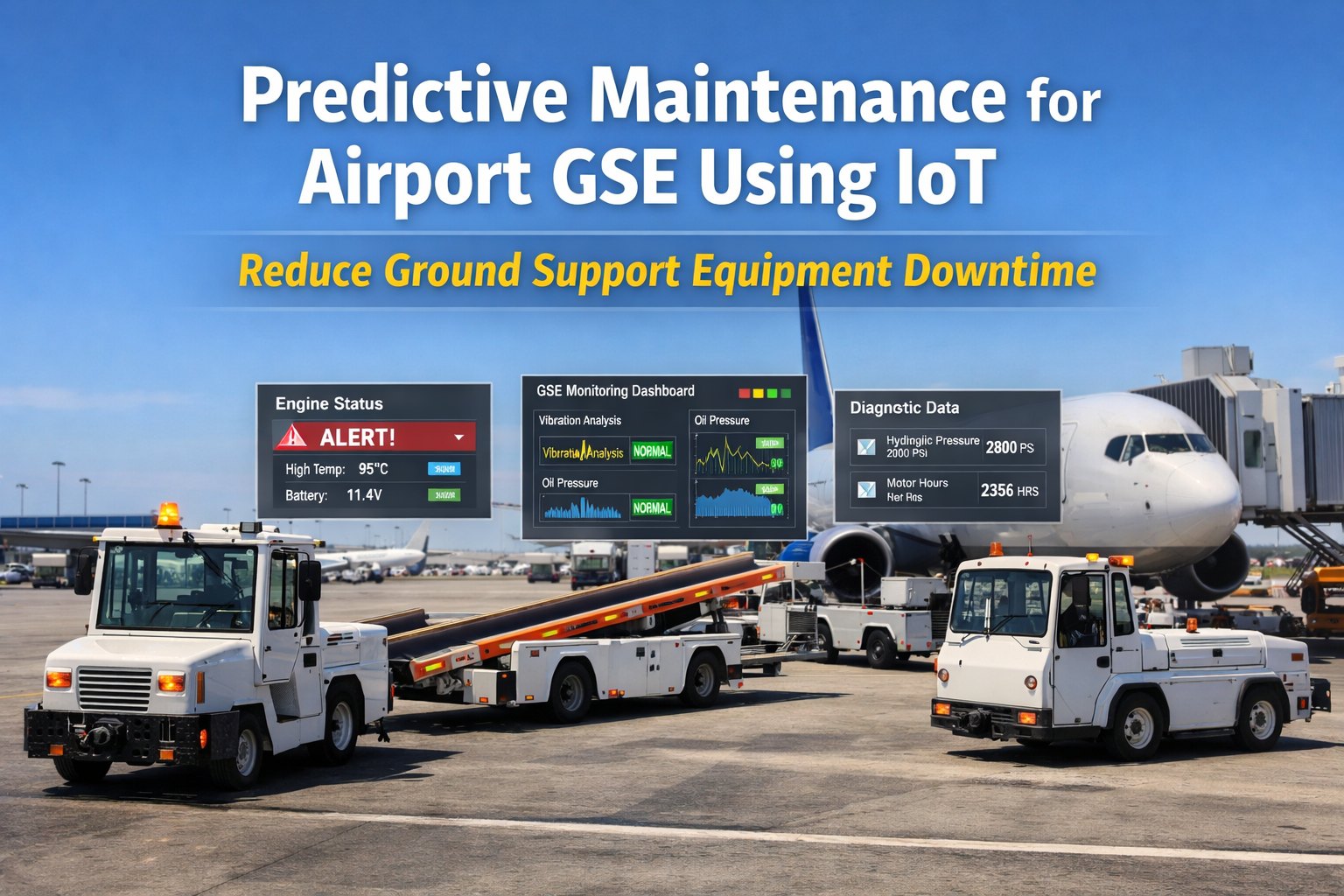
Artificial intelligence transforms GSE fleet management from a reactive scheduling function into a proactive operational capability grounded in continuous data. The foundational mechanism is real-time condition monitoring: telematics units and IoT sensors embedded in or connected to GSE assets stream continuous performance data — engine load cycles, battery state-of-health, hydraulic pressure readings, transmission temperature patterns, GPS location, idle time ratios, and fault code histories — into a centralized analytics platform. Machine learning models trained on historical failure and maintenance event data analyze these streams continuously, identifying the degradation signatures that precede equipment failure before any visible symptom emerges at the asset level. Want to see this applied to your GSE fleet? Book a demo and explore how AI condition monitoring works across your specific equipment categories.
The practical result is a maintenance intervention window — typically spanning several days to several weeks before a projected failure event — during which fleet managers can schedule service at a time that minimizes operational disruption, pre-position spare parts, and arrange equipment substitution to protect aircraft turnaround coverage. This shift from failure response to failure prevention is the core value mechanism behind AI GSE programs, and it is the primary driver through which leading ground handlers are achieving unplanned downtime reductions of 35–45% across critical apron equipment categories within 18 months of full program deployment.
Real-Time Telematics and IoT Monitoring
AI fleet management platforms connect to GSE assets through onboard telematics units, CAN bus integrations, and retrofit IoT sensor packages to establish continuous condition visibility across the entire fleet. Data streams are normalized, timestamped, and fed into anomaly detection models that build individual performance baselines for each asset — accounting for the fact that two units of the same model may exhibit meaningfully different normal operating signatures based on age, duty cycle, and environmental exposure.
Predictive Failure Analytics and Risk Scoring
Machine learning models — combining time-series anomaly detection with supervised classification trained on labeled failure event histories — generate equipment-specific risk scores that update continuously as new telematics data arrives. These scores surface to fleet supervisors through prioritized work queues that rank intervention urgency by failure probability, operational criticality of the asset, and time-to-projected-failure estimates relevant to scheduled flight operations.
GPS Fleet Tracking and Utilization Optimization
Real-time GPS visibility across the entire GSE fleet enables fleet managers to identify underutilized assets, detect unauthorized zone crossings, optimize equipment deployment during peak turnaround periods, and reduce idle engine time across diesel and hybrid units. Utilization analytics also provide the data foundation for right-sizing fleet inventories — identifying redundant asset classes and informing electrification transition investment decisions.
Electric GSE Fleet Management and Charging Optimization
As electric ground support equipment penetration accelerates, AI platforms provide the battery health monitoring, charge cycle management, and energy consumption analytics that diesel-era CMMS systems cannot support. State-of-health tracking across electric GSE batteries enables proactive battery replacement before capacity degradation affects operational availability, while charging schedule optimization reduces peak energy demand costs and maximizes equipment readiness for departure bank periods.
GSE Equipment Categories Where AI Delivers Highest Impact
While AI-driven fleet management delivers measurable operational improvements across all ground support equipment categories, certain asset classes present particularly strong value opportunities due to the combination of high operational criticality, significant failure cost, and the richness of telematics data available to support robust predictive modeling. Start tracking your critical GSE assets with a platform purpose-built for complex airport operations environments.
Aircraft Pushback Tugs
Pushback tug failures directly delay aircraft departures, making them among the highest-criticality assets in any GSE fleet. AI monitoring of transmission health, hydraulic system pressure, steering actuator wear, and tow bar coupling sensor data enables proactive maintenance that eliminates the on-gate failure scenarios most costly to airline operations.
Ground Power Units (GPU)
GPU failures at the gate force aircraft to run APUs for extended periods, increasing fuel burn and noise emissions while elevating maintenance load on aircraft systems. AI monitoring of generator output stability, cooling system performance, voltage regulation drift, and load cycle patterns enables GPU maintenance scheduling that protects gate power reliability across the full departure wave.
Baggage Tractors and Belt Loaders
High-cycle, high-utilization assets like baggage tractors and belt loaders accumulate wear at rates that calendar-based maintenance cannot accurately anticipate. AI platforms tracking engine hours against load intensity, hydraulic fluid condition indicators, and drivetrain fault code frequencies enable risk-stratified maintenance that prioritizes highest-wear units while extending service intervals for assets showing robust performance data.
Aircraft Fueling Equipment
Fueling hydrant trucks and refueling systems carry both safety and operational criticality requirements that make unplanned failures unacceptable. AI condition monitoring of pump pressure consistency, meter calibration drift, hose assembly integrity sensors, and vehicle safety system status enables fueling equipment maintenance programs that maintain both operational availability and regulatory compliance simultaneously.
Passenger Boarding Bridges
Jet bridge mechanical failures directly affect terminal passenger flow and boarding sequence integrity. AI monitoring of drive system motor performance, leveler hydraulic pressure, alignment sensor accuracy, and weather seal integrity enables predictive maintenance that eliminates mid-operation boarding bridge failures during critical departure and arrival windows.
Aircraft Air Start Units and Preconditioned Air
Air start units and preconditioned air systems that fail at the gate generate APU dependency and fuel burn consequences that compound across a full operating day. AI performance monitoring of compressor health, air delivery pressure consistency, filtration system condition, and coupling seal wear enables proactive service scheduling aligned with scheduled maintenance windows rather than on-gate failure events.
GSE Electrification: Data-Driven Transition Planning
The transition from conventional fossil-fuel GSE fleets to electric ground support equipment represents the most significant capital planning challenge facing airport operators and ground handlers in the current decade. Regulatory pressure, airline sustainability commitments, and airport decarbonization targets are converging to accelerate electrification timelines — but fleet electrification decisions made without comprehensive operational data routinely produce charging infrastructure gaps, operational availability shortfalls, and total cost of ownership miscalculations that undermine both financial performance and sustainability goals.
Asset Utilization Analysis for Electrification Sequencing
AI fleet management platforms provide the utilization data necessary to sequence GSE electrification decisions by operational risk and infrastructure readiness. Assets with predictable duty cycles, moderate daily range requirements, and access to gate-adjacent charging infrastructure are optimal early conversion candidates — while high-cycle assets operating across large airfield distances require charging infrastructure investment and operational modeling before transition commitment.
Charging Infrastructure Right-Sizing
Deploying electric GSE without adequate charging infrastructure produces the same operational availability gaps that the electrification transition is intended to eliminate. AI platforms modeling fleet utilization patterns, departure bank timing, and asset recharge duration requirements enable infrastructure planners to right-size charging station deployment — positioning sufficient capacity at the right terminal zones to support operational readiness across peak periods.
Battery Health Monitoring and Lifecycle Management
Electric GSE battery pack degradation follows complex patterns influenced by charge cycle depth, temperature exposure, discharge rate intensity, and storage conditions. AI battery health monitoring platforms track state-of-health trajectories across individual battery packs, enabling fleet managers to identify units approaching end-of-useful-life before capacity degradation affects operational availability — and to build replacement reserve schedules into capital planning cycles with data-supported confidence.
Total Cost of Ownership Modeling
Accurate electric GSE total cost of ownership requires integrating energy consumption data, battery replacement cost projections, reduced fuel cost actuals, maintenance cost differentials between electric and conventional drivetrains, and infrastructure depreciation allocations. AI analytics platforms aggregating operational data across mixed-fleet GSE inventories provide the evidence base for TCO models that support defensible electrification investment decisions and accurate ROI forecasting for capital committee review.
Technology Architecture: Integrating CMMS, Telematics, and AI
The technical foundation of a modern AI-driven GSE fleet management program sits at the intersection of three platform layers: the Computerized Maintenance Management System managing work orders and compliance documentation, the telematics and IoT data layer providing continuous asset condition visibility, and the predictive analytics engine translating sensor data into actionable maintenance intelligence. Understanding how these layers integrate is critical for fleet operations leaders evaluating platform investment decisions.
| Platform Layer | Primary Function | AI Capability | Integration Point |
|---|---|---|---|
| CMMS Core | Work order management, PM scheduling, technician dispatch | AI-prioritized work queues, automated work order generation | ERP, asset registry, compliance systems |
| Telematics Platform | GPS tracking, CAN bus data ingestion, real-time fleet visibility | Anomaly detection, utilization scoring, idle time analysis | CMMS, analytics engine, operations dashboard |
| Predictive Analytics Engine | Failure risk scoring, remaining useful life estimation | ML-based failure classification, ensemble modeling | CMMS, telematics platform, reporting layer |
| Electric Fleet Management | Battery health tracking, charge scheduling, energy analytics | State-of-health prediction, degradation trajectory modeling | Charging infrastructure, CMMS, energy management |
| Compliance Reporting Layer | Regulatory documentation, audit trail generation, certification tracking | Automated compliance gap detection, risk flagging | Airport authority systems, airline SLA platforms |
Implementation Roadmap: From Reactive GSE Operations to Predictive Fleet Management
The transition from reactive GSE maintenance operations to AI-driven predictive fleet management requires a structured implementation progression that addresses data readiness, technology deployment, and operational change management in parallel. Successful programs follow a phased approach that delivers early operational value while building the data foundation that enables full predictive capability over time.
Fleet Inventory Audit and Data Baseline
Conduct a comprehensive audit of all GSE assets — documenting equipment age, current maintenance status, service history completeness, existing telematics connectivity, and criticality classification by operational function. Identify the highest-value targets for initial AI monitoring deployment based on failure frequency, aircraft delay exposure, and data availability. Digitize paper-based maintenance records for priority asset classes to establish the historical data foundation that predictive models require to perform reliably.
Telematics Deployment and CMMS Integration
Deploy telematics units and IoT sensor packages across priority asset classes, establishing real-time GPS visibility and condition data streams for highest-criticality GSE equipment. Upgrade or integrate CMMS platforms with native AI capability and open API architecture that supports telematics data ingestion. Validate data pipelines from sensor to analytics platform, ensuring data quality standards are met before predictive model training begins.
Predictive Model Deployment and Calibration
Deploy AI failure prediction models for instrumented asset classes, beginning with equipment categories where sufficient historical maintenance data supports robust model training. Operate predictive alerts in parallel with existing maintenance workflows initially — allowing fleet technicians and supervisors to validate prediction accuracy against actual failure events before fully transitioning work order prioritization to AI-generated recommendations.
Operational Integration and Team Enablement
Integrate AI-generated work order prioritization into daily fleet operations — replacing or augmenting static PM schedules with dynamic, risk-stratified maintenance queues calibrated to actual equipment condition. Train fleet technicians and supervisors on interpreting AI risk scores, acting on predictive alerts, and providing feedback loops that improve model accuracy over time. Establish escalation protocols for high-confidence failure predictions on critical apron equipment categories.
Portfolio Expansion, Electrification Integration, and Continuous Optimization
Expand AI monitoring coverage progressively across the full GSE fleet portfolio, leveraging program performance data from initial deployments to secure capital for broader investment. Integrate electric GSE battery health monitoring and charging optimization capabilities as electrification fleet share grows. Establish continuous improvement cycles incorporating new failure event data, utilization pattern shifts, and fleet composition changes into model retraining pipelines. Develop executive-level reporting on downtime reduction outcomes, airline delay attribution improvements, and electrification TCO performance to guide ongoing program investment decisions.
Ready to Build a GSE Fleet Management Program That Delivers Measurable Results?
OxMaint combines AI-driven failure prediction, real-time telematics tracking, electric fleet management, and automated work order management in one platform designed for airport ground operations teams.
Measuring ROI from AI GSE Fleet Management Programs
Demonstrating return on investment from GSE fleet management technology requires a measurement framework that captures the full spectrum of value delivery — not just maintenance labor savings, but the operational and financial impact of downtime reduction, aircraft delay avoidance, emergency repair cost elimination, parts inventory optimization, and asset lifespan extension through condition-based service. The following KPIs represent the performance indicators that leading ground handlers and airport operators use to quantify AI fleet program value.
Unplanned GSE Downtime Rate
The primary metric for any fleet reliability program. Measured as the percentage of total available equipment operating hours lost to unplanned failures, tracked by asset class and terminal zone. Baseline measurement before AI deployment establishes the comparison point against which subsequent reductions are calculated. Top-performing programs report 35–45% reductions in unplanned GSE downtime within 18 months of full program maturity.
Aircraft Delay Attribution to GSE
The percentage of recorded aircraft departure delays attributable to GSE unavailability or equipment failure is the most direct measure of fleet management impact on airline operations performance. AI maintenance programs that consistently prevent on-apron failures demonstrate measurable improvements in GSE delay attribution rates — typically producing 20–35% reductions in airline-reported GSE delay incidents within two years of program deployment.
Emergency vs. Planned Maintenance Ratio
The ratio of emergency repair work orders to planned preventive maintenance work orders is a direct indicator of fleet program maturity. Reactive maintenance environments typically show emergency-to-planned ratios of 40–60%. Best-in-class AI-driven GSE programs drive this ratio below 15% — reflecting the fundamental shift from failure response to failure prevention that condition-based maintenance enables.
Electric GSE Operational Availability
For fleets undergoing electrification transitions, electric GSE availability — defined as the percentage of electric assets ready for dispatch at the start of each operating shift — is a critical KPI that measures both battery health management effectiveness and charging infrastructure adequacy. Leading electric fleet programs maintain availability rates above 92% through proactive battery health monitoring and AI-optimized charging schedule management.
Frequently Asked Questions
What is GSE fleet management and why does it matter for airport operations?
GSE fleet management encompasses all activities associated with maintaining, tracking, deploying, and optimizing the ground support equipment assets that enable aircraft servicing operations — including pushback tugs, baggage tractors, ground power units, fueling vehicles, belt loaders, and passenger boarding bridges. Effective GSE fleet management directly determines aircraft turnaround reliability, airline on-time performance, apron safety standards, and the operational cost base of ground handling services. As GSE fleets grow larger, more complex, and increasingly electrified, technology-enabled fleet management has become essential infrastructure rather than an operational enhancement.
How does predictive maintenance differ from preventive maintenance for GSE?
Preventive maintenance schedules service at fixed calendar or usage intervals regardless of actual equipment condition — servicing assets that may not yet need attention while occasionally missing failures that develop between scheduled intervals. Predictive maintenance uses continuous telematics data and AI analytics to identify the specific moment when an individual asset's condition indicates elevated failure risk, enabling maintenance scheduling based on actual need rather than calendar assumptions. Predictive programs consistently outperform preventive schedules in both unplanned downtime reduction and total maintenance cost efficiency across GSE fleet environments.
What role does telematics play in AI-driven GSE fleet management?
Telematics systems are the data foundation of AI-driven GSE fleet management — providing the real-time GPS location, CAN bus performance data, engine diagnostics, utilization metrics, and fault code histories that AI predictive models require to generate reliable failure risk assessments. Without continuous telematics data streams, AI analytics platforms lack the sensor signal quality necessary to distinguish normal operating variation from early-stage equipment degradation. Modern telematics platforms support both legacy diesel GSE and electric equipment monitoring, making them essential infrastructure for mixed-technology GSE fleets in electrification transition.
How should airports approach the transition to electric GSE fleets?
Successful GSE electrification transitions require operational data, infrastructure planning, and financial modeling that paper-based or legacy system fleet management cannot support. AI fleet management platforms provide the utilization analytics, battery health monitoring, and charging infrastructure modeling capabilities necessary to sequence electrification decisions by operational risk, right-size charging station deployment, and accurately project electric GSE total cost of ownership. Electrification transitions planned without this data foundation routinely produce charging capacity gaps and operational availability shortfalls that erode the financial case for electric fleet investment.
How long does it take to see ROI from an AI GSE fleet management program?
Initial predictive alerts for well-instrumented asset classes typically begin appearing within 60–90 days of telematics deployment and AI model calibration. Measurable reductions in unplanned GSE downtime events become visible within the first six months of active program operation. Full ROI realization — including aircraft delay attribution improvement, emergency repair cost reduction, parts inventory optimization, and asset lifespan extension — typically materializes over an 18–24 month program horizon as model accuracy matures and fleet technician workflows fully adapt to predictive work order prioritization.