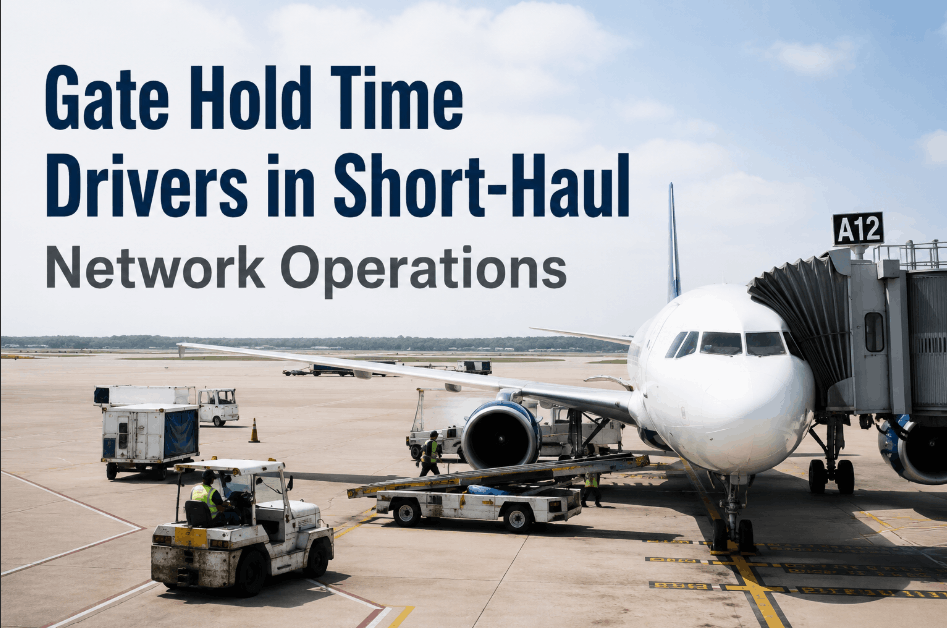
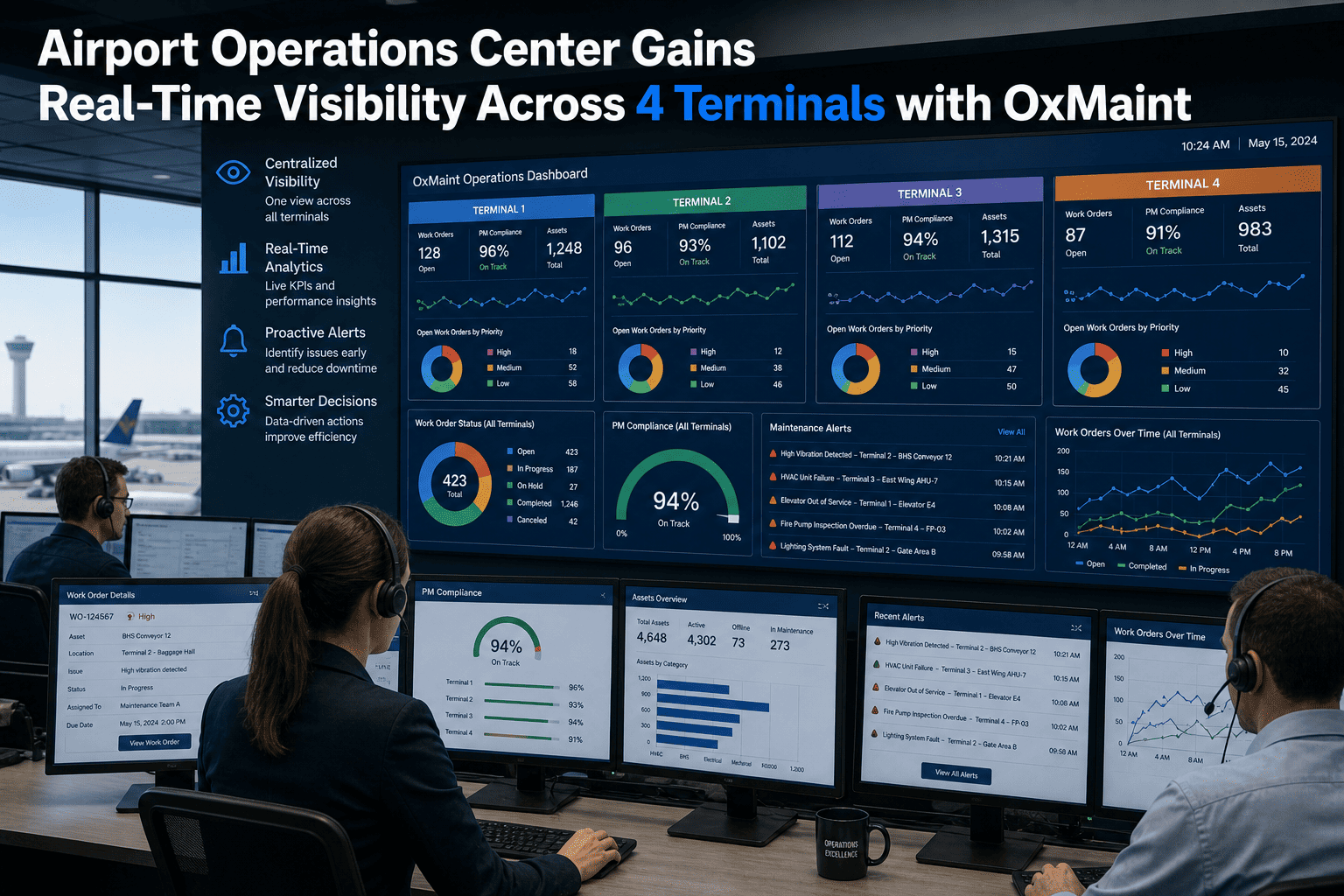
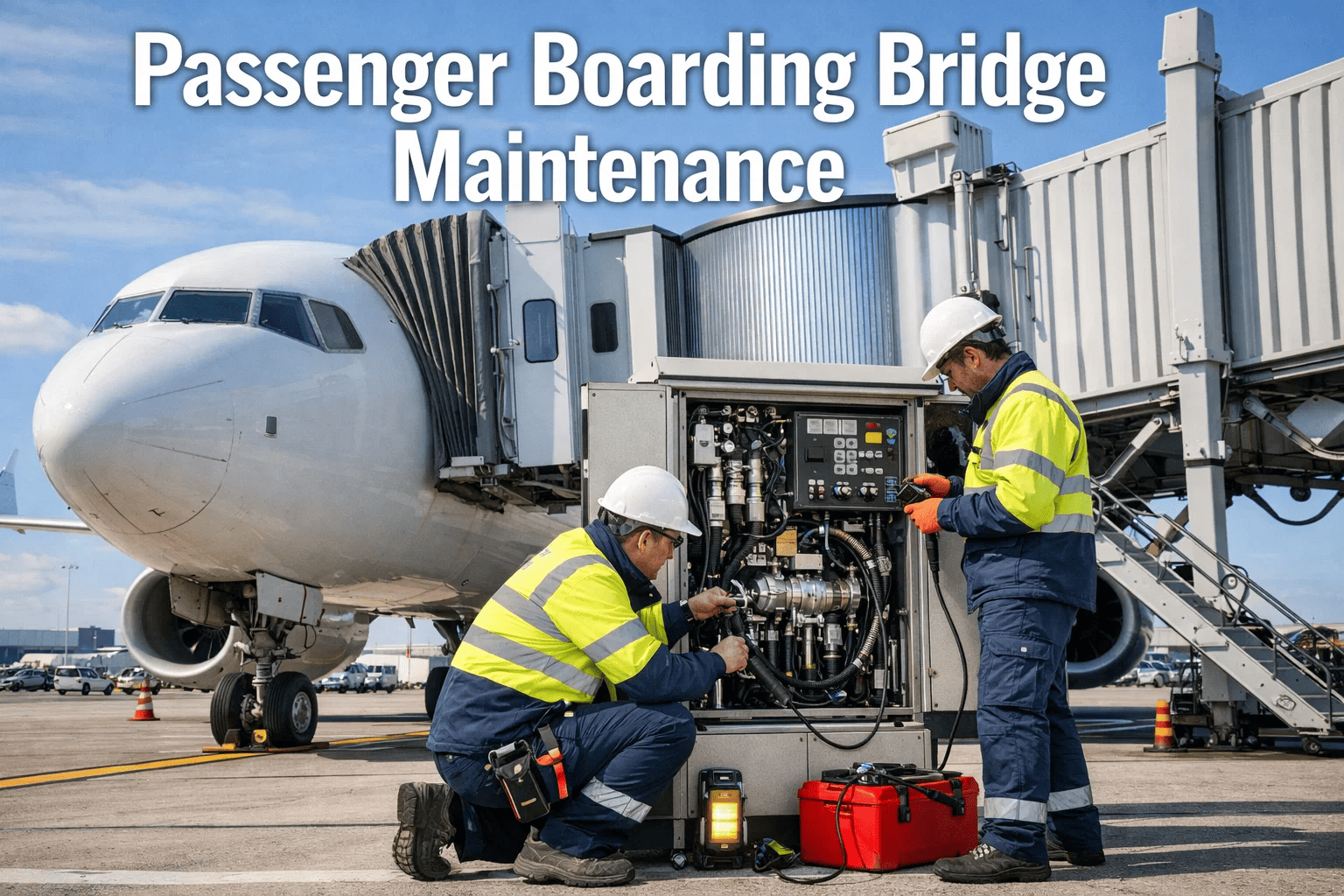
Gate readiness at busy terminals rarely fails because jet bridges break down without warning — it fails because pre-arrival checks are inconsistent, dock release is slow, and no one has a live view of which bridges are cleared and which are still holding a previous turn. When boarding delays stack across a peak wave, the compounding effect on passenger flow, gate agents, and downstream connections is disproportionate to the time lost. A major hub terminal operating 22 contact stands across two concourses identified this pattern clearly: bridge availability was running below service targets during morning and evening peaks, dock release averaged 9 minutes longer than the airline ground time standard, and maintenance checks before first use were completed inconsistently across shifts. If your ground crew is managing jet bridge availability without digital inspection tracking or dock-release workflows, Sign Up Free to see how Oxmaint structures gate readiness for high-frequency boarding operations — or Book a Demo with a terminal operations specialist.
Bridge Checks · Dock Release · Gate Readiness Tracking
Stop Losing Boarding Time to Jet Bridge Delays Your Crew Can't See Coming
Digital pre-arrival checklists, dock-release workflows, and live gate-readiness status — Oxmaint helps ground crews keep jet bridges available and boarding on schedule across every peak wave.
Facility Profile
The Operation: A Terminal Where Inconsistent Bridge Checks Were Costing Boarding Time at Every Peak
Facility Overview
IndustryCommercial aviation — hub terminal, dual-concourse layout
Scope22 contact stands, 22 jet bridges, 3 peak boarding waves daily, 6 ground crew supervisors across 3 shifts
Team34 ground crew agents, 4 bridge maintenance technicians, 2 terminal operations coordinators
Prior SystemPaper-based pre-arrival bridge check sheets with manual sign-off and no centralized dock-release tracking
Oxmaint FeaturesInspections & Checklists · Work Order Management · Asset Management · AI & Automation · Analytics & Reporting Dashboards · Real-Time Alerts
Baseline Bridge Availability Issues
9.3 min
Average dock release delay above airline ground time standard per turn
41%
Of pre-arrival bridge checks completed late or partially during peak waves
No visibility
Gate-readiness status was not centrally tracked — coordinators relied on radio confirmation from individual agents
Root Cause Analysis
Why Jet Bridge Delays Were Recurring Across Peak Boarding Waves
A review of gate delay logs, airline ground time records, and maintenance work orders identified four structural gaps driving bridge unavailability. The equipment was serviceable — the check and release process was not standardized. Sign Up Free to digitize your bridge check workflow — or Book a Demo to see dock-release tracking on a live operation.
37%
Pre-Arrival Checks Completed Inconsistently Across Shifts and Concourses
Paper-based check sheets allowed partial completions to pass without escalation, meaning bridges sometimes arrived at gate-ready status with uncleared minor faults that delayed first docking.
28%
Dock Release Waited on Radio Confirmation Rather Than a Verified Status Feed
Coordinators couldn't release a gate for inbound boarding until they received verbal confirmation from the stand — adding an average of 9 minutes of unnecessary waiting time per turn during busy peaks.
22%
Minor Faults Found During Checks Generated No Automatic Maintenance Ticket
When agents found a snag during a bridge check, raising a maintenance work order required a separate manual step — one that was frequently deferred until post-shift, leaving faults untracked.
13%
No Data Connecting Bridge Availability to Actual Boarding Delay Minutes
Terminal management couldn't quantify how much of each boarding delay was attributable to bridge check timing versus airline-side close-out issues, making improvement targeting difficult.
The Solution
How Oxmaint Standardized Bridge Checks and Automated Dock Release Across All 22 Stands
The terminal deployed Oxmaint to replace paper-based bridge checks with mobile digital inspections, connect check completion to gate-readiness status in real time, and auto-generate maintenance work orders for any fault found during a check. Sign Up Free to see jet bridge inspection workflows on your own stands — or Book a Demo to walk through dock-release automation live.
01
Mobile Digital Checklists Standardized Pre-Arrival Bridge Checks Across Every Stand and Shift
Oxmaint's inspection and checklist tools replaced paper sheets with mobile-first digital forms, ensuring every check step was completed in sequence before a bridge could be marked gate-ready — regardless of shift or concourse.
02
Check Completion Triggered Live Gate-Readiness Status Visible to All Coordinators
When a bridge check was completed and marked clear, Oxmaint automatically updated the stand's gate-readiness status on the coordinator dashboard — removing the radio confirmation step and cutting dock release waiting time.
03
Faults Found During Checks Auto-Generated Prioritized Maintenance Work Orders
Any snag identified during a bridge inspection triggered an automatic Oxmaint work order, routed by fault type to the appropriate maintenance technician — eliminating the deferred manual reporting step that left faults untracked between shifts.
04
Analytics Dashboards Linked Bridge Check Timing to Boarding Delay Attribution
Terminal management gained per-stand reporting that separated boarding delays caused by bridge check timing from those caused by airline-side close-out issues — enabling targeted improvement rather than blanket process reviews.
Results at 60 Days
Bridge Availability, Dock Release Time, and Boarding Performance Two Months After Deployment
78%
Reduction in pre-arrival check incompletions during peak boarding waves
2.1 min
Average dock release delay — down from 9.3 minutes at baseline
100%
Of stands reporting live gate-readiness status to coordinator dashboard
3×
Faster fault-to-work-order cycle from bridge check findings
29%
Reduction in total boarding delay minutes attributable to bridge readiness
3.1×
ROI on Oxmaint within 60 days from recovered boarding time and reduced airline penalties
| Metric |
Before Oxmaint |
60 Days After |
Change |
| Dock release delay per turn |
9.3 minutes average |
2.1 minutes average |
-77% |
| Peak check completion rate |
59% fully completed |
97% fully completed |
+64% |
| Gate-readiness visibility |
Radio confirmation only |
Live dashboard per stand |
Real-time |
| Fault-to-work-order cycle |
Manual, deferred |
Automatic on check completion |
Automated |
| Boarding delay from bridge readiness |
Untracked baseline |
29% reduction measured |
-29% |
| Platform ROI |
Not measured |
3.1× within 60 days |
3.1× |
Key Business Impact
What Standardized Bridge Checks and Live Gate Readiness Mean for Terminal Boarding Performance
Jet bridge delays almost never come from a bridge that's broken — they come from a check that wasn't completed, a fault that wasn't reported, or a coordinator waiting on a radio call that should have been a live status update. When you digitize the check, the readiness status flows automatically and the maintenance ticket gets raised the moment it's needed. The boarding wave runs on what the system knows, not on who has a radio free. Oxmaint gives ground crews that visibility layer without adding complexity to what's already a compressed turnaround window.
Priya Narayanan, Terminal Ground Operations & Gate Readiness Specialist
13 years airside terminal operations · Former ground services supervisor, international hub · Specialist in jet bridge maintenance programs, dock release optimization, and peak-wave boarding performance
Standardized Checks · Live Gate Status · Auto Work Orders
Give Your Ground Crew Gate Readiness Data Worth Acting On
Digital bridge checklists, automated dock-release status, fault-triggered work orders, and per-stand boarding analytics — Oxmaint helps terminal teams keep jet bridges available across every peak boarding wave.
FAQs
Frequently Asked Questions
How does Oxmaint help ground crews improve jet bridge availability?
By replacing paper-based checks with mobile digital checklists that push live gate-readiness status to coordinators the moment a bridge is cleared, removing the radio-confirmation delay from dock release.
Can Oxmaint automatically generate maintenance tickets from jet bridge inspection findings?
Yes. Any fault recorded during a bridge check triggers an automatic work order routed to the right technician by fault type — no separate manual step required.
Does Oxmaint support multi-stand gate readiness tracking for large terminal operations?
Yes. The coordinator dashboard shows live readiness status across all stands simultaneously, scaling to dual-concourse and multi-terminal layouts.
How does Oxmaint help attribute boarding delays to bridge readiness versus airline factors?
Per-stand analytics in Oxmaint break down each boarding delay by cause, separating bridge check timing from airline close-out overruns so improvement efforts target the right side of the problem.
How quickly can a terminal ground crew go live with Oxmaint's bridge inspection tools?
Most teams complete digital checklist setup and live gate-readiness integration within two weeks, with automatic work order routing active from day one of deployment.
Every Bridge, Every Stand, Every Wave
Bring Jet Bridge Readiness Tracking and Dock Release Automation to Your Terminal
Oxmaint brings standardized digital bridge checks, live gate-readiness dashboards, fault-triggered work orders, and boarding delay analytics to ground crews — without disrupting your existing gate operations.