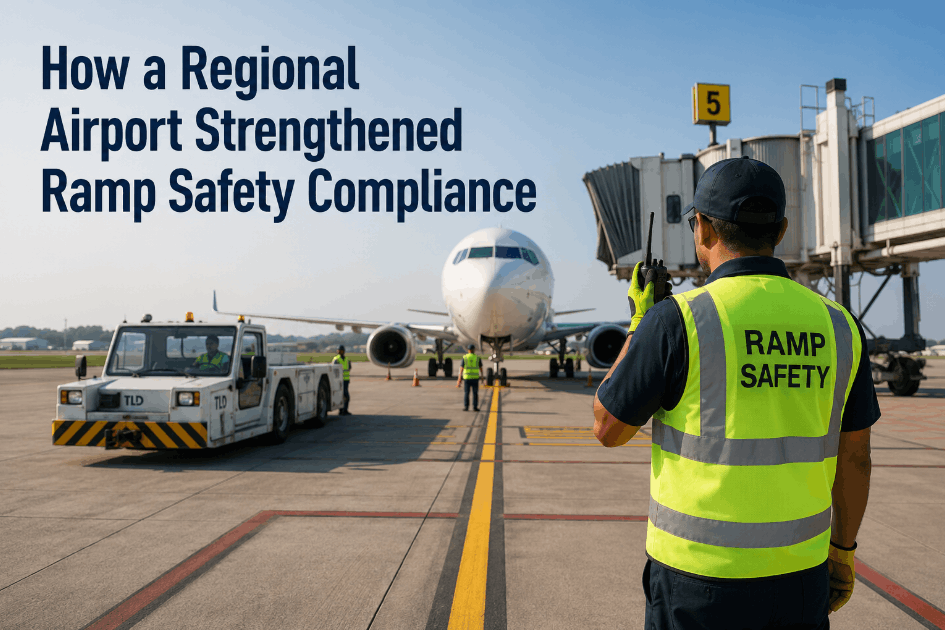
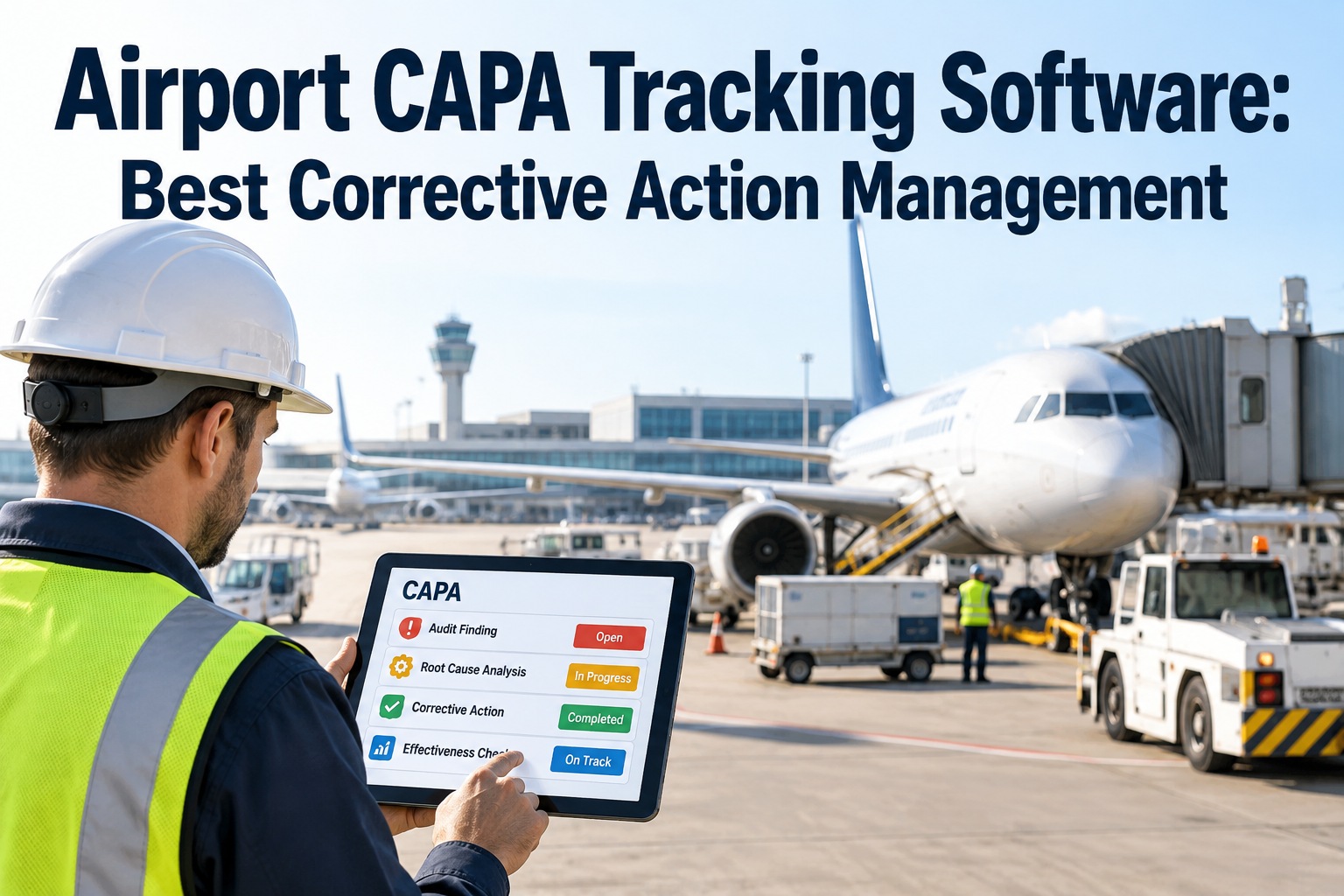
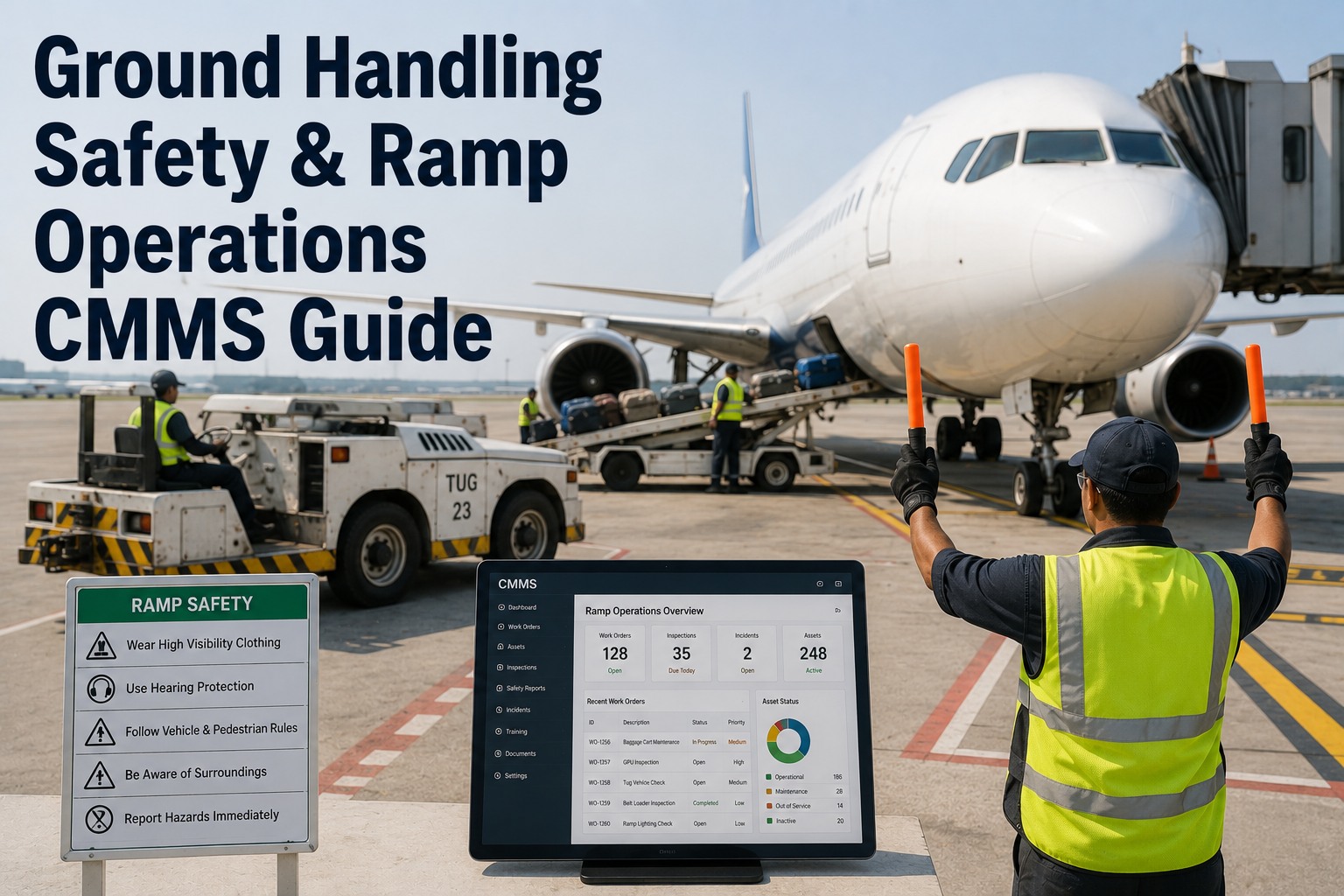
Ramp safety compliance at regional airports rarely fails because staff lack awareness of the rules — it fails because observation routines are inconsistent, corrective actions take too long to close, and there is no systematic way to track whether a hazard identified on Monday has actually been resolved by Friday. When safety findings sit in paper logs or shared drives without structured follow-through, the gap between identifying a ramp risk and verifying its closure becomes a liability that regulators, airlines, and insurance carriers notice before operations management does. A regional airport handling 94 daily aircraft movements across two aprons identified this pattern in its airside safety program: safety observation completion rates varied significantly by shift, corrective action closure averaged 11 days from identification, and there was no consolidated reporting connecting observation volume to actual incident reduction. If your ramp safety program is running without digital observation tracking or structured corrective-action workflows, Sign Up Free to see how Oxmaint structures airside safety compliance for regional airport operations — or Book a Demo with a ramp safety compliance specialist.
Safety Observations · Corrective Closures · Compliance Tracking
Stop Letting Ramp Safety Findings Sit Unresolved Between Shifts
Digital safety observation workflows, corrective action tracking, and airside compliance dashboards — Oxmaint helps regional airport teams close safety gaps faster without slowing daily ramp movements.
Facility Profile
The Operation: A Regional Ramp Safety Program Where Corrective Actions Outlived the Hazards They Were Meant to Fix
Facility Overview
IndustryCommercial aviation — regional airport, dual-apron layout
Scope2 aprons, 94 daily aircraft movements, 3 safety officers across 2 shifts, 6 ground crew supervisors
Team38 ramp agents, 3 airside safety officers, 1 compliance manager, 6 shift supervisors
Prior SystemPaper-based safety observation sheets with email-based corrective action follow-up and no centralized compliance tracking
Oxmaint FeaturesInspections & Checklists · Work Order Management · AI & Automation · Analytics & Reporting Dashboards · Asset Management · Real-Time Alerts · Compliance Reporting
Baseline Safety Compliance Issues
11 days
Average corrective action closure time from safety observation to verified resolution
44%
Variance in safety observation completion rate between best and worst performing shifts
No link
No reporting connected observation volume or corrective closure rate to actual ramp incident frequency
Root Cause Analysis
Why Ramp Safety Compliance Was Inconsistent Across Shifts and Slow to Close Findings
A review of safety observation logs, corrective action records, and incident reports identified four structural gaps in how ramp safety was observed, escalated, and verified. The safety culture was present — the process infrastructure was not. Sign Up Free to digitize your ramp safety observation workflow — or Book a Demo to see corrective action tracking on a live airside operation.
36%
Observation Routines Not Standardized Across Shifts or Apron Zones
Paper-based observation sheets allowed individual safety officers to cover different zones at different frequencies, creating blind spots that varied by shift rather than by actual risk level.
31%
Corrective Actions Tracked by Email With No Escalation or Closure Verification
Safety findings were emailed to supervisors for action, but there was no automated escalation when a corrective action was overdue and no mechanism to confirm a hazard had actually been resolved.
22%
No Real-Time Visibility Into Open Safety Findings Across Both Aprons
The compliance manager had no single view of which findings were open, how old they were, or which zones were accumulating unresolved hazards — making proactive risk management impossible.
11%
No Reporting Connecting Safety Compliance Metrics to Incident Rate Trends
Leadership could not demonstrate to regulators or airline partners whether the safety program was actually reducing incident frequency, because observation data and incident records lived in separate systems.
The Solution
How Oxmaint Standardized Ramp Safety Observations and Automated Corrective Action Follow-Through
The airport deployed Oxmaint to replace paper-based safety sheets with mobile digital inspection workflows, connect safety findings to structured corrective action work orders, and give the compliance manager a live dashboard of open findings, closure rates, and incident trends across both aprons. Sign Up Free to see ramp safety compliance workflows on your own airside — or Book a Demo to walk through corrective action automation live.
01
Mobile Digital Safety Checklists Standardized Observation Routines Across All Shifts and Zones
Oxmaint's inspection and checklist tools replaced paper observation sheets with zone-specific mobile forms, ensuring every safety officer covered the same checkpoints in the same sequence regardless of shift — eliminating the blind-spot variance between crews.
02
Safety Findings Auto-Generated Corrective Action Work Orders With Escalation Timers
When a safety observation was logged in Oxmaint, it automatically created a corrective action work order assigned to the responsible supervisor, with escalation alerts triggered if the action remained open past its resolution deadline — replacing the email follow-up chain with a tracked, verified process.
03
Live Compliance Dashboard Gave the Safety Manager Real-Time View of Open Findings Across Both Aprons
Oxmaint's analytics dashboard showed the compliance manager every open safety finding, its age, its assigned corrective action, and its current status — enabling proactive follow-through rather than reactive discovery when findings aged past acceptable limits.
04
Consolidated Safety Reporting Linked Observation Volume and Closure Rates to Incident Frequency
Monthly compliance reports in Oxmaint brought observation completion rates, corrective closure times, and actual ramp incident frequency into a single view — giving leadership the data to demonstrate safety program effectiveness to regulators and airline partners.
Results at 60 Days
Corrective Closure Time, Observation Consistency, and Incident Trends Two Months After Deployment
73%
Reduction in average corrective action closure time — from 11 days to under 3 days
2.8 days
Average corrective action closure — down from 11 days at baseline
44% → 6%
Variance in observation completion rate between best and worst performing shifts
100%
Of open safety findings now tracked in real time with escalation timers active
38%
Reduction in ramp incidents over the 60-day period versus prior-period baseline
2.7×
ROI on Oxmaint within 60 days from reduced incident costs and improved airline safety ratings
| Metric |
Before Oxmaint |
60 Days After |
Change |
| Corrective action closure time |
11 days average |
2.8 days average |
-73% |
| Shift observation completion variance |
44% between shifts |
6% between shifts |
-86% |
| Open finding visibility |
Email tracking only |
Live dashboard with escalation timers |
Real-time |
| Corrective action follow-up method |
Manual email chain |
Automated work order with escalation |
Automated |
| Ramp incident frequency |
Baseline (tracked separately) |
38% reduction measured |
-38% |
| Platform ROI |
Not measured |
2.7× within 60 days |
2.7× |
Key Business Impact
What Structured Ramp Safety Compliance Means for Regional Airport Airside Risk
The gap in most regional airport safety programs isn't awareness — it's follow-through. A finding logged on paper and emailed to a supervisor has a half-life of about 48 hours before it disappears into the backlog. When you replace that chain with a digital observation that auto-generates a work order, sets an escalation timer, and stays open on a live dashboard until it's verified closed, the culture doesn't need to change — the process just stops letting things fall through. Oxmaint gives small airside safety teams the same structured compliance infrastructure that large hub operators have, without the headcount to run it manually.
Amara Diallo, Regional Airport Airside Safety & Compliance Specialist
15 years airport safety operations · Former airside compliance manager, dual-apron regional airport · Specialist in ramp safety observation programs, corrective action workflow design, and regulatory compliance reporting
Standardized Observations · Auto Work Orders · Live Compliance View
Give Your Ramp Safety Team a Compliance Process That Closes What It Opens
Digital safety checklists, automated corrective action work orders, escalation timers, and consolidated compliance reporting — Oxmaint helps regional airport teams improve ramp safety without slowing daily operations.
FAQs
Frequently Asked Questions
How does Oxmaint help regional airports standardize ramp safety observations across shifts?
Zone-specific mobile checklists ensure every safety officer covers the same checkpoints in the same sequence regardless of shift, eliminating the observation gap variance that paper sheets allow.
Can Oxmaint automatically escalate overdue corrective actions from safety findings?
Yes. Every safety finding generates a corrective action work order with an escalation timer that alerts supervisors and the compliance manager automatically when resolution deadlines are missed.
Does Oxmaint support real-time visibility into open ramp safety findings across multiple aprons?
Yes. The compliance dashboard shows all open findings, their age, assigned corrective actions, and current status across all apron zones in a single live view.
How does Oxmaint help airports demonstrate safety compliance to regulators and airline partners?
Consolidated monthly reports link observation completion rates, corrective closure times, and incident frequency into a single compliance record that supports regulatory audits and airline partner safety reviews.
How quickly can a regional airport safety team go live with Oxmaint's observation and compliance tools?
Most teams complete digital checklist setup and corrective action workflow configuration within two weeks, with the live compliance dashboard active from the first week of deployment.
Every Finding, Every Apron, Fully Tracked
Bring Structured Ramp Safety Compliance to Your Regional Airport Operation
Oxmaint brings standardized digital safety observations, automated corrective action work orders, live finding dashboards, and consolidated compliance reporting to regional airport teams — without adding headcount to manage the process.