Airport control towers and airfield operations facilities operate under one non-negotiable constraint: 24/7 availability with zero tolerance for service interruption. The HVAC system that cools the ATC equipment room, the UPS that keeps radar and communication systems live through a grid outage, the backup generator that sustains operations through an extended power failure — these are not just building systems. They are components in an aviation safety chain, and their failure consequences are measured not in inconvenience but in airspace closures and incident investigations. Yet at many airports, the maintenance programmes for these critical facilities are managed with the same spreadsheets and reactive workflows applied to any other building. Start a free trial of Oxmaint and build a structured maintenance programme for your ATC and airfield operations facilities — or book a live demo to see how Oxmaint manages mission-critical facility maintenance for airport operations.
Control Tower & Airfield Operations Facility Maintenance: ATC Reliability Guide 2026
How airport facility managers maintain control towers, TRACON facilities, and airfield operations buildings to 24/7 reliability standards — covering HVAC, UPS, emergency power, communication systems, and environmental controls with CMMS-driven maintenance.
ATC Facility Maintenance Is Not Building Maintenance — It Is Aviation Infrastructure
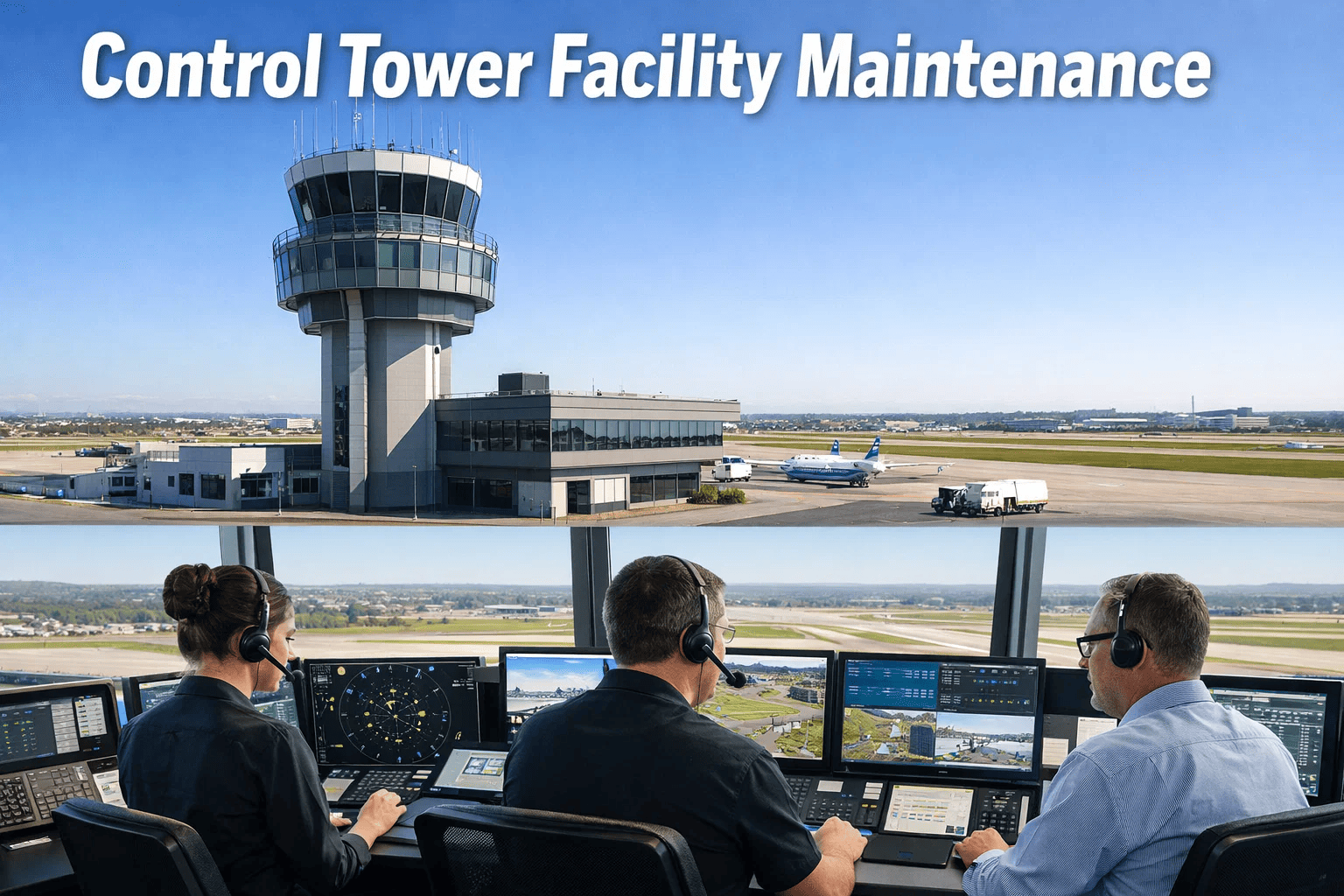
The control tower cab, the radar processing room, the communications equipment vault, and the backup power plant are all physical facilities with maintenance requirements as precise as the avionics equipment they house. ICAO Annex 11 and national ATC authority standards impose facility requirements — temperature range, humidity control, power quality, backup duration — that building management teams typically meet through maintenance programmes, not just installation. When the precision air conditioning unit serving a radar processing room drifts out of its 18–24°C setpoint range for extended periods, equipment failure rates accelerate. When UPS battery capacity degrades silently below 80% rated capacity, the first indication is a power event the system cannot bridge. When a backup generator fails its monthly test undetected, the result is a facility with no power resilience against the next grid interruption. The answer is not more manual checks — it is structured, CMMS-driven maintenance that removes human memory from the loop entirely. Start a free trial of Oxmaint and replace your control tower maintenance spreadsheets with structured PM programmes — or book a demo to see how ATC facility assets are managed to 99.999% uptime standards.
The Six Systems That Determine ATC Facility Reliability
Computer Room Air Conditioning units maintaining 18–24°C and 45–65% RH in ATC equipment rooms. Redundant N+1 configurations require active switchover testing. Filters, coils, compressors, and humidifier systems require PM cycles independent of standard HVAC intervals. Temperature exceedances above 25°C must trigger immediate work orders.
Uninterruptible power supply systems for ATC equipment rooms must provide clean power and bridge outages until generator transfer. Battery state of health (SoH) testing is critical — batteries degrade to below 80% SoH before physical signs appear, making scheduled capacity testing the only reliable indicator of actual bridge time. Annual full-load discharge tests are the minimum standard.
Diesel or natural gas standby generators must start, transfer load, and sustain rated output within the 10-second transfer window defined by IEC 60364 and NFPA 110. Monthly no-load test runs are standard; quarterly or bi-annual full-load tests are required to confirm rated output. Fuel quality, coolant condition, battery starter health, and auto-transfer switch testing all require documented maintenance cycles.
VHF/UHF radio transceivers, VCCS (Voice Communication Control Systems), and data link equipment require temperature-controlled environments, clean power, and ESD-safe maintenance procedures. While avionics technicians handle equipment calibration, facility managers are responsible for the physical environment — rack cooling, cable tray organisation, access control, and fire suppression system integrity in equipment rooms.
Control tower cab 360-degree glazing panels require anti-reflective coating condition checks, seal integrity inspection, and solar control film performance verification — degradation creates glare affecting controller sightlines. Structural maintenance of tower stairwells, lift systems, and emergency egress routes requires annual inspection and documented certification.
Aviation obstruction lights on control tower structures are safety-critical under FAA/ICAO requirements. White high-intensity (daytime), medium-intensity red (night), and steady red low-intensity systems require individual circuit monitoring, lamp condition checks, and photocell sensor testing on defined cycles. Failure to maintain obstruction lighting creates both regulatory violation and airspace safety risk.
ATC Facility Maintenance Cannot Depend on Spreadsheets and Memory
Oxmaint replaces manual tracking with structured PM schedules, mobile digital inspections, and real-time compliance dashboards — so every UPS battery test, every generator load run, and every CRAC unit PM is scheduled, executed, documented, and escalated automatically. Never miss a critical interval again.
The Difference Between Reactive and Structured ATC Facility Maintenance
Oxmaint Capabilities for ATC and Airfield Operations Facility Management
Register every CRAC unit, UPS system, generator, distribution board, obstruction light circuit, and communication room asset with nameplate data, installation date, certification status, and condition score — in a hierarchical structure from tower to individual component.
Build maintenance schedules from ICAO Annex 11 facility requirements, FAA Engineering Brief standards, and NFPA 110 emergency power requirements. PM intervals auto-trigger with escalation on overdue — removing human memory from the critical interval loop entirely.
Monthly test run results — start time, transfer time, voltage output, oil pressure, coolant temperature — captured on mobile inspection forms and attached to generator asset record. Full test history available for ATC authority inspection at any time.
Annual capacity test results, battery age, and manufacturer replacement thresholds tracked per UPS system. Condition-based replacement triggers when SoH reaches defined threshold — not after a failure event. Replacement budget automatically included in CapEx forecast.
CMMS work orders triggered by BMS temperature or humidity alarms in ATC equipment rooms. Oxmaint receives alerts via API from building management systems and converts threshold breaches to maintenance work orders with immediate mobile dispatch to the on-call facilities technician.
Complete maintenance history, inspection records, and corrective action documentation for any ATC facility asset — exportable in under 15 minutes for ICAO, national authority, or internal compliance audits. Every record is date-stamped with digital technician sign-off.
Frequently Asked Questions
What are the ICAO requirements for control tower facility maintenance documentation?
ICAO Annex 11 requires that ATC facilities be maintained in a condition that enables continuous provision of air traffic services. National ATC service providers (FAA, NATS, Airservices Australia, etc.) translate this into specific facility maintenance standards including temperature range requirements for equipment rooms, UPS bridge time minimums, generator transfer time standards, and documentation requirements. The common thread: all maintenance must be documented, with records retained for a minimum of 2 years (longer in many jurisdictions). Oxmaint stores all maintenance records digitally with indefinite retention. Start a free trial to build your compliant documentation programme.
How often must UPS systems in ATC facilities be tested?
NFPA 110 and IEC 62040 provide the primary framework. Monthly visual inspection and battery charger checks are minimum standards. Annual full-load discharge tests at rated duration are required to verify actual bridge time capacity. Battery SoH testing using impedance spectroscopy is increasingly common between annual tests for high-criticality installations. The critical point is that battery capacity degrades below manufacturer replacement thresholds before any physical symptoms appear — only testing reveals it. Book a demo to see how Oxmaint tracks UPS battery SoH over time.
Can Oxmaint integrate with building management systems (BMS) in control tower facilities?
Yes. Oxmaint integrates with BMS platforms via REST API or MQTT, receiving environmental alarms — temperature, humidity, power quality deviations — and converting them to CMMS work orders. This is particularly valuable for ATC equipment rooms where a temperature exceedance at 2am needs to generate an immediate work order and mobile alert to the on-call facilities technician, not wait until a morning manual check. Integration setup is a configuration exercise, not a development project. Start a free trial to explore BMS integration capabilities.
Does Oxmaint support maintenance at multiple ATC facilities across a regional network?
Yes. Oxmaint is built for multi-site portfolio management. A national ATC service provider or airport authority can manage control towers, TRACON facilities, and remote navigational aid sites under a single Oxmaint instance — with portfolio-level compliance dashboards for senior management and site-level task lists for individual facility technicians. Every asset, inspection record, and work order across the network is visible in a single system with no manual aggregation. Book a demo to see the multi-facility network management view.
The Next ATC Facility Failure Is Preventable. Build Your Maintenance Programme Now.
Oxmaint gives ATC facility teams a complete, structured maintenance platform — PM scheduling from ICAO standards, digital inspection records, UPS and generator tracking, BMS integration, and audit-ready compliance reports. No spreadsheets. No memory-dependent intervals. No undocumented gaps.