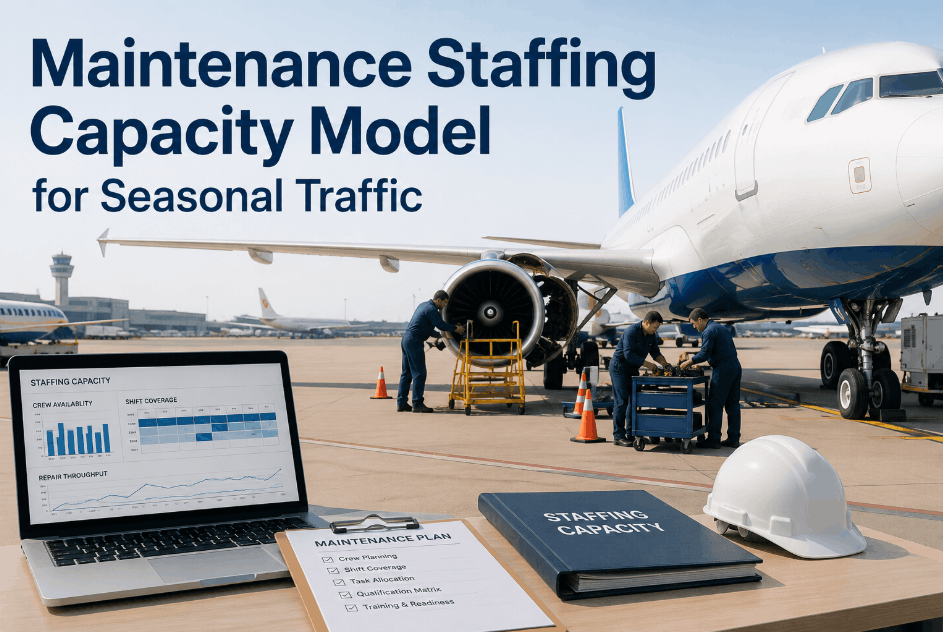
Maintenance staffing capacity planning is the operational discipline that keeps airport facility teams from entering peak seasonal traffic periods under-resourced or over-extended. When crew availability, shift coverage gaps, and repair throughput data are not modeled against projected passenger volume, maintenance operations absorb seasonal surges reactively — through unplanned overtime, delayed repairs, and service-level failures that compound across every busy travel week. Sign Up Free on Oxmaint to build a maintenance staffing capacity model that aligns crew availability with seasonal demand, tracks wrench time, and gives operations leadership the forward visibility needed to avoid staffing crises before the season starts.
Why Seasonal Traffic Demands a Staffing Capacity Model — Not Just a Headcount Review
Airport maintenance teams manage more work orders, more reactive calls, and more asset stress during peak seasonal periods than their standard staffing models are designed to absorb. A headcount review tells you how many people are employed; a capacity model tells you whether those people cover the right shifts, hold the right qualifications, and can deliver enough repair throughput to meet peak-season service demand. Book a Demo to see how Oxmaint models qualification matrices, dispatch efficiency, and task allocation across your entire maintenance workforce — giving operations managers a staffing readiness view before peak traffic arrives rather than after the first escalation.
The Four Capacity Planning Gaps That Break Seasonal Maintenance Readiness
Sign Up Free on Oxmaint to eliminate all four seasonal capacity gaps with qualification-aware scheduling, shift coverage visibility, throughput tracking, and forward demand forecasting built into your maintenance workflow.
Most airport maintenance teams track headcount but not the qualification profile of each technician relative to the asset types and task categories that peak season generates. Without a qualification matrix, dispatch efficiency degrades when the right technician is not available for the right asset failure.
Shift schedules designed for baseline traffic often leave coverage gaps during early morning departures, late-night arrivals, and holiday weekend surges. Without modeling shift coverage against projected traffic patterns, maintenance teams absorb peak periods reactively through emergency overtime.
Without measuring actual work order completion rate per technician and shift, operations managers cannot identify throughput bottlenecks that will compound during high-volume periods. Throughput data is the essential input for determining whether current staffing can handle projected seasonal load.
New technicians and cross-trained staff require documented training completion before they can be dispatched independently. Without tracking training hours and certification status per technician, capacity models overcount available qualified labor — creating gaps that only appear during a peak-season surge.
Staffing Capacity Model Parameters by Maintenance Function
Book a Demo to see how Oxmaint applies function-specific capacity parameters across your airport maintenance workforce — modeling qualification coverage, throughput demand, and shift gaps before seasonal traffic creates operational pressure your team cannot absorb.
| Maintenance Function | Peak Season Driver | Critical Qualification | Throughput Metric | Oxmaint Capacity Action |
|---|---|---|---|---|
| Airside Pavement and Markings | Increased aircraft movement volume | Airside safety certification | WOs closed per shift per crew | Qualification matrix + shift coverage model |
| Electrical and Lighting Systems | Extended operating hours, CAT requirements | Licensed electrician / airside | Response time from dispatch to close | Dispatch efficiency tracking WO |
| Baggage Handling Maintenance | Increased baggage volume, turnaround pressure | BHS system-specific certification | MTTR per incident type | Throughput trend + overtime pressure flag |
| HVAC and Climate Control | Summer heat load, occupant density | HVAC refrigeration certification | Reactive vs planned ratio per week | Seasonal staffing capacity WO trigger |
| Passenger Boarding Bridges | Gate cycle rate, turnaround frequency | PBB mechanical certification | Failure response time vs SLA | Task allocation model + SLA compliance WO |
Building the Seasonal Staffing Capacity Model in Oxmaint
Map Technician Qualifications to Asset Types and Task Categories
Oxmaint technician profiles capture certification status, training completion, and asset-type authorization for every member of the maintenance workforce — enabling dispatch systems to match qualified technicians to specific work orders rather than assigning the nearest available person.
Model Shift Coverage Against Projected Seasonal Traffic Patterns
Oxmaint scheduling tools allow operations managers to overlay current shift rosters against projected work order volume by time period — identifying coverage gaps during high-traffic windows before the season begins rather than reacting to overtime escalation after it starts.
Track Repair Throughput Per Technician and Shift to Establish Capacity Baseline
Oxmaint work order completion data generates throughput metrics per technician, per crew, and per shift — establishing the actual repair capacity baseline that seasonal demand modeling requires. Without measured throughput, capacity estimates remain theoretical rather than operational.
Monitor Training Hours and Certification Completion Before Peak Season
Oxmaint PM schedules include training task tracking for each technician — flagging certification gaps and incomplete training hours before the peak season staffing model is finalized. Undercounting qualified labor at the planning stage creates the overtime pressure that erodes team performance through peak periods.
Report Capacity Readiness to Operations Leadership Before Season Transition
Oxmaint reporting aggregates staffing coverage, qualification distribution, throughput capacity, and training completion into a seasonal readiness report — giving operations directors the structured view needed to approve staffing adjustments, approve contractor supplementation, or escalate training gaps before peak traffic arrives.
Staffing Capacity KPIs for Airport Maintenance Operations
Measures whether every shift has at least one qualified technician for each critical asset category. Gaps in coverage rate during peak season directly increase response time and service impact for high-consequence asset failures.
Tracks the proportion of technician time spent on direct maintenance activity versus travel, administration, and waiting. Low wrench time during peak season indicates dispatch inefficiency, not insufficient headcount.
Measures overtime hours as a percentage of total maintenance labor during peak seasonal periods. Sustained overtime above 15% confirms that planned staffing capacity fell short of actual seasonal demand — and that the capacity model requires recalibration.
Tracks the percentage of work orders assigned to a qualified technician on first dispatch without reassignment. Low rates indicate qualification matrix gaps that extend response time and reduce repair throughput during high-volume periods.
Measures whether all technicians who are counted in the seasonal staffing model have completed required certifications before peak traffic begins. Incomplete training inflates apparent capacity while reducing actual qualified labor availability.
Compares actual work order completion rate during peak season against the throughput model projected at capacity planning time. Variance beyond 10% confirms that the staffing model requires recalibration before the next seasonal cycle.