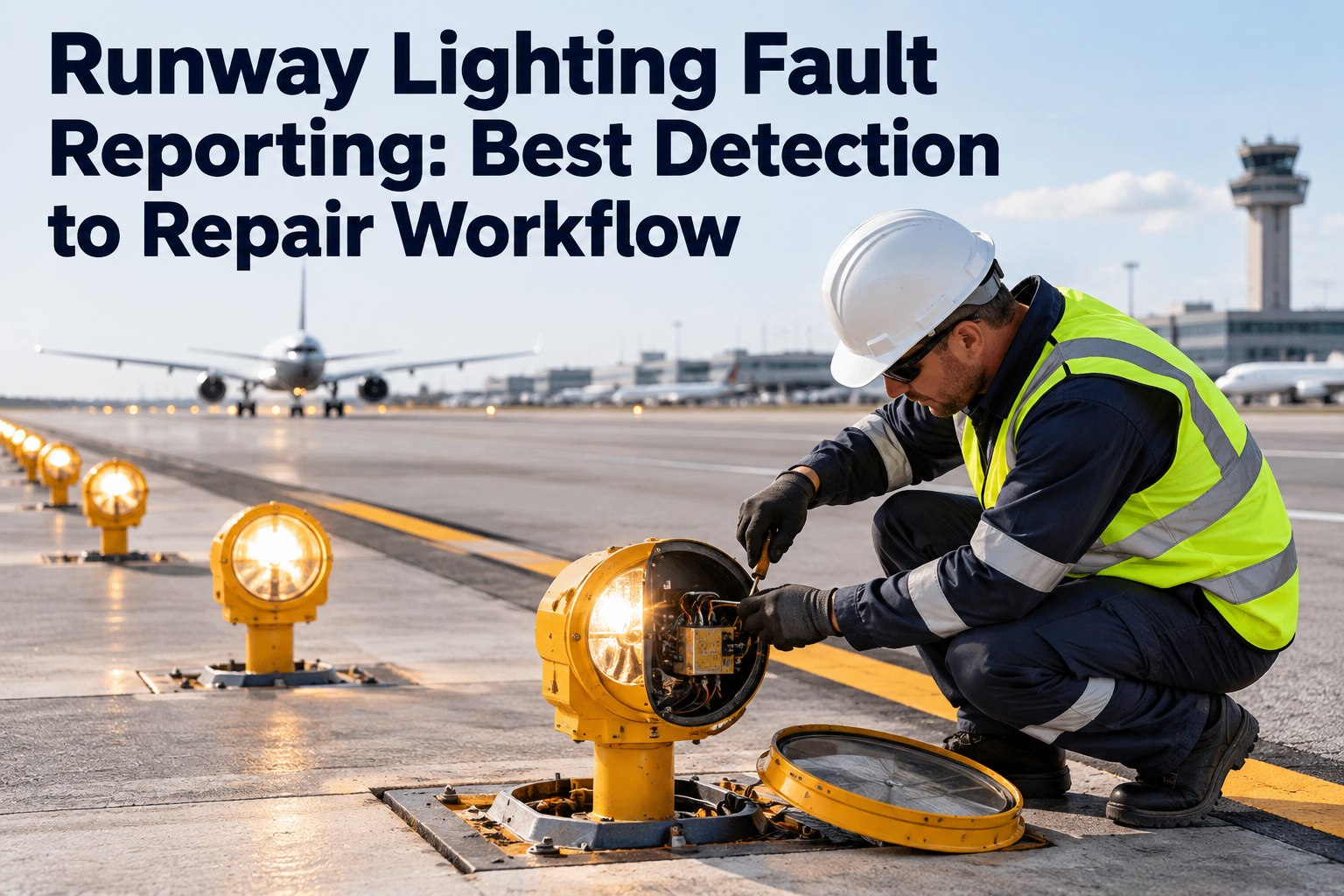
A centerline light goes dark at 2 a.m. — who logs it, who classifies it, and how long before a technician is dispatched and the fault is closed out? If the answer lives in a radio call and a paper logbook, the clock is already working against you. OXMAINT AI is AI-powered maintenance management software (CMMS) that runs the whole fault path — detection or inspection to classified defect, dispatched work order, and verified closeout — so every runway lighting fault is timestamped, triaged and restored on a workflow, not a whiteboard. Book a demo to see the detect-to-repair loop on your airfield.
Runway Lighting · Fault Reporting Workflow
From "A Light Is Out" to "Fault Closed" — On One Timed Workflow
A dark light is a clock, not a note. OXMAINT AI takes the outage the moment it's detected or reported, classifies it against serviceability rules, dispatches a ranked work order to the right technician, and holds it open until a verified closeout — so detection-to-repair is one tracked chain and nothing gets lost between the tower and the truck.
- 1Detect / report
- 2Classify severity
- 3Dispatch work order
- 4Verified closeout
The response clock
Fault detectedT+0
Classified & loggedminutes
Technician dispatchedwork order
Repaired & verifiedclosed
Every step timestamped, so response time is measured — not estimated.
Not Every Dark Light Is the Same Emergency
A single edge light out is a work order. A gap in the touchdown zone during low visibility is a different problem entirely. Fault reporting only works when severity is classified the instant the fault is logged — and the standards give you the lines. Start a free trial to classify faults automatically.
Critical
Pattern-breaking outage
Touchdown-zone or centre-line loss, or two adjacent lights out — the failure changes what the pilot sees. Immediate dispatch and escalation.
Serviceability risk
Threshold approaching
Enough isolated lights out to near the serviceable-percentage limit for the runway category. Prioritized before it crosses the line.
Routine
Single isolated fault
One non-adjacent light or a fixture dimmed below spec. Scheduled into the next maintenance window, still tracked to closeout.
Serviceability reference: ICAO deems a light unserviceable when main-beam average intensity falls below 50% of a new light; FAA AC 150/5340-26C Table A-8 sets serviceable minimums such as ~95% for runway centre line and CAT II/III edge lights and ~90% for touchdown zone. Two adjacent unserviceable lights are the line most standards draw hardest. Sources: International Airport Review; Airport Improvement (AC 150/5340-26C).
The Detect-to-Repair Pipeline, Step by Step
This is the workflow OXMAINT AI runs for every reported fault. The point isn't more steps — it's that no step is skipped, and each one is timestamped so the gaps show. Book a demo to walk the pipeline on sample faults.
1
Detect or report
A monitoring alert, a self-inspection, or a tower call opens a fault record with location, circuit and timestamp — no radio-to-logbook gap.
2
Classify against the rules
The fault is tagged critical, serviceability-risk or routine using the light type, adjacency and category thresholds — so priority is set by the standard, not the mood.
3
Dispatch the work order
A ranked work order goes to the right technician with the circuit, the spare and the access window — batched with nearby faults to cut airside trips.
4
Repair & escalate if stuck
If a fault stalls past its target time, it escalates automatically — a critical outage never sits quietly in a queue.
5
Verified closeout
Closeout requires the fix confirmed and, where needed, a photometric re-check — then the record stands as a timestamped audit trail.
Close the Gap Between "Reported" and "Repaired"
See how OXMAINT AI turns a fault report into a dispatched, escalated, verified work order — with the whole timeline on record.
The Four Response Metrics Worth Measuring
You can't shorten a response you never timed. When every step carries a timestamp, these four numbers stop being guesses and start driving the workflow. Start a free trial to measure them from day one.
Time to detect
How long a fault existed before it was logged. Monitoring and inspection cadence drive this one down.
Time to classify
Detected to prioritized. Rule-based tagging collapses this from a judgment call to seconds.
Time to dispatch
Classified to technician-assigned. Batching and clear ownership are where this time is won or lost.
Time to closeout
Dispatch to verified fix — the number that decides whether the runway is back to full serviceability.
Does This Fault Need to Escalate Now?
Every fault runs through the same two questions, so escalation is a rule, not a hunch. It keeps critical outages moving and stops routine ones from crowding the queue. Book a demo to see escalation logic on your circuits.
Does the outage break the pilot's pattern — TDZ, centre line, or two adjacent lights?
Yes
Is a technician already dispatched?
No: escalate immediately, dispatch now, and notify operations — this is a serviceability event.
Yes: keep it flagged critical and track to verified closeout without letting it slip.
No
Is the serviceable-percentage limit close?
Yes: prioritize before the next isolated failure crosses the threshold.
No: schedule into the next maintenance window, still tracked to closeout.
How OXMAINT AI Runs Fault Reporting End to End
OXMAINT AI is maintenance management software that keeps detection, classification, dispatch and closeout in one connected loop — so a reported fault becomes a timed, ranked, verifiable work order without leaving the platform. Start a free trial to run it on your airfield.
1
Capture
Open a timestamped fault record from a monitor alert, self-inspection or tower report — with location and circuit attached.
2
Classify
Tag severity by light type, adjacency and category threshold, so priority follows the serviceability rules.
3
Dispatch
Route a ranked work order to the right technician, batched with nearby faults to reduce airside access events.
4
Close & learn
Verify the repair, hold the audit trail, and surface repeat-offender circuits for preventive attention.
Frequently Asked Questions
When is a runway light considered unserviceable?
ICAO deems a light unserviceable when its main-beam average intensity drops below 50% of a new light; FAA guidance also flags fixtures well below rated output. That's the line a fault report should key on.
Start a free trial to flag it automatically.
Why do two adjacent lights out matter so much?
A single isolated light rarely changes the pattern a pilot reads, but two adjacent failures can — which is why standards treat adjacency as a hard line and classification has to catch it.
Book a demo to see adjacency-aware triage.
How does a CMMS speed up fault response?
What should a closed fault record contain?
Detection time, classification, who was dispatched, the repair, and a verification such as a photometric re-check — a timestamped trail you can stand behind in an audit.
Book a demo to see the closeout record.
Can OXMAINT AI show which circuits fail repeatedly?
Put Every Runway Lighting Fault on a Timed Workflow
Detect, classify, dispatch and close out every fault on one platform — with the response clock running where you can see it.