Foreign Object Debris costs the aviation industry up to $13 billion annually—and a single undetected bolt on a runway can destroy a jet engine in milliseconds. Drone-based inspection systems equipped with AI vision, thermal imaging, and LiDAR are replacing slow, manual runway walks with autonomous scans that cover an entire runway in minutes. Paired with CMMS integration, every detected crack, FOD item, and surface defect flows into automated maintenance workflows. Schedule a consultation to explore how OXmaint connects drone inspection data to your airport's maintenance operations.
The FOD Problem: Why Runways Need Smarter Inspection
Every takeoff and landing creates an opportunity for Foreign Object Debris to damage aircraft, injure personnel, or trigger catastrophic failure. The Concorde disaster of 2000—caused by a single 43cm titanium strip on the runway—remains the most devastating reminder that small debris carries enormous risk. Today, with global air traffic projected to double by 2036, the pressure on runway inspection programs has never been greater.
$13B+
Annual global FOD cost to aviation (direct + indirect)
$4B
Direct damage from FOD annually (Boeing estimate)
$338
Total FOD cost per flight (direct + indirect, US airlines)
22%
Of all aviation accidents are runway excursions
Common FOD sources: loose hardware, luggage fragments, pavement pieces, wildlife remains, ground equipment parts, ice chunks, packaging material
How Drone Inspection Transforms Runway Safety
Traditional runway inspections require vehicles or personnel to physically traverse the runway surface—closing it to traffic for 15-30 minutes per inspection cycle. Airports conducting the FAA-recommended minimum of daily inspections lose valuable runway capacity. Drone-based systems fundamentally change this equation by inspecting faster, detecting more, and generating digital records automatically.
Current Standard
Manual / Vehicle Inspection
Coverage Time
15-30 minutes per runway
Detection
Human visual (daylight dependent)
Smallest Object
~25mm (varies by speed/lighting)
Records
Paper logs or manual entry
Night Capability
Limited (flashlight/headlights)
Runway closed during inspection
2026 Standard
AI Drone Inspection
Coverage Time
3-8 minutes per runway
Detection
AI vision + thermal + LiDAR
Smallest Object
~5mm (camera-dependent)
Records
Auto-archived with GPS coordinates
Night Capability
Full (thermal + IR illumination)
Minimal runway disruption
Core Drone Technologies for Runway Inspection
Not all inspection drones are created equal. The most effective runway inspection platforms combine multiple sensor technologies to detect everything from millimeter-scale FOD to subsurface pavement cracks invisible to the human eye.
LAYER 1
High-Resolution RGB Camera
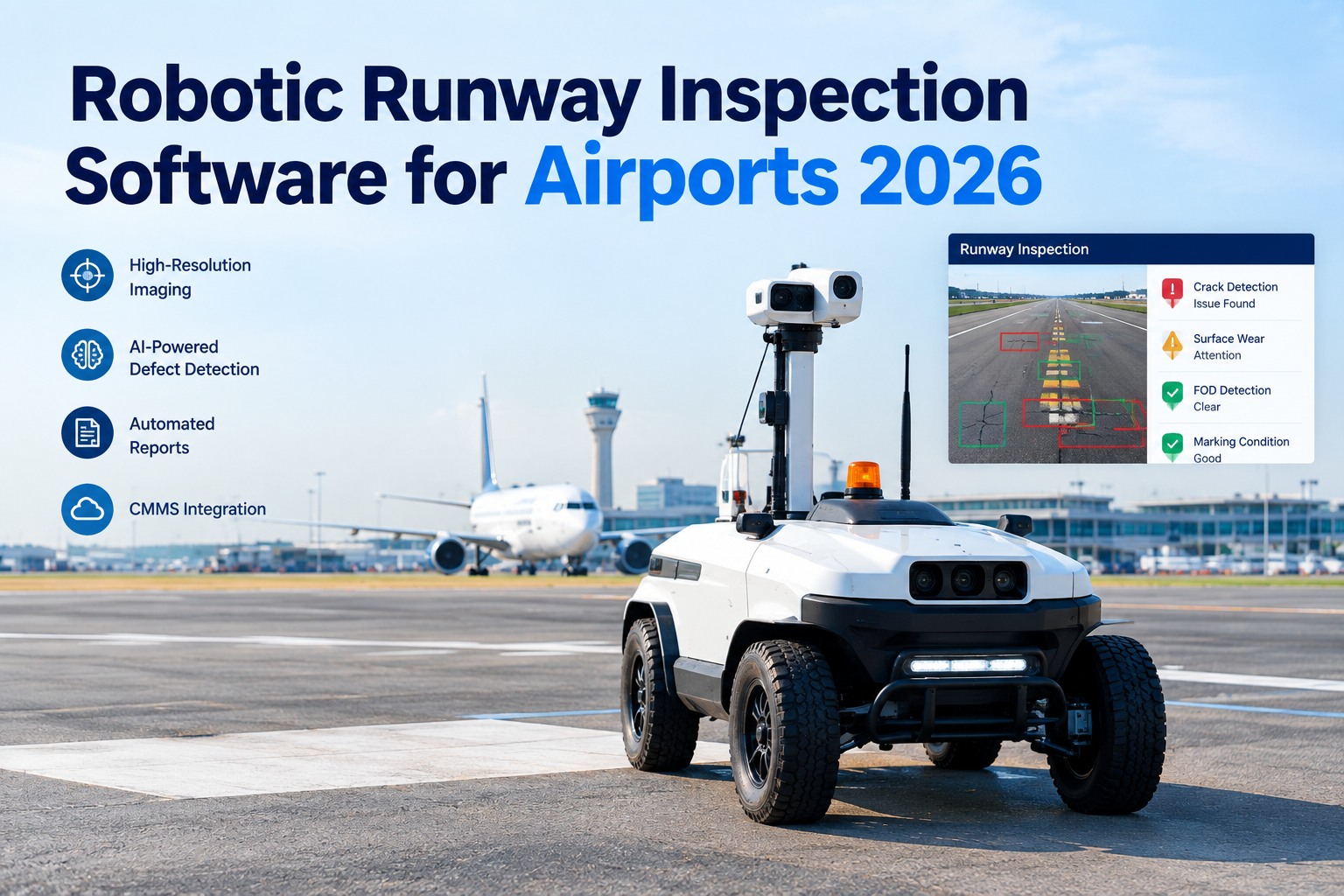
4K or higher resolution cameras capture surface imagery at sub-centimeter pixel resolution. AI computer vision models (YOLOv8, vision transformers) process images in real time to detect and classify FOD objects, pavement cracks, rubber deposits, and marking degradation.
FOD objects
Surface cracks
Marking wear
Rubber buildup
LAYER 2
Thermal / Infrared Imaging
Thermal cameras detect temperature differentials that reveal subsurface moisture, delamination, and hidden voids in pavement structure. Essential for night operations and low-visibility conditions where RGB cameras lose effectiveness.
Subsurface moisture
Delamination
Night FOD detection
Ice formation
LAYER 3
LiDAR 3D Scanning
Light Detection and Ranging creates millimeter-accurate 3D surface models of the entire runway. Detects elevation changes, rutting, settlement, and FOD height profiles. The drone LiDAR market is projected to grow from $114M to $892M by 2032, driven heavily by infrastructure inspection use cases.
Surface elevation
Rutting depth
FOD height profile
Settlement tracking
Ready to connect drone data to your maintenance workflows? Create a free OXmaint account and start turning drone inspection findings into automated work orders.
Sign Up Free
What to Look for in a Runway Inspection Drone (2026)
Choosing the right drone platform for airport operations involves more than sensor specs. Regulatory compliance, operational integration, and data management capabilities determine whether a drone program delivers lasting value or becomes expensive shelf-ware.
Flight Performance
Flight Time
30+ minutes for full runway coverage with payload
Wind Resistance
Stable operations in 25+ knot winds (airport environment)
BVLOS Ready
Detect-and-avoid capability for Part 108 compliance path
Detection Capability
FOD Detection
Objects down to 5-10mm at operational altitude
Crack Detection
AI error margin within 8-12% vs manual assessment
Night Operations
Thermal + IR illumination for 24/7 inspection capability
Compliance & Safety
Remote ID
Built-in compliance with FAA Remote ID requirements
ADS-B Awareness
Detect manned aircraft broadcasting ADS-B Out
Cybersecurity
Blue UAS list or equivalent security certification
Data & Integration
CMMS Integration
API-driven export to maintenance management platforms
Image Archive
Georeferenced imagery linked to runway sections
Trend Analytics
Historical comparison for predictive maintenance
Regulatory Landscape: Flying Drones at Airports in 2026
Operating drones in airport environments involves some of the most complex airspace regulations in aviation. Here is where the regulatory framework stands heading into 2026—and what it means for airport drone inspection programs.
Current
FAA Part 107 + Waiver
Airport drone operations require Part 107 certification plus specific waivers for controlled airspace (Classes B, C, D). BVLOS operations need separate waiver approval with detailed safety cases. Over 26,000 BVLOS approvals have been issued to date under existing frameworks.
In Progress
Proposed Part 108 (BVLOS Framework)
The FAA's 2025 NPRM proposes a dedicated BVLOS regulatory framework separate from Part 107. Performance-based requirements for detect-and-avoid systems, two-path approval (permits for lower-risk, certificates for complex operations), and mandatory Remote ID compliance.
June 2025
Executive Order: "Unleashing American Drone Dominance"
White House directive fast-tracks BVLOS rulemaking, mandates AI-accelerated Part 107 waiver processing, prioritizes American-made drone platforms for federal operations, and launches eVTOL pilot programs. Signals aggressive federal support for airport drone integration.
2026+
Routine BVLOS Airport Operations
As Part 108 finalizes, airport drone inspection programs will shift from waiver-dependent to standardized approval paths. ICAO's SkyInspect360 initiative proposes global standardization of drone-based runway inspection protocols including AI, robotics, and advanced imaging.
See how drone data flows into automated maintenance workflows. Book a demo and we'll show you how OXmaint CMMS turns aerial inspection findings into tracked, prioritized work orders.
Schedule Demo
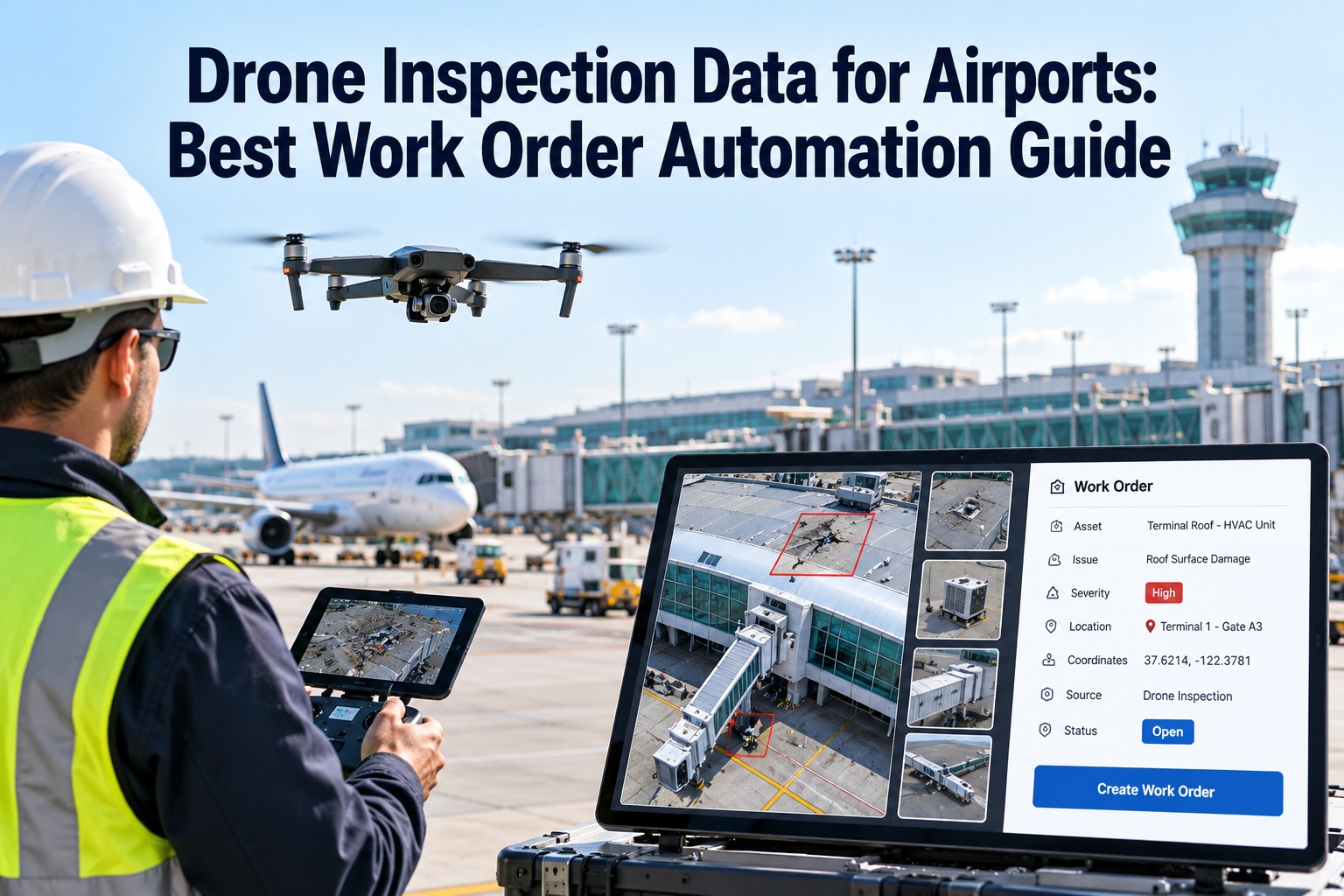
CMMS Integration: From Drone Scan to Work Order
Drone-captured data is only valuable when it connects to action. OXmaint CMMS bridges the gap between aerial inspection and ground-level maintenance by automating the entire workflow from detection to resolution.
1
Fly
Drone completes autonomous runway scan capturing RGB, thermal, and LiDAR data
2
Detect
AI classifies FOD, cracks, and surface defects with GPS-tagged locations
3
Log
OXmaint archives findings by runway section with full image and severity data
4
Dispatch
Automated work orders route to maintenance crews with priority and location
5
Verify
Post-repair drone scan confirms resolution and closes the maintenance loop
Runway Section Mapping
Every defect is pinned to exact GPS coordinates and mapped to your runway's third-by-third grid. Maintenance crews know precisely where to go—no searching required.
Severity-Based Prioritization
AI-scored defect severity automatically determines work order priority. Critical FOD triggers immediate dispatch; hairline cracks queue into scheduled maintenance windows.
Historical Trend Tracking
Compare drone scans over weeks, months, and seasons. Identify pavement sections degrading faster than expected and shift from reactive repairs to predictive maintenance budgeting.
Compliance Documentation
Every inspection, finding, work order, and resolution is digitally archived with timestamps and audit trails for FAA Part 139, ICAO Annex 14, and EASA compliance reporting.
Frequently Asked Questions
Can drones legally operate on airport runways?
Yes, but it requires specific authorizations. Airport drone operations in controlled airspace need FAA Part 107 certification plus airspace waivers. The upcoming Part 108 framework will create a more standardized approval path for BVLOS airport operations. Many airports—including Heathrow, Changi, and San Sebastian—have already implemented drone inspection programs under existing regulatory frameworks.
How small an object can runway inspection drones detect?
Current AI-equipped drone systems can detect objects as small as 5-10mm depending on camera resolution, flight altitude, and lighting conditions. LiDAR-equipped drones achieve millimeter-level surface accuracy for pavement condition assessment. For context, the titanium strip that caused the Concorde disaster was 43cm—well within modern drone detection capabilities.
Do drone inspections replace manual runway walks?
Not entirely—at least not yet. Current FAA and ICAO guidance still requires human-validated inspections. Drones serve as a force multiplier, increasing inspection frequency, improving detection accuracy, and reducing the time runways must be closed. As regulations evolve under Part 108, drone-primary inspection programs may become the standard.
What is BVLOS and why does it matter for airport drones?
BVLOS (Beyond Visual Line of Sight) allows drones to fly beyond the operator's direct visual range. For runway inspection, BVLOS capability enables a single operator to launch fully autonomous scans of multiple runways without repositioning. The FAA's proposed Part 108 rule is designed to normalize BVLOS operations, which will be transformative for airport inspection programs.
How does OXmaint CMMS integrate with drone inspection data?
OXmaint ingests georeferenced inspection data through standard APIs and data protocols. Detected defects are automatically mapped to runway asset records, scored by severity, and converted into prioritized maintenance work orders—all with full image documentation and audit trails.
Sign up for a free account to explore integration capabilities for your airport.
Connect Drone Intelligence to Runway Maintenance
OXmaint CMMS transforms drone inspection data into automated, trackable maintenance workflows—from FOD detection to pavement repair, with complete compliance documentation for every finding and every resolution.