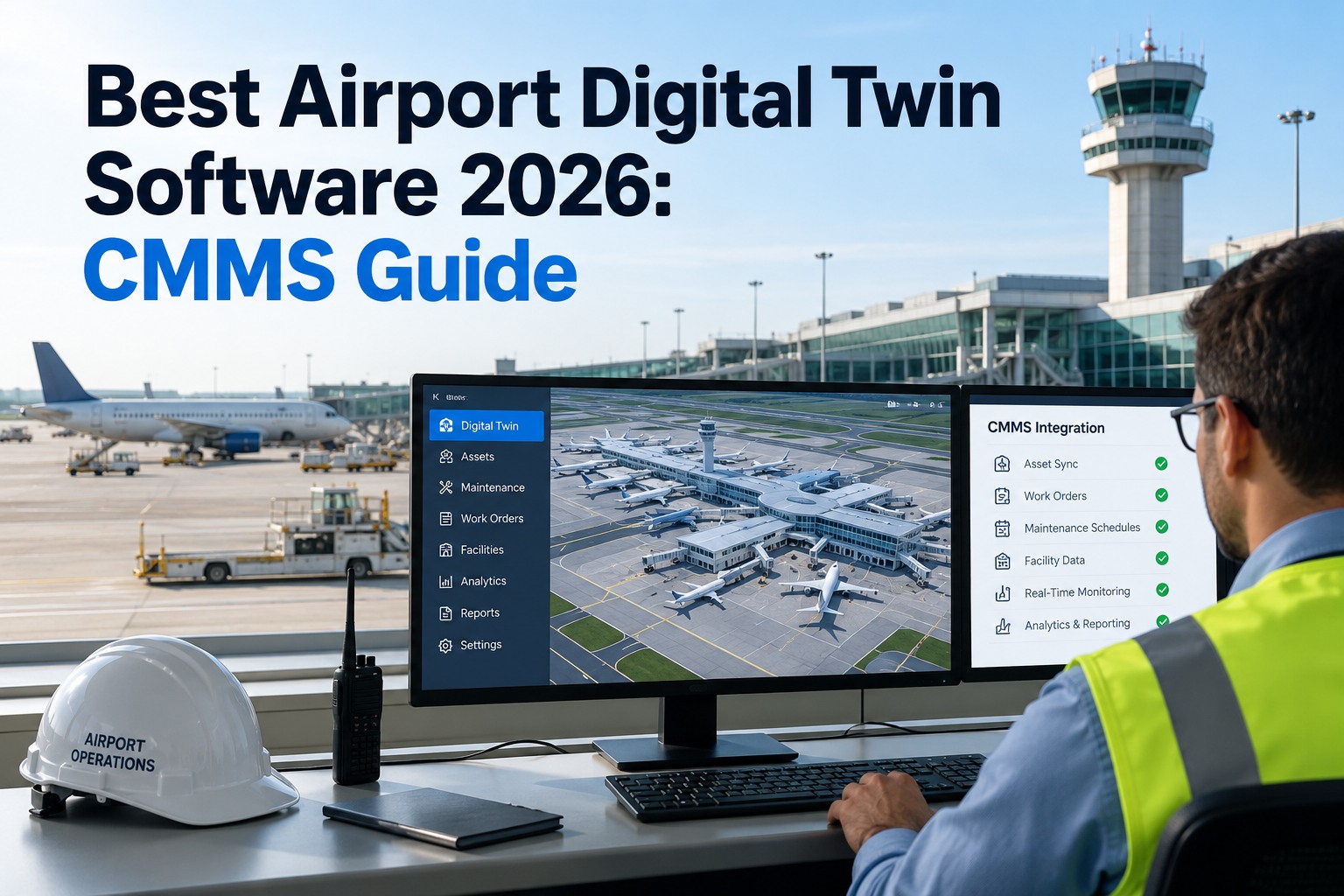
Your airport sits on thousands of acres of infrastructure—runways, terminals, baggage systems, HVAC networks, utility grids—all aging at different rates, maintained by different teams, tracked in different systems. Without a unified digital model, you're making million-dollar capital decisions based on incomplete data, reacting to failures instead of preventing them, and guessing at asset lifecycles instead of knowing them. OXmaint's digital twin platform creates a real-time virtual replica of your entire airport infrastructure, integrating IoT sensor data, BIM models, and maintenance records into one living system that predicts failures, simulates scenarios, and optimizes every maintenance dollar you spend. Schedule a demo to see your airport infrastructure come alive in a digital twin.
The Digital Twin Revolution Is Here
Digital twin technology is reshaping how the world's largest infrastructure operators manage their assets. From Schiphol to Changi, from Pittsburgh to DFW, airports are building virtual replicas to predict failures, optimize operations, and plan capital investments with unprecedented precision. The market trajectory tells a clear story.
$21.14B
Market Size 2025
→
47.9%
CAGR Growth
→
$149.8B
Projected by 2030
MarketsandMarkets Digital Twin Market Report
1 Billion+
U.S. air passengers expected annually by 2033
FAA Aerospace Forecast
50%
Surge in European air travel expected by 2040, straining already congested facilities
Industry Forecast Analysis
What Happens Without a Digital Twin
Most airports still manage infrastructure through disconnected spreadsheets, paper records, and siloed software. Here's the reality on the ground.
80%
of airports run primarily reactive maintenance programs—fixing things only after they break
ACRP Research Report 155
60%
of airports maintain an 80:20 ratio of reactive to proactive maintenance
Mahaz and Alfaqih Study
46%
of enterprises face multi-configuration challenges during cross-system integration
Application Gateway Market Report
Result
Unplanned downtime of critical infrastructure, compliance gaps, wasted capital, and technicians spending more time on paperwork than repairs
Stop guessing. Start simulating. Build your airport's digital twin with OXmaint and make every maintenance decision data-driven.
Start Free
Inside the OXmaint Digital Twin Monitor
OXmaint's Digital Twin Monitor gives you a real-time operational command center for your entire airport. The moment you log in, three live dashboards deliver instant situational awareness—system health, maintenance pulse, and asset distribution—all updating continuously as your facility operates.
System Health
Operational snapshot
Operational Assets156 / 156
System Uptime100.00%
Critical Issues10
Alerts114
Maintenance Status
Live maintenance pulse
Scheduled78
In Progress0
Overdue10
Next Interval30h
Asset Distribution
Zone coverage
Terminals0
Utilities156
Ground Ops0
Parking0
Digital Twin Canvas — Live Facility Map
The Digital Twin Canvas renders your entire airport as an interactive, zone-based facility map. Every terminal, cargo area, power distribution node, and ground operations zone appears as a live tile with real-time asset status indicators. With 111 live ops nodes and 6 active AI-routed paths, your maintenance teams see exactly where every asset stands—operational, under maintenance, or critical—at a glance.
Live Ops Nodes • 111 active
Auto-route AI • 6 active paths
Power Distribution
26 assets
Parking & Ground Ops
9 assets
Route Stabilized
Active Systems
HVAC Network
Water Distribution
Fire Systems
Lighting Grid
Access Control
BHS Control
Legend
Operational
Maintenance
Critical
AI Synced
Real-Time Event Stream
Every operational action across your airport flows into a live event feed, giving your team instant visibility into what's happening right now. From fire panel diagnostics and power swap events to baggage conveyor recoveries and utility load balancing—every event is timestamped, categorized, and logged automatically so nothing falls through the cracks.
03:27 PM
Fire panel diagnostics
Terminal C • detector zone recalibrated
03:26 PM
Gate power UPS swap
Gate F3 • redundant unit engaged
03:26 PM
Baggage conveyor recovery
Line 9 • auto-restart applied
03:26 PM
Utility grid load balanced
Substation 2 • peak reduced 6%
03:26 PM
CCTV perimeter audit complete
North apron • 120 feeds healthy
Asset Monitoring & Service Tracking
Every asset in your airport is cataloged, tracked, and monitored through a unified asset registry. The Asset Monitoring view gives your maintenance managers a complete picture of every piece of equipment—from VAV boxes and AHUs to escalators and baggage belt motors—with real-time status, last service date, and next scheduled service, all in one sortable, searchable table.
Overview
Assets
Outage Planning
Incidents
Analytics
Asset ID
Name
Status
Last Service
Next Service
ASSET74725417
VAV Box VAV-00018
Active
2025-12-23
2025-12-31
ASSET04719247
VAV Box VAV-00017
Active
2025-12-23
2025-12-31
ASSET72044925
VAV Box VAV-00016
Active
2025-12-23
2025-12-31
ASSET71245212
VAV Box VAV-00015
Active
2025-12-23
2025-12-31
ASSET05277470
VAV Box VAV-00014
Active
2025-12-23
2025-12-31
ASSET12507501
VAV Box VAV-00013
Active
2025-12-23
2025-12-31
See Your Airport in a Digital Twin
Book a personalized demo and we'll show you how OXmaint transforms your infrastructure data into a living, predictive digital twin.
How OXmaint's Digital Twin Works
OXmaint creates a living, breathing virtual replica of your airport infrastructure by fusing three critical data layers into one intelligent platform that evolves continuously with your facility.
Data Layer 1
Physical Infrastructure Model
BIM integration, 3D facility models, GIS mapping, asset registry with spatial relationships. Import Revit/IFC models, as-built documentation, MEP system layouts, and floor plans into one unified spatial database.
BIM / IFC
GIS Mapping
3D Spatial Models
Asset Registry
Data Layer 2
Real-Time Sensor & IoT Data
Live telemetry from vibration sensors, temperature monitors, energy meters, air quality systems, and equipment health indicators streamed continuously through SCADA, BACnet, MQTT, and REST APIs.
IoT Sensors
SCADA / BACnet
BMS Feeds
Edge Computing
Data Layer 3
Maintenance Intelligence Engine
Historical work orders, failure pattern analytics, lifecycle degradation models, predictive AI algorithms, and what-if scenario simulation capabilities—all processing continuously to surface insights.
Predictive AI
Work Order History
Lifecycle Models
Simulation Engine
Five Ways Digital Twins Transform Airport Maintenance
A digital twin isn't just a 3D model—it's an intelligent, data-driven platform that fundamentally changes how your maintenance team operates, plans, and makes decisions.
01
Predictive Failure Detection
Without
Baggage belt motor fails at 6 AM during peak departures. 3-hour emergency repair. 12 delayed flights.
With Digital Twin
Vibration anomaly detected 3 weeks early. Motor replaced during overnight window. Zero disruption.
Without
New HVAC zoning plan proposed. No way to test impact before $2M investment. Hope for the best.
With Digital Twin
Simulate 15 zoning configurations against real passenger load data. Identify optimal layout. Save $400K.
03
Capital Planning Intelligence
Without
Replace all 200 escalators on a 15-year cycle regardless of condition. Massive upfront capital outlay.
With Digital Twin
Lifecycle models show 40% can safely run 18+ years. Stagger replacements. Spread capital over 5 years.
04
Cross-System Impact Analysis
Without
Electrical panel upgrade in Terminal B. Unknown downstream effects on BMS, fire suppression, and lighting.
With Digital Twin
Visualize every connected system. Identify 3 dependency conflicts. Plan safe upgrade sequence in advance.
Without
Terminal cooling runs at full capacity 24/7. Energy bills climbing 8% year over year. No visibility into waste.
With Digital Twin
Model energy usage against occupancy, weather, and flights. Reduce cooling waste by 25%. Save $600K annually.
Data Sources That Feed the Twin
OXmaint's digital twin doesn't replace your existing systems—it unifies them. Every data source becomes a building block for your virtual infrastructure model.
BIM & 3D Models
Revit/IFC model imports, as-built documentation, floor plans, MEP system layouts, spatial asset relationships
Real-time sync
IoT & Sensors
Vibration and temperature sensors, energy meters, air quality monitors, equipment runtime counters
Live streaming
CMMS & Work Orders
Maintenance history, failure mode analytics, PM schedule compliance, technician performance data
Bi-directional
Operations & Planning
Flight schedule feeds, passenger flow data, weather system inputs, capital budget forecasts
API integration
Airports Already Building Digital Twins
The world's most forward-thinking airports aren't waiting—they're investing billions to gain competitive advantages in maintenance, operations, and sustainability.
Dublin Airport
$1.8B Investment
140+ modernization projects using Autodesk's Tandem digital twin platform for connected asset, space, and systems management across the entire campus.
Autodesk / Matterport 2024
DFW International
$8-16M Value
Integrated GIS, BIM, and real-time IoT into a comprehensive digital twin for utility management, terminal operations, and emergency response across a city-sized campus.
Geo Week 2025
Pittsburgh Intl.
8,800 Acres
Building a full-campus digital twin integrating weather data, traffic patterns, and predictive maintenance for their new terminal opening, with a 3-5 year comprehensive rollout plan.
Esri Case Study 2025
Schiphol Amsterdam
Hundreds of Sensors
Deployed a digital twin aggregating data from hundreds of IoT sensors to forecast equipment health and minimize unscheduled outages across all terminal buildings.
Industry Research
Implementation Roadmap
Building an airport digital twin is a phased journey. OXmaint's approach ensures you start seeing value within weeks—not years—while building toward a fully predictive infrastructure model.
Phase 1
Weeks 1–4
Foundation & Data Integration
Import BIM models and as-built documentation. Connect existing CMMS work order history. Map critical asset locations and spatial relationships. Establish baseline asset health profiles across all departments.
Unified asset model with historical performance data
Phase 2
Weeks 5–10
Live Data Overlay
Connect IoT sensors and BMS data feeds. Enable real-time asset health monitoring. Configure alert thresholds and anomaly detection rules. Deploy mobile access for field technicians working across terminals.
Real-time infrastructure visibility across all systems
Phase 3
Weeks 11–16
Predictive Intelligence
Activate AI-driven failure prediction models. Build lifecycle degradation curves for critical asset classes. Enable scenario simulation for maintenance and capital planning. Generate automated forecasts and recommendations.
Predictive maintenance with full simulation capabilities
Frequently Asked Questions
What exactly is a digital twin for airport infrastructure?
A digital twin is a real-time virtual replica of your airport's physical infrastructure—buildings, systems, equipment, and utilities. It combines 3D models (BIM), live sensor data (IoT), and historical maintenance records into one unified platform. Unlike a static 3D model, a digital twin evolves continuously, reflecting the current condition of every asset and using AI to predict future performance.
Schedule a demo to see it in action.
Do we need existing BIM models to start building a digital twin?
No. While BIM models accelerate the process, OXmaint can build your digital twin from existing documentation—CAD drawings, floor plans, equipment databases, and GIS data. We support progressive modeling where you start with your most critical systems and expand coverage over time. Most airports begin with high-impact areas like terminal MEP systems and runway infrastructure.
How does predictive maintenance work within the digital twin?
The digital twin continuously monitors real-time sensor data—vibration, temperature, runtime hours, energy consumption—and compares it against historical failure patterns and manufacturer specifications. AI models identify anomalies indicating degradation or impending failure weeks before they happen. The system automatically generates predictive work orders with recommended actions, parts requirements, and optimal maintenance windows.
What IoT sensors and systems does OXmaint integrate with?
OXmaint integrates with virtually any IoT platform or BMS that provides data via standard protocols—MQTT, REST APIs, SCADA, BACnet, and Modbus. Common integrations include vibration sensors, temperature and humidity monitors, energy meters, air quality systems, and equipment runtime counters. Our API gateway handles data translation and routing seamlessly.
Start your free trial to explore options.
How long does it take to see ROI from a digital twin?
Most airports see measurable returns within the first 90 days of Phase 2 deployment. Initial value comes from catching equipment issues before failure and improving PM compliance. DFW International estimated their digital infrastructure improvements could yield $8–16 million in value through reduced disruptions. Longer-term ROI compounds as lifecycle models mature and capital planning becomes data-driven.
Book a demo to discuss ROI projections.
Build Your Airport's Digital Twin
Transform scattered infrastructure data into an intelligent, living digital twin—predict failures before they happen, simulate before you spend, and plan capital investments with confidence.