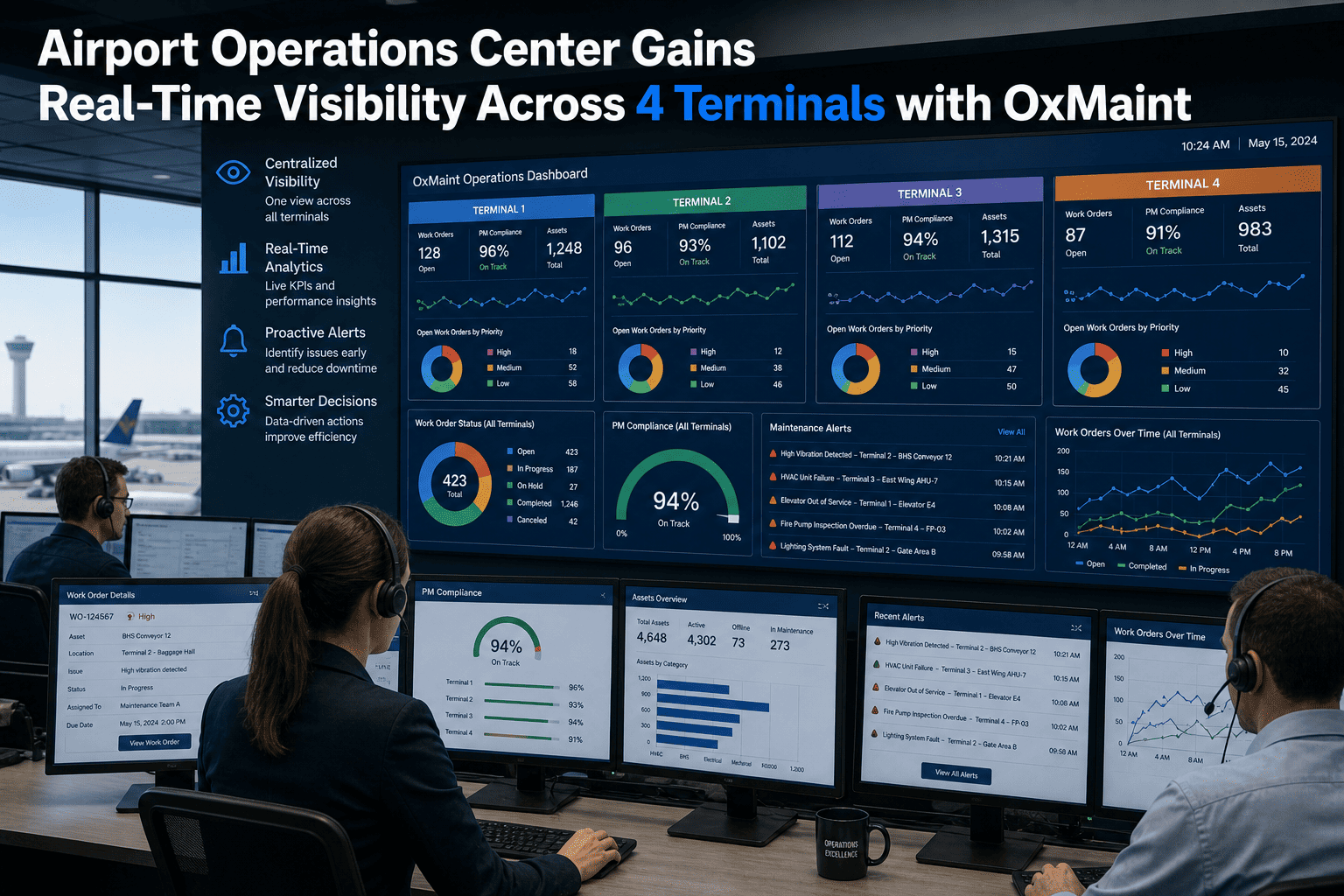
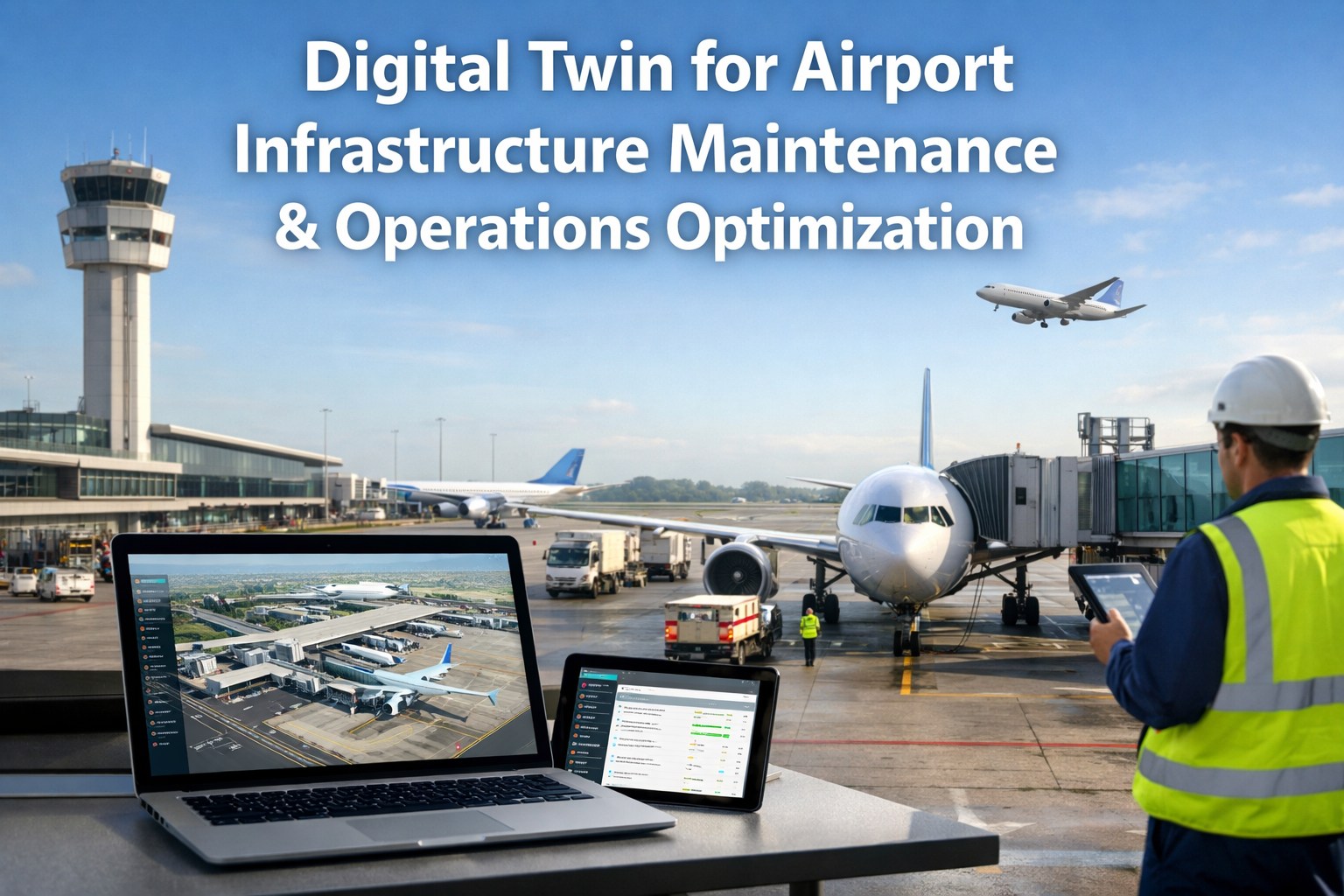
Airport infrastructure failures are not random — they follow patterns that become visible only when you connect sensor data, maintenance history, and operational context into a unified model that can simulate what happens next. Digital twin technology creates that unified model: a live, learning virtual replica of your terminals, runways, baggage systems, and ground support equipment that runs continuous simulations, detects anomalies, and predicts failures before they cascade into flight delays, passenger chaos, and emergency repair bills. If you want to see how real-time airport simulation works in practice, start a free trial with Oxmaint — or book a 30-minute demo to discuss your specific airport infrastructure.
Airport Digital Twins Are No Longer Pilot Projects — They Are Delivering Measurable ROI at Major Hubs Worldwide
The global airport digital twin market reached $1.12 billion in 2024 and is expanding at 22.4% annually toward $8.6 billion by 2033 — driven by airports that have proven the technology reduces downtime, cuts maintenance costs, and transforms operations from reactive to predictive.
Your Airport Already Has the Data — What You Need Is the Intelligence Layer
IoT sensors on jet bridges, baggage carousels, HVAC systems, and ground support equipment are generating data every second. The missing piece is a maintenance platform that structures that data into actionable predictions. Oxmaint builds that intelligence layer — transforming raw sensor streams into work orders that prevent failures before they reach the ramp.
What an Airport Digital Twin Actually Does — And Why It Matters for Your Operations
An airport digital twin is a continuously updated virtual model of your physical infrastructure — terminals, runways, baggage handling systems, jet bridges, ground support equipment, HVAC, electrical, and security systems — that mirrors real-time operating conditions using live sensor data. It is not a static 3D model for architects. It is a dynamic, data-fed simulation that learns how your assets actually behave under real operating loads, then predicts when and how they will fail.
The physical infrastructure sends data — vibration readings, temperature, current draw, pressure, passenger flow counts, equipment cycle times — through IoT sensors to the digital model. The model processes that data against physics-based equations, historical maintenance records, and machine learning algorithms to produce the one output that matters: a prediction of which asset will fail next, and what to do about it before it disrupts a single flight. Ready to see how this works for your airport? Start a free trial and connect your first assets today.
Why Traditional Airport Maintenance Is Failing — And What It Costs You
Airports operate thousands of critical assets across terminals, runways, and ground operations — each with different failure modes, maintenance intervals, and operational dependencies. Without a unified view, maintenance teams are always reacting to the last crisis instead of preventing the next one.
Unplanned downtime costs industrial operations $260 per minute on average. For airport-critical systems like jet bridges and baggage handling, the cascading impact on flights makes the true cost far higher.
Proactive repairs cost 3-5x less than emergency repairs. When a belt loader fails mid-turnaround, you pay overtime premiums, expedited shipping, and rushed contractor rates — plus the airline delay penalty.
37% of airports lack integration between BIM, CMMS, and operational systems. Maintenance teams cannot see dependencies — a cooling system failure that will cascade to IT infrastructure within 4 hours goes undetected.
Airports face rising passenger volumes and shrinking maintenance workforces. Technicians spend only 25-35% of their time on actual repairs — the rest is finding parts, waiting for equipment, and traveling between assets.
These problems compound when your maintenance data lives in spreadsheets, paper logs, and disconnected systems. Want to see how airports are solving this? Book a demo and we will walk through your specific operational challenges.
Six High-Impact Digital Twin Applications for Airport Operations
Digital twins are not a single solution — they are a platform capability that unlocks different value in each operational context. These six applications are generating the strongest ROI at airports today.
The digital twin runs continuous simulations of asset degradation trajectories — jet bridges, baggage carousels, HVAC chillers, escalators. When vibration patterns or thermal signatures deviate from baseline, the twin calculates remaining useful life and triggers a work order before the failure stops operations.
Integrating passenger movement data with digital twin models helps airports optimize signage, reduce congestion, and allocate security staff dynamically. Real-time flow visualization identifies bottlenecks before they cascade into delays — and measures exactly how infrastructure changes will affect throughput.
Ground support equipment — pushback tractors, belt loaders, GPU units — is scattered across multiple terminals with no visibility into condition. Digital twins track each unit's location, utilization, and maintenance status, ensuring the right equipment is at the right gate before aircraft arrival.
Terminals consume massive amounts of energy for HVAC, lighting, and equipment operation. Digital twins model energy draw under different conditions, identifying assets running inefficiently and optimizing schedules around peak tariff periods — supporting carbon reduction targets while cutting costs.
Before breaking ground on terminal expansions or runway projects, the digital twin simulates construction impacts on operations — identifying which gates will be affected, which passenger flows will be disrupted, and where temporary capacity needs to be created. Guangzhou Airport increased construction efficiency by 25% using 4D modeling.
Digital twins enable simulation of disaster scenarios, security incidents, and evacuation routes without disrupting actual operations. Teams can explore the best evacuation paths, test emergency equipment placement, and train staff in immersive virtual environments before real emergencies occur.
Airport Digital Twin Success Stories
Built the first real-time 3D digital twin in North America using Unity. The twin uses historical and real-time data to enable data-driven decision making, streamline maintenance processes, and improve collaboration across operations. The maintenance team can access work orders from mobile devices and view nearby tasks on a map.
Deployed Bentley Systems' Maps@SYD digital twin using historical and real-time data from multiple sources. Project managers overlay environmental studies and operational information including airspace obstacle limitation surfaces and noise contours — turning infrastructure into a single source of truth.
Deployed motional digital twins combining LiDAR data with flight, video, and operational information to create a continuously updated 3D model of people, baggage, vehicles, and aircraft. Real-time demand forecasting enables proactive congestion management and dwell-time optimization.
Used 4D modeling with Bentley SYNCHRO to simulate complex road construction projects before execution. The team ran detailed rehearsals for the trickiest parts of the build, reducing errors and accelerating delivery of one of China's most complex airport infrastructure projects.
These airports started with structured maintenance data as their foundation. Want to build the same foundation? Start your free trial today.
What Changes When Digital Twins Enter Airport Operations
| Operational Decision | Without Digital Twin | With Digital Twin |
|---|---|---|
| When to schedule maintenance | Fixed calendar intervals or after failure | When twin signals approaching failure threshold |
| Repair vs replace decision | Engineering judgment, incomplete history | Remaining useful life from actual usage data |
| Passenger flow optimization | Historical averages, reactive staff allocation | Real-time simulation, predictive staffing |
| GSE fleet deployment | Radio calls, manual tracking, gate delays | Live location, condition-based dispatch |
| Capital project planning | Drawings and spreadsheets, discover conflicts during construction | 4D simulation validates impact before breaking ground |
| Energy management | Annual audits, static recommendations | Continuous real-time modeling per asset per zone |
Scroll horizontally to view full table on mobile
How to Start Your Airport Digital Twin Journey — Without a Multi-Million Dollar Budget
The highest-ROI deployment strategy is not a plant-wide overhaul. It is starting with one high-impact asset category, proving the economics, and scaling from documented results.
Calculate total annual cost of failures by asset category: emergency parts, overtime, flight delays, airline penalties. Jet bridges? Baggage carousels? GSE fleet? The category with the highest failure cost is your starting point — the economics of prevention are most compelling there.
Before installing sensors, inventory what data exists: BIM models, CMMS records, sensor outputs, manual inspection logs, production data. Digital twin models built with rich maintenance history outperform those relying on sensor data alone — structured CMMS data is foundational, not optional.
Install sensors appropriate for primary failure modes: vibration for rotating equipment, thermal for electrical, pressure for hydraulic. Run 4-8 weeks under normal conditions to establish baseline signatures the twin uses to detect deviations. Cover all operating modes — startup, full load, shutdown.
A digital twin generating predictions no one acts on is a data science experiment, not a business tool. Predictions must connect to a CMMS that creates work orders, assigns technicians, checks parts availability, and tracks completion. The feedback loop makes predictions progressively more accurate.
Compare downtime, maintenance cost, and MTBF against 12-month baseline. Validated ROI from one asset category is the business case for the next five. Scale sequentially — adding categories as capability matures — rather than attempting simultaneous deployment that overwhelms your team.
Most airports achieve measurable improvement within 60 days of first asset configuration. Ready to start? Book a consultation and we will map your specific implementation path.
The Four Layers of Airport Digital Twin Intelligence
IoT sensors on jet bridges, baggage systems, HVAC, escalators, GSE. Data transmitted via OPC-UA, MQTT, or BACnet to centralized processing. Typical coverage: 4-12 measurement points per critical asset.
Raw sensor streams cleaned, normalized, fused with maintenance history, flight schedules, and environmental data. Context transforms signals into meaningful equipment state — a vibration spike means something different if the baggage carousel just handled a peak rush.
Physics-based equations model asset degradation. Machine learning algorithms trained on historical failure data recognize signatures preceding specific failure modes. Models run continuously, updating failure probability and remaining useful life as new data arrives.
Predictions trigger structured work orders in Oxmaint — pre-populated with asset history, required parts, technician assignment. Completed work orders feed back into the model. Each maintenance event makes the twin smarter: predictions refine based on what inspections actually found.
Digital Twins for Airports — Questions Decision-Makers Ask
How much does it cost to implement a digital twin for airport infrastructure?
Pilot deployments targeting a single asset category — GSE fleet, jet bridges, or baggage handling — typically range from $50,000 to $200,000 depending on existing sensor infrastructure and integration complexity. Airports using Oxmaint as their CMMS already have structured maintenance history that reduces implementation costs by eliminating the data reconstruction step. Cloud-based platforms have also significantly reduced upfront capital compared to on-premise deployments.
What data does an airport digital twin need to predict equipment failures accurately?
Effective failure prediction requires three data streams: real-time sensor telemetry, historical maintenance records showing what was repaired and when, and operational context including flight schedules, passenger loads, and environmental conditions. Airports without structured digital maintenance history can still deploy digital twins, but prediction accuracy improves 20-30% when historical work order data is available. Talk to our team about building your data foundation.
How long does it take to see ROI from an airport digital twin implementation?
Most airport implementations targeting high-failure-cost assets demonstrate positive ROI within 6-12 months, with some seeing payback in as little as 4-6 months. The first prevented failure event often represents the full pilot implementation cost. A regional airport documented $820,000 in annual savings and 38% downtime reduction within 11 months of deploying digital maintenance management across their GSE fleet.
Can digital twins work for existing airport infrastructure that was not designed with IoT in mind?
Yes — the majority of successful deployments are built on legacy infrastructure retrofitted with external sensors rather than replaced with connected-native equipment. Wireless vibration, temperature, and current-draw sensors can be installed non-invasively on motors, pumps, and compressors without operational disruption. The key constraint is data quality: a legacy asset with rich maintenance history in a digital system like Oxmaint supports more accurate predictions regardless of sensor sophistication.
The Maintenance Data You Capture Today Becomes the Intelligence Your Digital Twin Learns From Tomorrow
Every work order completed in Oxmaint — asset, fault type, parts used, time taken, corrective action — becomes a training data point that makes your future digital twin predictions more accurate. Airports that build structured, searchable digital maintenance history today are the ones whose digital twin implementations will outperform competitors in two years. Start your data foundation with Oxmaint now, or talk to our team about connecting your sensor infrastructure to a maintenance execution platform that closes the prediction-to-action loop.