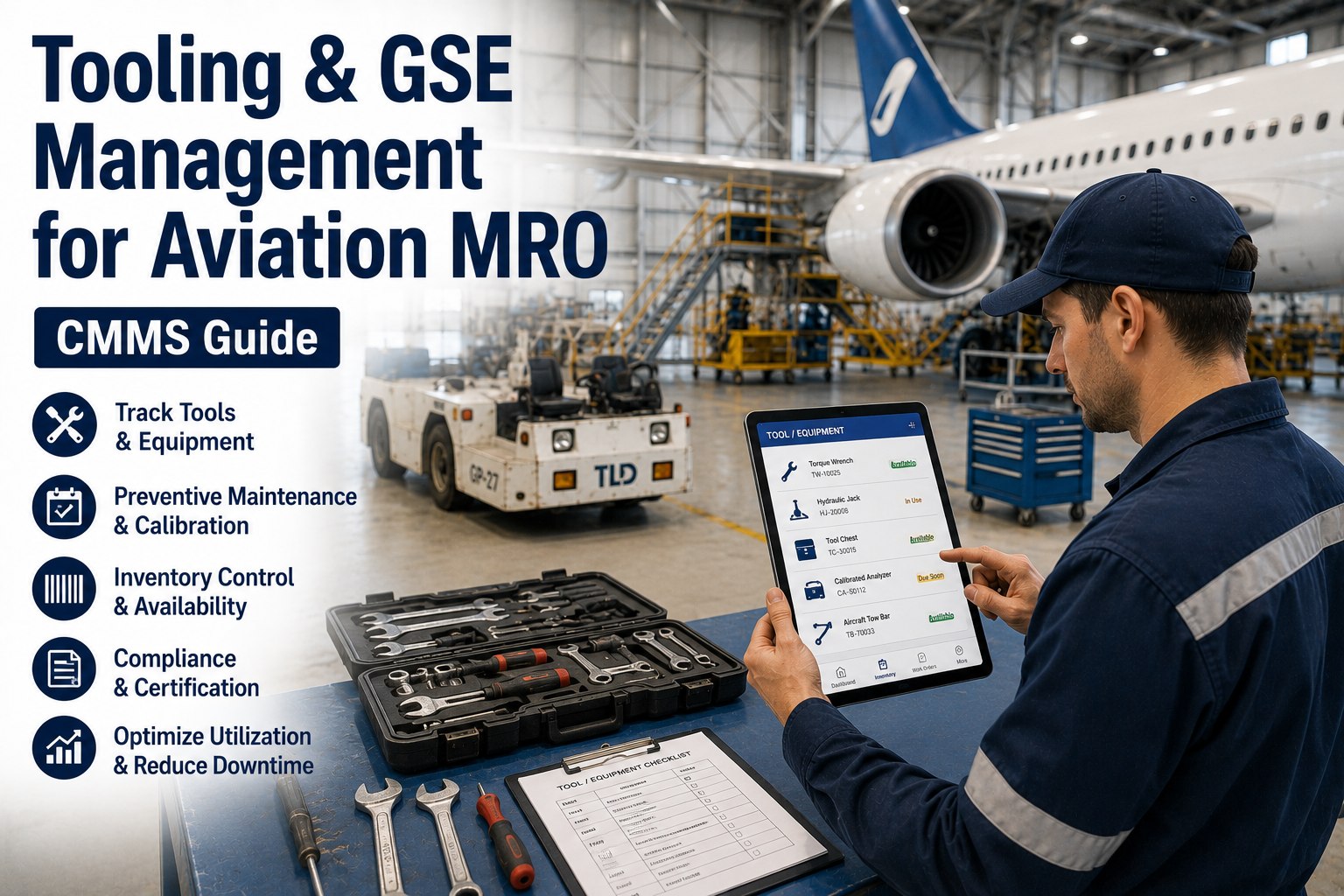
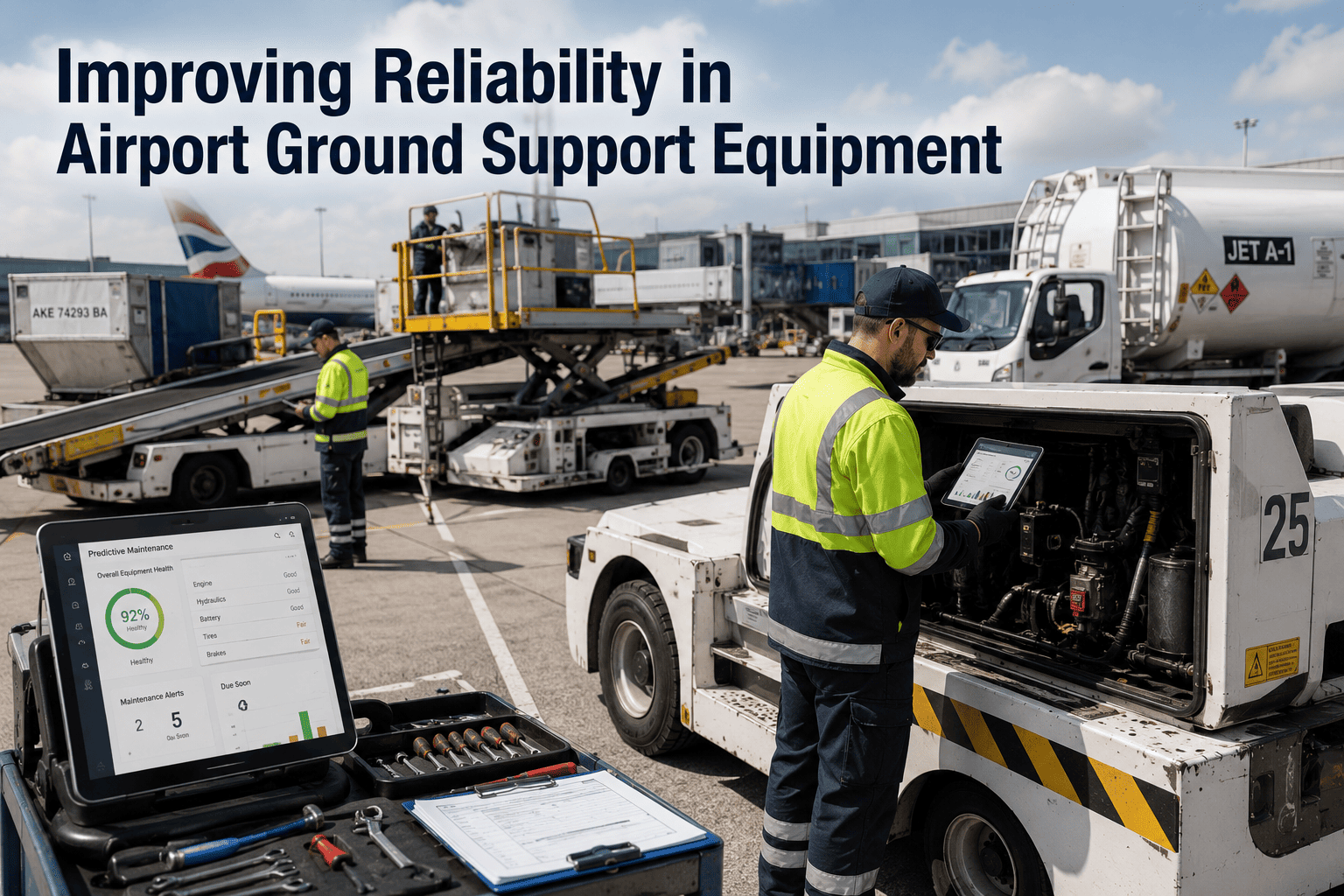
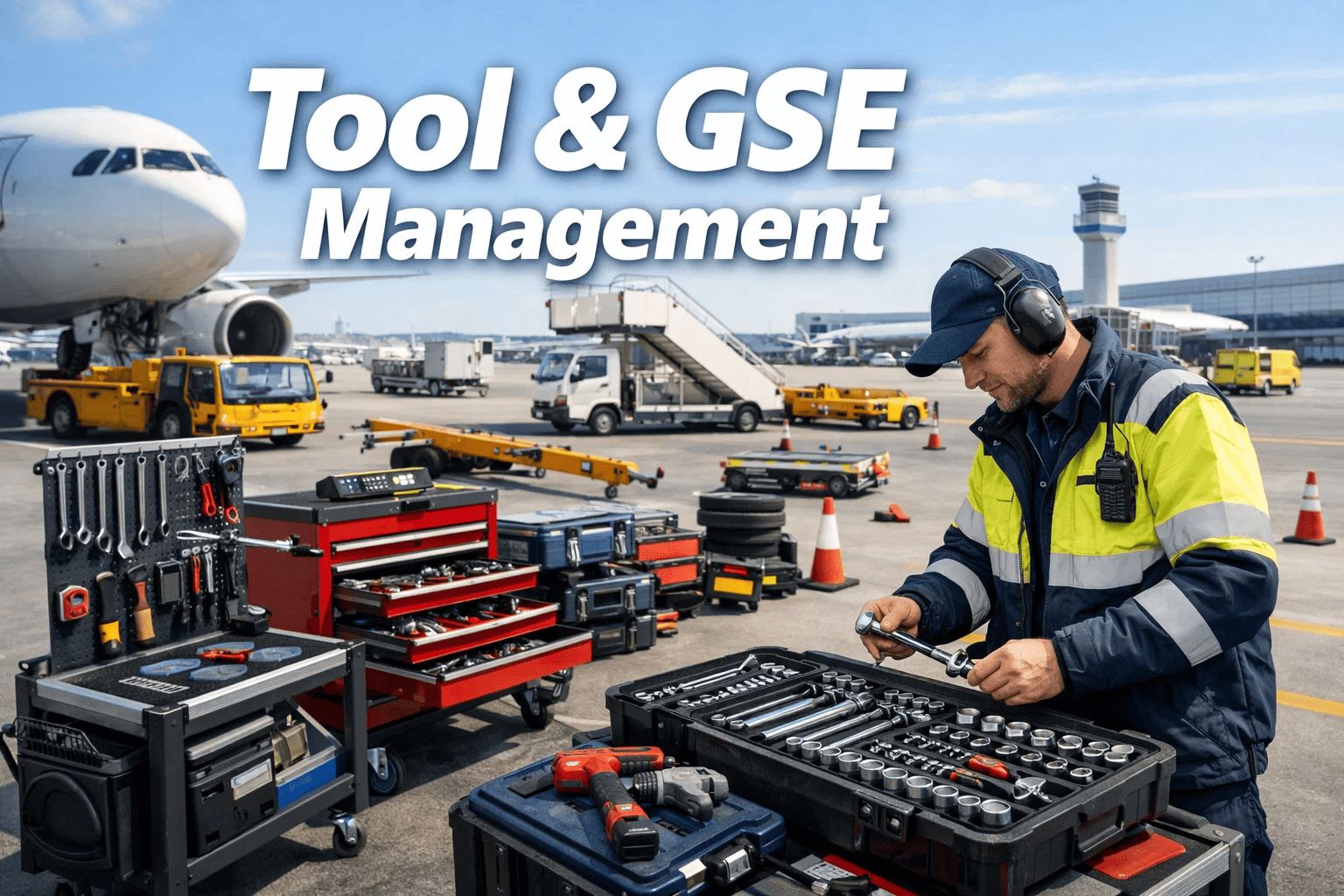
Missing or expired tooling grounds aircraft as fast as missing parts — yet most MRO facilities cannot tell you, at this moment, where every calibrated torque wrench, hydraulic jack, and NDI test block actually lives. A single overdue calibration on a critical torque tool can delay a C-check by 24 to 72 hours, burning $15K–$40K per grounded aircraft per day in lease, slot, and crew costs. Tooling and ground support equipment (GSE) management built directly into your CMMS closes that gap, automating custody transfer, calibration due-dates, and PM schedules so no aircraft is ever delayed by a missing tool again. Ready to stop hunting for tools and start tracking them? Start Free Trial.
Aviation MRO Tooling Guide · 2026
Do you know exactly where every calibrated tool is — right now?
Most MROs lose 4–8 hours per week per technician chasing misplaced torque wrenches, hydraulic jacks, and NDI test blocks. Tooling custody built into your CMMS eliminates the search and the paperwork, so no aircraft ever waits on a missing tool.
7
hours per technician, per week, lost to tooling hunts across a typical line-station — the figure a CMMS tooling module eliminates within the first 30 days.
The True Cost of Lost Tooling
A missing 3/8-inch torque wrench costs more than you think
Tooling gaps are rarely tracked because they hide inside delay codes labeled "parts," "waiting tech," or "ground time." When MROs isolate tooling-caused delays, the numbers are sobering.
$26K
Average daily cost of a grounded narrowbody aircraft waiting on tooling — lease, slot, crew, and re-positioning.
18%
Of AOG and critical-path delays in a typical MRO trace back to missing, expired, or out-of-calibration tooling.
72hr
Maximum allowable torque-wrench recalibration window under FAA AC 120-80A before a tool is legally unairworthy.
3.2x
Higher replacement spend at MROs without CMMS-based custody versus those with barcode checkout at the tool crib.
CMMS Tooling Custody Workflow
Five steps from tool-crib request to traceable return
A CMMS-anchored workflow removes the paper logbook and replaces it with an auditable, real-time custody chain that satisfies FAA, EASA, and CAA inspectors on demand.
01
Request & Reserve
Technician requests the tool via the CMMS mobile app; the system verifies calibration status, current custody, and task-card linkage before approving issue.
02
Issue & Custody Transfer
Tool-crib attendant scans the tool's barcode or RFID tag; custody legally transfers to the technician with a timestamped, user-attributed record.
03
Use on Aircraft
The tool is linked to the specific aircraft tail, work order, and step in the task card — providing full traceability from torque value to technician identity.
04
Return & Inspection
On return, the crib attendant logs condition, usage hours, and any damage; the CMMS auto-flags tools due for recalibration before re-stocking.
05
Auto-Reconciliation
At shift change, the CMMS auto-reconciles issued tools against returns, immediately pinging supervisors with any open-custody exceptions.
Calibration & Compliance Tracking
Never let an expired torque wrench ground another aircraft
Calibration management is the single highest-risk tooling control in aviation MRO. A CMMS automates the calendar, the alerts, and the audit trail — eliminating manual spreadsheets that inspectors routinely flag.
| Tool Class |
Calibration Interval |
Standard / Reference |
CMMS Alert Window |
Auto-Lockout |
| Torque wrenches (click-type) |
Every 90 days or 5,000 cycles |
ASME B107.300 / AC 120-80A |
15 days prior |
Yes — at expiry |
| Hydraulic jacks (10–50 ton) |
Annual + load-test every 6 months |
ASME PALD-1 / OEM SMM |
30 days prior |
Yes — at expiry |
| NDI test blocks (UT / ET) |
Annual verification |
NAS-410 / ASTM E1444 |
30 days prior |
Yes — at expiry |
| Borescopes & videoprobes |
Annual OEM service |
OEM SMM (e.g., GE, Olympus) |
45 days prior |
Recommended |
| Multimeters & cable testers |
Annual calibration |
ANSI/NCSL Z540-3 |
30 days prior |
Yes — at expiry |
| Pull-test rigs (cable tension) |
Every 180 days |
OEM SMM / ATA Spec 2000 |
20 days prior |
Yes — at expiry |
Worked Example · Widebody C-Check
A 14-aircraft MRO recovered 1,960 labor hours per year
A regional widebody MRO operating two C-check bays audited its tooling delays over 12 months. The findings below are typical for a mid-size facility still relying on paper logbooks and wall-mounted calibration stickers.
−42%
Reduction in tool-search time per technician per shift after barcode checkout went live.
$186K
Annual labor-cost recovery from eliminated hunting, waiting, and rework hours.
0
Out-of-calibration tool findings during the subsequent 12-month FAA ramp inspection.
8 mo
Payback period on the CMMS tooling module including hardware, training, and rollout.
GSE Preventive Maintenance
Ground support equipment is tooling at scale — manage it the same way
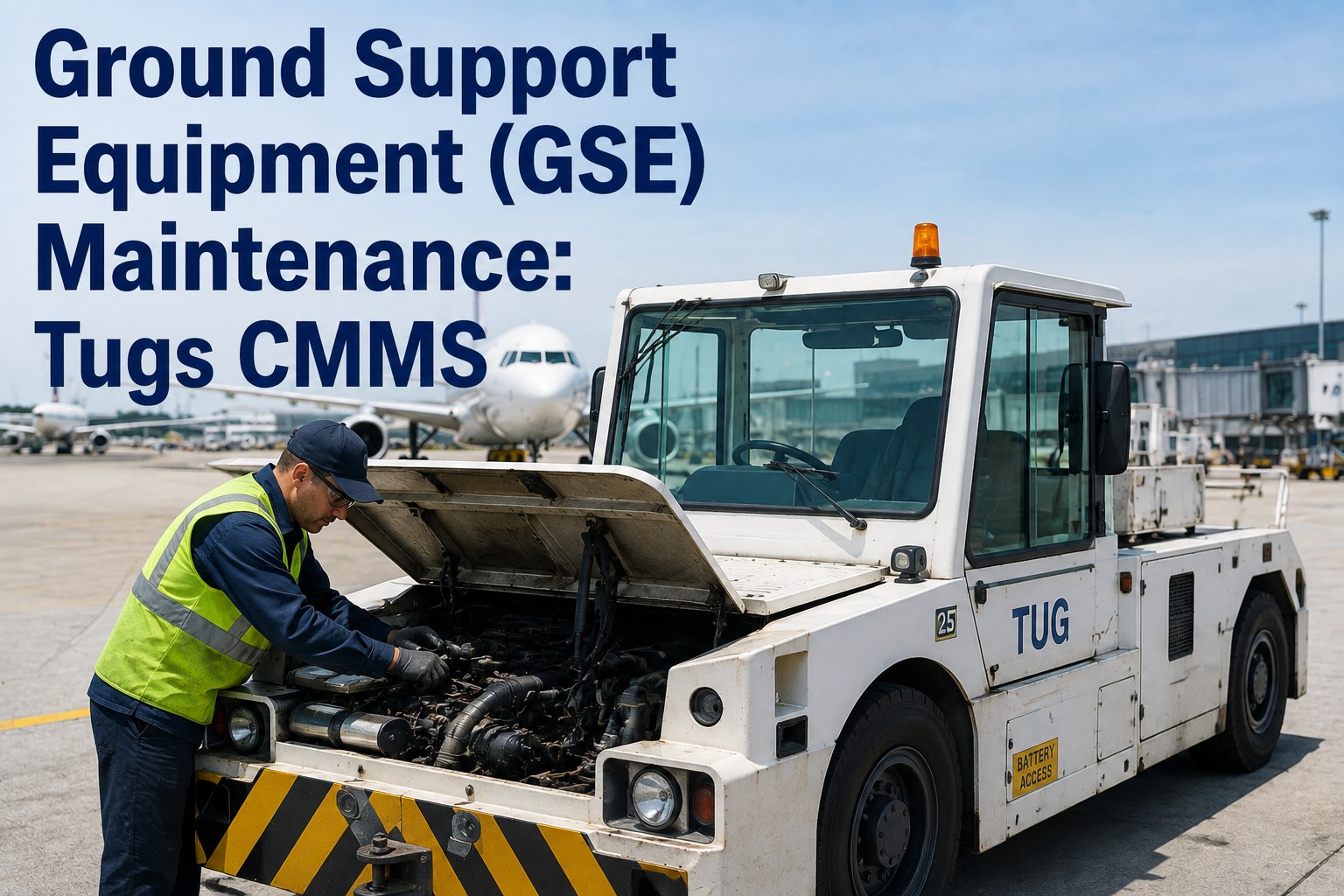
Tow tractors, GPUs, air-start units, and de-icing trucks are calibrated assets with their own PM schedules, hydraulic-fluid intervals, and certification cycles. A unified CMMS treats GSE with the same discipline as bench tooling.
Tow Tractors & Tugs
PM interval250 hrs / quarterly
Critical PMsBrake torque, tow-pin wear, hydraulic pressure
ComplianceOEM SMM + IATA AHM 913
Ground Power Units (GPU)
PM interval500 hrs / semi-annual
Critical PMsOutput voltage, frequency, cable insulation
ComplianceISO 6858 / FAA AC 150/5210
Air Start Units (ASU)
PM interval300 hrs / quarterly
Critical PMsBleed-air pressure, fuel system, EGT calibration
ComplianceOEM SMM + SAE AS8080
Hydraulic Jacks
PM intervalAnnual + 6-mo load test
Critical PMsRelief valve, seal integrity, load-cell cert
ComplianceASME PALD-1 / OEM SMM
Testimonial
What a calibrated tooling program delivers on the hangar floor
5/5
★★★★★
"Within 60 days of switching to a CMMS-driven tool crib, we cut tool-search time by 40 percent and passed our EASA audit with zero calibration findings. The custody trail alone saved us roughly 30 hours of paperwork per month."
Director of Maintenance
Tier-1 MRO, 6-bay widebody facility
Stop chasing tools. Start tracking custody.
Deploy a CMMS tooling module that knows where every calibrated asset is, who holds it, and when it is due back — before it delays your next delivery.
Frequently Asked Questions
Aviation MRO tooling & GSE management, answered
How does a CMMS track torque-wrench calibration due dates automatically?
Each tool is created as a calibrated asset with a defined interval (e.g., 90 days or 5,000 cycles). The CMMS calculates the next due date from the last calibration event, sends escalating alerts at 30, 15, and 5 days out, and automatically locks the tool from checkout once it expires — so no technician can legally issue an unairworthy tool. See it in action when you
Start Free Trial.
What happens if a technician does not return a tool at shift change?
The CMMS runs an end-of-shift auto-reconciliation that compares issued tools against scanned returns. Any open-custody item triggers an immediate supervisor alert with the tool ID, technician name, tail number, and timestamp — turning a next-morning surprise into a same-shift resolution.
Can the system manage both bench tooling and ramp GSE in one platform?
Yes. A unified aviation CMMS treats a $400 torque wrench and a $180,000 tow tractor with the same discipline — asset record, PM schedule, calibration or certification cycle, custody chain, and audit trail — so maintenance control has a single source of truth across the hangar and the ramp.
How long does it take to roll out CMMS tooling management in an MRO?
A typical mid-size MRO (10–20 aircraft, 1,500–3,000 tools) goes live in 4 to 8 weeks: tool data import, barcode or RFID tagging, calibration baseline import, tool-crib hardware setup, and technician training. Most facilities recover the implementation cost inside the first 8 to 10 months of operation.
Does the CMMS generate the audit trail required by FAA and EASA inspectors?
Yes. Every custody transfer, calibration event, PM completion, and exception is timestamped and user-attributed, exportable as a PDF or CSV audit packet. The system satisfies FAA AC 120-80A, EASA Part-145 tooling controls, and ISO 9001 / AS9100 traceability requirements. Want a live walkthrough?
Book a Demo.
Eliminate lost-tooling delays in 30 days
Deploy a CMMS tooling and GSE module that gives you real-time custody, automated calibration alerts, and a bulletproof audit trail — without spreadsheets, stickers, or shift-end surprises.
Free 14-day trial · No credit card