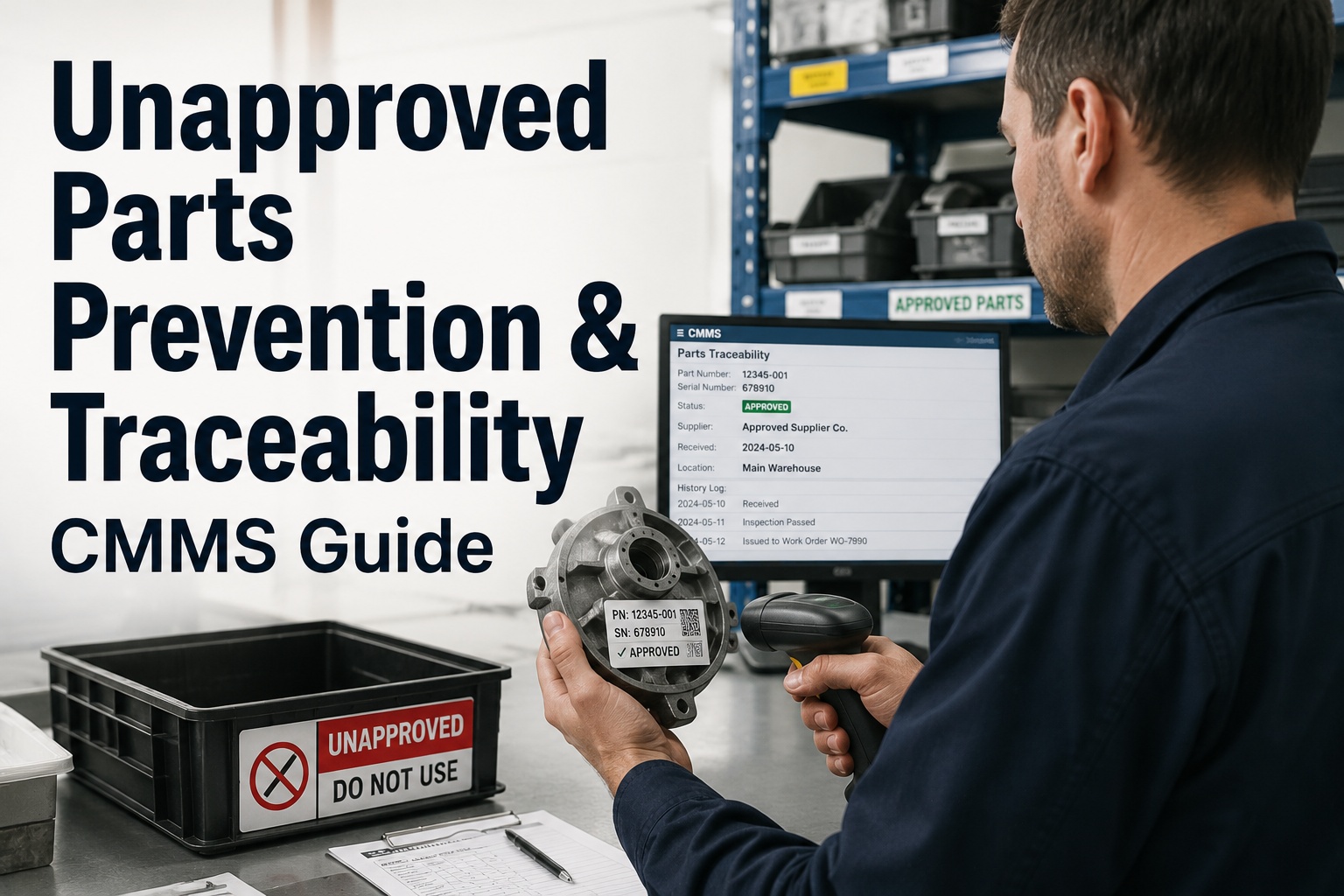
Unapproved parts in aviation maintenance are not a paperwork problem — they are an airworthiness threat that can ground aircraft, trigger FAA enforcement, and end operator certificates. This unapproved parts prevention and traceability CMMS guide covers how maintenance teams use modern CMMS platforms to verify FAA Form 8130-3 and EASA Form 1 certificates, enforce receiving-inspection controls, and build a SUP prevention program regulators trust. If your team is still tracking parts certificates in spreadsheets, the gap between compliance and a violation is one audit away — OxMaint closes that gap with AI-powered parts traceability, automated certificate matching, and instant grounding-investigation workflows. Start Free Trial to see it on your fleet today.
UNAPPROVED PARTS PREVENTION
Can your team prove every part on every aircraft is traceable — in under 60 seconds?
Suspected Unapproved Parts (SUP) remain one of the FAA's most serious aviation-maintenance findings. Without a CMMS that links each installed component to its 8130-3, EASA Form 1, supplier approval and receiving-inspection record, a single unapproved part can cascade into fleet-wide groundings, six-figure fines, and certificate revocation.
THE COST OF UNAPPROVED PARTS
Why unapproved parts aviation failures escalate fast
The FAA's Suspected Unapproved Parts Program (AC 21-29D) exists because the supply chain is porous — counterfeit, stolen, overhauled-without-authorization, and fraudulently tagged parts enter inventories through dozens of paths.
"A part without complete traceability isn't a part — it's a liability. The moment you cannot produce the certificate chain, the aircraft is unairworthy."
— FAA SUP Program guidance, AC 21-29D
CERTIFICATE VERIFICATION
Aviation parts certificate verification: 8130-3, EASA Form 1 & beyond
Parts traceability in a CMMS means every component installed on an aircraft is linked — digitally and immutably — to its origin certificate, supplier approval record, receiving inspection, and removal/installation work order history.
Supplier approval & sourcing controls
Before a part enters your facility, the vendor must be on your Approved Supplier List (ASL) with a valid FAA repair-station certificate, EASA Part-145 approval, or PMA/STC authorization. OxMaint stores each supplier's approval scope and expiration date, auto-flagging expired or out-of-scope vendors at PO creation.
Receiving inspection & certificate matching
At the dock, each inbound part's FAA Form 8130-3 or EASA Form 1 is scanned and matched against the PO line, serial number, and part number in OxMaint. Block-by-block verification — including block 13 (certification) and block 14a (authorized release signature) — runs automatically. Mismatches quarantine the part before it reaches stock.
Installation linking on work orders
When a mechanic installs a part, the CMMS work order captures the part's serial number, the aircraft tail number, the position/location, and the cert reference — creating a permanent digital thread. No part can be installed without a matched, unexpired certificate on file.
Continuous traceability & audit recall
From cradle to removal, OxMaint maintains a complete chain: manufacture date, first installation, TSN/TSO, cycling, removal reason, and next disposition. When the FAA or EASA audits, the full traceability report for any serial number is one query away — not a week of archive-diving.
BUILD THE PROGRAM
How to build a SUP prevention program regulators trust
A regulator-trusted program is not a binder of SOPs — it is a system of enforced controls that makes non-compliance structurally difficult. Here is the checklist audit-ready operators use.
Approved Supplier List with live expiry tracking
Every supplier in your CMMS carries its FAA/EASA approval number, scope, and expiration. OxMaint auto-notifies procurement 90/60/30 days before expiry and blocks POs to lapsed vendors.
Mandatory 8130-3 / Form 1 scan at receiving
No certificate, no stock-in. OxMaint's receiving-inspection workflow forces a digital certificate upload and field-by-field validation before the part moves from quarantine to available inventory.
Serialized part-to-aircraft installation record
Every installation is linked to a work order, tail number, position, and cert. The system prevents closing a work order until all installed parts have verified certificates — no exceptions.
Immediate grounding investigation workflow
When a SUP notification hits, OxMaint's reverse-traceability engine identifies every aircraft, position, and work order where a suspect serial or batch was installed — in minutes, not days.
Quarantine & discrepancy escalation
Parts with mismatched certs, damaged tags, or suspicious sourcing are automatically routed to a segregated quarantine location and flagged for quality-manager review before they ever reach the flight line.
Audit-ready traceability reporting
Generate a complete birth-to-current traceability report for any serial number — supplier, cert, receiving inspection, installations, removals, and current status — in a single click. That is what inspectors ask for.
SCENARIO
What a suspected-part notification costs — with and without CMMS traceability
Consider a regional operator with 45 aircraft that receives an FAA SUP notification for a batch of 12 brake assemblies from a specific supplier, suspect of fraudulent 8130-3 tags.
| Response Factor | Spreadsheet / Paper System | OxMaint CMMS Traceability |
|---|---|---|
| Identify affected aircraft | 3–5 days of manual logbook and PO archive search | Under 5 minutes via serial/batch reverse-trace query |
| Aircraft grounded during investigation | 8–14 aircraft, averaging 9 days each | Only confirmed-affected aircraft, grounded under 48 hours |
| Revenue loss | $420K–$980K at $12K/day per grounded aircraft | $58K–$120K — scoped and resolved before cascade |
| FAA penalty exposure | High — inability to demonstrate immediate investigation | Low — timestamped investigation report on demand |
| Crew & mechanic confidence | Eroded — "are any of our parts safe?" | Maintained — full visibility, surgical response |
In this scenario, the operator using OxMaint avoided roughly $640K in grounding revenue loss and demonstrated proactive SUP response to the FAA — the difference between a letter of correction and a certificate action. The operator on spreadsheets spent three weeks in reactive chaos and still faced enforcement.
HOW OXMAINT HELPS
OxMaint unapproved parts CMMS guide: 4 capabilities that close the gap
OxMaint was built for maintenance and reliability teams that cannot afford a traceability gap. Each capability below maps directly to a SUP prevention control — with a measurable outcome.
Automated certificate matching at receiving
OxMaint OCR-scans FAA Form 8130-3 and EASA Form 1 at the dock, validates every block against the PO and part master, and auto-quarantines mismatches. Outcome: 95% reduction in receiving-inspection time and zero uncertified parts reaching stock.
Immutable serial-to-tail installation tracking
Every work-order installation captures serial number, aircraft tail, position, and cert reference in a tamper-evident record. Work orders cannot close without verified certificates. Outcome: 100% installation traceability, auditable in seconds.
Reverse-trace grounding investigation engine
When a SUP notification arrives, OxMaint's AI-powered reverse-trace engine identifies every aircraft, position, and work order linked to a suspect serial or batch instantly. Outcome: Investigation time cut from days to under 10 minutes.
Supplier lifecycle & ASL enforcement
OxMaint tracks every supplier's approval scope, certificate number, and expiry — auto-blocking POs to lapsed or out-of-scope vendors and flagging high-risk sourcing patterns. Outcome: Eliminate procurement-path SUP risk before parts ship.
REAL RESULT
What changes when traceability is built into the workflow
"We moved from a spreadsheet-based parts log to OxMaint after a near-miss with a suspect batch of hydraulic actuators. The week we went live, OxMaint flagged two inbound parts with mismatched 8130-3 block entries that our manual process would have missed. Our last FAA ramp inspection took 40 minutes instead of two days — the inspector pulled a full traceability report on a serial number right there in the hangar."
Director of Maintenance
Part 121 Regional Carrier, 45-aircraft fleet
See OxMaint traceability on your fleet — book a 30-minute demo
Watch a live reverse-trace grounding investigation, certificate-matching workflow, and audit-ready traceability report on real-world aviation parts data. Bring your toughest SUP question.
FREQUENTLY ASKED
Unapproved parts prevention & CMMS traceability — answered
What is an unapproved part in aviation maintenance?
An unapproved part is any part, material, or appliance installed on a type-certificated aircraft that was not produced, maintained, or released under an FAA-approved system — including counterfeit parts, parts with fraudulent or altered 8130-3/EASA Form 1 tags, parts overhauled by unapproved facilities, and parts lacking complete traceability. The FAA's SUP Program (AC 21-29D) requires operators to detect, quarantine, report, and investigate them immediately.
How does a CMMS prevent unapproved parts from entering inventory?
A CMMS like OxMaint enforces prevention at three gates: supplier (ASL with live approval tracking and PO blocking), receiving (mandatory certificate scan and field-by-field validation before stock-in), and installation (work orders that cannot close without a matched, verified cert on the serialized part). Parts that fail any gate are auto-routed to quarantine. You can Start Free Trial to test the full receiving-inspection workflow on your parts.
What is parts traceability in aviation CMMS?
Parts traceability in a CMMS is the digital, immutable chain linking every installed component to its supplier approval, origin certificate (8130-3 or Form 1), receiving inspection, installation work order, aircraft tail and position, TSN/TSO, removal history, and current status. It enables forward-trace (where did this part go?) and reverse-trace (which aircraft have this suspect batch installed?) in seconds rather than days.
How fast can a CMMS identify aircraft affected by a suspected unapproved part?
With OxMaint, a reverse-trace query by serial number, part number, batch, or supplier returns every affected aircraft, installation position, and associated work order in under 10 minutes. Manual spreadsheet and paper-log searches typically take 3–5 days — during which affected aircraft may continue flying with suspect parts, compounding regulatory and safety exposure. Book a demo to see a live grounding-investigation query.
What records does the FAA expect during a SUP investigation?
The FAA expects operators to produce the complete traceability chain for every suspect part: supplier identity and approval, purchase order, receiving inspection record, 8130-3 or EASA Form 1 certificate, installation work order with mechanic sign-off, aircraft tail and position, and removal/disposition record. They also expect evidence of immediate quarantine and notification. OxMaint generates this full report in a single click — timestamped, auditable, and regulator-ready.
Make unapproved parts prevention structural — not procedural
OxMaint's AI-powered CMMS enforces certificate verification, serial-to-tail traceability, and instant grounding investigation so no uncertified part ever reaches your aircraft. Start in days, not months.
Free 14-day trial · No credit card