Warranty Management and Claims Tracking for Aviation Components

By Lewis Abbott on April 1, 2026

warranty-management-claims-tracking-aviation-components

Aviation components fail. But when they fail under warranty, every dollar of recovery depends on whether your team caught it, logged it, and filed it in time. Most MRO operations lose 30–40% of recoverable warranty value simply because claims are tracked in spreadsheets, emails, and memory. Want to stop leaving money on the table? start a free trial or book a demo with our aviation team today.

Aviation MRO · Warranty Operations · 2026

Stop Losing Warranty Money
You Already Earned

Aviation component warranties are worth millions — but only to teams who track, file, and recover them. This guide shows maintenance managers and MRO directors exactly where warranty value leaks out, and how modern CMMS tools seal every gap.

$2.1B
Unclaimed aviation warranty value annually across global MRO

38%
Of valid warranty claims filed late or missed entirely

4.8x
Cost difference between warranty-covered and out-of-pocket repairs

72 days
Average time to close a warranty claim without automation
Take Action Now

Your Warranty Recovery Gap Is Measurable — and Fixable

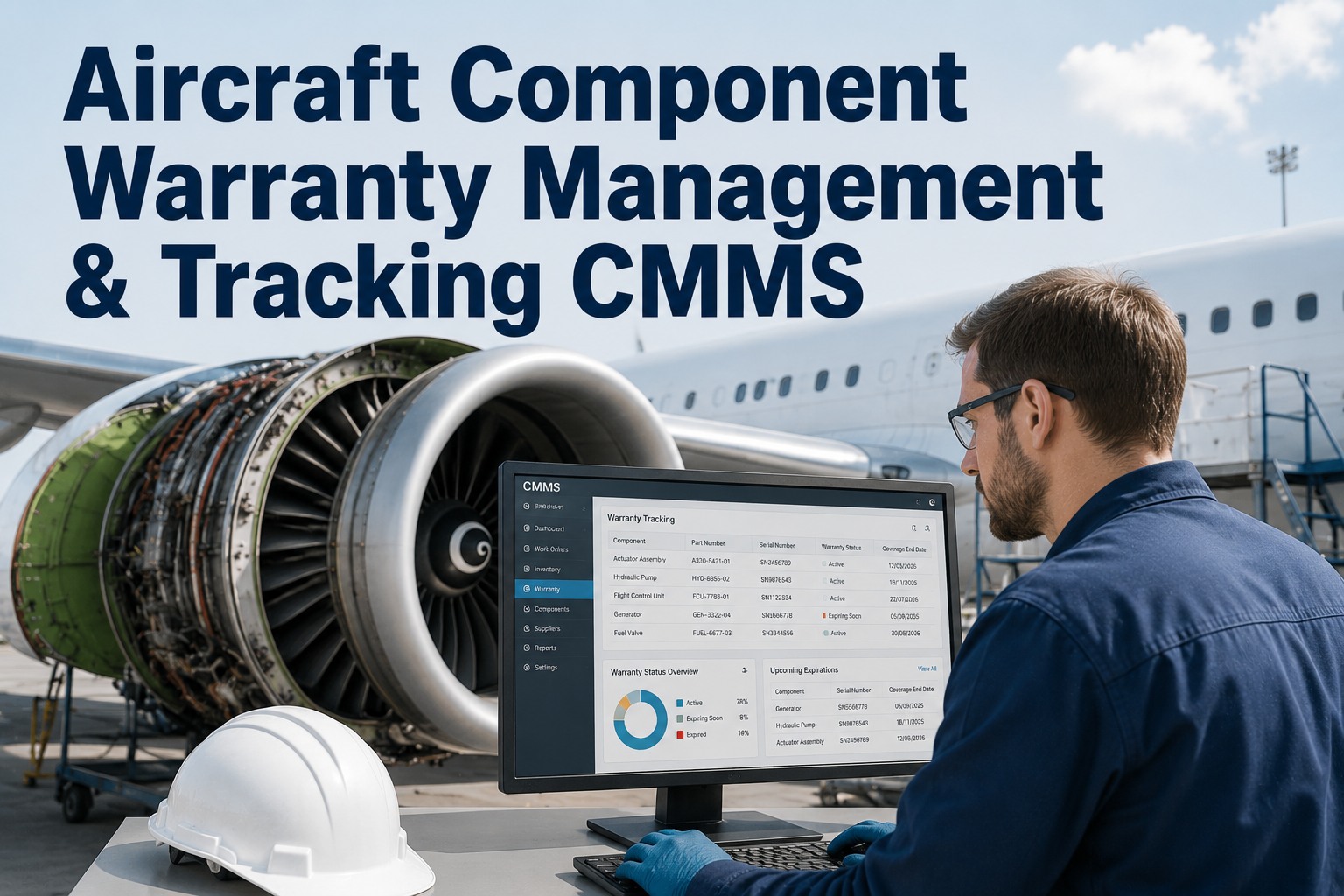
Oxmaint's warranty tracking module connects directly to your asset registry and work order history, so every eligible claim is flagged before the window closes. Teams using Oxmaint recover an average of 34% more warranty value in their first year. If your team is still filing claims reactively — after the repair is complete and someone remembers to check — you are already past the optimal filing window for many OEM agreements. Start a free trial and see your first uncaptured claims within 48 hours, or book a demo with an aviation warranty specialist.

The Foundation

What Is Aviation Component Warranty Management?

Warranty management in aviation is the end-to-end process of identifying components covered by OEM or supplier warranties, tracking their service life against warranty terms, filing claims when failures occur within coverage windows, and recovering costs from manufacturers or vendors — before deadlines expire.

It spans parts warranties (defect coverage by cycle, hour, or calendar date), workmanship warranties on repairs, and service agreements that cover labor reimbursement. Done right, warranty management is a revenue recovery operation. Done poorly, it becomes an afterthought that costs maintenance budgets millions per year. The difference is almost entirely about systems and process — not effort. Start a free trial to see how Oxmaint automates the tracking layer your team is missing right now, or book a demo to walk through a live warranty dashboard.

The 4 Warranty Types in Aviation MRO
01
New Parts Warranty
OEM coverage for defective components — tracked by install date, flight hours, and cycles
02
Repair Station Warranty
Workmanship coverage from certified repair facilities on overhauled components
03
Service Agreement Coverage
PBH and fleet hour agreements covering scheduled parts, labor, and exchange units
04
Vendor Warranty
Supplier-level coverage for avionics, tires, batteries, and consumable components
Where Money Disappears

8 Reasons Your Team Is Missing Warranty Recovery

None of these are unique to one airline or MRO. They are systematic failures that happen when warranty management is treated as a back-office task rather than a financial discipline.

01
No Centralized Warranty Register
Coverage terms live in vendor emails, purchase orders, and binders. Technicians cannot check warranty status at the point of removal — so claims never start.
02
Deadline Blindness
Most OEM warranty windows close 30–90 days after failure. Without automated expiry alerts, teams discover missed deadlines only when checking invoices months later.
03
Incomplete Removal Documentation
OEMs reject claims without exact removal reason, part serial number, and service history. Manual paper records lose this data 40% of the time before the claim is submitted.
04
No Link Between Work Orders and Coverage
Work orders are closed without anyone checking if the failed part falls under active warranty. The repair cost posts to budget with zero recovery attempt.
05
Parts Consumed Before Claim Is Filed
Defective parts are scrapped or returned to stock before anyone captures the documentation needed for an OEM claim. Physical evidence is gone — so is the recovery.
06
Multi-Vendor Tracking Complexity
A single aircraft carries components from 40+ vendors, each with different coverage terms, submission portals, and documentation requirements. Manual tracking collapses under this volume.
07
No Recovery Rate Visibility
Finance teams cannot report on warranty recovery rate, claim success rate, or pending claim value — because the data is scattered across departments with no single source of truth.
08
Repeat Failures on Same Component
Without warranty analytics, engineering teams cannot identify patterns in repeat removals — missing the evidence needed to escalate chronic failure issues to OEMs for goodwill or special warranty extension.
Before vs. After

Manual Warranty Tracking vs. Oxmaint Warranty Module

The operational gap between spreadsheet-based warranty management and a connected CMMS is not a question of convenience — it is a question of how much you recover.

Without Warranty Automation
Claim Identification
Manual — depends on technician memory
Deadline Tracking
Spreadsheet calendar — frequently missed
Documentation
Paper records — 40% incomplete at submission
Claim Processing Time
72+ days average from removal to recovery
Recovery Rate
Under 60% of eligible claims recovered
Repeat Failure Visibility
None — no pattern detection across fleet
With Oxmaint Warranty Module
Claim Identification
Automatic — flagged at point of work order creation
Deadline Tracking
Live expiry countdown — alerts at 30, 14, and 7 days
Documentation
Digital capture at removal — complete by default
Claim Processing Time
Under 18 days — documentation ready at closure
Recovery Rate
94%+ of eligible claims submitted on time
Repeat Failure Visibility
Analytics dashboard — escalation evidence built automatically

Ready to move from the left column to the right? Start a free trial or book a demo with our warranty operations team.

How Oxmaint Solves It

8 Warranty Module Features That Close the Recovery Gap

Each feature targets a specific point in the claim lifecycle where recovery leaks out under manual processes. Together they make missing a valid warranty claim nearly impossible.

01
Warranty Register Linked to Asset Records
Every component in the asset registry carries its warranty terms — OEM coverage period, flight hours limit, cycle cap, and vendor contact. Technicians see coverage status the moment they open a work order.
02
Auto-Flag at Work Order Creation
When a work order is raised on a component under active warranty, the system flags it instantly. No manual check required — the claim opportunity is visible before the wrench turns.
03
Expiry Countdown and Alert Engine
Live countdown on every open warranty claim. Automated alerts at 30, 14, and 7 days before OEM filing deadlines. Claims teams act on data — not on memory or calendar reminders.
04
Digital Removal Documentation
Technicians capture removal reason, failure description, serial number, and service history digitally at the point of removal. Documentation is OEM-submission-ready by the time the part leaves the aircraft.
05
Multi-Vendor Claim Dashboard
All open claims across every vendor — Boeing, Airbus, CFM, Honeywell, and 40+ others — consolidated in a single view. Filter by status, age, value, or aircraft registration. No switching between portals or spreadsheets.
06
Claim Value Tracking and Recovery Analytics
Track pending claim value, approved recovery, denied claims, and average cycle time by vendor. Finance teams get a live picture of warranty receivables — not a quarterly estimate compiled by hand.
07
Repeat Failure Pattern Detection
Analytics surface components with above-average removal rates within warranty windows. Engineering teams get the evidence needed to escalate chronic failures to OEMs for goodwill extension or fleet-wide remedies.
08
Audit-Ready Warranty History
Complete digital audit trail for every claim — who filed it, when, what documentation was submitted, OEM response, and final disposition. Fully searchable and exportable for regulatory reviews and fleet transactions.
Where Claims Get Lost

The Warranty Claim Lifecycle — and Where It Breaks

1
Component Removal
Part removed from aircraft. Failure reason captured on paper — or not at all.
Risk: Lost documentation
2
Warranty Check
Someone manually checks purchase records to see if part is in warranty.
Risk: Skipped under workload pressure
3
Claim Preparation
Compile serial number, removal reason, hours, cycles, photos. Submit to vendor portal.
Risk: Incomplete data causes rejection
4
OEM Review
OEM reviews claim — approves, requests more data, or denies. Average: 21–45 days.
Risk: No visibility on status
5
Recovery Posted
Approved credit or replacement part posted to account. Finance reconciles.
Goal: Maximum recovery, minimum cycle time

Oxmaint connects steps 1 through 5 in a single digital thread — so no documentation is lost, no deadline is missed, and finance always knows what is in the pipeline. Start a free trial and run your first automated warranty audit in under a day, or book a demo to see the full claim lifecycle in action.

Measured Results

What Automated Warranty Management Delivers

94%
Claims Submitted On Time
Versus under 60% for teams relying on manual tracking. Automated deadline alerts eliminate the most common cause of warranty forfeit.
34%
More Warranty Value Recovered
Average first-year improvement for Oxmaint users — driven by identifying eligible claims that were previously invisible at the point of work order creation.
18 days
Average Claim Cycle Time
Down from 72 days. Complete digital documentation at point of removal means claims are submission-ready the moment the work order closes — not weeks later.
3.2x
ROI in Year One
Recovery uplift from captured claims alone typically covers platform investment within the first two quarters, with compounding gains as the warranty register matures.
FAQ

Common Questions About Aviation Warranty Management

01 How does Oxmaint know which components are under warranty?

Warranty terms are entered once into the component's asset record — coverage type, start date, expiry trigger (calendar, hours, or cycles), vendor, and submission portal. From that point, Oxmaint tracks the component's service history against those terms automatically. When the component is pulled and a work order is raised, the system cross-references coverage status in real time. For new parts, warranty registration can be triggered at goods receipt so coverage begins tracking from the moment the part enters your inventory. No manual checking at the time of removal — the system has already done it.

02 Can we manage warranties across multiple aircraft types and vendors in one place?

Yes — multi-vendor and multi-fleet warranty management is the primary use case the module was built for. Each vendor has different claim windows, documentation requirements, and submission formats. Oxmaint stores these requirements per vendor and surfaces the relevant checklist when a claim is initiated. The consolidated dashboard shows all open claims across Boeing, Airbus, CFM, Honeywell, and any other vendor in a single view — sortable by value, age, status, and fleet. Airlines and MROs managing mixed fleets see the most significant recovery improvement because the complexity of manual multi-vendor tracking was suppressing their claim rate the most.

03 What documentation does Oxmaint capture to support OEM claims?

At point of removal, Oxmaint captures: part number and serial number, aircraft registration and tail number, removal reason and failure description, technician ID, removal date and flight hours at removal, total cycles at removal, prior work order history on the component, and any attached photos or inspection findings. This is the standard OEM claim package — assembled automatically rather than compiled manually after the fact. For vendors requiring specific claim forms, the module exports data in their preferred format. The result is that OEM rejections for incomplete documentation drop to near zero for teams running on Oxmaint.

04 How does warranty analytics help us escalate chronic failure issues?

Oxmaint surfaces components that are removed repeatedly within their warranty window — flagging part numbers with removal rates above fleet averages. This data becomes engineering evidence for OEM escalation. Airlines have used this pattern detection to negotiate goodwill warranty extensions, trigger OEM fleet campaigns, and secure special pricing on replacement parts for identified problem components. Without the analytics layer, these patterns are invisible in siloed work order histories — and the cost of chronic failures absorbs into maintenance budget with no recourse. With Oxmaint, repeat failure data is organized, exportable, and ready for OEM review meetings.

Your Warranty Recovery Starts Here

Every Day Without Automated Tracking Is a Claim You May Never File

Oxmaint gives aviation maintenance teams a complete warranty management system — from component registration through claim submission and recovery analytics — without lengthy implementation or consultant fees. Start recovering the warranty value already sitting in your asset records. Teams see their first uncaptured claim opportunities within 48 hours of going live.
Share This Story, Choose Your Platform!