Cement manufacturing is the third largest industrial source of air pollution, releasing over 500,000 tons of sulfur dioxide, nitrogen oxide, and carbon monoxide into the atmosphere every year. Dust emissions alone from kilns, clinker coolers, mills, and material handling systems create persistent compliance risks that traditional monitoring methods simply cannot keep up with. Manual visible emission observations happen a few times per week at best. Continuous opacity monitors cover only stack emissions. Neither approach catches the fugitive dust events at transfer points, storage areas, and open conveyors that regulators increasingly target. AI-powered camera systems change the equation entirely. They watch every emission source across your plant 24 hours a day, detect dust events in real time, quantify their severity, and generate the documentation you need before an inspector ever arrives. If your cement plant is managing emissions with periodic walk-throughs and aging opacity monitors, schedule a walkthrough with OxMaint to see how AI vision monitoring works on your actual facility layout.
EPA Enforcement
The cement sector is classified as the third largest industrial source of pollution by the U.S. EPA. Facilities face penalties of up to $25,000 per day per violation under NESHAP regulations, with mandatory compliance evaluations for major sources at least once every two years.
8%
of global CO2 emissions come from cement manufacturing
925 kg
of CO2 produced per ton of cement along with particulate matter
$25K
per day per violation under NESHAP for emission non-compliance
Where Dust Emissions Occur in a Cement Plant
Dust is not limited to the stack. Cement plants generate particulate matter at nearly every stage of production, from raw material extraction through final packaging. Understanding where emissions originate is the first step toward controlling them. AI camera systems are deployed across all of these zones to provide continuous visual monitoring that no manual inspection program can match.
High Risk
Kiln and Clinker Cooler
Primary source of HAP emissions including particulate matter, mercury, acid gases, and dioxins. Kiln exhaust and cooler vents release fine dust continuously during operation. PM2.5 can constitute up to 18% of emissions from dry process kilns.
High Risk
Raw Mill and Cement Mill
Grinding operations generate significant airborne particulates. Bag house filter leaks at mills are a leading cause of visible emission violations. AI cameras detect plume formation at mill vents within seconds of filter degradation.
Medium Risk
Crushers and Material Transfer
Limestone crushing and belt transfer points create localized dust clouds. These fugitive emissions are difficult to capture with traditional point monitors but clearly visible to AI camera systems positioned at strategic vantage points.
Medium Risk
Storage Silos and Packing
Silo filling, truck loading, and bag packing operations release cement dust into the ambient environment. These intermittent events are frequently missed by scheduled inspections but captured consistently by continuous AI monitoring.
Fugitive Sources
Haul Roads, Stockpiles, and Open Areas
Wind-blown dust from material stockpiles, unpaved haul roads, and open conveyor systems. These sources are difficult to monitor with any fixed sensor but are captured by wide-angle AI cameras covering large areas of the plant.
How AI Camera Monitoring Works
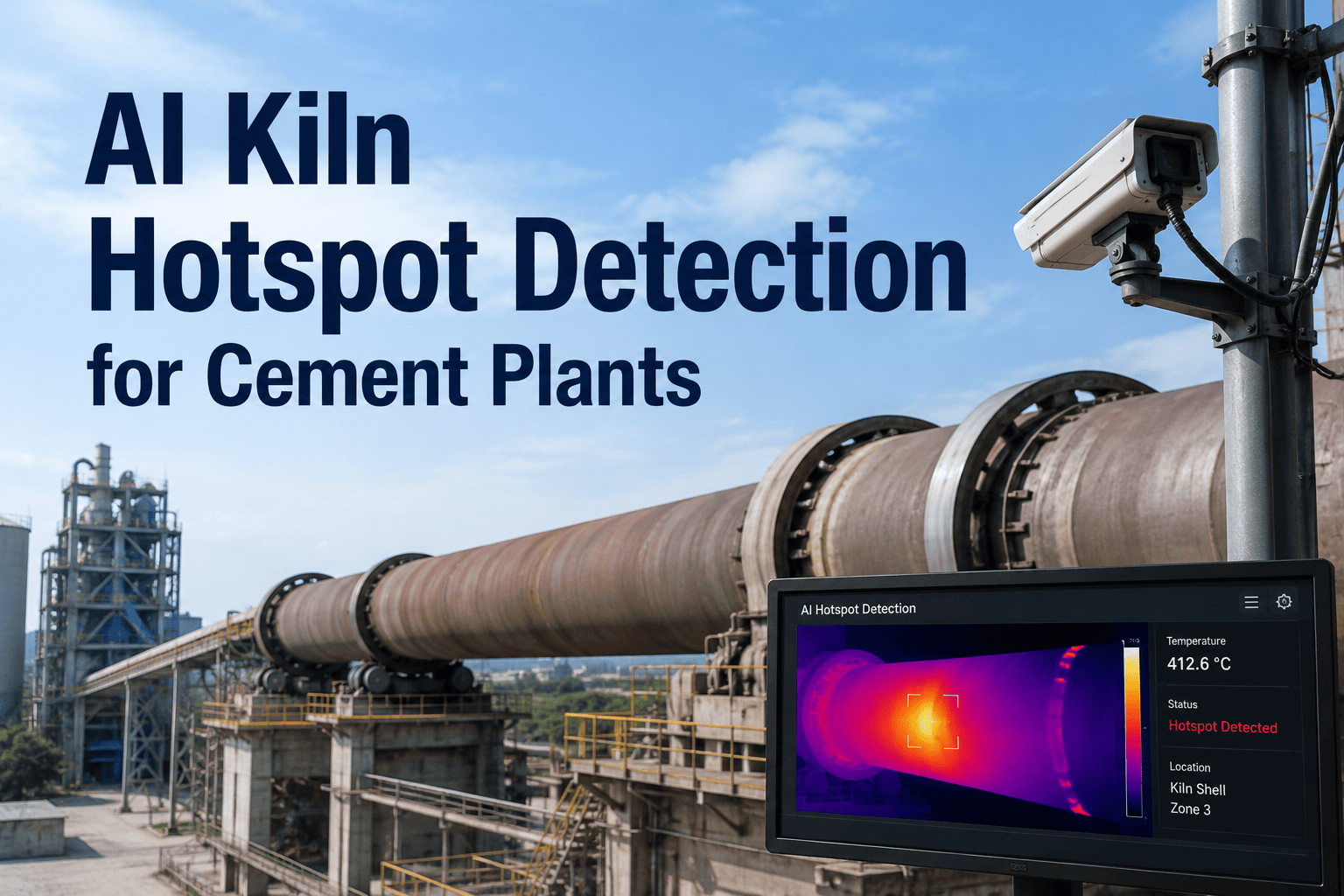
OxMaint deploys industrial-grade cameras at strategic positions across your cement plant. Each camera feeds a continuous video stream into an AI vision engine that has been trained specifically on cement plant dust patterns, distinguishing real emission events from steam, heat shimmer, fog, and normal ambient conditions.
1
Continuous Visual Capture
Industrial cameras rated for extreme heat, dust, and vibration capture video feeds from kiln stacks, mill vents, transfer points, storage areas, and plant perimeters. Each camera covers multiple emission sources simultaneously.
2
AI Dust Detection and Classification
Deep learning models analyze each frame to detect visible dust plumes, classify their source type (stack, fugitive, or process), estimate opacity levels, and distinguish genuine emissions from false positives like steam or heat haze.
3
Quantification and Severity Scoring
Each detected event receives a severity score based on plume density, duration, and spatial extent. The system correlates visual data with wind speed and direction to estimate dispersion patterns and potential boundary-line impacts.
4
Instant Alerts and Auto-Documentation
When emission levels cross your configured thresholds, OxMaint sends real-time alerts to plant operators and environmental managers. Every event is automatically logged with timestamped video, severity data, and source identification.
5
Compliance Reporting and Audit Trail
All detection data feeds into OxMaint's compliance dashboard, generating audit-ready reports for EPA, CPCB, state agencies, and internal environmental reviews. Historical data is searchable, exportable, and stored permanently.
See AI Camera Monitoring on Your Plant Layout
Walk through a live demo showing camera placement, real-time detection, and compliance reporting configured for cement manufacturing facilities.
AI Vision vs. Traditional Emission Monitoring
Coverage Area
Single stack or point source only
Entire plant including fugitive sources
Monitoring Frequency
Periodic observations or hourly averages
Continuous 24/7 real-time analysis
Fugitive Emission Detection
Not covered by fixed monitors
Full coverage of transfer points, roads, stockpiles
False Positive Rate
High (steam, fog trigger opacity alarms)
Low (AI trained to distinguish dust from steam/haze)
Documentation
Paper logs, manual data entry
Automatic timestamped video and event logs
Audit Readiness
Days of preparation before inspections
Always audit-ready with searchable compliance records
Response Time
Hours or days after event
Seconds from detection to alert
Measurable Results for Cement Plant Environmental Teams
85%
Faster Emission Event Response
Real-time alerts mean operators respond to dust events in minutes instead of discovering them hours later during walkthrough rounds
60%
Reduction in Emission Violations
Continuous monitoring and early detection prevent small issues like filter leaks from escalating into reportable compliance events
90%
Less Audit Preparation Time
All emission events are pre-documented with video evidence, timestamps, and corrective actions. No last-minute scramble before EPA or CPCB inspections
24/7
Continuous Plant-Wide Coverage
Every emission source monitored around the clock, including nights, weekends, and shift changes when manual observation gaps typically occur
What the AI Camera System Detects
The OxMaint AI vision engine is trained on thousands of hours of cement plant footage. It recognizes the visual signatures specific to cement manufacturing environments and classifies each detection with high accuracy.
Kiln exhaust opacity above threshold
Clinker cooler vent plumes
Bag house filter breakthrough events
Coal mill exhaust anomalies
Belt transfer point dust clouds
Crusher feed and discharge dust
Truck loading and unloading plumes
Stockpile wind erosion events
Silo filling overflow dust
Packing line particulate releases
Conveyor enclosure leaks
Bucket elevator seal failures
Environmental compliance in cement manufacturing has reached an inflection point. Regulators are moving beyond periodic stack tests and scheduled opacity readings toward continuous compliance demonstration. The cement sector emits over 500,000 tons of SO2, NOx, and CO annually, and particulate matter violations remain among the most frequently cited issues during EPA and state inspections. Plants that rely solely on continuous opacity monitors are covering only a fraction of their actual emission sources. Fugitive dust from transfer points, haul roads, and material handling accounts for a significant portion of total plant particulate emissions but goes unmonitored at most facilities. AI camera systems represent the first technology capable of providing true plant-wide emission surveillance at a cost that makes economic sense for cement operators.
Regulatory Trend: Continuous Compliance
EPA NESHAP Subpart LLL already requires continuous parametric monitoring for cement kilns and coolers. AI cameras extend this standard to every emission source across the plant
Community Relations and Social License
Visible dust events generate community complaints faster than any other emission type. AI detection and rapid response demonstrates environmental responsibility to neighbors and local authorities
Integration with Dust Suppression
OxMaint can trigger automated dust suppression systems including water sprays and fogging units the moment a dust event is detected, reducing human response dependency
Complete AI Vision Features for Cement Plants
24/7 AI-powered dust plume detection and classification
Automatic opacity estimation from visual analysis
Fugitive emission monitoring at transfer points and stockpiles
Real-time alerts via SMS, email, and dashboard notifications
Timestamped video evidence for every detected event
NESHAP, EPA, and CPCB compliance report generation
Steam and heat haze false-positive filtering
Wind speed and direction correlation for dispersion analysis
Automated dust suppression system triggers
Historical trend analysis and emission pattern reporting
Your Cement Plant Deserves Eyes That Never Blink
Join cement manufacturers using OxMaint AI camera systems to monitor every emission source continuously, respond to dust events in seconds, and stay audit-ready at all times. See the system configured for your plant layout.
Frequently Asked Questions
How does the AI distinguish dust from steam, fog, or heat haze?
The AI model is trained on thousands of hours of cement plant footage that includes all common visual conditions. Dust plumes, steam, fog, and heat shimmer each have distinct visual characteristics in terms of opacity gradient, edge definition, dispersion pattern, and temporal behavior. Dust rises and disperses differently than steam, which dissipates rapidly. The model analyzes these characteristics frame by frame to classify each detection accurately, achieving low false-positive rates even in plants with multiple steam vents near dust sources.
How many cameras are needed for a typical cement plant?
Camera count depends on plant layout and the number of emission sources to be monitored. A typical integrated cement plant with kiln, raw mill, cement mill, clinker cooler, crushers, and material handling systems requires between 8 and 20 cameras. Each camera can cover multiple emission sources depending on positioning and field of view. During the deployment assessment, OxMaint maps your plant layout and emission sources to determine optimal camera placement for complete coverage.
Does AI camera monitoring replace our existing opacity monitors?
No, AI cameras complement existing continuous opacity monitors and continuous emission monitoring systems. Regulatory requirements under NESHAP Subpart LLL may still require COM or PM CPMS for specific sources like kilns and clinker coolers. The AI camera system extends monitoring coverage to all the emission sources that traditional point monitors cannot cover, including fugitive sources, transfer points, storage areas, and plant perimeters. Together, they provide complete emission surveillance.
Can the system generate reports for EPA, CPCB, or state regulators?
Yes. OxMaint generates compliance reports formatted for EPA NESHAP requirements, CPCB norms, state environmental agency formats, and internal environmental management reviews. Reports include event summaries, severity trends, video evidence links, corrective action records, and historical comparison data. All data is searchable, exportable, and maintained in a permanent audit trail that regulators can review during inspections.
How quickly can the AI camera system be deployed at a cement plant?
Most cement plants complete full deployment within 3 to 6 weeks, including site assessment, camera installation, AI model calibration for your specific plant conditions, and team training. The cameras are industrial-grade units rated for extreme temperatures, dust, and vibration. Calibration involves the AI learning your plant's specific visual conditions including lighting, backgrounds, and normal process emissions so that detection accuracy is optimized from day one.