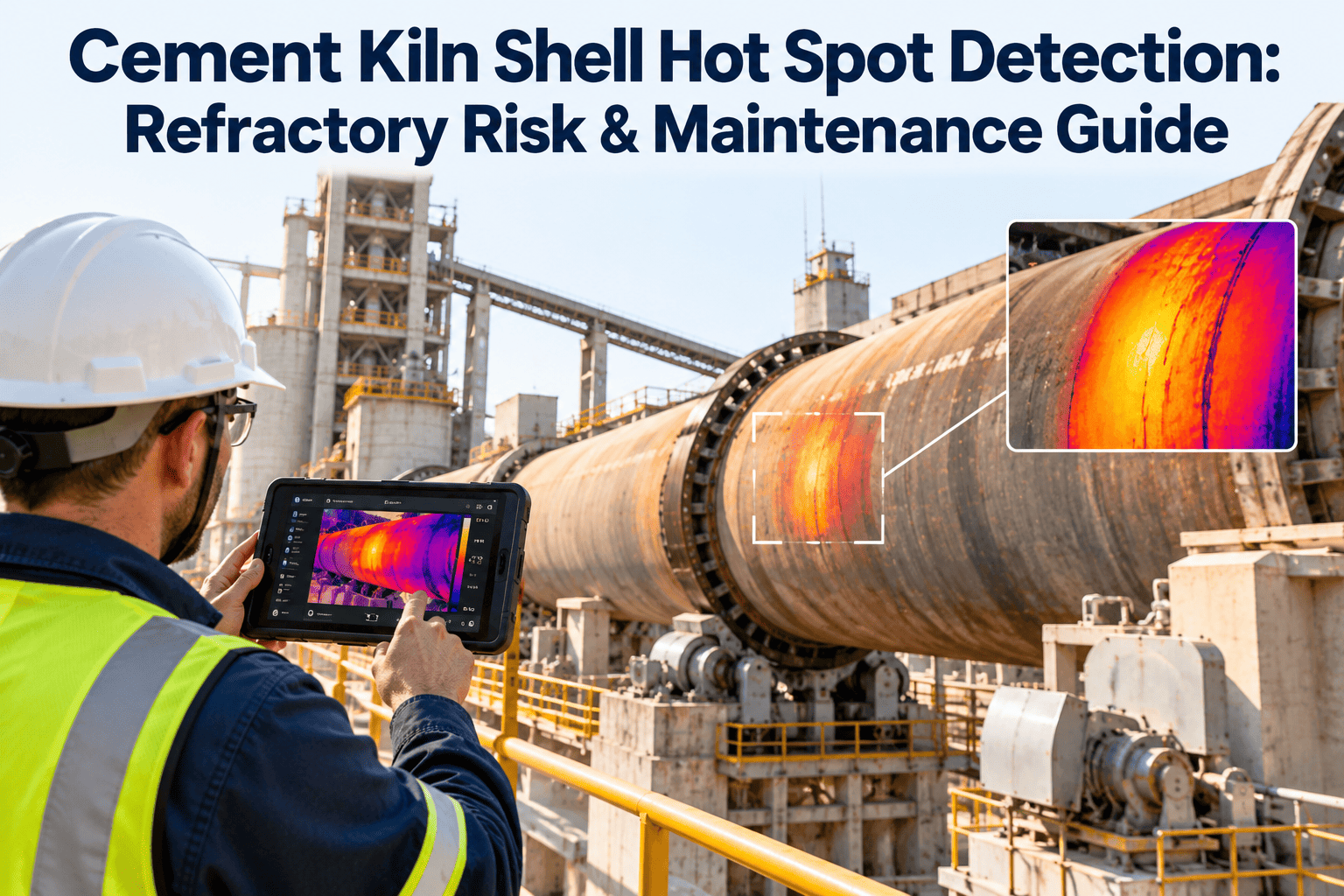
Cement kilns burn at 1,450°C around the clock — and the refractory lining protecting your shell steel is degrading with every rotation. A single unplanned refractory failure costs cement plants $800,000 to $2.5 million in emergency relining, lost production, and expedited brick procurement. AI-powered kiln shell scanners with 360-degree thermal mapping and ovality analysis now detect hot spots, coating loss, and shell deformation 60 to 90 days before failure — and auto-generate CMMS work orders so your maintenance team acts on data, not guesswork.
AI Kiln Shell Scanner and Thermal Mapping for Cement Plants
Continuous 360-degree infrared scanning with AI-driven refractory life prediction, ovality tracking, and automatic work order generation — purpose-built for cement kiln reliability teams.
Why Monthly Handheld Readings Are Not Enough
Most cement plants still rely on monthly handheld pyrometer readings and annual shutdown inspections to assess refractory condition — discovering catastrophic wear patterns only after they have progressed to emergency territory. The kiln generates revenue at $20,000 to $85,000 per hour. Losing even 48 hours to an unplanned stop means $1 million to $4 million gone before the kiln returns to stable operation.
Blind Between Readings
A hot spot can develop and reach critical 380°C in 72 hours. Monthly readings miss the entire degradation curve — your first signal is a red kiln alarm.
Ovality Goes Untracked
Shell ovality above 0.5% of diameter crushes refractory brick at tight spots. Without continuous measurement, tyre creep and shell deformation silently shorten lining life by months.
Data Sits in Silos
Scanner data lives in one system, maintenance records in another, and refractory installation history in spreadsheets. No single view connects thermal anomalies to maintenance action.
Reactive Relines Waste Brick
Calendar-based reline schedules retire 15 to 25% of remaining brick life. At $180,000 to $400,000 per zone, that waste compounds across every campaign cycle.
From Raw Infrared Data to Predictive Maintenance Action
An AI kiln shell scanner is not just a thermometer — it is a continuous diagnostic system that maps, analyses, and predicts refractory condition across every rotation and every zone of your kiln. Here is how the technology pipeline works from sensor to work order.
360° Infrared Capture
Fixed IR scanner arrays or robotic pan-tilt systems capture full circumferential thermal profiles every kiln rotation. Multiple scanner positions eliminate shadow zones caused by pillars, secondary air tubes, and structural obstructions.
AI Thermal Analysis
Machine learning algorithms map shell temperature distribution zone by zone, detect coating loss and hot spot formation, and distinguish between refractory failure, coating instability, and ring formation — avoiding false alarms that waste maintenance hours.
Ovality and Deformation Tracking
Continuous shell curvature measurement at tyre sections identifies ovality exceeding 0.5% threshold, tyre creep beyond 20mm per revolution, and shell crank conditions — all correlated with thermal data to isolate root causes.
Refractory Life Prediction
AI calculates wear rate per meter per month for each zone, projects remaining useful life, and overlays installation history with thermal trends — giving your team a concrete planning horizon of 4 to 8 weeks for reline scheduling.
Auto CMMS Work Orders
When any zone crosses configured thresholds — 330°C watch, 350°C alert, 380°C critical — OxMaint generates prioritised work orders with zone location, historical context, and recommended action. Response time drops from hours to minutes.
See the full thermal-to-work-order pipeline configured for your kiln profile. OxMaint connects to your existing scanners, DCS, and SCADA — no infrastructure replacement needed.
What AI Tracks Across Your Kiln
Each kiln contains 8 to 14 distinct refractory zones with different brick chemistries, wear profiles, and thermal loads. AI does not treat your kiln as one asset — it monitors every zone independently and correlates data across the full length to catch degradation patterns that single-zone monitoring misses.
| Kiln Zone | Typical Temp Range | AI Monitors | Alert Threshold | Failure Cost |
|---|---|---|---|---|
| Burning Zone | 1,350 - 1,450°C | Coating stability, brick wear rate, hot spot migration | Shell > 350°C | $800K - $1.5M reline |
| Upper Transition | 1,100 - 1,350°C | Alkali infiltration, chemical attack depth | Shell > 330°C | $300K - $600K |
| Lower Transition | 900 - 1,100°C | Ring formation, coating build-up instability | Ring temp spike > 40°C/hr | $200K - $400K |
| Calcining Zone | 600 - 900°C | Thermal gradient shifts, false air infiltration | Shell > 300°C | $150K - $300K |
| Tyre Sections | Variable | Ovality, creep rate, shell curvature deformation | Ovality > 0.5% diameter | $500K - $2M shell repair |
What Changes When You Move to AI Scanning
The difference between plants running at 85% kiln availability with frequent unplanned stops and plants achieving 94%+ availability is not maintenance budget — it is whether the monitoring system detects degradation continuously and converts detection into planned action before failure occurs.
How OxMaint Connects Scanner Data to Maintenance Action
Scanner data without maintenance context is just numbers on a screen. OxMaint bridges the gap between your kiln monitoring system and your maintenance execution — so thermal intelligence becomes work orders, parts procurement, and reline planning automatically.
Real-Time Thermal Dashboards
Shell temperature visualisation across all kiln zones with historical trending, anomaly highlighting, and refractory installation dates overlaid. Your control room sees kiln health — not raw data.
Automated Threshold Alerts
Configurable graduated alerts by zone — watch at 330°C, alert at 350°C, critical alarm at 380°C. Each alert creates a prioritised work order with zone location and historical trend context.
Refractory Lifecycle Tracking
Every zone registered as a discrete asset with brick chemistry, installation date, supplier, and wear rate trending. OxMaint projects remaining useful life and triggers reline work orders at the optimal intervention point.
Ovality Trend Correlation
Shell curvature and tyre creep data trended alongside thermal maps. When ovality rate of change increases, OxMaint triggers mechanical inspection before brick crushing damage begins.
Frequently Asked Questions
Stop Guessing. Start Predicting.
OxMaint turns your kiln shell scanner data into automated work orders, refractory life forecasts, and ovality trend reports — keeping your kiln running and your maintenance team ahead of every failure mode.