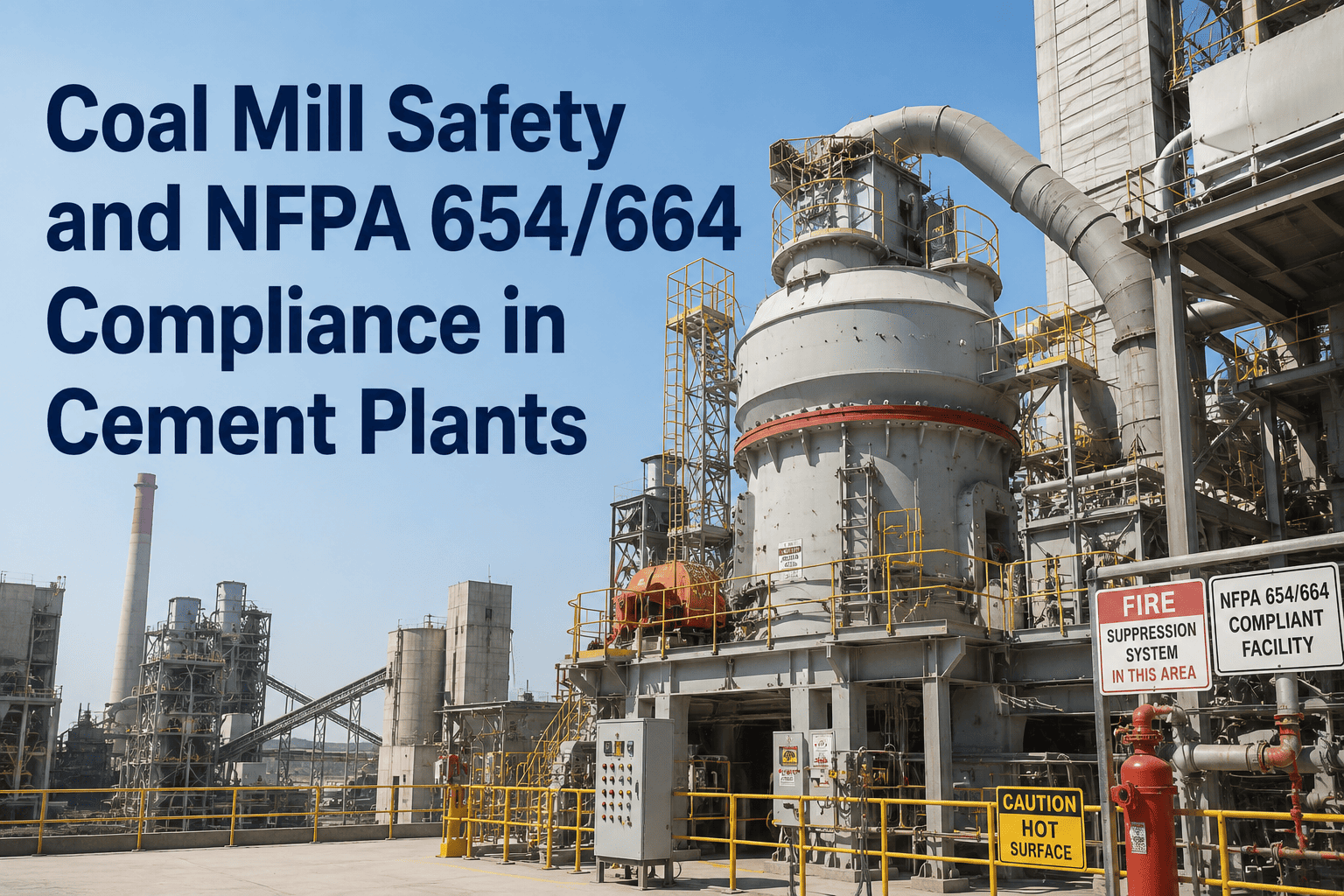
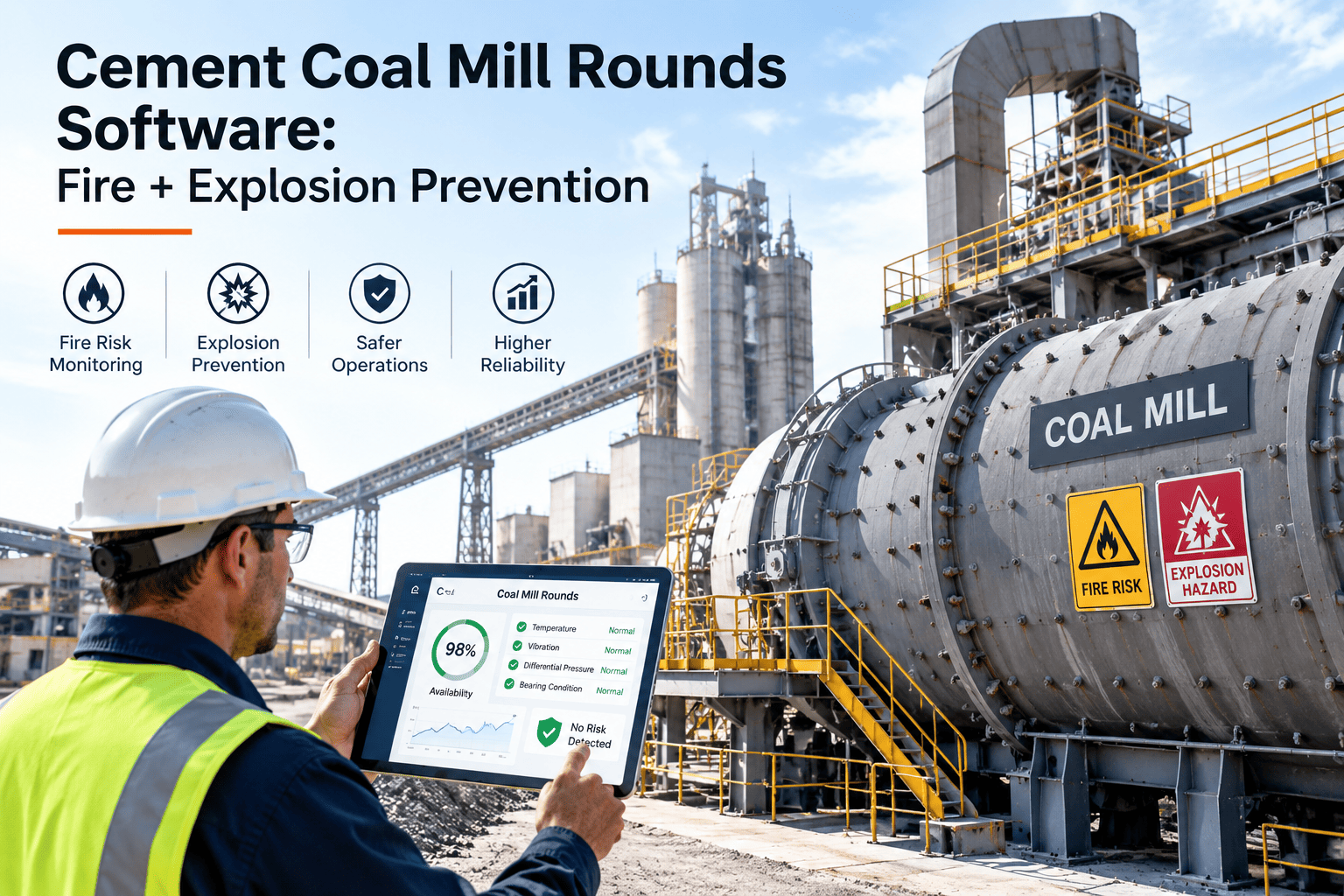
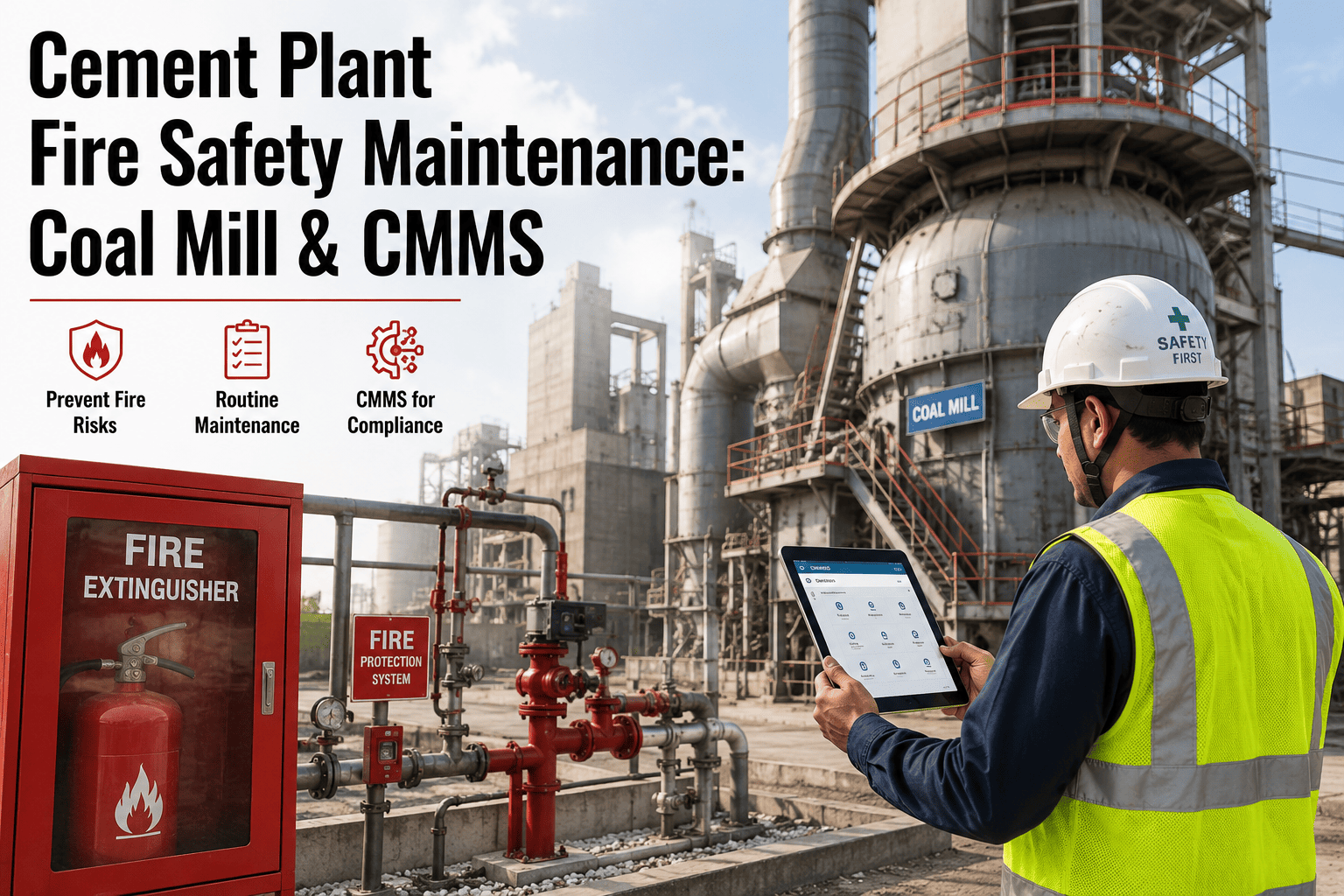
Coal mill fires and explosions are the most catastrophic safety event in cement manufacturing — and the warning signs appear 4 to 8 hours before the incident in the form of CO trending, rising outlet temperatures, and O₂ concentration drift above the 12–13% explosive atmosphere threshold. NFPA 654 and NFPA 664 set the structural protection requirements: coal mills must be built to withstand 50 PSI pressure, explosion venting must be sized and positioned correctly, and inerting systems must be capable of reducing internal O₂ below 12% before ignition conditions develop. The gap between compliant plants and plants waiting for an incident is almost never a gap in equipment — it is a gap in the preventive maintenance records, alarm response procedures, and inspection documentation that OSHA, insurance auditors, and NFPA standards require. A CMMS like Oxmaint converts CO, temperature, and O₂ signals into structured work orders, lockout/tagout procedures, and audit-ready records before the window for intervention closes. If your plant's coal mill PM records, inerting system test logs, or housekeeping inspection records are managed in spreadsheets, book a 30-minute consultation to understand the documentation risk you are carrying.
NFPA 654 / NFPA 664 Compliance Guide
Coal Mill Safety in Cement Plants
CO monitoring, O₂ control, inerting, explosion venting — and the CMMS records that prove your system was maintained before the inspector or insurer asks.
The Explosion Triangle in a Coal Mill
FUEL
Coal dust in suspension
IGNITION
Static, hot surface, spark
Eliminate any one element — explosion becomes impossible. Inerting controls O₂. CMMS controls the PM that prevents ignition sources.
Incident Timeline
How a Coal Mill Explosion Actually Develops — and Where CMMS Intervenes
Cement plant coal mill explosions almost never begin at the moment of detonation. They begin 4 to 8 hours earlier with measurable signals that pass through the monitoring system unactioned. This is the representative incident timeline — and the intervention points a CMMS creates.
T – 8 hrs
Normal Operation
O₂ below 12%, CO at baseline, mill outlet temperature within range. No active risk.
CMMS: Continuous PM records, sensor calibration logs up to date
T – 6 hrs
CO Begins Rising
Smouldering begins in coal feed or conveyor — self-oxidizing coal meeting a warm surface. CO detectable but below alarm threshold. This is the most actionable window.
CMMS: CO trending alert generates inspection work order — assignable in minutes
T – 4 hrs
Outlet Temperature Rises
CO climbs above 50 ppm. Outlet temperature rises beyond normal range. O₂ fluctuating. Explosive atmosphere not yet present — but approaching.
CMMS: Level 2 alert triggers inerting system check work order and LOTO permit
T – 1 hr
O₂ Exceeds 12–13% Threshold
Explosive atmosphere now present inside the mill. Any ignition source — static electricity from coal dust, a hot bearing surface, a spark — triggers detonation.
CMMS: Level 3 event arms inerting trigger, blocks restart until O₂ recovers with verified inspection on file
T – 0
Explosion / Fire Event
Detonation or sustained fire. Structural damage, production loss, regulatory notification required within 24 hours. MSHA and OSHA investigation follows.
Plants with CMMS: every prior alarm, work order, and inspection is timestamped — critical for liability and insurance
NFPA Requirements
What NFPA 654 and NFPA 664 Actually Require
NFPA 654 covers prevention of fire and dust explosions in the processing and handling of combustible particulate solids. NFPA 664 addresses prevention in wood processing and woodworking facilities, but its explosion venting and suppression principles are referenced in cement industry coal safety practice. Together, they establish the structural, monitoring, and maintenance obligations that insurance underwriters and safety regulators use as their compliance baseline.
NFPA 654
Combustible Dust — Structural Requirements
Pressure Resistance
Coal mills must withstand 50 PSI — constructional explosion protection as last-resort defence
Explosion Venting
Vents sized and positioned to relieve pressure before structural failure; vent area calculated from Kst and Pmax values for coal dust
Housekeeping
Combustible dust accumulation above 1/32 inch on any surface within 10 feet of equipment requires immediate cleaning — documented inspections required
Grounding
Static electricity bonding and grounding for all coal handling equipment — periodic test records required
NFPA 664 Principles
Explosion Suppression and Prevention
Suppression Systems
Chemical suppression systems must be tested and logged at manufacturer-specified intervals — typically every 6–12 months
Isolation Valves
Deflagration isolation valves on inlet and outlet ducts to prevent flame propagation — annual function tests required
Inerting Integrity
N₂ or CO₂ inerting system volumes must be stored 2–3× maximum necessary volume with double-stock safety reserve
Emergency Response
Written emergency response plan with documented drills — plan must be current with any equipment change
Monitoring System
The Three Signals That Prevent Coal Mill Incidents
Effective coal mill safety is a monitoring problem before it is a response problem. Three continuous signals give plants the time to intervene before conditions become irreversible. All three must be monitored, trended, and acted upon through a structured workflow.
What it means
Rising CO indicates active oxidation — smouldering coal releasing combustion products before a visible fire begins. CO trending is the earliest warning signal available.
Alert
CO above baseline trend — generate inspection work order
Action
CO above 50 ppm — reduce feed rate, prepare inerting system
Emergency
CO above 100 ppm — initiate inerting, issue LOTO, stop mill
What it means
O₂ above 12–13% inside the mill creates an explosive atmosphere. Cement plants intentionally operate with reduced O₂ — using 3% O₂ process air from the precalciner — to prevent explosive conditions from forming.
Normal
O₂ below 10% — inert atmosphere maintained
Warning
O₂ 10–12% — inerting system armed and monitored
Critical
O₂ above 12% — explosive atmosphere present, trigger inerting immediately
What it means
Rising outlet temperature indicates heat accumulation in the grinding circuit — either from a bearing failure, product buildup, or developing hot spot. Combined with rising CO, it confirms active smouldering.
Normal
Within established setpoint range — no action required
Elevated
5–10°C above setpoint — bearing inspection work order generated
High
10°C+ above setpoint with rising CO — concurrent emergency action required
Warning signals don't prevent explosions. Acted-upon warning signals do.
Oxmaint converts CO, O₂, and temperature thresholds into automatic work orders with assigned technicians, required procedures, and NFPA-compliant inspection checklists — so every signal gets a structured response, not a verbal acknowledgment that leaves no record.
PM & Audit Records
The Coal Mill PM Records OSHA and Insurers Will Request
Safety inspections and insurance underwriters request coal mill records that most plants either cannot produce quickly or have never maintained in structured form. These are the specific record categories that regulators and insurers expect — and that Oxmaint generates automatically through the PM workflow.
Record Type
Required Frequency
Requesting Body
Oxmaint Generates
CO sensor calibration
Monthly minimum
OSHA, insurance
Auto PM work order
O₂ analyzer calibration
Monthly minimum
OSHA, insurance
Auto PM work order
Inerting system function test
Every 6 months
NFPA 654, insurance
Scheduled + checklist
Explosion vent inspection
Annually
NFPA 654, OSHA
Scheduled + photo
Isolation valve function test
Annually
NFPA 664 principles
Scheduled work order
Housekeeping inspection (dust accumulation)
Weekly
OSHA, NFPA 654
Recurring inspection
Grounding continuity test
Quarterly
NFPA 654, insurance
Auto PM work order
Restart permit after trip or shutdown
Every restart event
MSHA, OSHA
Checklist-gated permit
Emergency response drill records
Annually minimum
OSHA, NFPA
Drill record + sign-off
FAQ
Questions Safety Managers and Plant Engineers Ask About Coal Mill Compliance
What is the O₂ threshold that creates explosive conditions in a coal mill?
O₂ concentrations above 12–13% inside a coal mill can create explosive conditions when coal dust is in suspension. Cement plants intentionally operate with inert or low-oxygen atmospheres — often using hot process gases from the precalciner with as little as 3% O₂ — to keep the atmosphere below the explosive threshold. A continuous O₂ analyzer with CMMS-connected thresholds is the primary guard against this condition developing without an actionable alert.
Oxmaint can be configured to arm the inerting trigger automatically when the 12% threshold is approached.
How does NFPA 654 apply specifically to coal mills in cement plants?
NFPA 654 requires that equipment handling combustible particulate solids — including coal grinding mills — be designed to withstand 50 PSI minimum, that explosion vents be properly sized and installed, that combustible dust accumulation above 1/32 inch be immediately cleaned and documented, and that grounding and bonding systems be maintained and tested with records. Coal dust is explicitly covered as a combustible particulate solid.
Book a consultation to review your current PM records against NFPA 654 requirements.
What makes a restart after a coal mill trip a high-risk event?
MSHA incident data shows a documented pattern of ignition occurring at restart after a trip — the "inspection-door and restart ignition" pattern. The mill is opened for inspection, ambient air enters and raises internal O₂, and restart before O₂ recovers below the explosive threshold creates detonation conditions. A CMMS restart permit that gates restart on verified O₂ recovery, inerting status confirmation, and a signed inspection checklist is the control that eliminates this risk.
How often should coal mill inerting systems be tested?
Inerting system function tests are typically required every 6 months under NFPA 654 and insurance underwriting standards, with inert gas volume verification confirming the 2–3× maximum necessary volume plus double-stock safety reserve required for effective emergency inerting. Sensor calibration for CO and O₂ analyzers that trigger inerting must be tested monthly at minimum. Oxmaint auto-generates all of these as scheduled PM work orders with completion records.
What records does OSHA request after a coal mill incident?
OSHA typically requests CO and O₂ monitoring logs covering the 24–48 hours before the incident, maintenance work orders for all safety-related equipment, housekeeping inspection records, the restart permit record if applicable, and emergency response drill documentation. Plants without CMMS-generated records are forced to reconstruct these from memory and manual logs — which creates significant liability exposure regardless of whether the records existed.
Oxmaint stores all of these with timestamps and user sign-offs.
A coal mill incident doesn't wait for your records to catch up.
Oxmaint structures every coal mill safety obligation — sensor calibration, inerting tests, housekeeping inspections, restart permits, and emergency response records — into a single audit trail that is ready before the incident, not assembled after it.