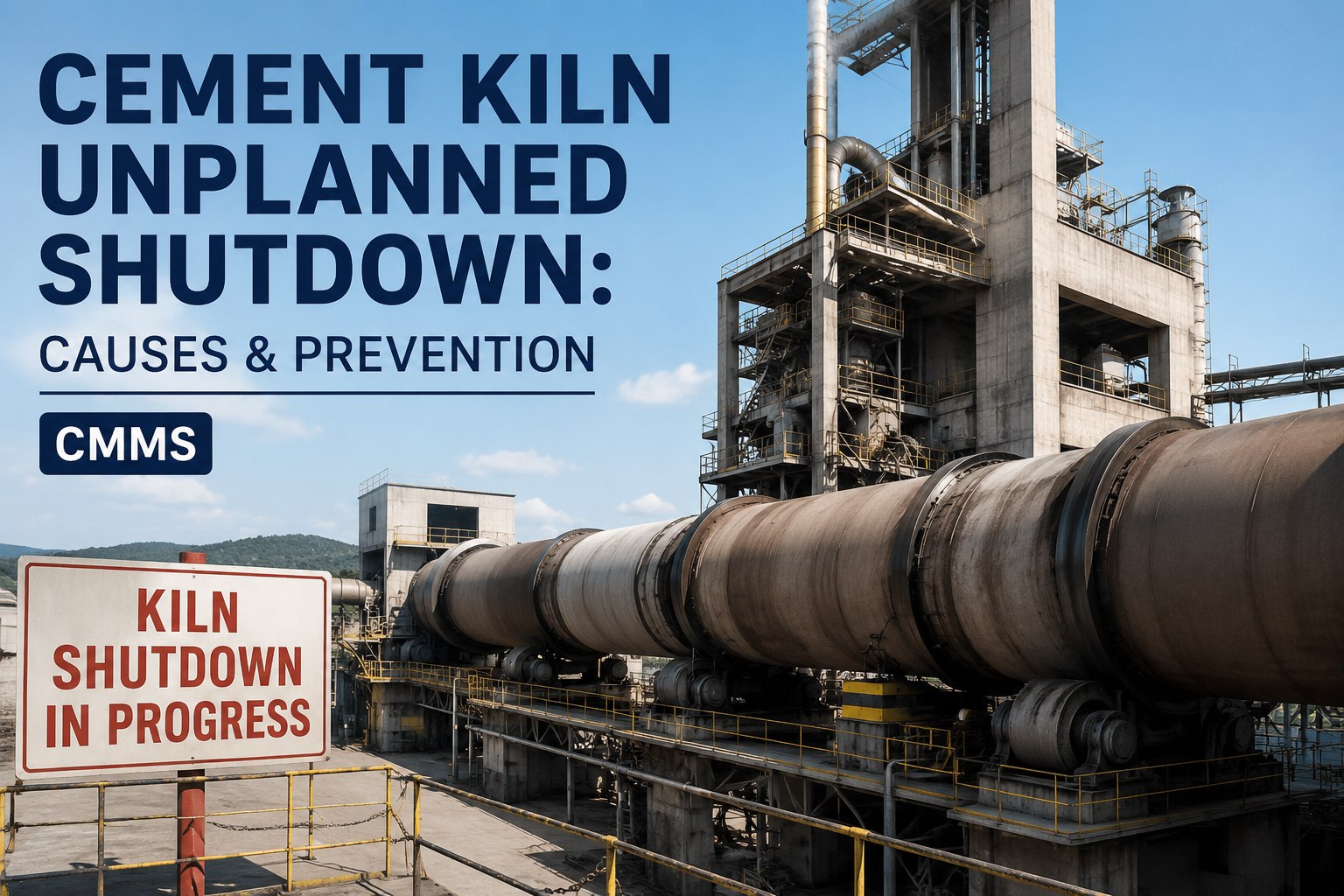
In March, a cement group operating three integrated lines in West Africa received a vibration alert on its largest kiln's main gearbox output shaft bearing. The alert came from Oxmaint's predictive analytics module — 9 days before the bearing would have seized. The team scheduled an emergency-but-planned replacement into the upcoming weekend window. Total kiln downtime: 14 hours of planned work. The alternative, based on the failure mode and equipment history, was a catastrophic seizure with an estimated repair and lost-production cost of $4.2 million. The difference between those two outcomes was a 9-day warning. Start a free trial to see Oxmaint's predictive analytics applied to your kiln bearings, or book a 30-minute session with our cement reliability team.
Case Study · Cement Group · 3 Integrated Kiln Lines · West Africa
$4.2M Unplanned Kiln Stop. Avoided.
A 9-day predictive vibration warning gave one cement group's maintenance team the window they needed to turn a catastrophic failure into a planned 14-hour repair.
What Would Have Happened
$4.2M
Catastrophic gearbox seizure · 11-day emergency stop · lost clinker production · crane hire · expedited parts
VS
What Actually Happened
14 hrs
Planned weekend bearing replacement · pre-staged parts · zero production loss beyond scheduled window
The 9-Day Timeline
Day 0
First Predictive Alert
Oxmaint flags RMS velocity deviation on main gearbox output shaft bearing — 2.1 mm/s above rolling 30-day baseline. No alarm on SCADA yet. No symptoms visible.
Day 2
Maintenance Team Reviews
Reliability engineer opens work order. Reviews trend chart, bearing history, last lubrication record. Escalates to maintenance manager with recommendation: plan replacement within 10 days.
Day 3
Parts Confirmed, Window Locked
Spare bearing confirmed in stores. Weekend kiln stop window locked in for Day 8. Crane and crew scheduled. Parts pre-staged at the gearbox platform.
Day 7
Vibration Accelerating
RMS velocity now 4.7 mm/s above baseline. SCADA high-vibration alarm fires. Kiln kept running — replacement already scheduled for next morning. Team fully prepared.
Day 8
Planned Replacement Complete
14-hour replacement window. Kiln back online on schedule. Extracted bearing showed significant raceway fatigue — without early warning, seizure would have occurred within 2–3 days.
How Predictive Vibration Works in Oxmaint
Step 01
Continuous Sensor Ingestion
Online vibration sensors on kiln main drive, tire, and support roller bearings stream data via OPC-UA or MQTT into Oxmaint's analytics layer — continuously, not on a fortnightly manual round.
Step 02
Baseline + Deviation Model
Each bearing builds a rolling 30-day RMS velocity baseline. Oxmaint's trend engine flags statistically significant deviations — not just threshold crossings — so the alert fires days before SCADA alarms.
Step 03
Work Order with Full Context
Alert generates a work order pre-loaded with: bearing ID, 30-day trend chart, last lubrication date, maintenance history, spare parts on hand, and recommended action. No information chase needed.
Step 04
Planned Window Coordination
The planner uses the lead time window — typically 9–18 days — to book the stop, confirm spares, schedule crew, and pre-stage equipment. Reactive emergency becomes a coordinated planned repair.
9 days is the difference
Your Next Bearing Failure is Already Starting. Oxmaint Sees It First.
Continuous vibration analytics. 9–18 day warning lead times. Work orders with full context delivered before SCADA alarms. No control system changes required.
The Cost Breakdown: Planned vs Unplanned
Cost Element
Emergency Seizure
Planned Replacement
Kiln downtime
11 days (264 hrs)
14 hours
Lost clinker production
~$2.4M at $9,000/hr
$126,000
Gearbox repair / parts
~$980,000 (seizure damage)
$74,000 (bearing only)
Emergency crane and crew
~$560,000
$18,000 (scheduled)
Expedited parts freight
~$260,000
$0 (in stock)
Total Cost
~$4.2M
~$218,000
What the Maintenance Manager Said
We saw the alert on a Tuesday morning. By Thursday we had the bearing on order and the weekend stop confirmed. When the SCADA alarm finally fired on the Friday, we were already set up and ready. Without Oxmaint, that Friday alarm would have been the start of an eleven-day crisis. Instead it was background noise while we executed a job we had already planned.
Maintenance Manager, 3-Line Cement Group, West Africa
Frequently Asked Questions
How far in advance does Oxmaint typically detect bearing degradation?
In kiln main drive and support roller bearings, the predictive alert typically fires 9–18 days before failure based on current deployment data. The lead time depends on failure mode — fatigue-driven failures give more warning than lubrication-related or contamination-driven failures. Book a session to discuss your specific bearing types and expected lead times.
Do we need to install new vibration sensors, or does Oxmaint work with existing ones?
Oxmaint ingests data from any sensor that outputs via OPC-UA, MQTT, or a standard REST or CSV endpoint — including SKF, Emerson, Schaeffler, and most IIoT retrofit devices. The West Africa plant in this case study used sensors already installed. Start a free trial to validate compatibility with your current sensor set.
How is the deviation model built — and how long does it take to calibrate?
The baseline model uses a rolling 30-day window of RMS velocity readings per bearing. A useful baseline is established within the first 4–6 weeks of live data. During this period, Oxmaint operates in observation mode before issuing predictive alerts, reducing false positives in the early weeks.
What happens when a predictive alert fires — who gets notified?
A work order is automatically created and assigned to the configured reliability engineer or maintenance planner. A mobile push notification is delivered with the full trend chart, bearing history, and recommended action. No manual monitoring of dashboards is required — the alert comes to the right person immediately.
Will this require changes to our DCS or SCADA system?
No changes to your control system are required. Oxmaint reads sensor data via OPC-UA or MQTT subscription in read-only mode. PLC logic, SCADA screens, and DCS configurations remain entirely untouched throughout deployment and operation.
Stop the next $4.2M event before it starts
9 Days of Warning Changes Everything. Start Seeing Your Bearings the Way This Plant Did.
Continuous vibration analytics, predictive deviation alerts, automated work orders — deployed in 6–8 weeks without touching your control system.