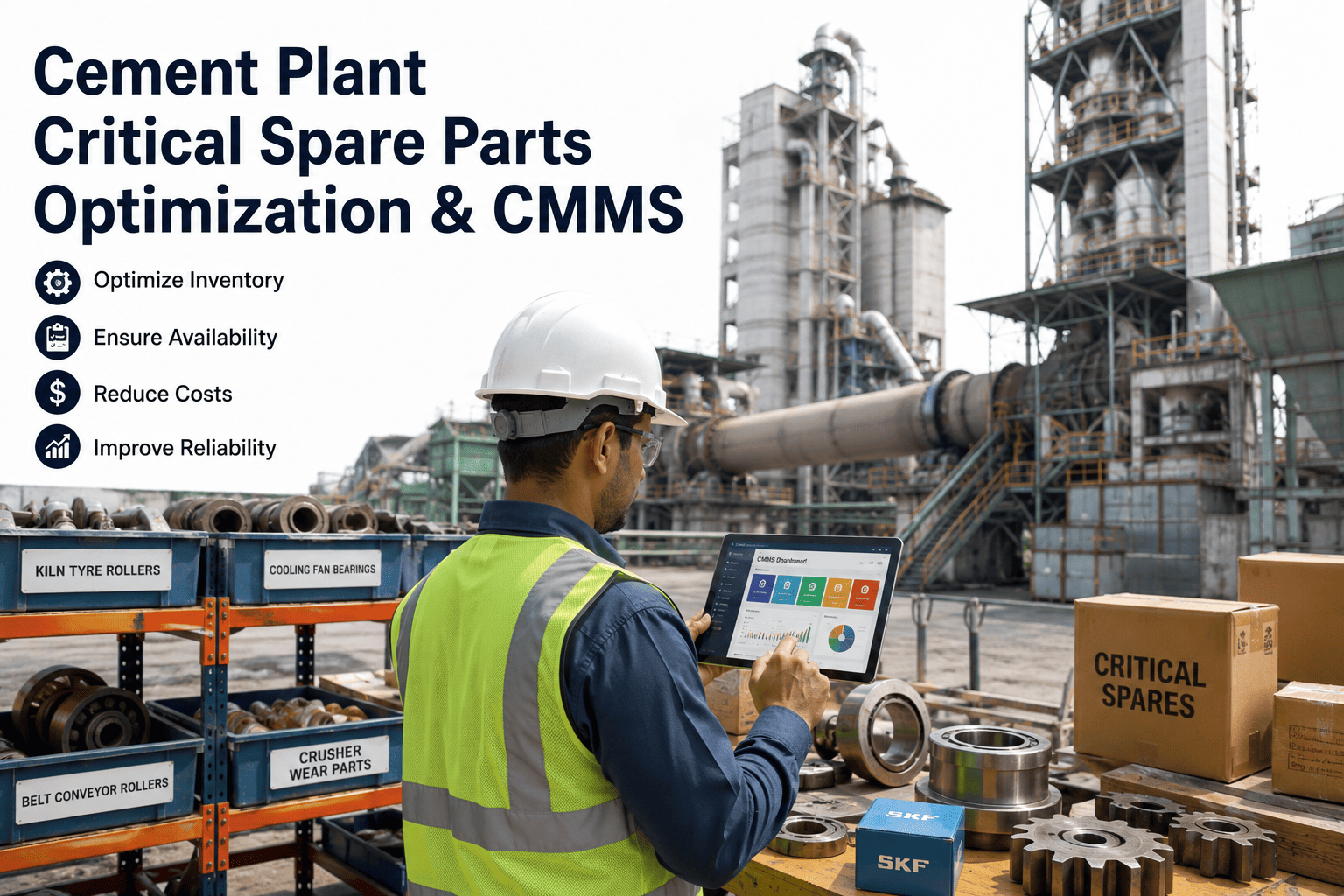
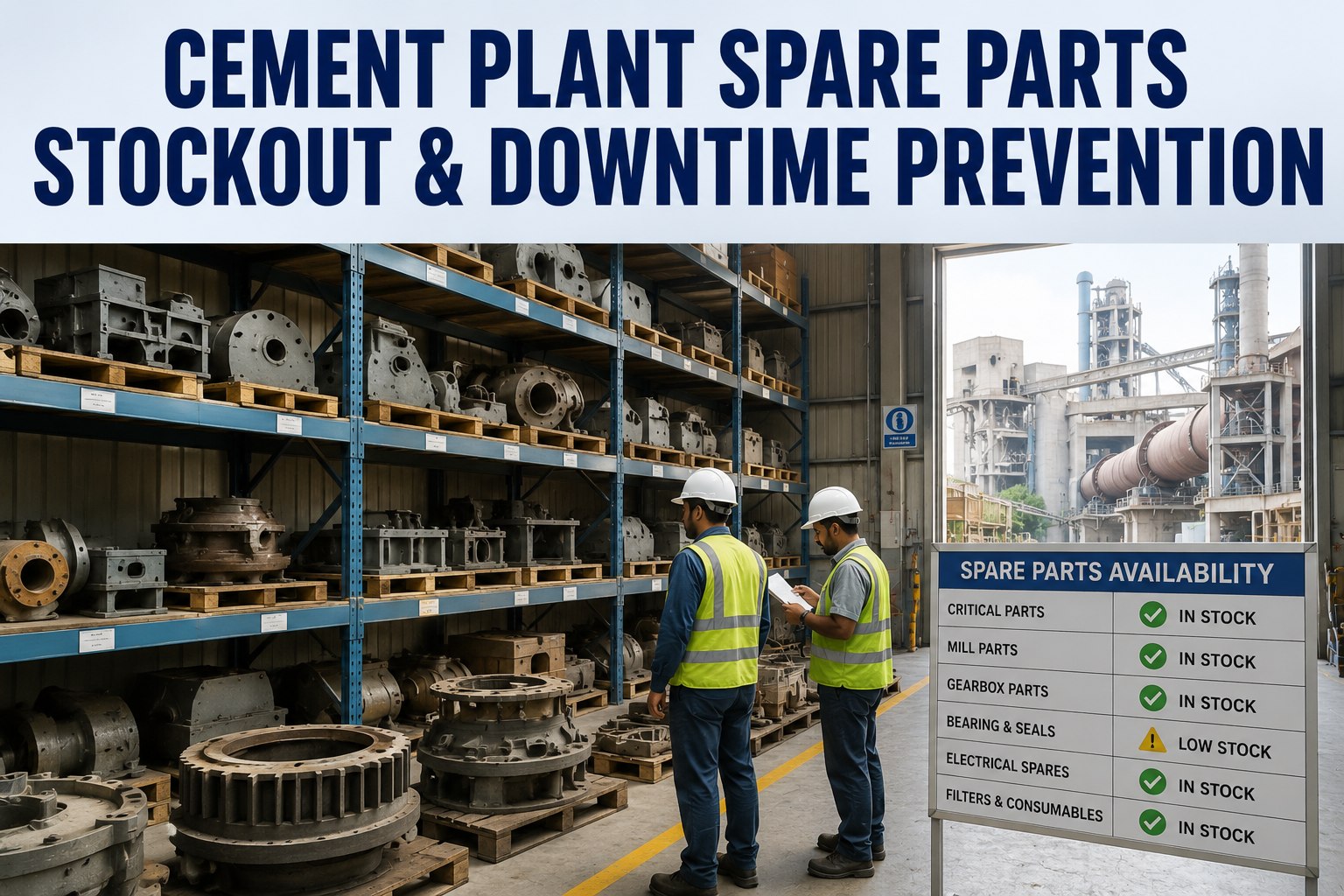
Cement plants lose an average of $9,000 per minute when critical equipment fails — and 60% of those shutdowns trace back not to the failure itself, but to a missing spare part that should have been on the shelf three weeks earlier. AI-powered demand forecasting changes the equation entirely: by reading your CMMS work order history, asset condition trends, and supplier lead times simultaneously, it predicts exactly which parts you need, in what quantity, and when to order them — before the failure ever happens. Book a demo to see OxMaint's forecasting engine predict demand across your cement plant asset base in real time.
Cement Plant Operations · AI Inventory Intelligence
AI Spare Parts Demand Forecasting for Cement Plants
Stop reacting to stockouts. Start predicting them. AI-driven forecasting reads failure histories, production schedules, and supplier lead times to put the right part on your shelf before the work order is ever created.
35%
avg reduction in inventory carrying costs
40%
fewer emergency procurement events
88%
forecast accuracy at 60-day horizon
6–12mo
typical full ROI payback period
The Real Problem
Why Cement Plants Keep Running Out of the Wrong Parts
A cement plant's spare parts problem is not about budget — it's about visibility. Most plants have too much of the parts they never need and too little of the ones that bring the kiln down. Traditional reorder-point systems were designed for predictable, calendar-based demand. Cement plant failures are anything but predictable.
01
Static Reorder Points Fail
A reorder point set two years ago doesn't know that Kiln Drive Gearbox #2 is running 12% hotter than baseline this quarter. Static thresholds miss dynamic failure signals entirely.
02
Phantom Inventory Blinds Planners
The system shows 3 units in stock. The shelf shows zero. A technician borrowed parts without a system transaction. The planner discovers this at 2 AM when the crusher stops. Emergency freight follows.
03
Lead Times Are Ignored
A critical bearing has a 14-week lead time. The CMMS triggers the reorder when stock hits zero. By the time the part arrives, the plant has already lost weeks of production or sourced at premium cost.
04
Overstock Locks Working Capital
Conservative planners stock 5 years of slow-moving parts to avoid emergencies. Across 15,000–40,000 SKUs, this conservative buffer accumulates into millions in working capital earning nothing on a shelf.
How AI Forecasting Works
Three Signal Sources That Replace Guesswork
AI demand forecasting doesn't replace your maintenance team's judgment — it gives them information they could never compile manually. The model reads three streams of data simultaneously and produces a live demand forecast per SKU, updated as conditions change.
H
Historical CMMS Data
Work order consumption per part number, asset model, and failure type. The model learns that Kiln #1 bearings fail every 2,200 run-hours — not every 6 months.
→
C
Condition Alerts
Vibration, temperature, and run-hour thresholds. When a crusher bearing crosses a wear threshold, a replenishment signal fires before the work order is created.
→
S
Supplier Lead Times
Actual historical delivery performance per vendor, not catalog promises. If a supplier is running 9 days slow, reorder points shift automatically to absorb the gap.
↓
OUTPUT
Live 30 / 60 / 90-Day Demand Forecast Per SKU
Red flags surface automatically when stock will fall below safety threshold before the next replenishment. Procurement acts on data — not on gut feel or last year's averages.
Stop Ordering Parts After the Failure. Start Ordering Before It.
OxMaint's AI forecasting engine connects your CMMS history, asset condition data, and supplier lead times into a single live demand signal. Your first forecast is ready within hours of connecting your data — no IT project required.
Asset-Level Intelligence
Which Cement Plant Assets Benefit Most
AI demand forecasting delivers the highest ROI on assets where failure cost is high and lead times are long. Prioritizing these asset classes first builds the ROI case and expands plant-wide from there.
| Asset |
Critical Spare Examples |
Typical Lead Time |
Avg Failure Cost |
AI Forecasting Impact |
| Rotary Kiln Drive |
Main girth gear, pinion bearings, drive coupling |
8–16 weeks |
$200K–$500K |
Replenishment signal 60 days before predicted wear-out |
| Raw Mill / Ball Mill |
Shell liners, trunnion bearings, gearbox seals |
4–12 weeks |
$50K–$200K |
Liner consumption tracked per run-hour, auto-reorder triggered |
| Crusher (Limestone/Clinker) |
Jaw plates, hammer wear parts, main shaft bearings |
2–8 weeks |
$30K–$120K |
Wear-rate model predicts replacement need 3–4 weeks ahead |
| Preheater / Precalciner |
Cyclone refractory bricks, gas duct seals, fan bearings |
3–10 weeks |
$80K–$300K |
Thermal condition data linked to refractory consumption forecast |
| Cement Mill (Vertical) |
Grinding rollers, table segments, separator bearings |
6–14 weeks |
$60K–$250K |
Roller wear indexed against tonnage throughput for precision timing |
| Bag Filter / ESP |
Filter bags, rapper mechanisms, inlet dampers |
2–6 weeks |
$20K–$80K |
Pressure drop trending triggers bag replacement forecast |
Old Way vs AI Way
What Changes When AI Replaces Spreadsheets
Traditional Planning
Reorder points set manually — updated once a year if remembered
Stockout discovered when technician opens empty bin at 2 AM
Emergency procurement at 3–5x standard unit cost
30–50% of MRO parts untouched in 24+ months — dead capital
No connection between condition data and inventory signals
Lead time ignored until shortage — then premium freight follows
AI-Driven Forecasting
Dynamic reorder points recalculated live from consumption and condition data
Stockout predicted 30–60 days ahead — procurement acts in planned cycle
Standard purchase orders replace emergency sourcing — cost normalized
Obsolescence flagged automatically — dead stock identified before write-off
Condition alert fires replenishment signal before work order is created
Lead time factored into every reorder calculation — no surprises
Measured Outcomes
What Plants Report After AI Forecasting Deployment
23%
Less Inventory Held
Plants using risk-segmented AI stocking policies achieve near-perfect service levels while holding significantly less working capital in MRO stock.
40%
Fewer Emergency Orders
Automated reorder triggers convert crisis sourcing into planned purchase cycles — eliminating premium freight and overtime costs that stack up invisibly across a year.
20%
Lower Downtime
Siemens reported a 20% reduction in unplanned downtime after deploying predictive parts forecasting — the same model now available inside OxMaint's CMMS platform.
60–90
Days to First Results
Most plants begin seeing improved part availability and reduced excess inventory within the first 60 to 90 days of deployment — before the first full quarter closes.
Common Questions
AI Spare Parts Forecasting — What Cement Maintenance Teams Ask
Do we need new sensors or IoT hardware to use AI demand forecasting?
No new hardware is required. OxMaint's forecasting engine runs on data your CMMS already has — work order history, PM schedules, and existing condition readings. Most plants generate a live demand forecast within hours of connecting their data.
Start a free trial to see your first forecast.
How does AI forecasting handle cement plant parts with intermittent demand?
Intermittent demand is exactly where AI outperforms spreadsheet models. By combining failure history, condition signals, and PM schedules, the model predicts demand spikes for low-frequency, high-impact parts that traditional reorder systems miss entirely.
Which cement plant spare parts should be prioritized for AI forecasting first?
Start with the 10 to 15 part numbers with the highest historical emergency procurement frequency and the longest supplier lead times. Kiln drive components, grinding mill liners, and crusher wear parts typically deliver the fastest ROI.
Book a demo to map your highest-priority SKUs in OxMaint.
What is the ROI timeline for AI spare parts forecasting in a cement plant?
Industry data shows a 3–7x ROI within 6 to 12 months when combining inventory carrying cost reduction, eliminated emergency procurement premiums, and production loss prevention. A single avoided kiln shutdown recovers the platform cost in most mid-sized plants.
Can AI forecasting reduce our total number of stocked SKUs?
Yes. AI continuously flags parts that haven't moved in 18–24 months and calculates statistically optimal stock levels per SKU. Plants typically discover 30–50% of their MRO inventory is obsolete or overstocked — working capital that can be recovered without increasing stockout risk.
OxMaint CMMS · AI Inventory Intelligence · Cement Industry
The Next Critical Part Shortage Is Already Predictable. Make Sure Your CMMS Sees It.
OxMaint connects your cement plant's CMMS history, asset condition data, and supplier lead times into a single AI forecasting engine that predicts demand before it becomes an emergency. Every SKU. Every asset. Updated live.