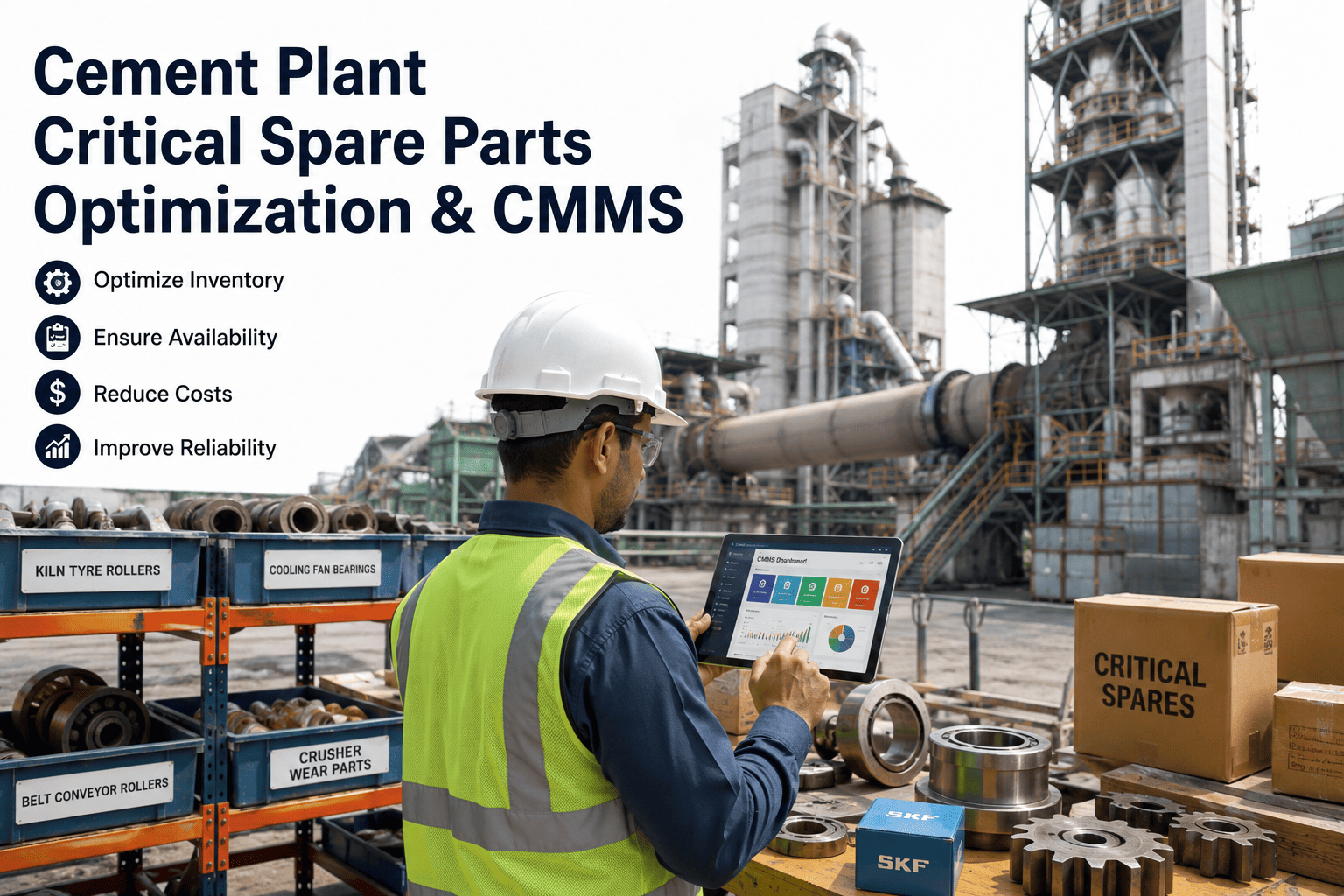
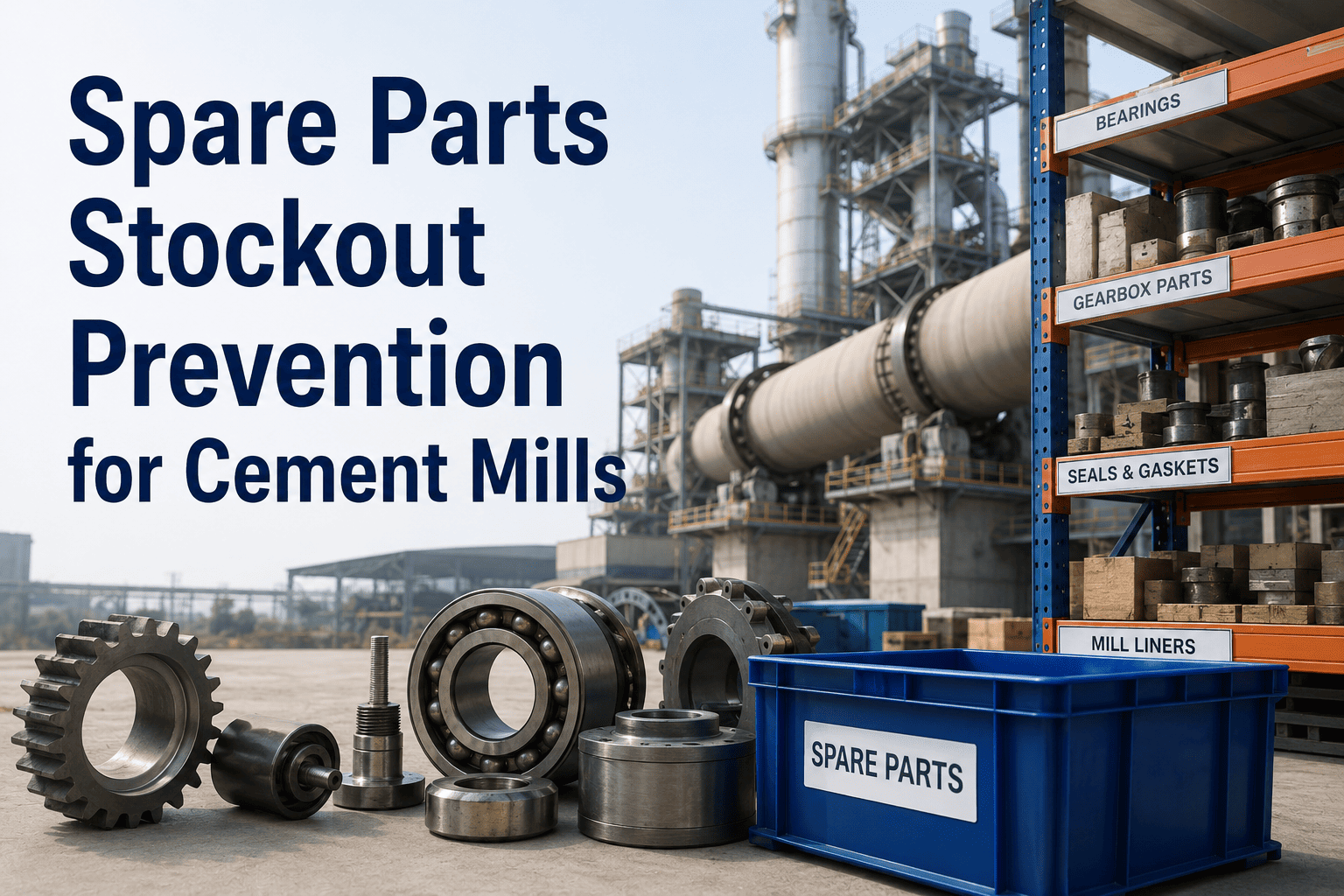
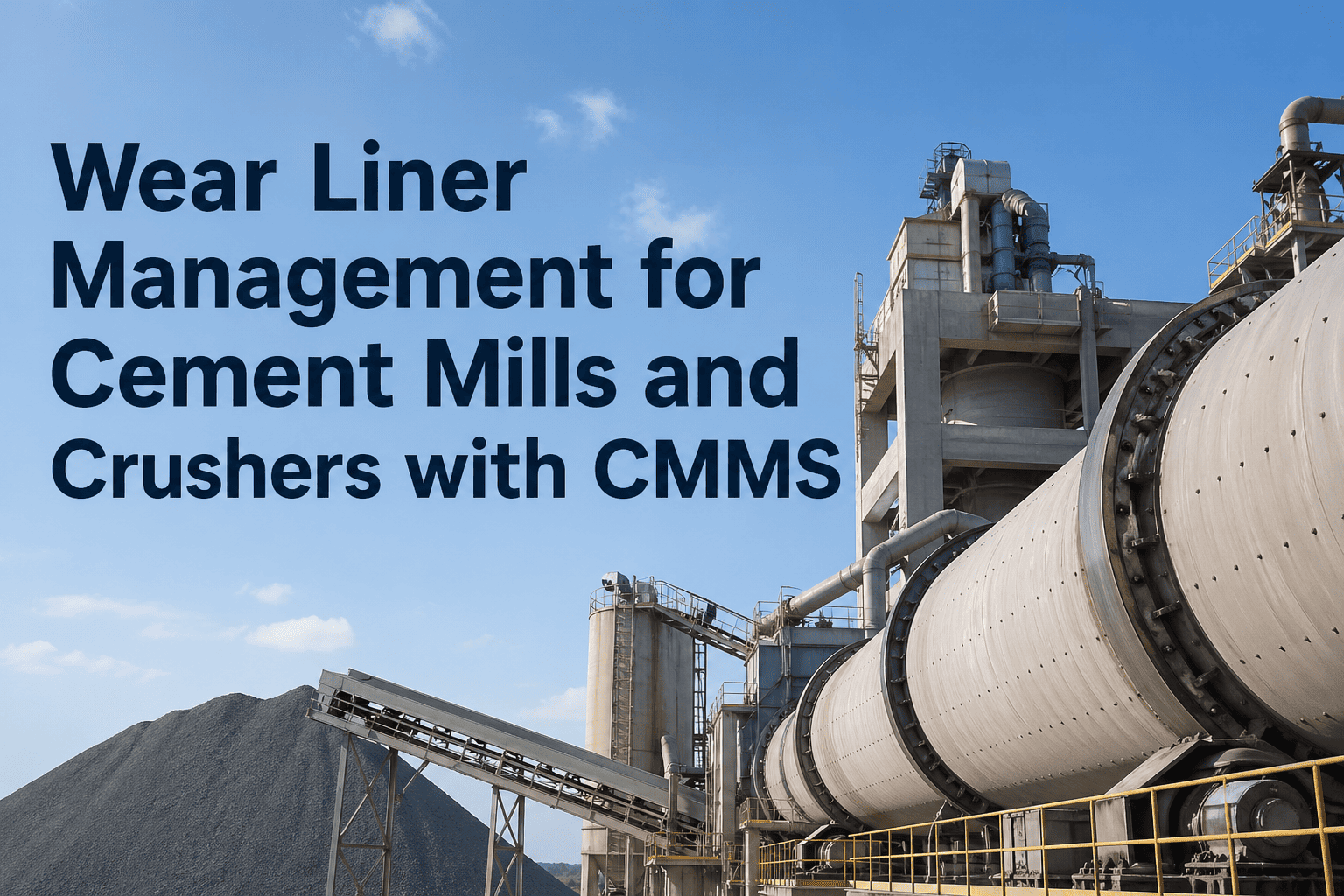
A cement plant running without a spare parts criticality program isn't managing maintenance — it's gambling. When a kiln refractory fails at 3 AM on a Sunday and the right bricks aren't in the store, the cost isn't just the repair bill — it's every hour of lost clinker output until the shutdown is complete. OxMaint's CMMS spare parts management module helps cement plant maintenance teams build criticality-based stocking strategies so the right parts are available when the highest-consequence assets fail — without tying up capital in slow-moving inventory that never gets used.
Blog · Spare Parts Management
Cement Plant Spare Parts Criticality: Refractory, Bearings, Liners & Wear Parts
How cement plant maintenance teams classify, stock, and track the four critical spare categories that determine whether a major shutdown costs 8 hours or 8 days.
$180K
Average cost per unplanned kiln shutdown in a mid-size cement plant
43%
Of extended shutdowns are caused by parts unavailability, not repair complexity
6–18 wk
Lead time for specialty refractory and large bearing orders without VMI agreements
Why Cement Plants Need Criticality-Based Spare Parts Programs
Cement production is capital-intensive, thermally constrained, and highly sensitive to unplanned downtime. Unlike discrete manufacturing where a line stoppage can sometimes be absorbed, a kiln shutdown is an immediate, escalating cost event — fuel waste during cool-down and heat-up alone can exceed the cost of the failed part by 10 to 1. Criticality-based stocking ensures that the parts with the highest consequences for failure are always available, while reducing inventory investment on parts that are cheap, fast to source, or rarely fail.
K
Kiln System
Continuous operation asset. Any unplanned stop triggers refractory cool-down risk, fuel cost, and clinker production loss. Parts criticality is extreme for all kiln-zone components.
M
Grinding Mills
Liner wear is predictable but accelerates unpredictably under feed variation. Mill stops for liner change are planned — but parts must be staged and available at the scheduled window or the window is wasted.
C
Crushers
Wear parts consumption is highly variable based on feed hardness. Jaw plates, mantles, and blow bars have consumption patterns that require real data — not guesswork — to stock correctly.
B
Rotating Equipment
Bearings, seals, and couplings on high-criticality rotating equipment — fans, pumps, conveyors — represent the highest-frequency failure category in most cement plants. Stock levels must reflect actual consumption, not catalog defaults.
The 4 Critical Spare Part Categories in Cement Plants
These four categories represent the majority of both inventory investment and unplanned downtime risk in a cement plant. Each category has distinct criticality logic, sourcing lead time, and stocking strategy.
Refractory bricks and castables protect the kiln shell from temperatures exceeding 1450°C. A refractory failure doesn't just stop the kiln — it risks shell overheating, structural damage, and a reline that can take 3 to 6 weeks. Refractory is the highest-consequence spare category in any cement plant and the one most often understocked because of its bulk and cost.
Key Items to Stock
Burning zone bricks (magnesia-spinel, dolomite)
Transition zone castable and anchors
Nose ring castable and preshaped pieces
Preheater cyclone castable
Cooler grate wear tiles
Criticality Factors
Lead time: 6–18 weeks for specialty grades
Minimum stock: 1 full burning zone campaign
Storage: temperature and humidity controlled
Consumption tracking: tons per campaign
VMI recommended for slow-moving grades
Bearings are the most frequently replaced item in a cement plant across kiln drive, fans, conveyors, separators, and mills. Despite being a mature technology, bearing failures remain the number one cause of unplanned downtime in most plants — primarily because the right bearing isn't in stock when it's needed, or the wrong grease was applied, or vibration data showing deterioration wasn't acted on before failure.
High-Priority Bearing Types
Kiln thrust and support roller bearings
Main motor and gearbox bearings
Fan shaft bearings (raw mill, cement mill, cooler)
Separator bearings (dynamic classifiers)
Bucket elevator head shaft bearings
Stocking Strategy
Min-max based on 12-month consumption history
Critical bearings: min 2 units always in store
Non-critical: reorder point at 1 unit remaining
OEM cross-reference list maintained in CMMS
Review stocking after each unplanned failure
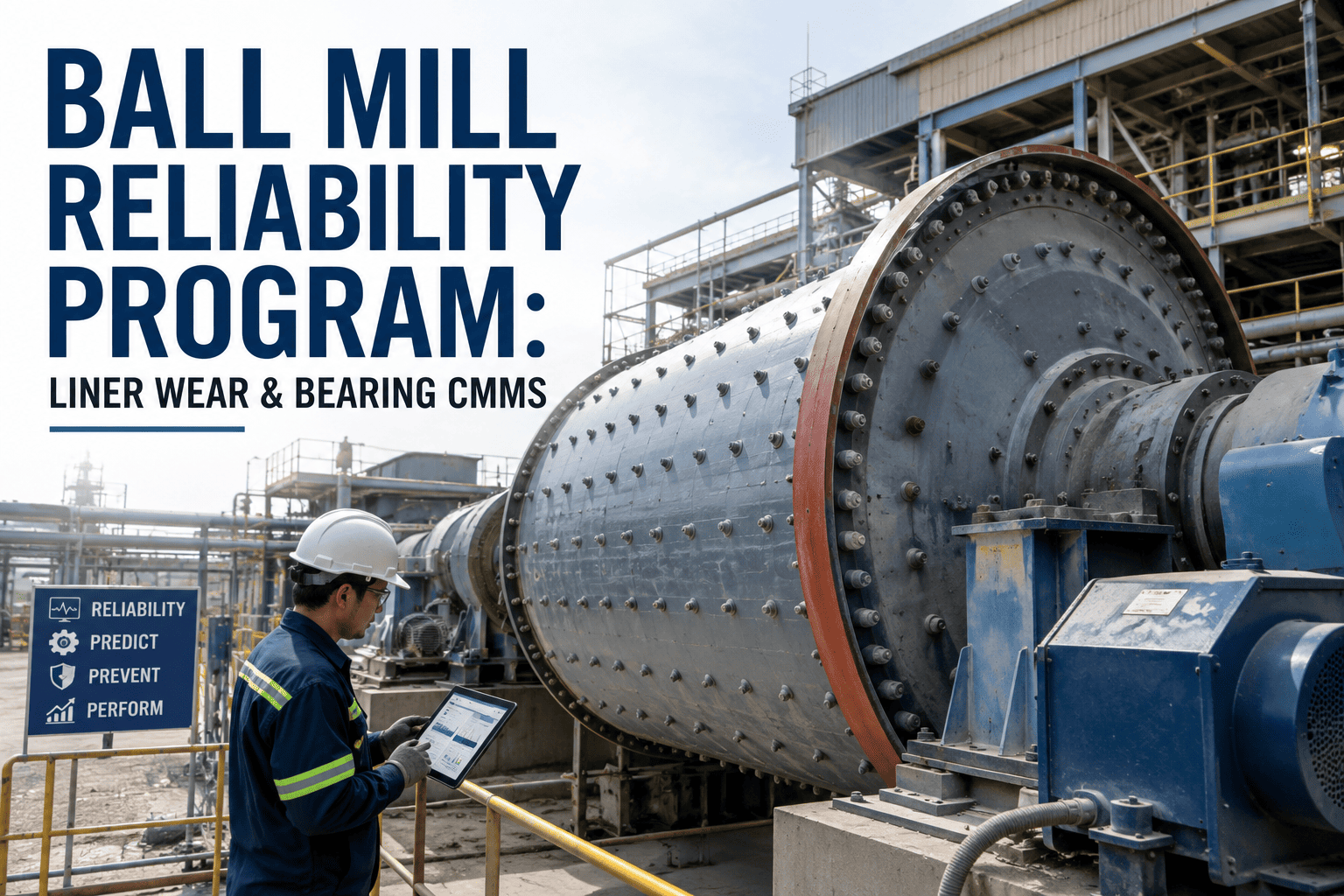
Mill liners are a planned maintenance item — but their wear rate accelerates with feed changes, and many plants find that a liner life estimated at 18 months fails at 12. Without liners staged and available at the planned shutdown window, the shutdown extends while parts are rushed from the supplier. Liner criticality is primarily a planning and procurement problem, not a reactive one.
Key Liner Types
Ball mill shell liners (raw and cement)
Ball mill end liners and grate plates
Vertical roller mill table segments
VRM grinding roller tires
Hammer mill and impact breaker bars
Best Practice Stocking
Order next set at 70% of estimated liner life
Track liner thickness at each monthly inspection
Adjust reorder trigger based on actual wear rate
Stage staged parts 30 days before planned shutdown
Use CMMS to link liner WO to parts reservation
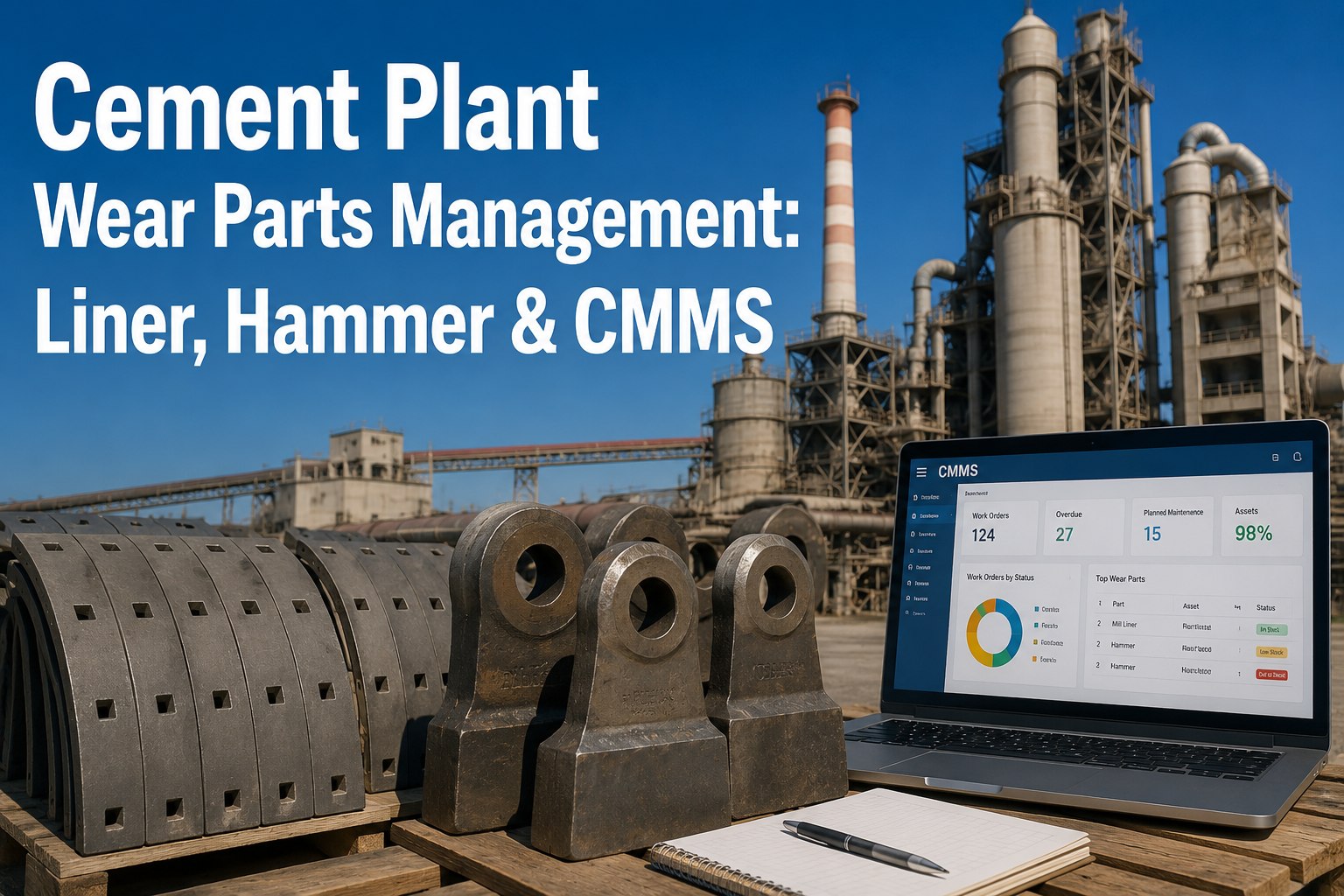
Crusher wear parts — jaw plates, mantles, concaves, blow bars, and impact bars — have consumption rates that vary by 40–60% depending on limestone hardness, feed size, and throughput. Plants that stock wear parts based on catalog estimates rather than actual quarry feed data routinely experience both over-stocking and unexpected shortfalls. CMMS-tracked consumption history is the only reliable stocking input for this category.
Wear Parts by Crusher Type
Jaw crusher: fixed and swing jaw plates, cheek plates
Gyratory: mantle, concave segments, spider arm liner
Cone crusher: mantle, bowl liner, feed cone
Impact crusher: blow bars, side liners, breaker plate
Hammer mill: hammers, screen bars, impact plates
Consumption Tracking
Record tons crushed per wear part set in CMMS
Calculate wear rate in g/ton crushed per grade
Set reorder point at 1.5x average replacement interval
Review stocking quarterly against quarry plan changes
Maintain 2 sets of critical wear parts in store
Spare Parts Criticality Matrix: How to Classify Every Item
Apply this two-axis matrix to every spare part in your inventory. Criticality score determines stocking policy. No spreadsheet needed — this is a CMMS configuration, not a one-time exercise.
| Criticality Level |
Failure Consequence |
Lead Time |
Stocking Policy |
Min Stock Level |
Review Frequency |
| A — Safety-Critical |
Production stop + safety risk |
Any |
Always in store. No stockout acceptable. |
2–5 units or 1 campaign |
Monthly physical count |
| B — Production-Critical |
Production stop, no safety risk |
> 4 weeks |
Min-max stocking. Reorder at minimum. |
2 units |
Quarterly review |
| C — Production-Critical |
Production stop, no safety risk |
< 4 weeks |
Reorder point stocking. 1 in store. |
1 unit |
Bi-annual review |
| D — Production-Supporting |
Degraded output, no full stop |
Any |
Order on demand. No stock held unless high frequency. |
0 (order as needed) |
Annual review |
| E — Non-Critical |
No production impact |
Any |
Order on demand only. |
0 |
As required |
OxMaint Spare Parts CMMS
Build Your Cement Plant Criticality Matrix in OxMaint — and Never Run Out of a Critical Part Again.
OxMaint lets you classify every spare part by criticality, set min-max levels, track consumption per work order, and receive automatic reorder alerts — so your storeroom reflects actual risk, not catalog guesses.
The Cement Plant Spare Parts Audit: Where to Start
Most cement plants have a storeroom built on historical habit, not criticality data. A structured audit takes 2 to 4 weeks and produces a defensible stocking strategy aligned to actual downtime risk.
1
Export Current Inventory Against Asset Register
Map every storeroom item to the asset it supports. Parts with no linked asset are either obsolete or incorrectly coded. Items linked to decommissioned assets should be dispositioned immediately — they represent dead capital that obscures your real inventory picture.
2
Identify Zero-Movement Items (12+ Months)
Run a zero-movement report for all parts with no issues in the past 12 months. Segment these into: still-critical assets with low failure frequency (keep), non-critical assets (disposition), and unknown assets (investigate before keeping). In most cement plant inventories, 20–30% of line items fall into the disposition or investigate category.
3
Cross-Reference Against Last 3 Years of Downtime Events
For every unplanned shutdown in the past 3 years that extended beyond the initial repair time, identify whether parts availability was a factor. Any event where "waiting for parts" was a root cause represents a stocking gap that should be addressed in the criticality matrix — regardless of failure frequency.
4
Assign Criticality Codes and Set Min-Max Levels
Apply the A–E criticality classification to each part. For A and B items, set minimum stock levels in the CMMS with automatic reorder alerts. For C items, set a reorder point. For D and E items, remove standing stock reservations — these should be ordered on demand only, freeing capital for higher-criticality items that are currently understocked.
5
Establish VMI for Long-Lead Critical Items
For specialty refractory grades, large bearings, and custom wear parts with 8+ week lead times, evaluate Vendor Managed Inventory arrangements. Under VMI, the supplier holds stock at a defined consignment level and the plant pays on consumption — not on receipt. This eliminates the capital cost of holding slow-moving, high-value items while maintaining guaranteed availability for critical shutdowns.
ROI of a Criticality-Based Spare Parts Program
The business case for a formal criticality program has two sides: downtime prevention value and inventory capital reduction. Both are measurable within 12 months of implementation.
Downtime Prevention Value
2.4 hrs
Average reduction in repair-to-restart time when critical parts are pre-staged vs sourced reactively
$75K+
Value of 2.4 hours of avoided kiln downtime in a 3,000 TPD plant at $32/ton clinker value
3–4 events/yr
Typical number of downtime extensions caused by parts unavailability in plants without criticality programs
Inventory Capital Reduction
18–25%
Average inventory value reduction achievable through criticality-based rationalization without increasing downtime risk
$240K
Median capital released from inventory in a 2,000 TPD plant after full criticality audit and rationalization
14 months
Average ROI payback period for full CMMS-based spare parts criticality program implementation
Expert Review
"The single biggest spare parts mistake I see repeatedly in cement plants is stocking the wrong things in large quantities while having zero stock of the right things. Stores are full of generic fasteners, low-criticality seals, and catalog-ordered bearings for equipment that was replaced five years ago — while the burning zone brick supply is three months below minimum because someone decided to save capital costs last quarter. A criticality matrix doesn't require a revolution — it requires someone to answer one question for every part: 'If this item is not available when the failure happens, what does that cost per hour?' Once you have that number, stocking decisions make themselves."
— Cement Plant Maintenance Director, 24 years managing MRO programs at integrated cement facilities across three continents
Frequently Asked Questions
How do we prioritize which assets to classify first when building a criticality matrix?
Start with the kiln system — every component from preheater through cooler — because this is where the consequence of downtime is highest and parts lead times are longest. From there, move to the main grinding circuits (raw mill and cement mill), then to the primary crusher. This sequence covers roughly 80% of your critical downtime risk in the first classification cycle. Non-process assets — water systems, compressed air, utilities — can be classified in a second phase.
OxMaint's asset criticality ranking tool makes this sequencing process systematic rather than opinion-driven.
What is the right minimum stock level for refractory bricks?
How should we handle bearings that have multiple OEM and aftermarket cross-references?
Maintain a single CMMS inventory record for the bearing specification — not separate records for each brand. The record should include all approved cross-references: OEM part number, SKF equivalent, NSK equivalent, and any approved aftermarket alternatives. This prevents the common problem of having three stock records showing "1 in store" each, when effectively you have 3 units of the same bearing spread across different location codes and unable to be counted together in min-max calculations. Cross-reference consolidation alone typically reveals 10–15% "phantom inventory" in cement plant bearings stores that exists on paper but is operationally inaccessible.
What is VMI and is it appropriate for cement plant spare parts?
Vendor Managed Inventory is an arrangement where a supplier holds physical stock at a consignment level defined in your supply agreement, and you pay on consumption rather than on receipt. It's most appropriate for high-value, long-lead, slow-moving items — specifically specialty refractory grades, large-diameter bearings, and custom wear parts — where holding cost is high but availability criticality is extreme. VMI is not suitable for fast-moving bearings and standard wear parts where the administrative overhead of a VMI agreement exceeds the holding cost benefit. The right VMI shortlist for most cement plants covers 20–35 SKUs and can reduce critical spare parts holding cost by 30–45% while maintaining guaranteed availability through the supplier agreement.