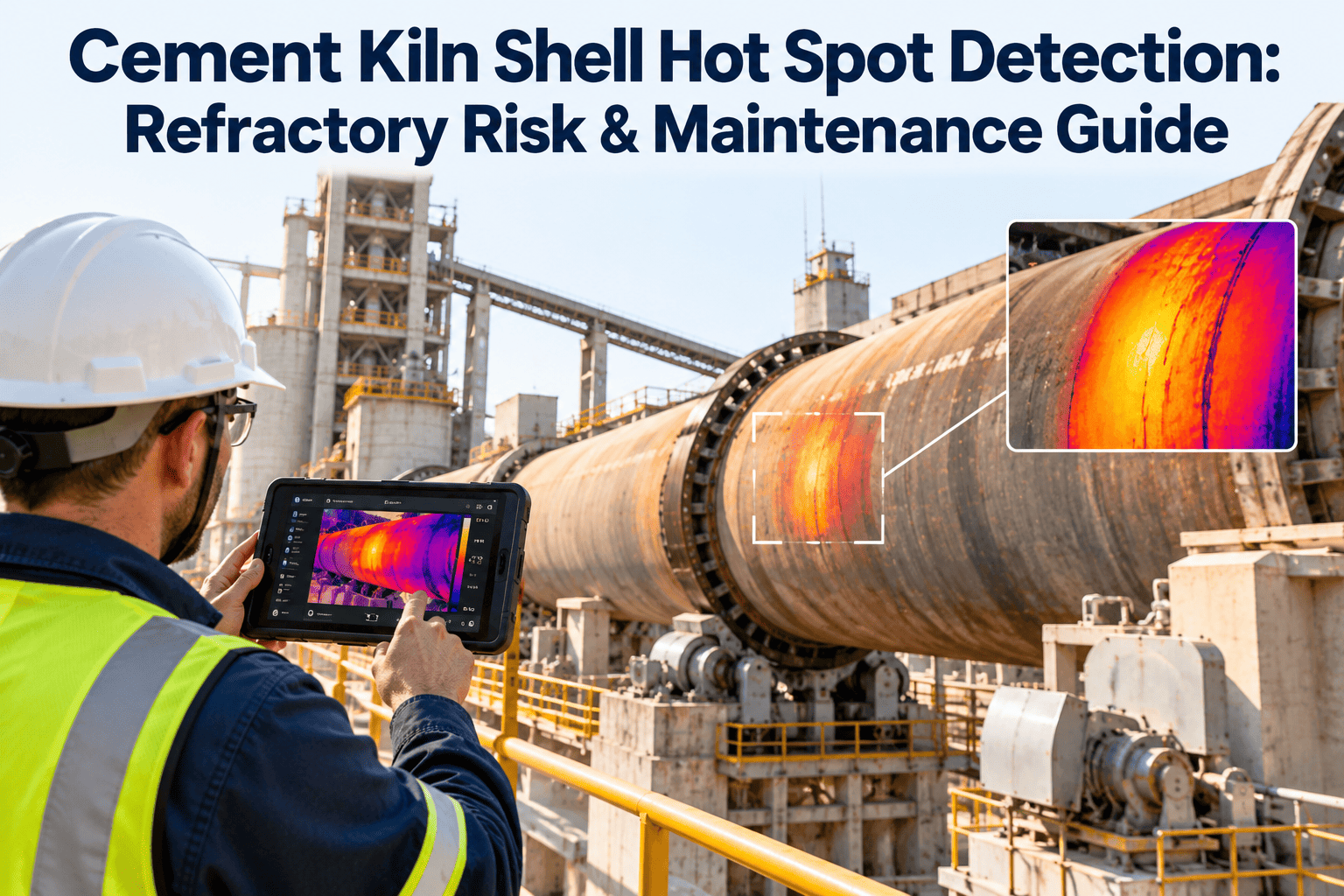
A cement kiln in Alabama missed a developing shell hot spot detected only by manual thermal gun readings taken once per shift — by the time the anomaly was visible, the refractory had already failed, the steel shell had warped past 400°C, and the plant faced 45 days of emergency repairs costing $2.3 million. AI thermal models monitoring the same kiln continuously — every rotation, every zone — would have flagged the developing hot spot 23 days earlier, enabling a targeted repair during a planned stop at a fraction of that cost. Book a demo to see how OxMaint's thermal monitoring integrates kiln scanner data directly into work order generation and refractory lifecycle planning.
Technical Article · Cement Operations · Kiln Safety
AI Thermal Runaway Detection in Cement Kilns and Precalciners
Cement kilns operate at 1,450°C. A 47°C shell temperature anomaly detected 23 days early saves $1.8M. An anomaly missed until failure costs $2.3M and 45 days of shutdown. AI thermal models see what shift-based manual readings cannot.
1,450°C
Internal kiln operating temperature
300°C
Shell temp threshold requiring immediate attention
$2.3M
Cost of one missed thermal runaway event
23 days
Early warning window AI delivers vs manual shift checks
Why Thermal Runaway Happens
The Cascade That Manual Monitoring Cannot Stop
Thermal runaway in a cement kiln is not a sudden event — it is a cascade that unfolds over days or weeks, beginning with microscopic refractory wear that manual readings miss entirely. By the time a single-shift thermal gun reading detects an anomaly, the cascade is already advanced. AI models read every rotation and detect the rate of temperature change — the leading indicator that determines whether an anomaly is stable or accelerating toward failure.
Stage 1
Refractory Brick Wear
Coating loss or brick degradation begins. Shell temperature rises 5–10°C above zone baseline. Detectable only by continuous trending — invisible to shift readings.
Shell: +5–10°C
→
Stage 2
Hot Spot Formation
Localized zone heats past 280–320°C. Rate of temperature rise accelerates. AI detects the inflection in the trend curve — the critical window for intervention.
Shell: 280–320°C
→
Stage 3
Refractory Failure Zone
Without intervention, brick collapse exposes steel shell to kiln gases. Temperature spikes to 380–420°C. Emergency shutdown becomes unavoidable.
Shell: 380–420°C+
→
Stage 4
Shell Deformation
Steel shell warps. Emergency reline required. 30–60 days offline. $1.5M–$3M+ in parts, labor, and production loss — all preventable at Stage 1 or 2.
Crisis: $1.5M–$3M
AI Detection Architecture
How AI Models Catch Thermal Runaway at Stage 1 — Not Stage 4
Continuous IR Scanning
Fixed infrared scanner arrays or robotic pan-tilt systems capture full circumferential shell temperature profiles every kiln rotation — every 30 seconds, 24 hours a day. Multiple scanner positions eliminate blind zones caused by structural obstructions.
Coverage: 100% of shell circumference per rotation
AI Anomaly Classification
ML models distinguish between normal operating temperature variation, transient coating events, and genuine developing hot spots using rate-of-rise analysis. A 5°C rise over 30 rotations produces a different AI response than a 5°C stable reading.
Key signal: temperature rate-of-rise, not absolute value
Zone-by-Zone Threshold Layers
OxMaint uses graduated alert thresholds per kiln zone — Watch at 310°C, Alert at 340°C, Critical at 370°C in the burning zone. Each zone has independent thresholds reflecting its normal operating envelope and refractory specifications.
Burning zone thresholds differ from inlet/outlet zones
Automated CMMS Work Order
When a threshold is crossed, OxMaint generates a prioritized work order with zone location, temperature trend history, refractory installation date, and recommended action — reducing response time from 14 hours to under 23 minutes in documented deployments.
Response time: from 14 hrs to 23 min with automated dispatch
Kiln Scanner Data Without CMMS Context Is Just Numbers. Make It Actionable.
OxMaint connects your thermal scanner output directly to maintenance execution — converting temperature anomalies into work orders, refractory lifecycle plans, and procurement triggers before damage escalates.
Precalciner Specifics
Why Precalciners Require Separate AI Thermal Models
Precalciners operate differently from the main kiln barrel — higher combustion variability, multiple burner zones, and rapid temperature swings driven by fuel type changes. A single AI model trained on kiln shell behavior does not transfer directly to precalciner monitoring. OxMaint maintains separate thermal models per equipment type.
Precalciner Thermal Risk Factors
Fuel Type Switching
Alternative fuel blending — waste-derived fuels, biomass, petcoke — causes combustion parameter shifts that spike localized temperatures in specific cyclone stages. AI models track fuel type against temperature response per stage.
Cyclone Blockage Heat Buildup
Partial blockages in cyclone preheater stages trap hot gases, elevating temperature in the stage above. Temperature distribution asymmetry across parallel cyclone strings is a leading indicator AI detects before pressure drop alarms trigger.
Combustion Zone Drift
When combustion completes outside the designed calciner volume, refractory in adjacent zones receives heat loads beyond design specification. AI identifies combustion zone drift from temperature distribution patterns before structural refractory damage begins.
AI Monitoring Parameters
Stage Exit Temperatures
Monitored per cyclone stage continuously
Temperature Distribution
Asymmetry across parallel strings flagged
Rate of Rise Analytics
Trend acceleration triggers alert before absolute threshold
Fuel Parameter Correlation
Combustion inputs mapped against thermal response
Gas Composition Trends
CO and O₂ trends indexed against temperature anomalies
Refractory Age Overlay
Zone-specific brick age weighted into anomaly scoring
Documented Results
What AI Thermal Detection Delivers in Cement Operations
70%
Reduction in temperature-related failures
Plants deploying AI-powered thermal monitoring of kiln and calciner assets report up to 70% fewer temperature-driven equipment failures compared to shift-based manual readings.
$1.5M+
Saved per prevented catastrophic kiln failure
One avoided emergency reline covers emergency labor, replacement brick, expedited procurement, and production loss — the full documented cost of a missed thermal runaway event.
23 min
Avg response time from detection to work order
Compared to 14 hours average for manual detection and maintenance dispatch, OxMaint's automated work order generation cuts anomaly response time by 97% in documented deployments.
Frequently Asked Questions
Thermal Runaway Detection — What Kiln Engineers Ask
Does OxMaint require us to replace our existing kiln scanner system?
How does AI distinguish a genuine hot spot from normal coating fluctuation?
AI thermal models analyze the rate-of-rise — not the absolute value. A 320°C reading that has been stable for 10 days differs fundamentally from a 320°C reading that was 280°C two days ago. The acceleration pattern is what identifies a developing failure. Stable thermal profiles, even at higher temperatures, generate watch-level alerts only.
What temperature thresholds does OxMaint use for kiln shell alerts?
Can the same AI system monitor both the kiln and the precalciner?
Yes, but OxMaint applies separate trained models to each equipment type. Kiln shell monitoring uses circumferential thermal profile analysis. Precalciner monitoring uses cyclone stage temperature distribution, combustion parameter correlation, and rate-of-rise analytics — different signals, different failure modes, different AI response protocols.
How far in advance can AI thermal models detect a developing hot spot?
In documented cement plant deployments, AI thermal models have detected developing hot spots 14–30 days before visible shell deformation or manual alarm thresholds were reached. A cement plant in Turkey received a 23-day advance warning that prevented a $1.8M refractory replacement. Early detection window depends on refractory type, kiln age, and scanner coverage density.
OxMaint CMMS · Kiln Thermal Intelligence · Cement Safety
Every Thermal Runaway Starts as a 5°C Anomaly. AI Catches It. Manual Readings Miss It.
OxMaint connects your kiln and precalciner thermal data to automated CMMS work orders, refractory lifecycle plans, and procurement signals — turning continuous scanner output into a structured maintenance response that prevents the $1.5M+ failures that shift-based readings cannot stop.