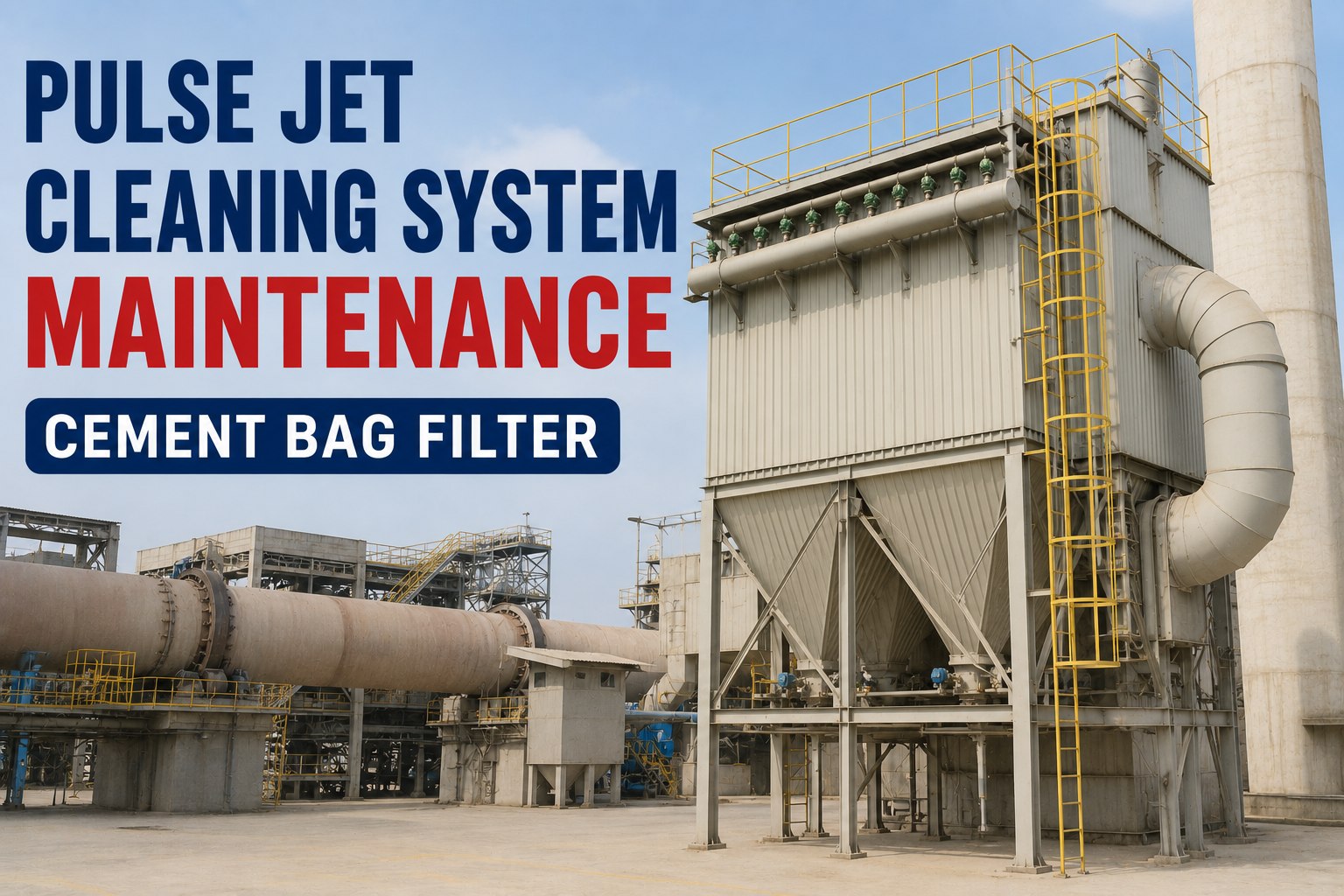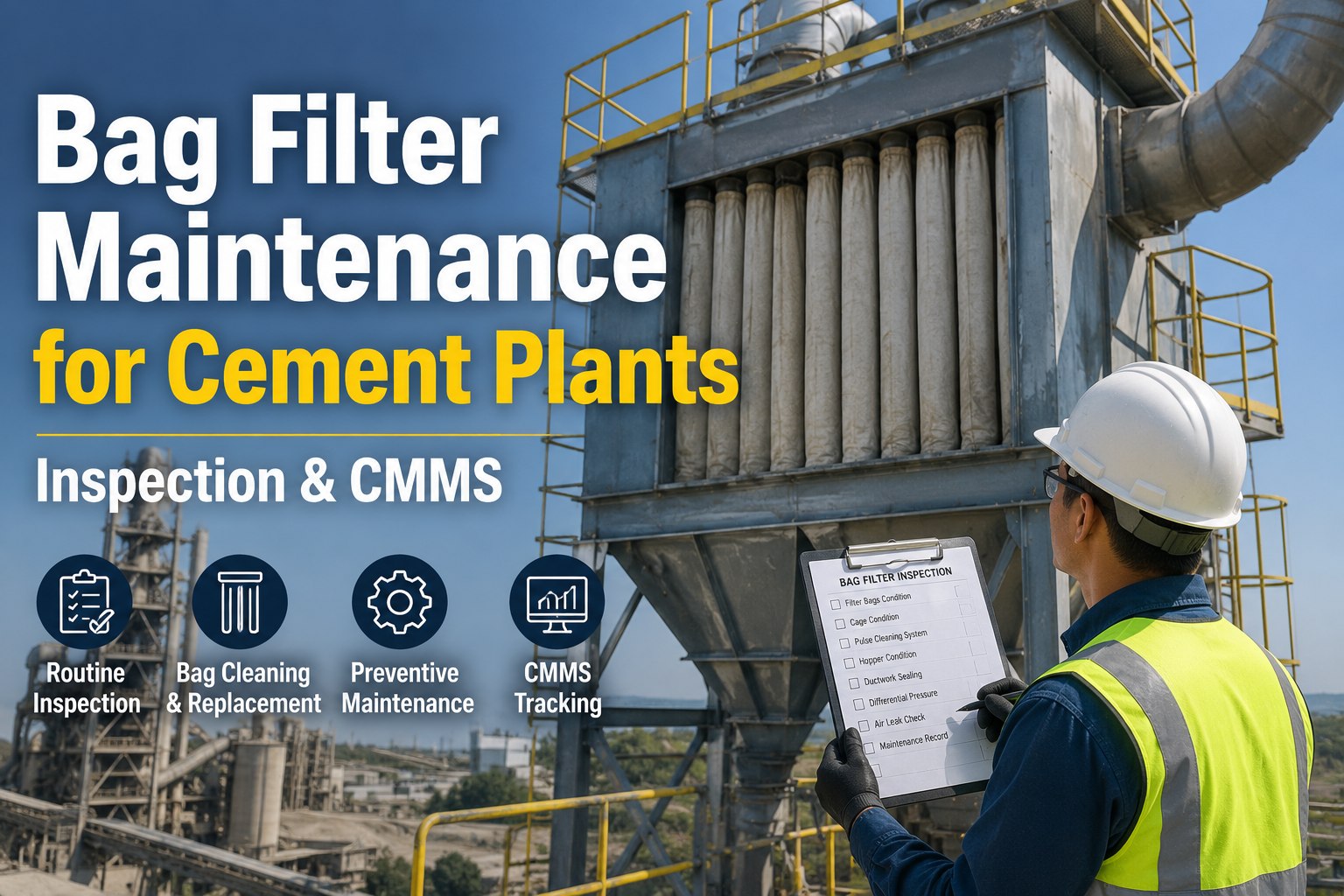
Bag filters shoulder most of the particulate load in a modern cement plant, and a single compromised chamber can push stack emissions past the 30 mg/Nm³ limit within hours. Differential pressure, pulse-jet health, and casing tightness together decide whether a set of bags reaches a 2-year service life or fails at 9 months. This guide maps the inspection rounds, replacement triggers, and CMMS setup that keep baghouses compliant, with a Start Free Trial path for teams ready to digitize the whole PM workflow.
Is your baghouse bleeding pressure drop before the next outage window?
A 50 mmH₂O rise in differential pressure across a cement bag filter adds roughly 4–6% to ID-fan power draw, shortens bag life by 20–30%, and silently pushes opacity toward the permit ceiling. The fix is rarely the bags — it is the inspection rhythm, pulse-jet tuning, and CMMS discipline behind them.
Pa
The cost equation behind every kiln baghouse
In a typical 5,000 TPD clinker line, the combined baghouse fleet — raw mill, kiln, cooler, cement mill, packer — holds 3,000 to 6,000 filter bags. At $25–$45 per bag plus change-out labor, a full set runs $180K–$400K, and that figure says nothing of the ID-fan energy penalty or the emission excursion risk while the set degrades.
A mid-sized plant running 14 baghouses on a reactive model — change bags when opacity alarms — typically spends 35–45% more on filter media and 6–8% more on fan energy than a plant of the same size running a structured PM program in a CMMS. The gap is not manpower; it is visibility. Without a logged ΔP trend, pulse-valve service history, and bag-change record per cell, every failure is a surprise and every replacement is an emergency.
Daily, weekly, and shutdown rounds — by frequency
Inspection frequency is the single biggest predictor of bag life. The tiered grid below is calibrated to a cement-plant baghouse running continuous duty; adapt cell counts to your specific model and dust loading.
- Record ΔP (mmH₂O or Pa) on the local gauge and on the DCS trend; flag any reading above the 2,000–2,500 Pa band.
- Verify pulse-jet solenoid indicators are cycling in sequence; note any valve that is stuck open or silent.
- Walk the clean-air plenum — listen for hissing that signals a torn bag or loose cage joint.
- Check hopper level indicators; a half-full hopper bridging into the tube sheet will abrade bags within days.
- Confirm rotary valve / screw conveyor is discharging and not back-feeding dust into the hopper.
- Measure compressed-air header pressure at the pulse manifold; nominal 0.4–0.6 MPa, log deviation.
- Drain moisture from the pulse-air receiver and refrigerated dryer; water in the header shortens diaphragm life 3×.
- Inspect pulse-valve diaphragms for leaks — a single leaking diaphragm bleeds continuous air and weakens adjacent pulses.
- Torque-clean the timer/electrical cabinet; verify solenoid coil resistances are within 5% of nameplate.
- Inspect bag-bottom access doors for gasket compression; 0.5 mm of gap leaks 8–12% of clean air back to dirty side.
- Pull 3–5 representative bags per cell; check for hardening, blinding, chemical attack, and mechanical wear at the cage contact line.
- Perform a fluorescent-powder or smoke test on the tube sheet to locate pinhole leaks at welded bag-cage seats.
- Inspect cage straightness and corrosion; a 10 mm bow rubs the bag 24/7 and is the #1 cause of premature mid-bag failure.
- Verify hopper walls for buildup; condensation at the dew point (typically 55–70 °C for cement dust) cakes the lower bag section.
- Re-torque all explosion-vent and door bolts; thermal cycling loosens them 15–25% within a year.
| Failure signal | What it usually means | First action |
|---|---|---|
| ΔP climbing 300+ Pa over 2 weeks, stable flow | Moisture blinding, failed pulse section, or hopper bridging | Isolate hopper level; check pulse timer sequence |
| ΔP falling suddenly with opacity spike | Torn bag or blown bag-cage seat | Run fluorescent test; isolate the leaking cell |
| Pulse header pressure 20%+ below setpoint | Leaking diaphragm, clogged filter-regulator, dryer fault | Drain receiver; replace worst diaphragm; re-test |
| Opacity rising only at one DCS flow step | Casing leak opening under negative-pressure swing | Smoke-test doors, gaskets, and expansion joints |
| Bags failing at the same row every cycle | Cage geometry defect or uneven gas-distribution baffle | Measure cage bow; CFD-check inlet baffle angle |
When to change bags — three hard numbers, not a calendar guess
Too many plants change bags on a fixed calendar interval, replacing healthy media and wasting $40K–$80K per cell. The defensible approach uses three measured triggers; any one is sufficient cause to schedule the change.
If running ΔP sits more than 1,500 Pa above the clean-bag baseline (typically 800–1,200 Pa) and pulse cleaning cannot bring it back, the bag is blinded or the cake is sintered. Schedule change-out within the next planned outage.
Even one torn bag in a 200-bag cell can lift opacity to 15–25 mg/Nm³. If the stack monitor sustains half your permit ceiling for a shift, isolate cells and run a fluorescent powder test before the next baghouse cycle.
When the gap between header and manifold pressure widens beyond 0.08 MPa, the pulse system is fighting blocked nozzles or saturated bags. If two consecutive weekly checks show the same gap after cleaning, the bags are no longer releasing dust — change them.
A 180-asset cement plant running 14 baghouses spent $42K/yr on emergency bag changes and $61K/yr on the ID-fan energy penalty from elevated ΔP. After moving to a CMMS-driven PM schedule — weekly ΔP logging, diaphragm-change intervals tied to runtime, and a 24-month rolling bag-replacement forecast per cell — emergency spend fell to $9K/yr and average fan energy dropped 5.8%. Payback on the CMMS deployment was under 4 months.
The two systems that decide bag life — pulse air and casing tightness
Bags rarely fail first. The pulse-jet cleaning system and the casing envelope fail first, and the bags die as a consequence. Servicing these two systems on a 90-day rhythm typically extends bag life 25–40%.
Configuring the bag-filter asset record, PM triggers, and history loop
A CMMS turns the rounds above into a closed loop: PM triggers fire automatically, work orders carry the exact inspection steps, and every reading feeds a trend that re-prioritizes the next outage. Here is the asset-and-trigger model that works for cement baghouses.
| CMMS trigger | Condition | Auto-generated work order | Priority |
|---|---|---|---|
| Weekly ΔP read | ΔP > 2,500 Pa or +300 Pa vs prior week | Inspect pulse timer + hopper level + casing | High |
| Pulse header pressure | Header < 0.4 MPa or Δ to manifold > 0.08 MPa | Diaphragm & dryer audit, drain receiver | Medium |
| Opacity monitor | > 50% of permit limit, sustained 4 hr | Isolate cells, fluorescent powder test | Critical |
| Bag age forecast | Projected ΔP breach before next outage +30 days | Pre-stage bags + cages for that cell | Planned |
| Quarterly casing audit | Smoke-test positive on any door / joint | Gasket replacement, re-torque bolts | High |
Stop running your baghouses on a calendar and a prayer.
Set up meter-based PM, auto-triggered inspections, and a 24-month bag-change forecast in OxMaint — usually live in under two weeks for a full cement-plant fleet.
Bag filter maintenance — the questions plant engineers actually ask
A clean, well-pulsed cement bag filter typically runs between 800 and 1,800 Pa (80–180 mmH₂O). Anything above 2,200–2,500 Pa on a sustained basis means the pulse system is under-performing, the bags are blinding, or the hopper is bridging — not that the timer needs to run faster. Log the clean-bag baseline after every change-out so you have a defensible reference for every later drift.
With structured PM, acrylic and PPS bags in kiln and raw-mill service typically reach 18–24 months; cement-mill bags often run 24–30 months because the dust is less aggressive. Replace when running ΔP exceeds the clean baseline by 1,500 Pa, when opacity sustains above half the permit limit, or when pulse-air pressure gap widens beyond 0.08 MPa after cleaning. Calendar-only replacement wastes 20–35% of useful bag life — a CMMS forecast against these triggers is the right way to schedule change-outs. Start Free Trial to set up the forecast per cell.
Almost always a cage or gas-distribution problem, not a media problem. A cage bowed more than 10 mm rubs the bag 24/7 and fails it at the same height every cycle. An inlet baffle angled wrong sends dust-laden gas straight at one row, abrading it 3× faster. Measure cage straightness on the next outage and CFD-check the inlet distribution — fixing the geometry once is cheaper than replacing that row every nine months.
Run a smoke-pencil test on every access door and expansion joint at operating negative pressure once a quarter, and a full fluorescent-powder test across the tube sheet at every major shutdown. A single leaking door gasket can pull 5–12% of clean-side air back to the dirty side, silently lifting opacity. Logging these tests in a CMMS gives you a dated, audit-ready record that the casing envelope was verified — not just assumed tight.
For most cement baghouses, target a 60–90 second interval between pulses and a 100–150 ms pulse width, with header pressure at 0.4–0.6 MPa. The goal is the lowest pulse frequency that keeps ΔP inside the 1,200–1,800 Pa band — over-pulsing shortens bag life by 15% and wastes compressed air. Re-tune quarterly and after any bag change, because fresh bags release dust more easily and need a gentler pulse than end-of-life bags.
Bring your whole baghouse fleet under one PM schedule.
Meter-based triggers, automated work orders, bag-change forecasts, and a compliance log your auditor will actually thank you for. Free 14-day trial — no credit card required.