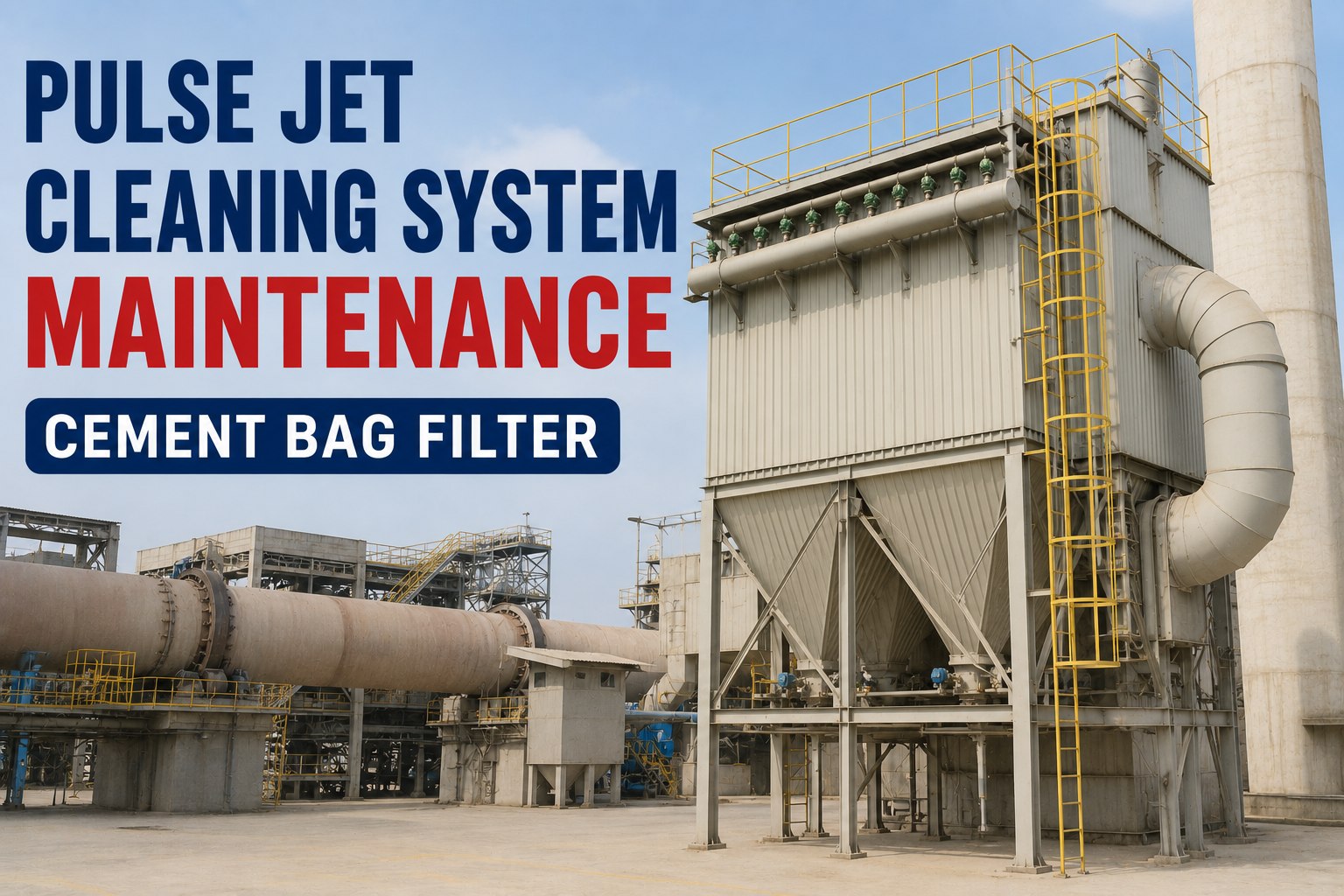
Pulse jet cleaning system maintenance is the single biggest determinant of bag filter differential pressure in a cement plant — and DP drift is exactly where energy waste, premature bag failure, and emission excursions hide. A well-tuned pulse jet system holds DP between 800 and 1,500 Pa while a neglected one silently climbs past 2,500 Pa, dragging ID fan amps up 15–25% and shortening filter bag life from 4 years to under 18 months. This guide walks plant reliability engineers and maintenance managers through the PM routines that matter: diaphragm valve service, header tank pressure management, solenoid coil inspection, sequence controller logic, and the CMMS configuration that keeps all of it on schedule. Ready to operationalize it across your plant? Start Free Trial and configure your pulse jet PM library today.
PULSE JET RELIABILITY GUIDE · CEMENT BAG FILTERS
Is your bag filter DP quietly burning $40K a year in wasted fan power?
Every 100 Pa of avoidable DP drift on a typical cement kiln bag filter adds roughly 3–5% to ID fan energy draw. Across a 5,000 TPD plant running three filters, that is real money leaking out of the compressed air and electrical budget every single day the pulse jet system underperforms.
DIAPHRAGM VALVE PM
Four failure modes that turn a $90 diaphragm into a $9,000 problem
Diaphragm valves are the heart of pulse jet cleaning — and the most over-looked PM item on the bag filter. Inspect every valve quarterly on a rotating schedule, replace diaphragms proactively at 18–24 months, and never wait for a sticking pulse to tell you one has failed.
Fatigue & hardening
Rubber diaphragms harden after 18–24 months of 6 bar pulsing at 70–90°C. Hardened rubber seals poorly, delivering weak pulse energy (under 50% of design) that fails to clear dust cake. Replace on calendar PM — not on failure.
Torn or pinched diaphragm
A torn diaphragm vents compressed air continuously, dropping header pressure 1–2 bar and starving downstream valves. Listen for a hissing valve during off-pulse; confirm with a pressure log on the header tank.
Pilot port blockage
Cement dust ingress into the solenoid-to-valve pilot line causes the valve to stick open or fail to fire. Blow out pilot tubing quarterly and verify the solenoid exhaust port is not caked with dust.
Spring fatigue & seat wear
Valve return springs lose tension over millions of cycles, slowing close time and wasting pulse air. During scheduled rebuilds, replace the spring kit alongside the diaphragm — parts cost is trivial versus downtime.
WORKED EXAMPLE · 180-ASSET PLANT
What a 6% DP reduction is actually worth on a kiln bag filter
A 180-asset cement plant running three kiln bag filters at 1,800 Pa average can recover ~110 Pa by restoring pulse jet performance to design. Here is what that translates to in hard dollars.
PULSE JET SAVINGS FORMULA
ΔS = (ΔP × Q × T × $kWh) ÷ η
Where ΔP = recovered pressure (Pa), Q = fan flow (m³/s), T = annual run-hours, η = fan-motor-drive efficiency. Drop a 110 Pa recovery into a 220 m³/s fan running 8,000 h/yr at $0.09/kWh and 65% wire-to-air efficiency:
≈ $26,800 / year recovered on one filter alone
| DP Operating Band | ID Fan Energy Impact | Bag Life Expectancy | Emission Risk | Annual Cost / Filter |
|---|---|---|---|---|
| 800–1,200 Pa (design) | Baseline | 36–48 months | Low | Baseline |
| 1,200–1,800 Pa | +8–12% fan kWh | 24–30 months | Moderate | +$22K |
| 1,800–2,500 Pa | +15–20% fan kWh | 18–24 months | Elevated | +$54K |
| > 2,500 Pa (neglected) | +25% fan kWh, trips likely | < 12 months | High — permit risk | +$95K+ |
INSPECTION CADENCE
A 12-month pulse jet maintenance timeline that fits a cement plant
Pulse jet PM is not a single annual shutdown task. It is a rolling cadence of weekly checks, monthly functional tests, quarterly component inspections, and annual rebuilds. Here is the sequence that holds DP inside the design band.
Header pressure & dew point log
Verify header tank pressure holds at 5.5–6.5 bar between pulses. Check compressed air dew point stays below −40°C to prevent moisture injection into hot filter bags — a leading cause of bag blinding in humid-season cement operations.
Solenoid valve functional test
Walk every row during a cleaning cycle. A healthy solenoid fires with a sharp, audible "pop." A weak or silent pulse means coil failure, pilot port blockage, or a stuck diaphragm — log it, flag it in the CMMS, and schedule the repair.
Diaphragm valve inspection & pilot blowdown
Isolate and inspect 25% of diaphragm valves on a rotating basis so every valve is checked annually. Blow out pilot tubing, verify diaphragm flexibility, and check spring return. Replace any diaphragm showing hardening, cracking, or seat erosion.
Sequence controller & timer audit
Verify pulse-on-time (80–150 ms), off-time, and sequence logic match the bag filter OEM spec. Drift in timer settings is a silent killer — a 200 ms pulse wastes 33% more compressed air than a 130 ms pulse with no improvement in cleaning.
Full diaphragm & coil replacement campaign
During the kiln shutdown window, replace all diaphragms older than 24 months and all solenoid coils older than 36 months. Re-gauge header pressure relief valves and recalibrate the DP transmitter that feeds the cleaning controller.
CMMS CONFIGURATION
How a CMMS keeps pulse jet PM from slipping through the cracks
The difference between a filter that runs at 1,100 Pa for 4 years and one that drifts to 2,400 Pa in 18 months is almost never the equipment — it is whether PM triggers actually fire on time. Here is the CMMS setup that enforces it.
Asset hierarchy by row & valve
Model each filter as a parent asset, rows as children, and individual diaphragm valves as grandchildren. Then a failed valve maps to a exact location, not "kiln filter somewhere."
Triggered PM by DP trend
Bind PM work orders to the DP transmitter trending. If DP crosses 1,600 Pa for 72 hours, auto-generate a pulse jet inspection — do not wait for the monthly calendar trigger.
Checklist-driven inspections
Digitize the pulse jet checklist so technicians log header pressure, solenoid pass/fail, and diaphragm condition against each valve ID — no paper, no lost data, no "we'll log it later."
Spare parts forecasting
Track diaphragm and coil replacement dates per valve. The CMMS forecasts kit demand 90 days out so procurement lands rebuild kits before the shutdown window — not after.
Pulse cycle optimization log
Record pulse-on-time, off-time, and header pressure per audit. Trend these against DP to find the energy-optimal cleaning band — most plants over-pulse by 20–30%.
Compliance & emission audit trail
Every PM, every valve replacement, every DP trend is timestamped and exportable. When the environmental regulator asks for pulse jet maintenance evidence, it is one report away.
We were replacing kiln filter bags every 14 months and running DP at 2,100 Pa. After digitizing pulse jet PM in the CMMS — quarterly valve inspections, triggered DP work orders, and a real spare-parts forecast — we dropped to 1,250 Pa and pushed bag life past 38 months. The system paid for itself on one filter.
Stop letting pulse jet drift drain your fan power budget
Deploy a CMMS that triggers pulse jet PM by DP trend, not by memory. Your bags, your fans, and your emissions report will all thank you.
FREQUENTLY ASKED
Pulse jet cleaning system maintenance — straight answers
What differential pressure should a cement bag filter run at?
A well-maintained pulse jet bag filter in a cement plant should hold DP between 800 and 1,500 Pa. Above 1,800 Pa you are paying 15–20% more in ID fan energy and shortening bag life significantly. If DP trends above 2,500 Pa you have both a pulse jet performance problem and a likely emission permit exposure — investigate immediately.
How often should diaphragm valves be replaced?
Replace diaphragm valves proactively at 18–24 months regardless of apparent condition. Rubber hardens from cyclic pressure and 70–90°C service temperature long before visible failure. A $90 diaphragm run to failure can vent header pressure, starve downstream valves, and cost $9,000+ in wasted compressed air and fan energy before someone notices. Book a Demo to see how Oxmaint auto-schedules these replacements per valve ID.
What compressed air pressure and dew point does a pulse jet system need?
Header tank pressure should hold 5.5–6.5 bar between pulses. Compressed air dew point must be below −40°C; moisture in pulse air injected into hot cement filter bags causes immediate dust cake blinding and accelerates bag degradation. Monitor dew point weekly and regenerate or replace the air dryer desiccant on schedule.
How do I know if my pulse jet timer settings are wrong?
Compare pulse-on-time and off-time against the bag filter OEM specification — typically 80–150 ms on, with off-time set by row count and process load. If on-time has crept to 200+ ms you are wasting 30% more compressed air than necessary. If off-time is too short, valves fire before header pressure recovers, weakening each successive pulse. Audit timer settings semi-annually.
Can a CMMS actually reduce bag filter operating cost?
Yes — by enforcing PM cadence, triggering work orders from DP trend data rather than calendar memory, and forecasting spare parts so rebuild kits arrive before shutdown. Plants that digitize pulse jet PM typically recover $50K–$90K per filter per year in fan energy, extended bag life, and eliminated compressed air waste. Start Free Trial to configure your pulse jet PM library and see the trend in your own plant.
Put your pulse jet PM on autopilot — starting today
Configure asset hierarchies, DP-triggered work orders, and spare-parts forecasting in under an hour. Your cement bag filters will run cooler, cleaner, and cheaper.
Free 14-day trial · No credit card