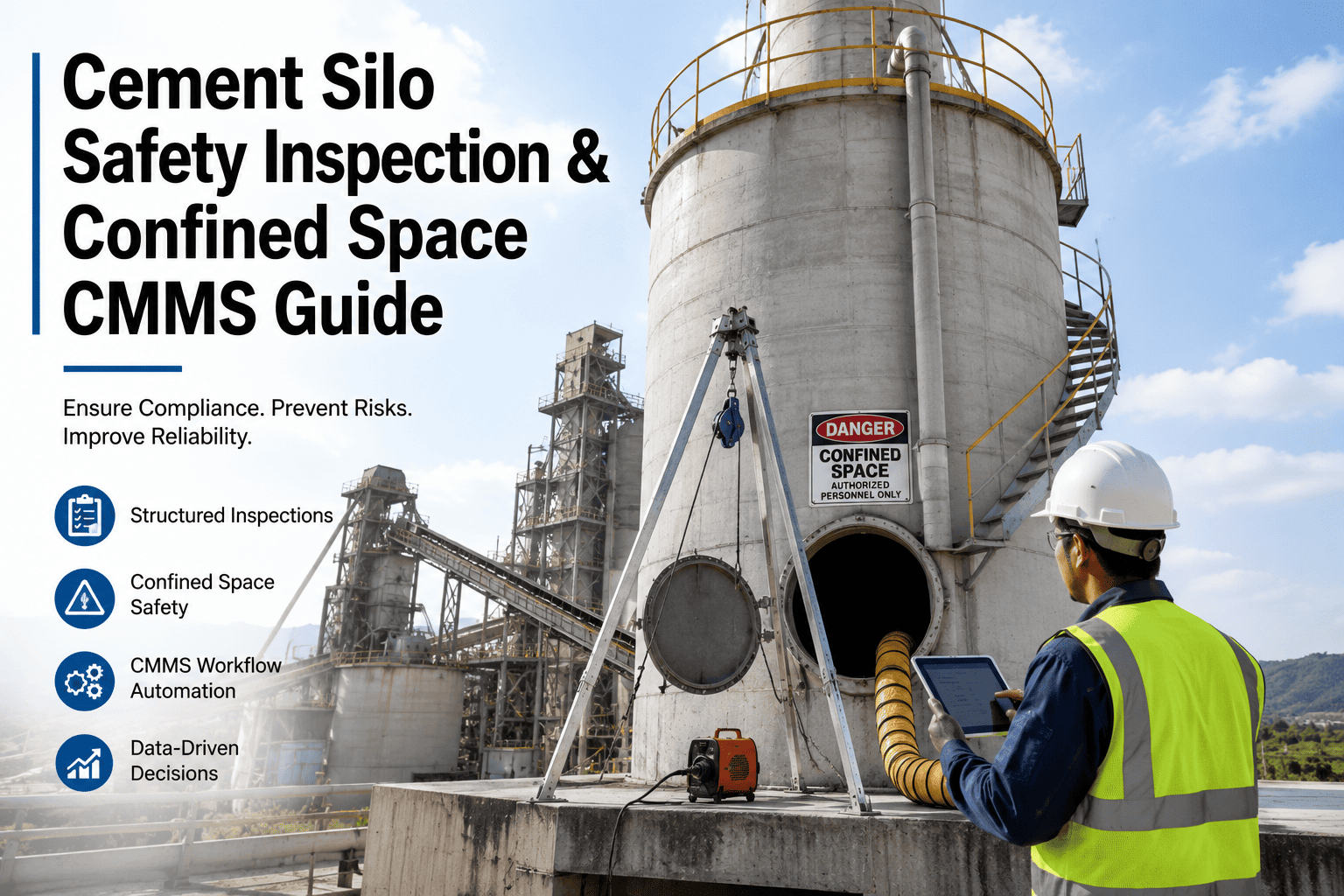
Non-destructive testing in a cement plant is the thin line between a planned shutdown and a catastrophic pressure-vessel failure on a 1,500-ton-per-day kiln line. Between ASME-coded vessels, API-653 silo floors, and structural conveyor galleries, a mid-sized operation typically carries 80–120 inspection-class assets that regulators and insurers expect to be examined on a documented cycle. A modern CMMS turns those findings into living work orders instead of paper reports that die in a filing cabinet. Start your Start Free Trial to see how OxMaint schedules NDT, tracks defect elimination, and keeps you audit-ready.
Is a single undocumented pressure vessel holding your entire kiln line hostage to an unplanned outage?
Cement operations lose an average of 18–24 production hours per unexpected shell or vessel failure. A CMMS-driven NDT program catches subsurface flaws during planned downtime — keeping your plant compliant with ASME Section VIII, API 510, and API 653 without disrupting the burn.
Match the right method to each cement-plant asset class
A 4,000-ton preheater tower, an API-653 clinker silo, and an ASME-coded compressed-air receiver each demand a different NDT approach. Selecting the wrong method wastes budget and misses the defect that matters.
Pressure Vessels & Air Receivers
Wet fluorescent magnetic particle testing on welded seams plus ultrasonic thickness (UT) at corroded zones. Frequency: internal every 5 years / API 510, external every 2 years.
Kiln Shell & Tire Seats
Phased-array UT on shell welds, acoustic emission monitoring during warm-up, and continuous shell-scanning lasers for ovality. Critical tire-to-shell NDT at every 12-month shutdown.
Silo Walls & Cone Hoppers
Ultrasonic thickness grid mapping per API 653, supplemented by magnetic particle inspection on anchor welds and MFL floor scans for plate thinning below 10% nominal.
Structural Steel & Conveyors
Visual + dye penetrant on gallery trusses, UT on high-stress pin connections, and vibration-based EMI on long belt-conveyor stringers subject to fatigue cracking.
A 12-month NDT scheduling timeline for a cement plant
Inspection cadence must align with the plant's operational rhythm — avoiding peak clinker-production months and clustering high-risk examinations around planned kiln outages.
Winter Prep — Pressure Vessels
UT thickness + WFMT on compressed-air receivers and dust-collection vessels while ambient temperatures permit magnetic particle suspension flow. Close out prior-year corrective work orders in CMMS.
Spring Silo Exams — API 653
External UT grid mapping on clinker and raw-meal silos, MFL floor scans where access permits, and MT on wind-ring anchors before the high-temperature clinker season.
Mid-Year Structural Sweep
PT + VT on conveyor galleries and preheater tower connections. Drone-assisted visual inspection at heights above 40 m reduces scaffolding cost by roughly 60%.
Planned Kiln Outage — PAUT & AE
Phased-array UT on kiln shell welds and tire seats, acoustic emission monitoring during cool-down, and ovality scanning — all performed while the line is down for refractory replacement.
Year-End Compliance Closeout
Reconcile all NDT findings against CMMS defect-elimination tickets, file NBIC R-1 reports for any repaired vessels, and set the next year's auto-generated inspection triggers.
What regulators and insurers actually expect from your NDT program
A defensible NDT program maps each asset to a governing code, a certified examiner level, and a retention rule. The table below mirrors the structure auditors ask for during an NBIC or insurance carrier review.
| Asset Class | Governing Code | Required NDT Method | Min. Examiner Level | Record Retention |
|---|---|---|---|---|
| Pressure Vessels (Air Receivers) | ASME Sec. VIII / API 510 | UT + WFMT | ASNT Level II | Life of vessel + 5 yr |
| Kiln Shell Welds | API 573 / OEM Spec | PAUT + AE | ASNT Level II | 10 years |
| Storage Silos (Clinker / Raw Meal) | API 653 / AWCI | UT Grid + MFL | ASNT Level I under L-II | 10 years |
| Process Piping (≥2 in NPS) | ASME B31.3 | UT / RT on welds | ASNT Level II | 5 years |
| Structural Steel Galleries | AISC / OSHA 1910 | VT + PT on critical joints | ASNT Level I | 5 years |
| Material Handling Bucket Elevators | OEM / Plant Spec | MT on head shaft | ASNT Level II | 3 years |
From finding to fix: closing the NDT defect-elimination loop
A CMMS only delivers value when NDT findings automatically generate work orders, owners, and due dates — not when they sit in a PDF. The scenario below illustrates the cycle at a real-world 1.8 MTPA plant.
A DER above 85% within 90 days is the benchmark used by major cement insurers to discount machinery-breakdown premiums.
Below 95% triggers an automatic compliance flag in the CMMS dashboard, alerting the reliability manager before an audit.
Five audit-readiness checks every NDT program must pass
When an NBIC inspector or your machinery insurer walks in, they look for five documented evidence points. Missing any one of them can trigger a shutdown order on a coded vessel.
Current ASNT Certification Roster
Every examiner who performed NDT in the last 24 months must have a valid SNT-TC-1A or NAS 410 certificate on file, with eye-acuity renewal within the year.
Procedure Qualification Records
Written NDT procedures for each method, signed by a Level III, with annual review dates logged inside the CMMS document-control module.
Calibrated Equipment Logs
UT flaw detectors, magnetic yokes, and penetrant kits must show traceable calibration to NIST-reference blocks, renewed per manufacturer or annual cycle.
Findings-to-Work-Order Traceability
Each reported indication links to a CMMS work order, a repair disposition, and a re-inspection record that confirms the defect was eliminated — not just patched.
Inspection Interval Compliance Report
A single dashboard view proving every in-scope asset was inspected within its code-mandated window — the report auditors ask for first.
NBIC R-1 Filing Trail
Any vessel repair or alteration triggered by an NDT finding must carry an NBIC R-1 form, with the AI inspector's signature attached to the CMMS asset record.
Stop letting NDT reports die in a filing cabinet
Turn every ultrasonic, magnetic-particle, and penetrant finding into a tracked, time-stamped CMMS work order that closes the defect-elimination loop.
NDT inspection in cement plants — your questions answered
How often should pressure vessels in a cement plant undergo NDT?
ASME-coded and API 510 vessels require an external inspection every 2 years and an internal or on-stream inspection every 5 years, with ultrasonic thickness measurement at each interval. Cement-plant air receivers and dust-collection vessels operating in abrasive environments often warrant annual UT spot checks given accelerated erosion at inlet nozzles.
Which NDT method is best for kiln shell crack detection?
Phased-array ultrasonic testing (PAUT) is the current standard for kiln shell longitudinal and circumferential welds, supplemented by acoustic emission monitoring during temperature transitions. Magnetic particle testing is added on tire-seat areas where surface-breaking fatigue cracks are most likely to initiate.
Can a CMMS automatically schedule NDT inspections?
Yes. A CMMS like OxMaint uses the asset's code classification and last-inspection date to auto-generate work orders at the correct interval — for example triggering an API 653 silo exam 60 days before the 10-year window closes. You can see it in action when you Start Free Trial or schedule a walkthrough.
What ASNT certification level is required to sign off on NDT reports?
A Level II examiner certified under SNT-TC-1A can perform and interpret most methods and sign reports. A Level III is required to write and qualify procedures, conduct annual performance demonstrations, and oversee the overall NDT program's compliance with the written practice.
How does a CMMS prove NDT findings were actually fixed?
The CMMS links each reported indication to a corrective work order, the technician who executed the repair, and a re-inspection record that confirms defect elimination. This closed-loop traceability — documented in a single asset history — is exactly what NBIC auditors and machinery insurers look for during a compliance review.
Build a defensible NDT program in under 14 days
OxMaint maps every pressure vessel, silo, and kiln weld to its code, schedules the right NDT method on time, and turns findings into closed work orders — all from one dashboard.
Free 14-day trial · No credit card