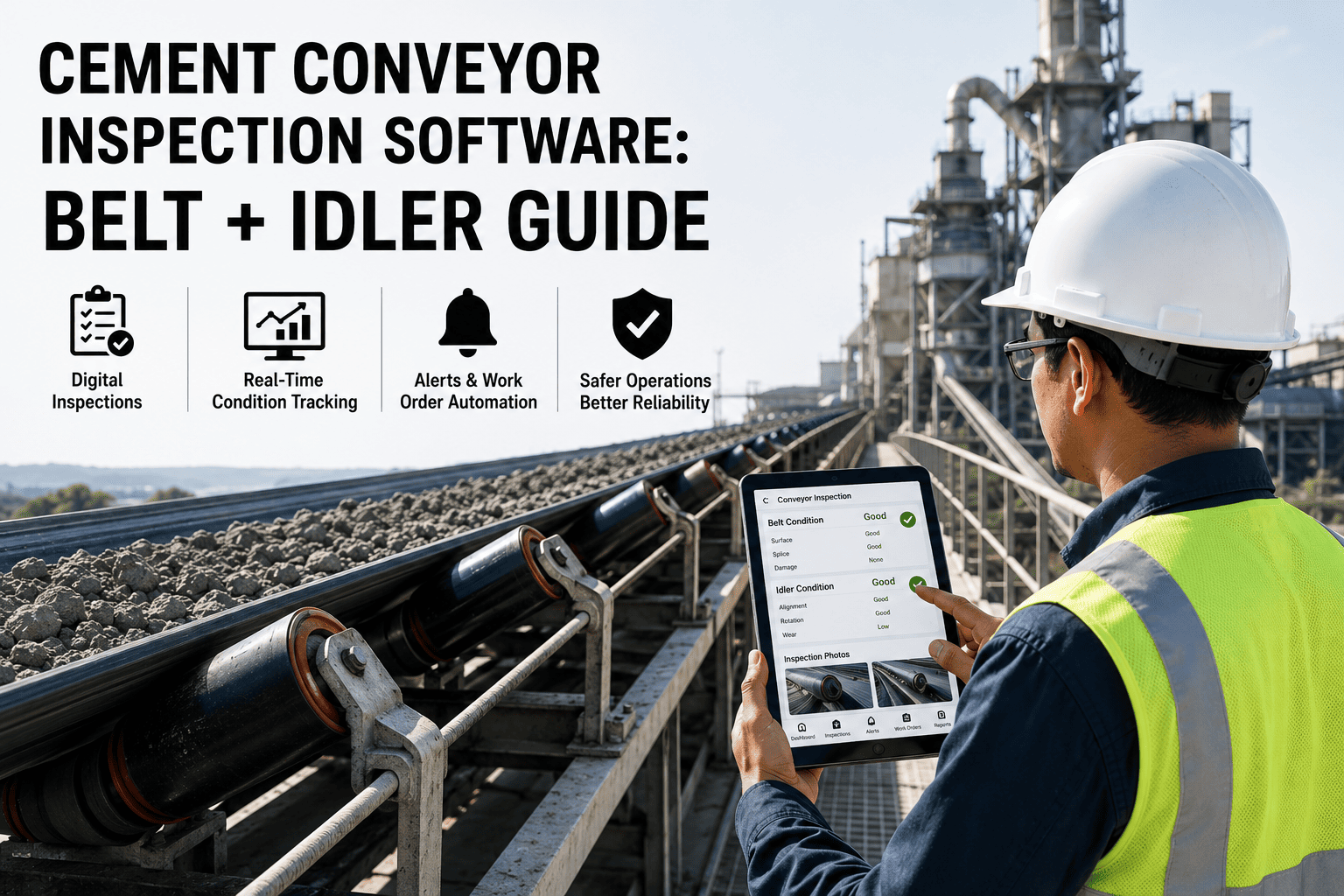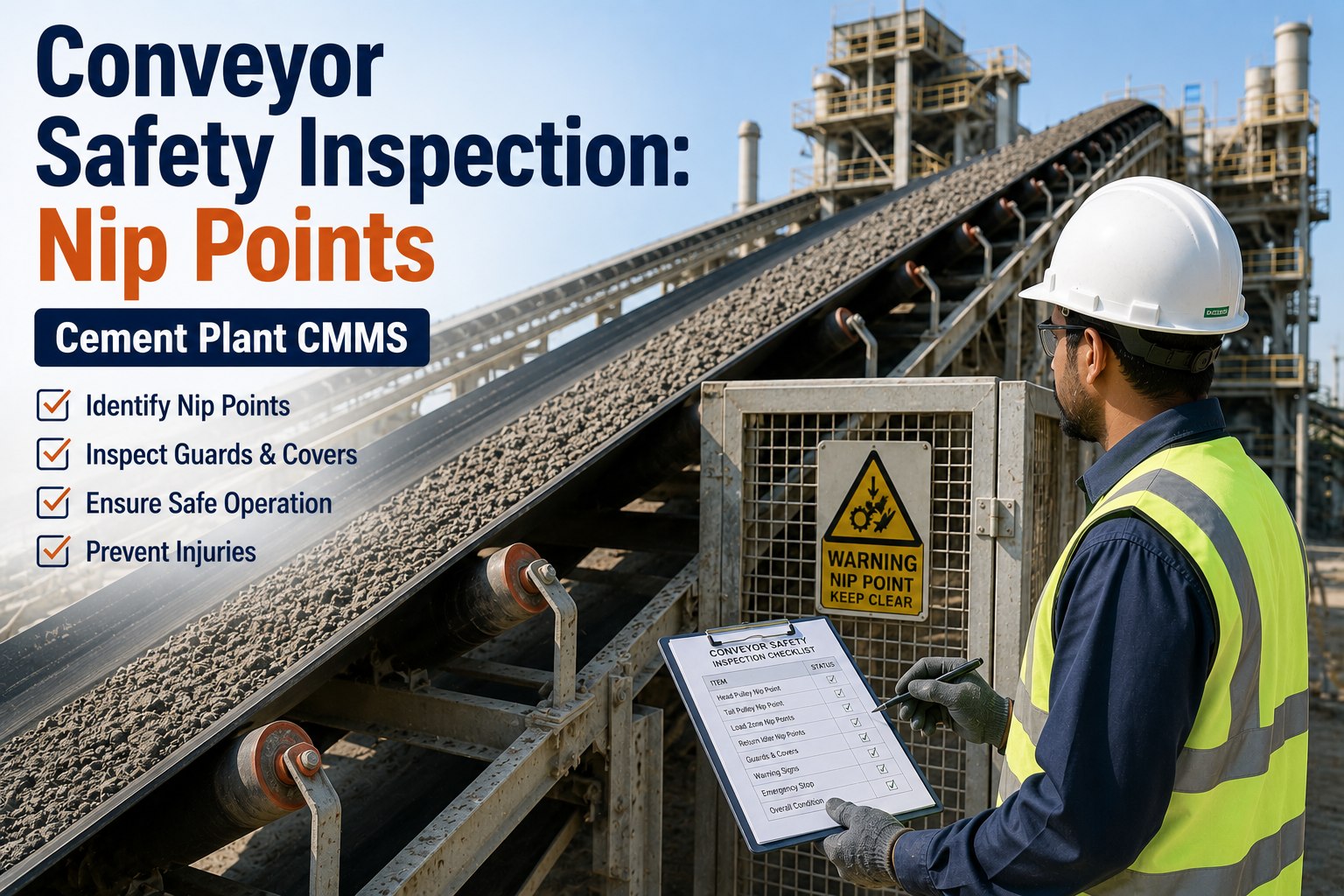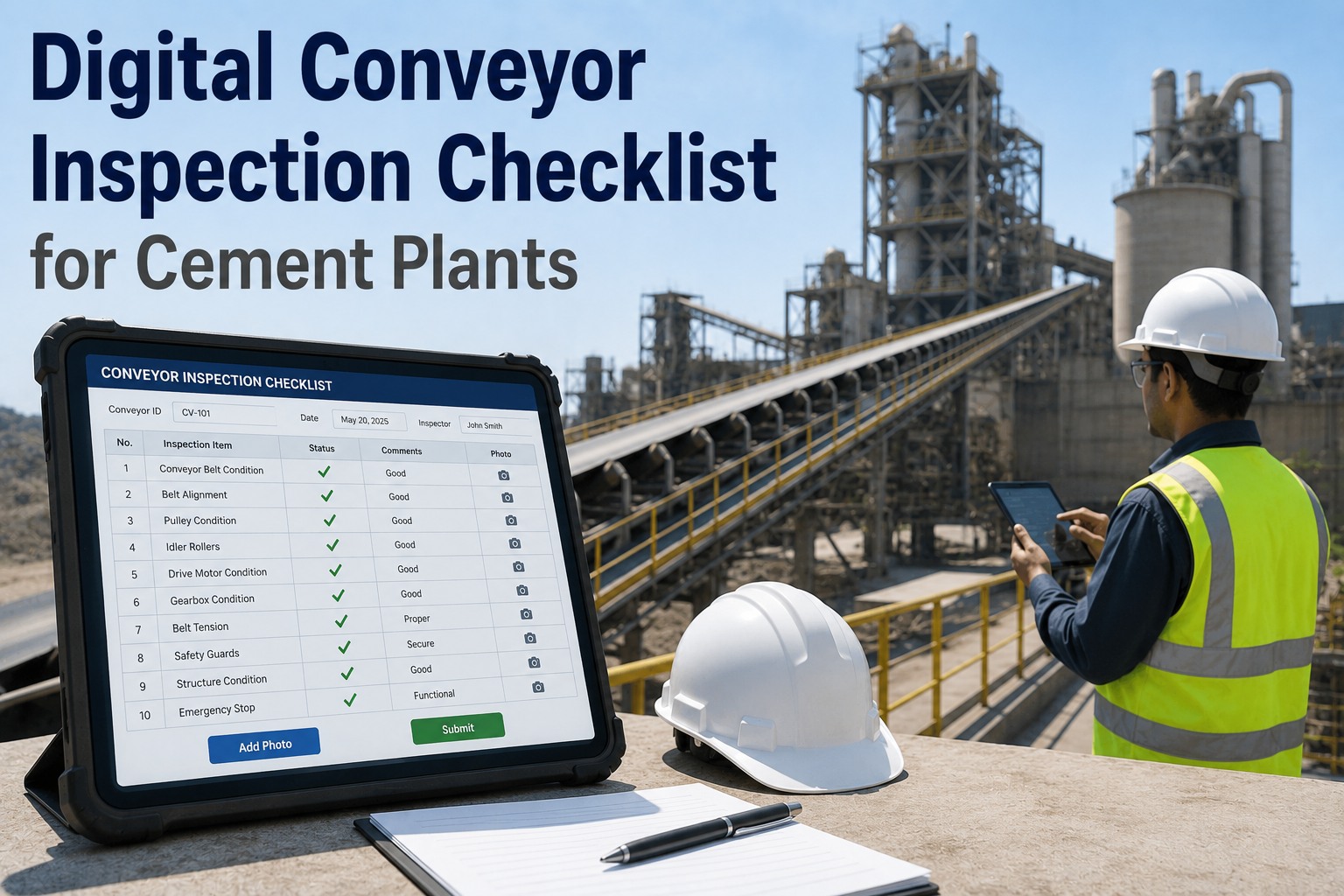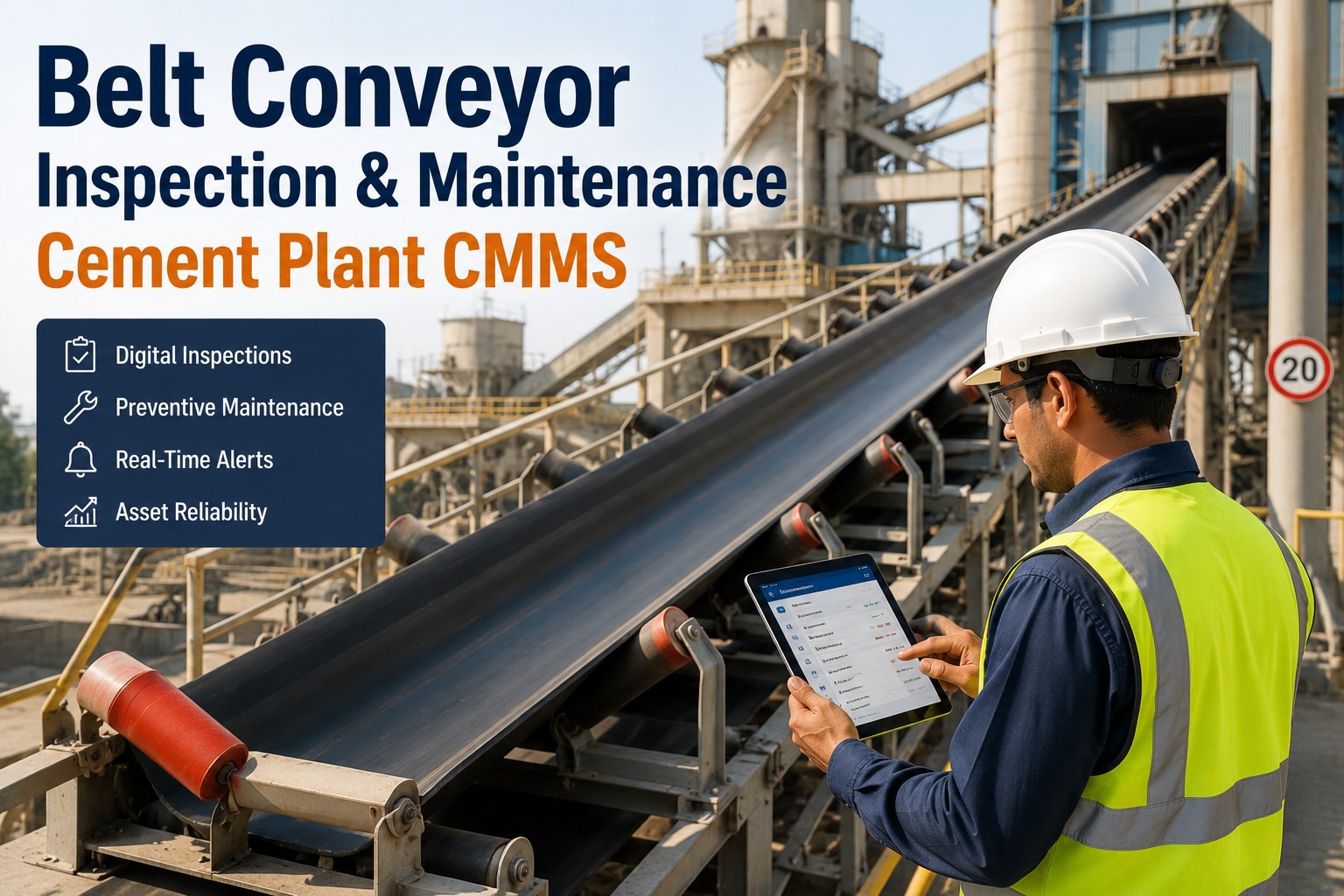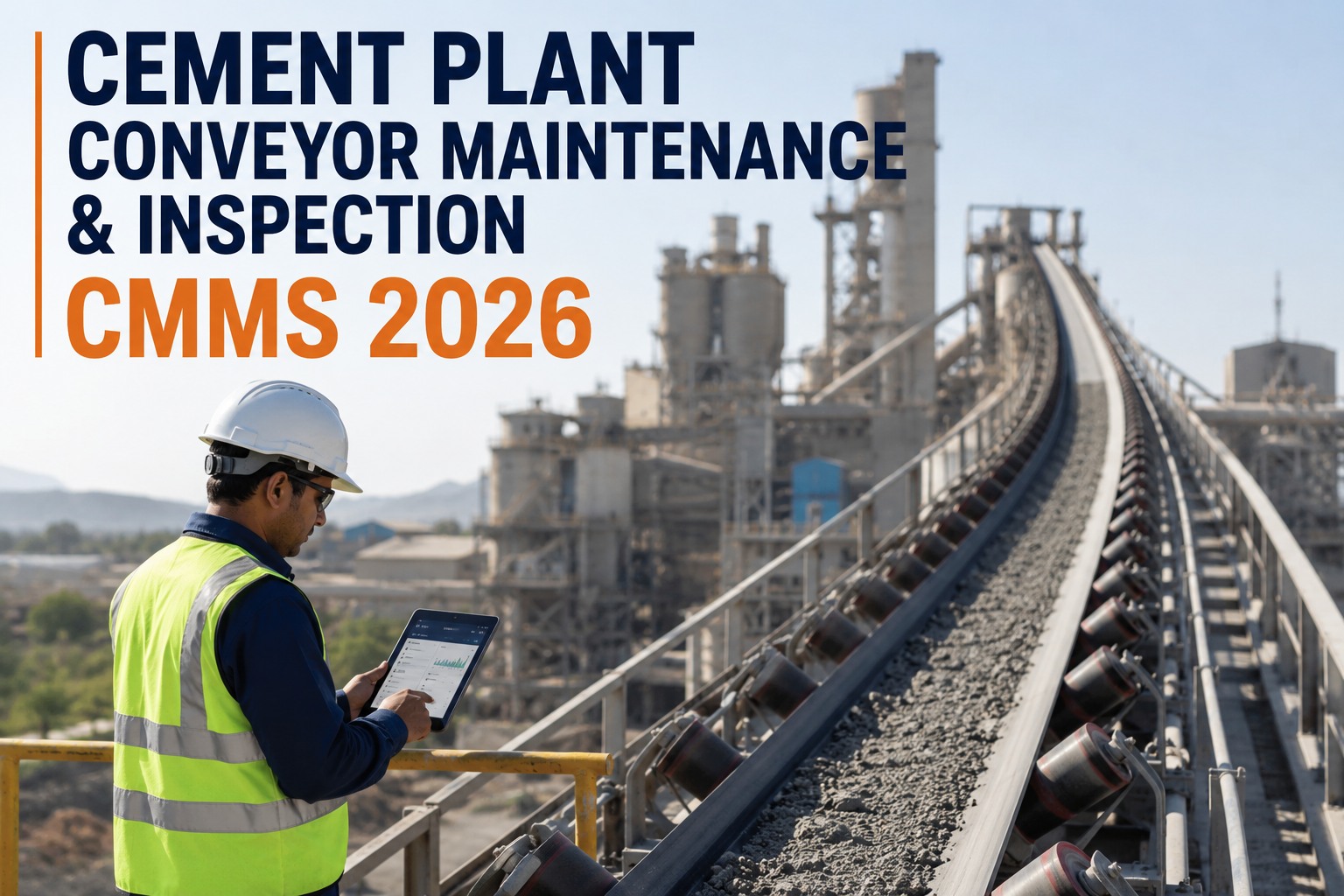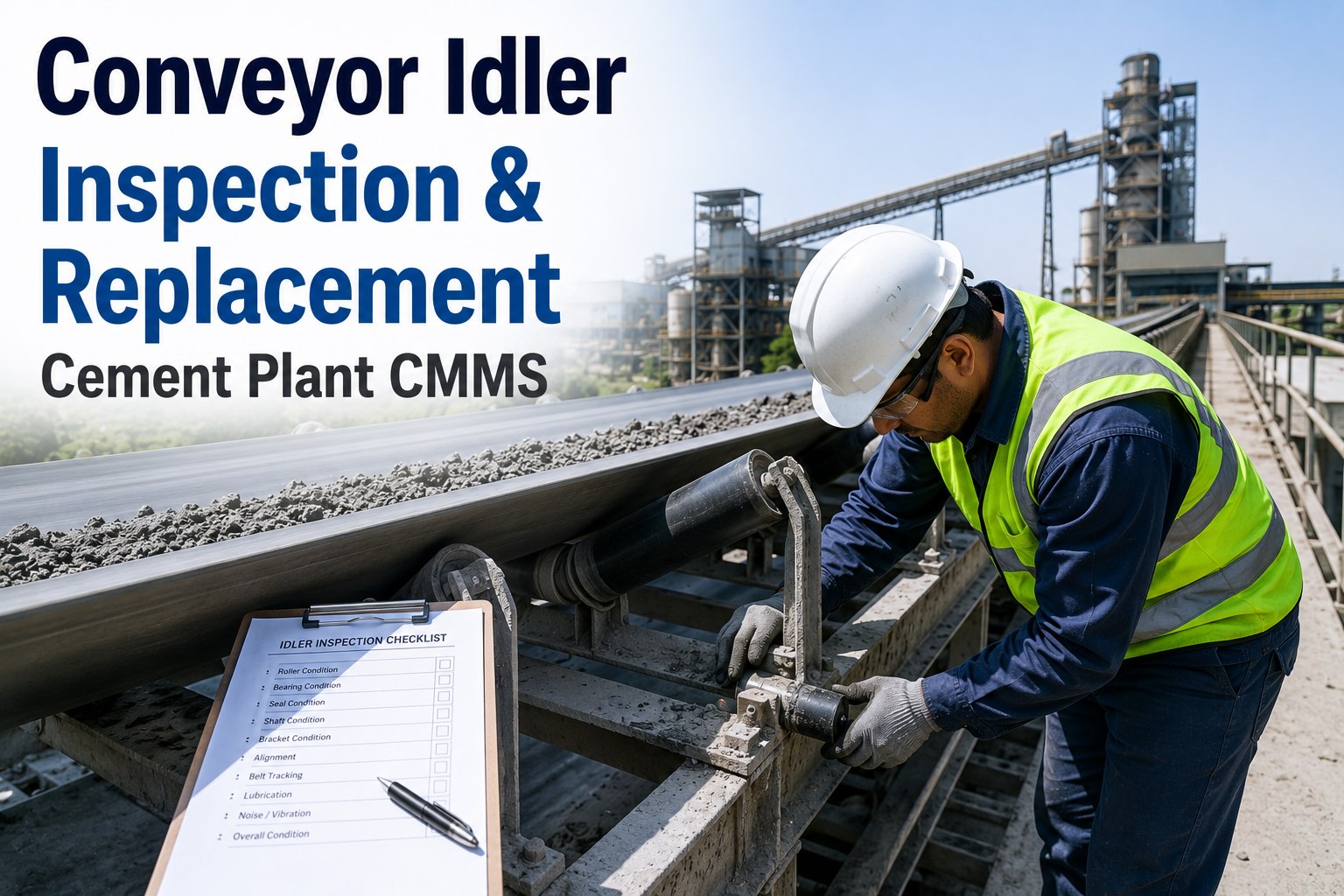
Conveyor idlers are the single most under-managed asset class in a cement plant — a typical 10,000-TPD operation runs 3,500 to 6,000 idlers across its raw meal, kiln feed, clinker and finished-cement belts, yet most are inspected only when a mechanic happens to walk by. A seized idler drags a hot belt for days, shedding cover at 2–3 mm per week and raising fire risk in a dusty, hot environment. A CMMS-driven idler program converts this invisible liability into a measurable, route-based discipline — acoustic detection, replacement thresholds, and stocked spares that keep belt life and conveyor efficiency on target. Start a structured program today through Start Free Trial or read on for the full inspection and replacement framework.
CMMS Idler Program · Cement
Are 4,000 idlers running blind on your conveyors?
Most cement plants inspect idlers reactively — a seized roller is found only when the belt starts smoking. A CMMS-driven inspection and replacement program turns thousands of neglected rollers into a route-based, acoustic-monitored, threshold-governed asset class that protects belt life, throughput, and fire safety.
Idler Failure Economics
Why idlers are the highest-ROI maintenance target in cement
Idlers outnumber every other rotating asset in a cement plant by 10:1, yet typically receive under 5% of maintenance budget attention. The math of neglect is unforgiving — and the math of intervention is equally dramatic.
Worked Example
A 180-conveyor cement plant in Rajasthan ran 4,200 idlers with no formal inspection route. Seized idlers caused 11 unplanned belt stoppages per year averaging 3.4 hours each, plus one belt replacement at $28,000. After deploying a CMMS-driven idler program with acoustic monitoring and 90-day inspection routes, unplanned idler events dropped to 2 per year and belt life extended by 14 months — a documented $61,200 annual saving on a $4,800 CMMS subscription.
Condition Assessment Methodology
How to inspect idlers — the tiered route
A defensible idler program is built on three inspection tiers running at different cadences, each feeding the CMMS so no roller is "invisible." Tier 1 catches the loud failures, Tier 2 catches the quiet ones, and Tier 3 catches the ones that have not failed yet.
Walk-by Acoustic Scan
- Listen for squeal, grind, or thump while belt is under load
- Flag any idler audible from 3 m away as P1 in CMMS
- Log GPS-tagged idler position via mobile CMMS app
- Check for material buildup on impact idlers at transfer points
Acoustic & Thermal Survey
- Acoustic gun scan of every carrying idler bearing — log dB in CMMS
- Thermal image of return idlers near hot clinker belts (>70 °C = flag)
- Measure rotational drag — hand-spin test, < 2 revolutions = replace
- Inspect seal integrity — torn or packed seals = schedule change-out
Predictive Health Audit
- Vibration spectrum on critical-section idlers (kiln feed, clinker)
- Belt alignment & trough angle verification every 50 m
- Review CMMS trend: any idler flagged 2× in 90 days = auto-replace WO
- Audit spare stock against replacement forecast from CMMS data
Replacement Thresholds
When to replace — the trigger matrix
Replacement decisions must be governed by objective thresholds stored in the CMMS, not by a mechanic's judgement at 2 a.m. The matrix below is the minimum trigger set used by mature cement-plant idler programs aligned with ISO 55000 asset-management principles.
| Inspection Finding | Threshold / Limit | CMMS Action | Max Delay |
|---|---|---|---|
| Acoustic level (carrying idler) | > 78 dB at 1 m, belt loaded | P1 work order — replace at next stop | 7 days |
| Bearing temperature | > 70 °C or ΔT > 25 °C above ambient | P1 work order — replace immediately | 24 hours |
| Rotational drag (hand-spin) | < 2 free revolutions after release | P2 work order — schedule within 14 days | 14 days |
| Seal integrity | Torn, packed, or grease-weeping seal | P3 work order — next planned outage | 30 days |
| Vibration RMS (critical belt) | > 7.1 mm/s at bearing housing | P2 work order — replace within 14 days | 14 days |
| Age in service (cement/clinker belt) | > 36 months continuous service | Auto-generate preventive replacement WO | Next outage |
| Age in service (raw meal/limestone) | > 48 months continuous service | Auto-generate preventive replacement WO | Next outage |
| Belt tracking deviation | > 75 mm off-center for 2 consecutive surveys | Inspect idler alignment & trough angle, replace suspect idlers | 14 days |
Acoustic Monitoring
Listening to idlers before they fail
Acoustic monitoring is the single highest-leverage technique for idler programs in cement — a trained technician with a $400 acoustic stethoscope can survey 200 idlers per shift and catch 80% of incipient bearing failures weeks before seizure. The CMMS stores the dB reading per idler, trends it, and auto-triggers a work order when the curve inflects.
Establish the baseline
Survey every carrying and return idler at commissioning or program launch. A healthy 6204-bearing idler at 2 m/s belt speed reads 58–65 dB. Store the baseline in the CMMS asset record — every future reading is compared against this, not against a generic table.
Route the survey monthly
A fixed CMMS-generated route ensures the same idlers are checked in the same sequence each month. The technician logs dB directly into the mobile app — no paper, no transcription errors, no skipped rollers. A 5,000-idler plant is fully surveyed in 6 shifts.
Trend and trigger automatically
The CMMS plots dB vs time per idler. A rise of 8 dB above baseline within 60 days is an early-warning flag; a reading above 78 dB is an automatic P1 work order. This catches the failure at Stage 2 — before heat, before drag, before belt damage.
Feed the spare-stocking forecast
Every flagged idler updates the replacement forecast. The CMMS aggregates P1/P2/P3 counts by idler type and triggers a purchase requisition when projected demand exceeds min-stock. No more "we have 200 of the wrong roller and zero of the right one."
Spare Stocking Strategy
The right roller, on the shelf, every time
Idler spare stocking in cement is notoriously chaotic — plants stock 15 idler types but routinely find 40% of demand is for a 16th type nobody carries. A CMMS-driven forecast fixes this by linking inspection data, replacement history, and lead times into a single min-max calculation.
Min Stock Level
Min = (Monthly Replacements × Lead Time weeks) / 4 × Safety Factor
Safety factor = 1.5 for standard trough idlers, 2.0 for impact and return idlers on hot clinker belts where failure rate is 3× higher.
Reorder Point
ROP = Min Stock + (Monthly Replacements × Lead Time weeks / 4)
When on-hand drops below ROP, CMMS auto-generates a purchase requisition — no manual counting, no stock-outs during peak outage season.
| Idler Type | Service Life (months) | Typical Plant Qty | Min Stock | Annual Replacements |
|---|---|---|---|---|
| Carrying trough — 35°, 152 mm | 36–48 | 2,400 | 18 | ~670 |
| Impact idler — rubber disc, 152 mm | 18–24 | 320 | 14 | ~175 |
| Return idler — flat, 127 mm | 30–42 | 1,100 | 10 | ~340 |
| Return idler — V-type, 152 mm | 24–30 | 280 | 8 | ~120 |
| Training idler — carrying, 152 mm | 24–36 | 90 | 4 | ~35 |
Deploy in Days, Not Months
Turn 5,000 neglected idlers into a managed asset class
Load your idler register, build inspection routes, and auto-generate replacement work orders in a single CMMS built for cement-plant maintenance teams.
Program ROI
What a CMMS idler program pays back
The economics are not subtle. A cement plant spending $42,000 per year on idler-related belt damage, unplanned downtime, and emergency spares can typically recover the full CMMS subscription cost within the first 90 days of program go-live.
Plants running structured acoustic routes see P1 idler events fall from 40+ per year to under 8.
Eliminating seized-idler drag preserves cover thickness and delays the next $25K–$40K belt replacement.
CMMS-driven min-max forecasting cuts obsolete inventory and eliminates emergency expediting fees.
A $4,800 annual subscription returning $53,000+ in avoided damage, downtime, and spares — typical mid-size plant.
"We went from finding seized idlers by smell to finding them by decibel reading. The CMMS route catches a failing bearing six weeks before it would have taken out a belt section. Our unplanned conveyor downtime dropped 78% in the first year."
Frequently Asked Questions
Idler inspection & CMMS — the questions cement teams ask
How many idlers should a cement plant inspect per route per day?
A trained technician using a mobile CMMS app and acoustic stethoscope can survey 180–220 idlers per 8-hour shift on a loaded belt. A 5,000-idler plant therefore requires roughly 24 inspection-shifts per monthly cycle — or one technician dedicated three days per week to idler routes. The CMMS auto-sequences the route by conveyor and GPS position so no idler is skipped and travel time is minimized.
What is the typical replacement interval for cement-plant idlers?
Carrying trough idlers on raw-meal and limestone belts typically last 36–48 months; the same idlers on hot clinker conveyors (80–120 °C belt surface) last 18–24 months. Impact idlers at transfer points fail fastest at 12–18 months. The CMMS should auto-generate a preventive replacement work order when service age hits these limits — not wait for the idler to seize. You can configure these thresholds and review full analytics when you Start Free Trial.
Can acoustic monitoring really predict idler bearing failure?
Yes — bearing defect frequencies generate distinctive acoustic signatures that emerge 4–8 weeks before seizure. A healthy idler reads 58–65 dB; a bearing with a spalled race or broken ball reads 72–85 dB. Trending the dB reading per idler in the CMMS catches the inflection point at Stage 2, when the bearing is still rotating freely and the belt is undamaged. This is the core technique behind the 80% reduction in unplanned idler failures documented by mature programs.
How does a CMMS calculate idler spare-stock min and max levels?
The CMMS aggregates replacement work-order history per idler type, divides by months in service to get a monthly consumption rate, then multiplies by procurement lead time in weeks (divided by 4) and a safety factor of 1.5–2.0. When on-hand stock drops below the reorder point, the system auto-generates a purchase requisition. This eliminates both stock-outs during outage season and the carrying cost of obsolete rollers — typically a 30–40% reduction in spare inventory value.
How long does it take to deploy a CMMS idler program in a cement plant?
A mid-size cement plant (3,000–5,000 idlers) can go live in 2–4 weeks: week one is loading the idler register and conveyor hierarchy; week two is building inspection routes and thresholds; week three is the baseline acoustic survey; week four is go-live with auto-generated work orders. Book a walkthrough at Book a Demo to see the deployment plan mapped to your plant's conveyor layout.
Your Idler Program Starts Now
Stop replacing belts. Start managing idlers.
Join cement plants that cut unplanned idler failures by 82% and extended belt life by over a year — with a CMMS built for the realities of hot, dusty, 24/7 cement operations.
Free 14-day trial · No credit card required