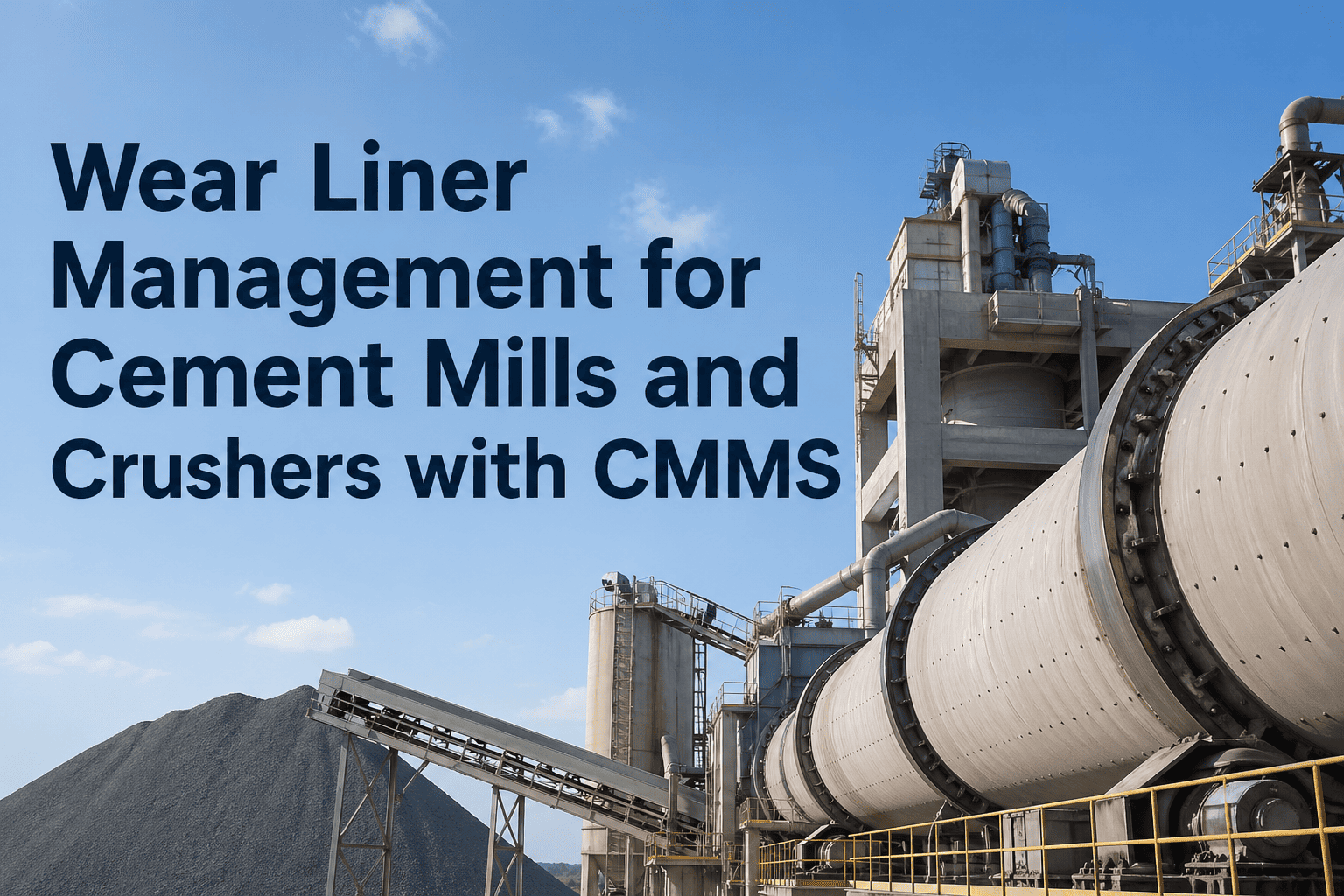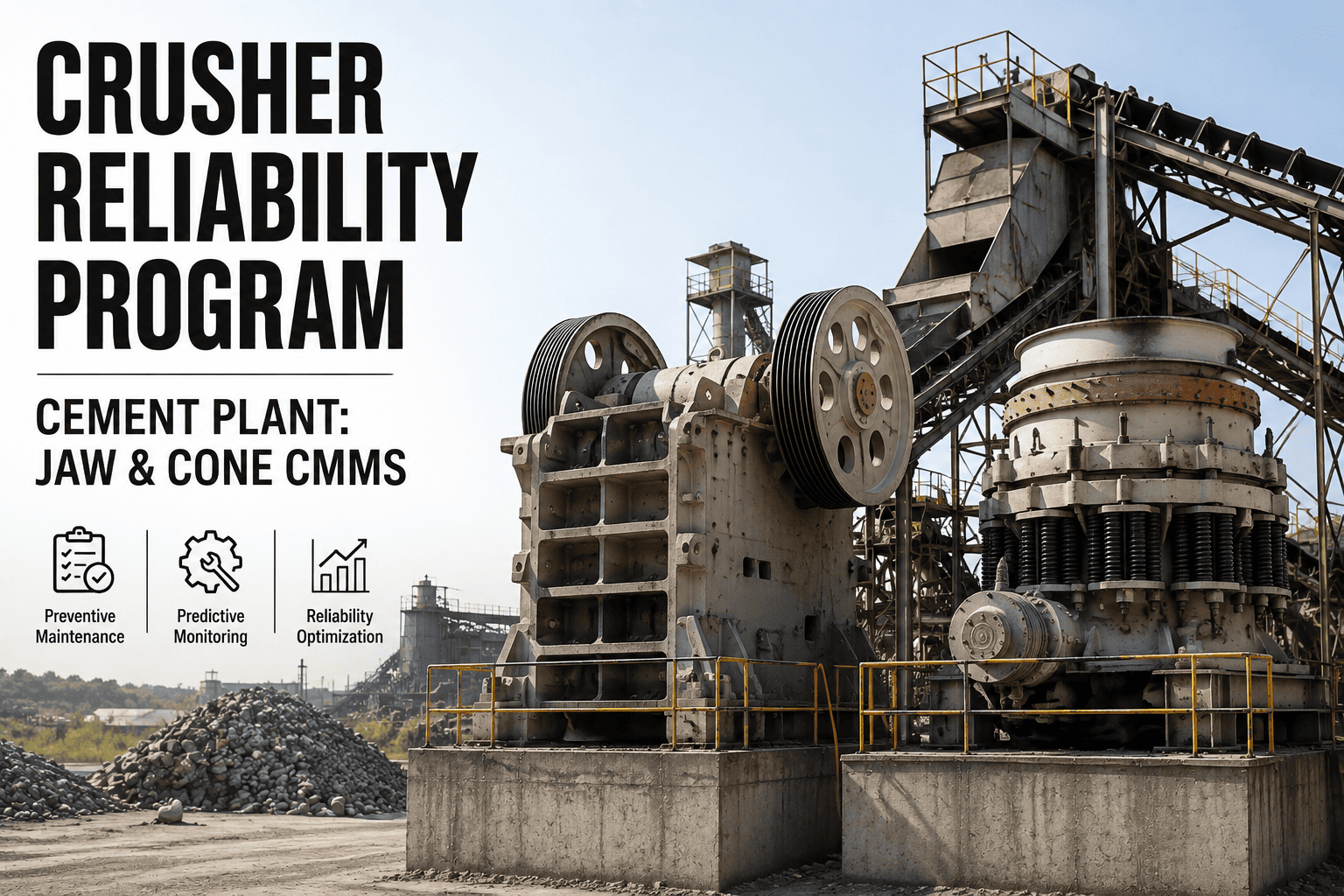
A cement plant's crushing circuit is the throat of the entire operation — when a primary jaw or secondary cone goes down, the kiln feed stockpile is the only thing keeping the plant alive, and that clock starts ticking immediately. For maintenance leaders managing abrasive limestone, recycled aggregate, and harder additives, a crusher reliability program anchored in a modern CMMS is what separates 92% circuit availability from chronic 70% firefighting. This guide breaks down wear part tracking, bearing condition monitoring, PM scheduling, and the data architecture that aligns crusher uptime with kiln feed requirements — the same framework you can deploy on a 14-day trial when you Start Free Trial at oxmaint.
Can your crushing circuit survive a 72-hour stockpile window?
Jaw, cone, and impact crushers feed the entire cement plant. When one fails, the kiln burns through stockpile at 280 t/h — and every hour past the buffer costs $18K in lost production. A CMMS-driven reliability program keeps availability above 94%.
Wear part lifecycle across the crushing circuit
Three crusher types, three different wear signatures — but one unified tracking discipline. Below is the baseline replacement cadence for abrasive cement-grade limestone at Mohs 4–5.
Jaw plate swing/fixed set at 600–900 t/h throughput. Manganese grade Mn18 provides 18% longer life than Mn14 in high-silica limestone. Track cheek plate wear at 50% of jaw plate cadence.
- Fixed jaw plate
- Swing jaw plate
- Cheek plates (pair)
- Toggle seat & beam
Mantle and concave life at 22mm CSS, feed top size 110mm. A 4–6 hour liner changeout restores throughput curve. Track eccentric bushing wear at every second liner change.
- Mantle liner
- Concave ring
- Eccentric bushing
- Spider cap liner
Blow bar life in high-recycle additive crushing. Chrome steel bars outlast martensitic by 35% in low-silica service. Monitor apron gap weekly — a 2mm drift drops product gradation by one sieve size.
- Blow bars (4-set)
- Apron liners
- Impact plates
- Rotor wear segments
Preventive maintenance calendar for cement crushers
A CMMS-driven PM schedule ties every inspection to a meter reading, not a calendar guess. Below is the cadence a 5,000 t/day plant runs to hold crushing circuit availability above 94%.
| Frequency | Jaw Crusher Tasks | Cone Crusher Tasks | Impact Crusher Tasks | Crew Hours |
|---|---|---|---|---|
| Shift (8h) | Grease toggle bearing, inspect discharge setting | Check lube pressure & temperature, listen for tramp | Inspect blow bar edge wear, clear feed chute | 1.5 |
| Weekly | Measure jaw plate thickness, check flywheel alignment | Sample lube oil, inspect countershaft seal | Measure apron gap, torque rotor bolts | 4 |
| Monthly | Vibration scan on frame & motor, ultrasonic bearing check | Mantle profile measurement, hydroset pressure test | Rotor dynamic balance verify, liner thickness log | 8 |
| Quarterly | Toggle plate NDT, cheek plate replacement planning | Eccentric bushing clearance, head nut torque audit | Full bar flip or replace, apron liner rotation | 16 |
| Annual | Jaw plate changeout, main bearing inspection | Mantle & concave change, pinion shaft service | Rotor rebuild, full bearing set replacement | 48–72 |
The cost equation: monitoring vs. catastrophic failure
Crusher main bearings fail predictably — but only if you measure. A single undetected bearing failure on a primary jaw costs 10× more than a planned changeout. Here is the worked math from a 5,000 t/day plant running a 160 kW primary jaw.
From reactive to predictive: a 6-month crusher reliability timeline
A 5,000 t/day cement plant in central India was losing 11.4% of crushing circuit availability to unplanned jaw and cone outages. Here is how a CMMS-structured program moved them to 94.2% availability in 180 days.
Registered 14 crusher assets (2 jaw, 4 cone, 3 impact, 5 feeders) in CMMS with full BOM. Captured 2.5 years of work order history to establish failure modes. Identified 3 jaw crushers running with >6mm frame cracking untracked.
82.6% baseline availabilityRolled meter-based PM triggers for all 14 assets. Jaw plate thickness logging weekly, cone lube sampling biweekly, impact apron gap daily. Backlog dropped from 47 overdue PMs to 4 within 45 days of go-live.
88.1% availability · PM compliance 94%Installed tri-axial vibration sensors on 6 critical crusher bearings. CMMS auto-generates work orders when ISO 10816 velocity exceeds 7.1 mm/s RMS. First detected fault: cone countershaft bearing at 9.2 mm/s — planned changeout in week 3.
91.4% availability · 1 catastrophic failure preventedCMMS wear trending flagged jaw plate rotation interval extending from 900h to 1,150h by matching manganese grade to silica content. Cone mantle life improved 19% through CSS optimization. Impact crusher blow bar inventory reduced 30% with predictive reorder.
94.2% availability · $312K parts savings annualizedWhat makes a crusher reliability program actually work
Four pillars separate a CMMS that drives 94% availability from one that just logs completed work orders. Each pillar maps to a measurable reliability outcome.
Meter-Based PM Triggers
Tie every PM to actual crusher throughput hours, not calendar dates. A jaw running 18 hours/day wears differently than one running 22. CMMS pulls meter data from the DCS or a manual entry every shift and auto-generates work orders at threshold.
Wear Part Lifecycle Tracking
Every jaw plate, mantle, concave, and blow bar gets a serialized record in the CMMS. Track installation date, throughput hours logged, measured thickness at each inspection, and projected replacement date based on wear curve trend.
Bearing Condition Integration
Vibration sensors feed ISO 10816 velocity data into the CMMS every 15 minutes. Auto-generated work orders trigger at 4.5 mm/s (alert), 7.1 mm/s (action), and 11.2 mm/s (critical). Oil analysis results attach to the asset record automatically.
Kiln Feed Buffer Alignment
CMMS dashboards show crusher availability against the live stockpile level and kiln feed rate. When stockpile drops below 8 hours of kiln feed, the system flags any open crusher work order as priority-critical and escalates to the maintenance manager.
Crusher reliability metrics that matter for cement
These are the five numbers a cement plant maintenance leader should see on the CMMS dashboard every morning — and the benchmarks that separate top-quartile from average performers.
We went from 11 unplanned crusher outages a quarter to one. The CMMS caught a cone countershaft bearing fault three weeks before it would have shredded the eccentric — that single event paid for two years of the platform.
Stop losing kiln hours to crusher failures
Deploy a CMMS-driven crusher reliability program in under 30 days. Start free, or book a 30-minute demo with a cement maintenance specialist.
Crusher reliability program — cement plant FAQs
How long does it take to deploy a CMMS crusher reliability program at a cement plant?
A typical 5,000 t/day plant with 10–20 crusher assets goes live in 21–30 days. Asset registry and BOM import take the first week, PM schedule configuration the second, and sensor integration plus crew training the third. You can Start Free Trial and have the first crusher asset registered within an hour.
What vibration thresholds trigger crusher bearing work orders in the CMMS?
For cement crusher bearings running 600–1,800 RPM, ISO 10816 thresholds are set at 4.5 mm/s RMS for alert (auto-generates inspection work order), 7.1 mm/s for action (schedules bearing replacement within 7 days), and 11.2 mm/s for critical (immediate shutdown and changeout). These are standard for machines in the 15–300 kW class typical of primary and secondary crushers.
Can the CMMS track different wear parts for jaw, cone, and impact crushers in one system?
Yes — each wear part gets a serialized asset record with installation date, throughput-hour trigger, measured thickness at each inspection, and a projected replacement date based on wear-curve trending. The system handles jaw plates, cone mantles and concaves, impact blow bars, and auxiliary liners like cheek plates and spider caps in a single registry with role-based views.
How does the crusher reliability program align with kiln feed requirements?
The CMMS dashboard displays live crusher availability against the raw mill stockpile level and kiln feed rate. When stockpile drops below 8 hours of kiln feed coverage, any open crusher work order is auto-prioritized and escalated. This prevents kiln starvation — the single most expensive failure mode in cement production at $18,000+ per hour of lost clinker output. You can see this configuration on a live call when you Book a Demo.
What is the typical ROI timeline for a crusher CMMS program at a cement plant?
Most cement plants recover full CMMS deployment cost within the first quarter. A single prevented catastrophic bearing failure on a primary jaw saves $190K–$220K in downtime, emergency parts, and overtime. With annual monitoring investment under $10K per crusher, the payback ratio exceeds 20× in year one when at least one major failure is prevented — which condition monitoring achieves in over 90% of deployments.
Your crushers feed the kiln. Feed your crushers a reliability program.
Join cement plants running 94%+ crushing circuit availability with oxmaint CMMS. Start your free trial today, or book a 30-minute demo with a cement maintenance specialist.
Free 14-day trial · No credit card