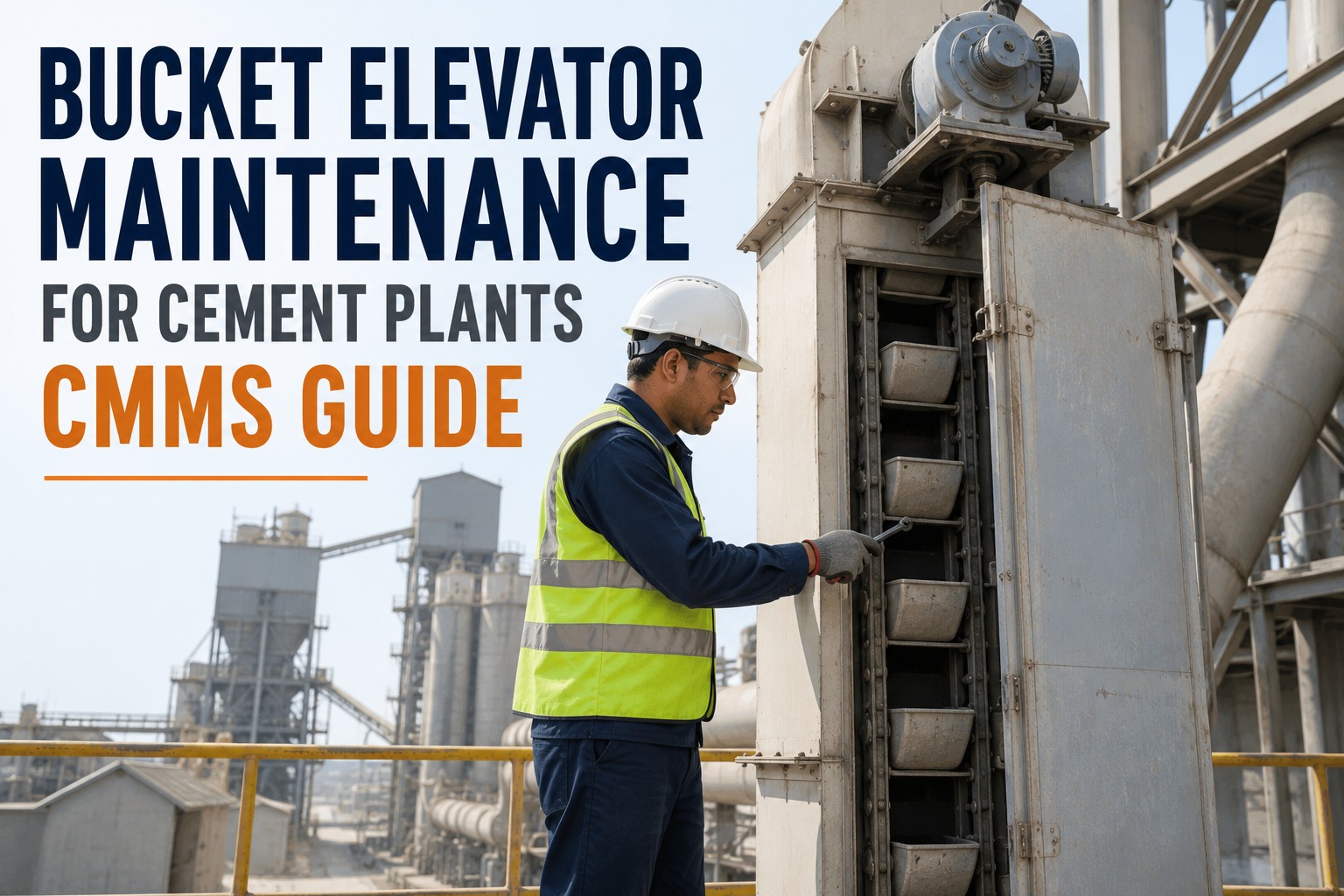
In a cement plant, almost every ton of clinker and finished cement passes through a bucket elevator at least once — and when that elevator stops, the line stops with it. Bucket elevators are mechanical single points of failure, and unplanned outages routinely cost cement producers $8,000–$25,000 per hour in lost throughput, plus the labour and parts needed for emergency repair. This guide lays out the preventive maintenance discipline that keeps availability above 98%: bucket replacement intervals, chain and belt condition monitoring, boot and head pulley service, take-up adjustment, and the CMMS workflows that turn reactive firefighting into planned work. Start Free Trial to put this entire PM framework on autopilot.
One elevator down stops the whole line — what does your maintenance plan do about it?
Bucket elevators carry clinker, raw meal and finished cement between silos, mills and kiln feed. They are mechanical single points of failure: a dropped bucket, a jumped chain or a mistracked belt can halt production for 4–18 hours. A CMMS-driven PM program targets availability above 98% and cuts unplanned elevator downtime by 40–60%.
Where bucket elevators fail in a cement line
A typical 5,000 TPD cement plant operates 8–14 bucket elevators across raw meal, kiln feed, clinker transport and finish grinding. Industry failure data shows roughly 70% of unplanned elevator outages originate in five zones — all inspectable on a fixed PM cycle.
The cement elevator PM checklist, by frequency
Run these inspections inside a CMMS that auto-generates work orders, captures readings and escalates deviations. Frequencies below assume a continuous-duty elevator handling abrasive clinker or raw meal.
- Walk the casing — listen for bucket scrape, chain slap or bearing whine
- Inspect boot and head bearings with IR thermometer (alarm at >80°C or Δ>15°C vs baseline)
- Check take-up travel remaining — log the measurement in the CMMS asset record
- Verify discharge chute is clear; clear buildup in boot sump
- Inspect motor amperage under load against baseline trend
- Measure chain elongation over 10 links — flag at 1.5%, schedule replacement at 2%
- Torque-check bucket bolts to spec (typically 110–145 Nm M16 grade 8.8); replace any with stripped threads
- Spot-inspect 10% of buckets for cracks at the attachment boss, lip wear and back-face gouging
- For belt elevators: inspect splice, tracking and ply separation; measure belt tension with a sonic tensiometer
- Grease bearings per OEM chart — never over-lubricate (purge 1–2 strokes max)
- Laser-align head and boot pulleys — tolerance ≤0.5 mm per metre of centre distance
- Inspect lagging for wear, tears and bond failure; remachine or replace at 50% wear
- Vibration-analyse gearbox and motor — ISO 10816 velocity alarm at 7.1 mm/s RMS for rigid mounts
- Oil-sample gearbox; act on ISO 4406 cleanliness > 21/19/16 or rising iron trend
- Test backstop / holdback — a failed backstop means reverse runaway on shutdown
- Full chain inspection: remove guards, measure every 10th link, document with photos in the CMMS
- Replace buckets showing ≥40% lip wear or any through-cracking; budget a 10–15% spares float
- Strip and inspect head/boot shafts for fatigue cracks — NDT dye-penetrant at keyways
- Re-calibrate weigh-feed and speed-sensor interlocks tied to the elevator
- Update asset criticality rating and revisit PM frequencies in the CMMS
A 180-asset plant, one elevator, and the $112K lesson
Consider a mid-size plant running 11 bucket elevators. One 90-metre-tall clinker elevator drops a chain on a Tuesday morning because elongation was never measured and the take-up had run out of travel 6 weeks earlier. Here is what that single failure actually cost.
What a CMMS actually changes for elevator maintenance
Most plants already have a checklist in a binder. The difference between that binder and 98% availability is enforcement: automatic triggers, captured readings, escalation rules and trend visibility. Here is what shifts when elevator PM runs inside a CMMS.
| Maintenance activity | Paper / spreadsheet | CMMS-driven | Impact |
|---|---|---|---|
| Bucket & bolt inspection | Monthly, often skipped when short-staffed | Auto work order + photo upload + completion sign-off | 90%+ compliance |
| Chain elongation measurement | Logged in a notebook, rarely trended | Numeric field with upper-limit alarm at 1.5% | Catches failure 4–8 weeks early |
| Bearing temperature | Spot-checked with a thermometer, no baseline | IR reading stored against asset baseline + ΔT alert | Prevents 70% of bearing seizures |
| Take-up travel remaining | Visual guess | Measured in mm, auto-schedules chain change at 20% travel left | Eliminates jumped-chain events |
| Gearbox oil sampling | Annual, results filed & forgotten | Lab result linked to asset; iron-trend alarm triggers change | Extends gearbox life 30–40% |
| Spare parts readiness | Stockout discovered at breakdown | Min/max auto-reorder tied to PM consumption | Parts always on hand |
When to replace buckets, chains and belts
Replacement windows vary with material abrasiveness, duty cycle and elevator type. Use these industry benchmarks as a starting point, then refine from your own CMMS trend data. Cement clinker is highly abrasive — expect the lower end of every range.
Stop firefighting elevators. Start preventing outages.
Oxmaint turns every checklist on this page into an automatic, auditable work order — with readings, photos, alarms and parts triggered on schedule, not after a breakdown.
Bucket elevator maintenance, answered
Put your elevator PM on autopilot in 14 days
Load your elevators, set the inspection grid above, and let Oxmaint trigger every work order, reading and alarm on schedule. Your kiln line will thank you.