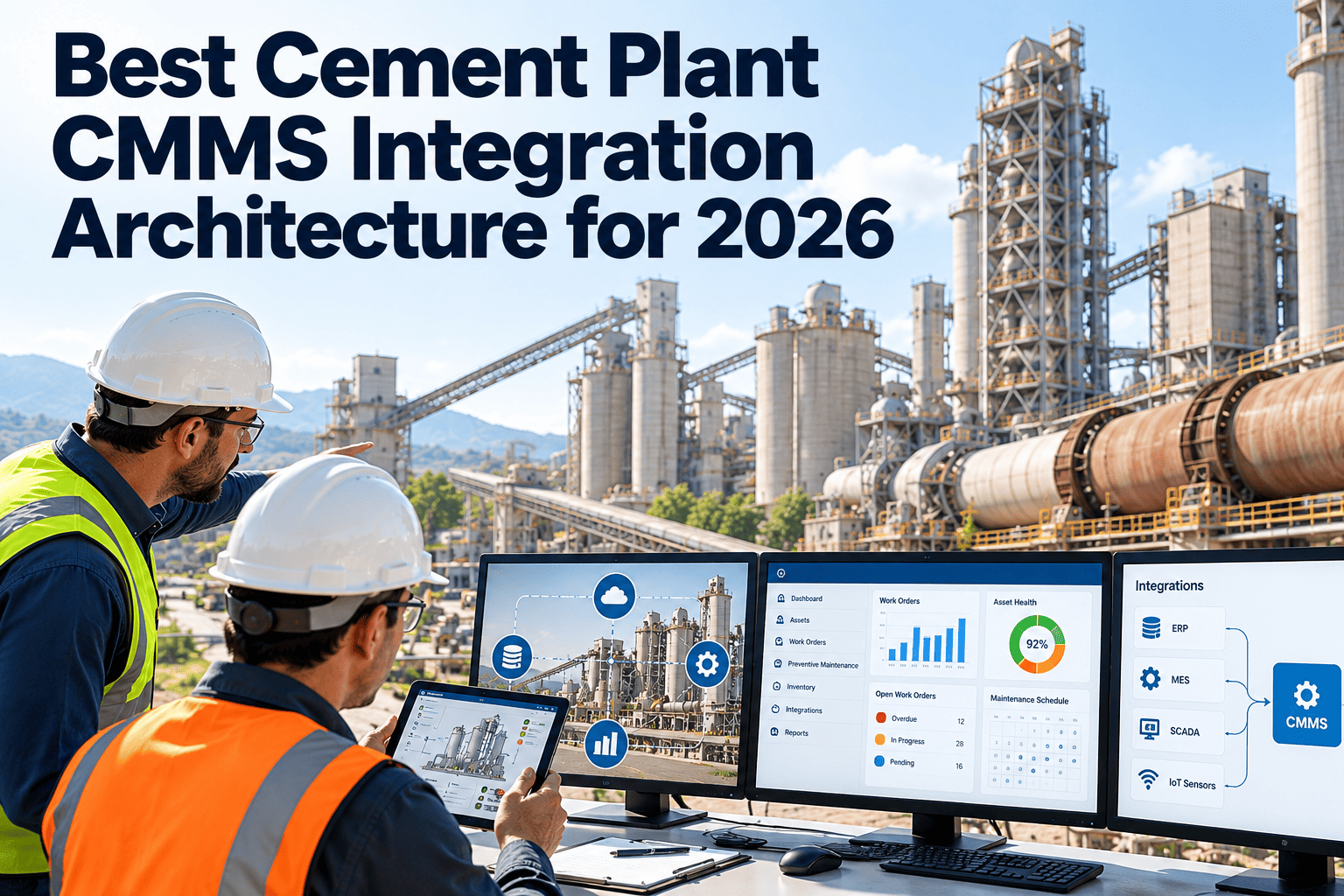
Every cement plant runs two parallel universes of data: the ERP handles procurement, finance, and materials — and the CMMS tracks work orders, asset history, and maintenance scheduling. When these systems don't talk to each other, the results are predictable: duplicate data entry, spare parts ordered too late, maintenance costs that disappear into general ledger black holes, and reliability teams making decisions with yesterday's inventory numbers. For a 1.5 MTPA cement plant, the estimated annual cost of ERP-CMMS data silos — through misallocated inventory, delayed procurement, and untracked maintenance spend — runs into millions. The seven integrations reviewed on this page represent the most widely deployed enterprise system combinations in cement manufacturing today, covering SAP PM, Oracle EAM, IFS, Microsoft Dynamics, AVEVA PI, OSIsoft, and Workday. If you're evaluating how to close this integration gap at your plant, start a free trial on Oxmaint and connect your existing ERP in days, not months.
Integration Guide · Cement Plant Operations 2026
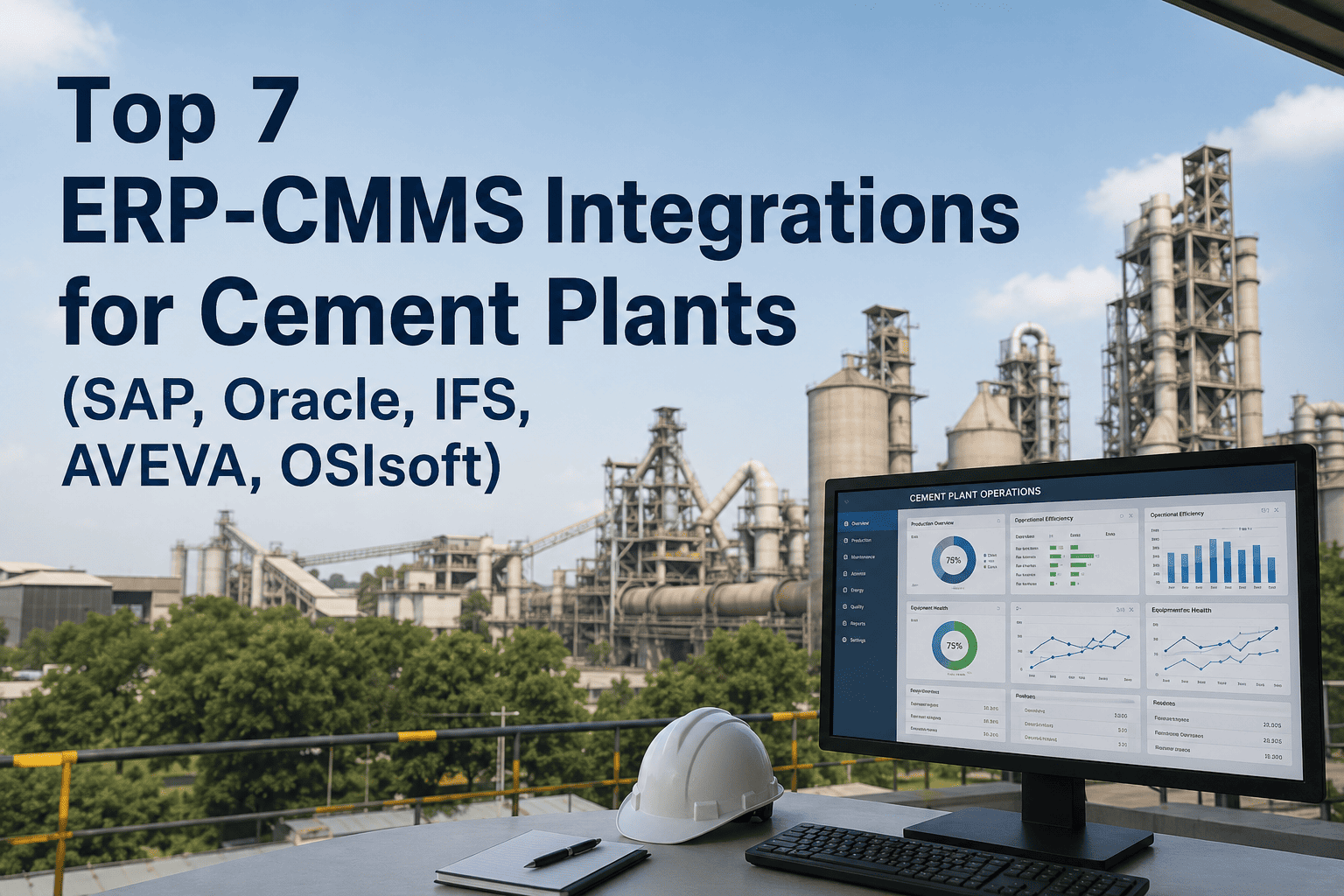
Top 7 ERP-CMMS Integrations for Cement Plants
SAP PM, Oracle EAM, IFS, Microsoft Dynamics, AVEVA PI, OSIsoft, and Workday — what each integration unlocks and what it takes to make it work.
The Integration Value Case
01
Eliminate Duplicate Data Entry
Work orders created in CMMS auto-post labor and materials costs to ERP cost centers. No re-keying, no reconciliation delays, no misallocated maintenance spend.
02
Real-Time Spare Parts Visibility
CMMS-triggered purchase requisitions flow directly into ERP procurement. Technicians see live inventory counts. Critical spares are reordered automatically when stock hits minimum thresholds.
03
Asset-Level Cost Accounting
Every maintenance activity — labor hours, parts consumed, contractor fees — posts to the correct asset in the ERP fixed asset register. MTBF, MTTR, and total cost of ownership become financially verified metrics.
04
Production Planning Alignment
Planned maintenance windows sync with ERP production schedules. Kiln shutdowns are coordinated with raw material delivery calendars. Finance sees maintenance spend before commitments are made.
The 7 Integrations — What Each One Delivers
SAP PM is the most deeply integrated maintenance module in enterprise software — when you're already on SAP, work orders, notifications, purchase requisitions, and cost postings flow natively without middleware. S/4HANA's Asset Management extends this with real-time equipment master data, predictive scenarios via SAP APM, and direct integration to SAP EWM for warehouse and parts management. For multi-plant cement groups already standardized on SAP, PM is the natural CMMS layer.
Best For
Cement groups already on SAP ECC or S/4HANA
Protocol
Native SAP APIs, RFC/BAPI, SAP Integration Suite
Key Benefit
Zero reconciliation — maintenance costs post directly to FI/CO in real time
Watch Out For
SAP PM configuration complexity; requires dedicated SAP PM consultant for initial setup
Oracle EAM sits inside Oracle Fusion or E-Business Suite, giving cement plants a fully native connection between asset maintenance, procurement, inventory, and financial reporting. Work orders trigger purchase orders in Oracle Procurement automatically. Oracle Asset Lifecycle Management extends coverage into capital asset tracking and depreciation scheduling alongside operational PM. If your organization runs Oracle for finance and supply chain, Oracle EAM eliminates the integration layer entirely.
Best For
Oracle-standardized cement organizations, Fusion Cloud deployments
Protocol
Oracle REST APIs, Integration Cloud, SOAP Web Services
Key Benefit
Native procurement integration — POs created and approved without leaving the maintenance workflow
Watch Out For
License cost per user adds up quickly for large technician workforces
IFS is purpose-built for asset-intensive industries and has strong adoption in cement, mining, and process manufacturing. IFS Cloud's maintenance module handles work order management, equipment hierarchies, and predictive maintenance natively — with strong integration to IFS Manufacturing and Supply Chain. IFS's open API architecture makes CMMS-to-ERP data exchange straightforward for plants not using IFS natively as well, with standard REST endpoints for work orders, parts, and labor.
Best For
Mid-size cement groups, asset-intensive operations without SAP/Oracle commitment
Protocol
REST APIs, IFS Connect middleware, OData feeds
Key Benefit
Strong equipment hierarchy modeling for complex kiln and mill asset structures
Watch Out For
IFS Cloud migration from older IFS versions can be disruptive without careful planning
Microsoft Dynamics 365 F&SCM includes an Asset Management module (formerly Dynaway EAM) that handles work orders, functional locations, and maintenance schedules alongside Dynamics financials and supply chain. For cement plants already in the Microsoft ecosystem — using Azure, Power BI, or Teams — the integration story is straightforward via Azure Logic Apps and Power Automate. CMMS data flows into Dynamics finance for cost posting, and inventory sync operates in near-real time via standard connectors.
Best For
Microsoft-ecosystem cement plants, Azure-hosted operations
Protocol
Azure Logic Apps, Power Automate, OData REST APIs, Dataverse
Key Benefit
Power BI dashboards pull live maintenance KPIs alongside financial and operational data
Watch Out For
Asset Management module is less mature than SAP PM or Oracle EAM for heavy industrial depth
AVEVA PI (formerly OSIsoft PI) is the dominant process historian in cement and heavy process industries — collecting billions of time-series data points from kiln temperature sensors, mill vibration monitors, and drive current signals. Integrating PI with CMMS transforms raw historian data into maintenance triggers: when a PI tag exceeds a threshold, a CMMS work order is automatically generated with the sensor context attached. This is the foundational data bridge for condition-based and predictive maintenance at scale.
Best For
Plants with established PI infrastructure seeking condition-based maintenance
Protocol
PI Web API, OPC-UA, AF SDK, REST endpoints
Key Benefit
Sensor-triggered automatic work orders — the first tag integration can go live in under 60 minutes
Watch Out For
Tag mapping and alarm routing require OT team involvement; PI licensing adds to total cost
Many cement plants run standalone OSIsoft PI deployments that predate the AVEVA acquisition — and these remain fully functional for CMMS integration through PI Web API and OPC-UA bridges. The integration pattern mirrors AVEVA PI: historian tag thresholds generate CMMS alerts, work orders carry sensor context, and post-repair data feeds back to update baseline models. For plants that haven't migrated to AVEVA PI System, the existing OSIsoft infrastructure connects to modern CMMS platforms without requiring a platform upgrade.
Best For
Plants on legacy OSIsoft PI without AVEVA migration plans
Protocol
PI Web API, OPC-DA/UA bridge, REST integrations
Key Benefit
No forced migration — existing sensor infrastructure generates maintenance value immediately
Watch Out For
OSIsoft PI support lifecycle; AVEVA migration may become necessary in the medium term
Workday is less common in legacy cement operations but increasingly deployed at multinational cement groups seeking cloud-native finance and HR platforms. The CMMS-Workday integration focuses on two flows: labor cost posting (technician hours from CMMS work orders into Workday payroll and project accounting) and procurement (maintenance purchase requisitions into Workday Procurement). The integration requires middleware (MuleSoft, Boomi, or Workday's own Integration Cloud) but delivers clean financial visibility once operational.
Best For
Multinational cement groups on Workday Finance/HCM replacing legacy ERP
Protocol
Workday REST APIs, Workday Integration Cloud, MuleSoft/Boomi middleware
Key Benefit
Technician labor automatically posts to Workday project accounting — no timesheet reconciliation
Watch Out For
Workday lacks a native maintenance module; CMMS integration is required, not optional
Oxmaint integrates with all seven of these systems — via REST APIs, webhooks, OPC-UA, and direct database connectors. Work orders, parts, labor costs, and sensor data flow in both directions. No rip and replace.
Side-by-Side Comparison
| System |
Type |
Best Fit |
Integration Protocol |
Depth |
| SAP PM / S/4HANA |
ERP-Native |
SAP-standardized groups |
RFC/BAPI, Integration Suite |
|
| Oracle EAM |
ERP-Native |
Oracle Fusion users |
REST APIs, Oracle IC |
|
| AVEVA PI System |
Historian |
Condition-based maintenance |
PI Web API, OPC-UA |
|
| OSIsoft PI (Legacy) |
Historian |
Legacy sensor infrastructure |
PI Web API, OPC-DA/UA |
|
| IFS Cloud |
Industry ERP |
Asset-intensive mid-market |
REST APIs, IFS Connect |
|
| Microsoft Dynamics 365 |
Cloud ERP |
Microsoft ecosystem |
Azure Logic Apps, OData |
|
| Workday |
Finance/HCM |
Multinational groups |
Workday REST, Middleware |
|
Frequently Asked Questions
How long does ERP-CMMS integration typically take at a cement plant?
For standard API-based integrations (SAP, Oracle, Dynamics), initial connectivity typically takes 4–6 weeks. Full bidirectional data flow with cost posting, inventory sync, and procurement triggers takes 8–12 weeks. AVEVA PI / OSIsoft historian integrations can go live faster — first tag integrations in under 60 minutes, full coverage in 2–4 weeks.
Oxmaint's integration architecture is built to avoid lengthy IT projects.
What happens to CMMS data if the ERP integration goes down temporarily?
Modern CMMS platforms use event queue architecture — all integration events generated during an ERP downtime are queued and processed in order when connectivity resumes. Technicians continue creating and closing work orders normally; cost postings and procurement triggers are batched and resolved automatically. No data loss occurs and the maintenance workflow is never interrupted.
Book a demo to see the resilience architecture.
Can Oxmaint integrate with SAP or Oracle without replacing them?
Yes. Oxmaint operates as a CMMS layer that integrates with SAP PM, Oracle EAM, or any existing ERP via REST APIs and webhooks — syncing work orders, asset data, parts, and cost postings in both directions. It is explicitly designed to complement existing ERP investments, not replace them. Most cement plants maintain their ERP as the financial system of record while Oxmaint handles day-to-day maintenance execution.
What is the ROI timeline for CMMS-ERP integration at a cement plant?
Most cement plants implementing comprehensive CMMS-ERP integration with predictive analytics see ROI within 6–12 months. A typical 1.5 MTPA plant captures $2–4 million in annual savings through reduced unplanned downtime (60–80% reduction), lower energy costs (15–25%), and improved throughput (10–15%). Spare parts inventory optimization alone typically saves 10–20% of annual parts spend by eliminating emergency procurement premiums.
Does AVEVA PI / OSIsoft integration require changes to the existing historian setup?
No. CMMS integration reads PI or OSIsoft data alongside existing SCADA clients without modifying the historian configuration. An OPC-UA gateway or PI Web API connection is typically all that is needed — no changes to historian tags, no disruption to existing engineering dashboards, and no production system modifications.
See how Oxmaint connects to your historian in the free trial.
Your ERP and CMMS Should Be One System in Practice
Oxmaint connects to SAP, Oracle, IFS, Dynamics, AVEVA PI, and Workday through standard APIs — so your cement plant stops running two parallel data universes and starts running one integrated maintenance and operations engine. Start free today.