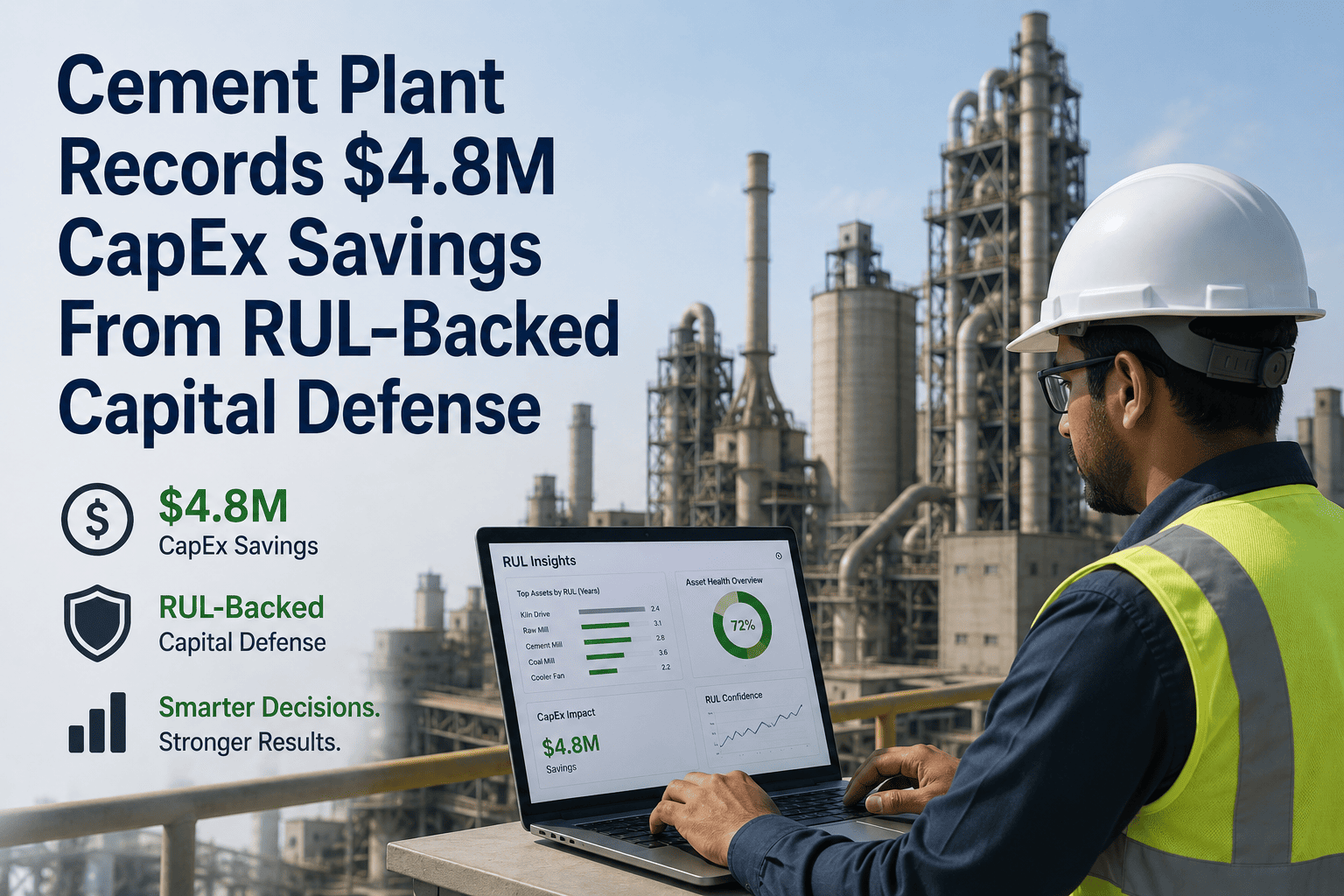
A kiln reline capital request walks into the CFO's office carrying a number between $1 million and $1.9 million for a 5,000 TPD line. The plant manager who got it approved last cycle and the plant manager who watched it bounce back into "next year's budget" did not present different numbers — they presented different defenses. The approved one walked in with zone-level wear rate data, brick consumption trends in grams per tonne of clinker, run factor history across the campaign, and a remaining useful life projection backed by 18 months of CMMS records. The rejected one walked in with a quote from the refractory supplier and a sentence about how the burning zone "looks worn." Same kiln. Same capital ask. Different evidence stack. This page is the defensible business case structure your reliability team needs — and Oxmaint is the system that captures every data point along the way.
How to justify a $1.5M kiln reline with CMMS data your CFO actually trusts
Lifecycle math, remaining useful life projections, brick consumption per tonne, run factor analysis, and the audit trail that converts a vendor quote into a board-approved capital project.
A kiln reline is not a maintenance line item — it is a $1M+ capital decision
For a 5,000 TPD kiln, a full reline runs $800,000 to $1.5M in refractory materials plus $200,000 to $400,000 in installation labour. Replace too early and you retire 15 to 25% of remaining brick life — pure waste compounded across every campaign. Replace too late and you risk shell damage that costs 10× the reline. The capital approval committee is not debating the reline itself — they are debating whether the timing is defensible. That defence is made of CMMS data or it is not made at all.
Every defensible kiln reline business case rests on the same three data foundations
If any one of these three pillars is missing or weak, the capital committee will defer the request. The good news is that CMMS data captures all three automatically when the kiln asset hierarchy is properly structured. The hard part is convincing yourself the pillars are in place before the meeting, not during.
Zone-by-zone thickness measurements, wear rate per metre per month, and a projection of when each zone crosses the minimum safe threshold. This is the data that proves the timing is right.
Grams of refractory consumed per tonne of clinker produced across the campaign. Benchmark is under 500 grams per tonne — a higher rate signals process or material issues that a new reline alone will not solve.
Operating hours divided by available hours across the campaign — every trip, every coating loss event, every fuel upset. World-class plants hit 85 to 90% run factor; operational instability shortens lining life by 40% or more.
The expected service life every reline business case anchors against
A reline business case is judged against industry-known life expectations by zone. If your burning zone made it to 16 months, that is top quartile. If it made it to 9 months, the committee will ask why before approving the next campaign at the same brick specification. These numbers below come from mature monitoring programmes across published cement-plant reliability data.
The reline business case ranks each zone against these bands — top quartile, median, or below. A zone below median needs a root cause explanation, not just a reline approval.
The cost comparison your CFO will actually run on the back of the request
The capital committee converts the reline request into a per-tonne cost figure and benchmarks it against industry data. The math below is the same calculation a cement-group finance team runs in the approval meeting. Walking in with these numbers already calculated removes the largest single objection.
| Scenario | Reline Cost | Campaign Output | Refractory Cost per Tonne | Risk Profile |
|---|---|---|---|---|
| Reline at 8 months — early | $1.5M | 2.0M tonnes | $0.75 per tonne | Retires usable brick — waste |
| Reline at 14 months — optimal | $1.5M | 3.5M tonnes | $0.43 per tonne | Top quartile economics |
| Reline at 18 months — late | $1.5M | 4.5M tonnes | $0.33 per tonne | Higher shell damage risk |
| Run-to-failure — worst case | $15M shell damage | Production halt | Unacceptable | Catastrophic shell repair |
Numbers assume a 5,000 TPD kiln at 90% run factor. Per-tonne refractory cost is the single most defensible metric for capital approval — it converts a one-time spend into a recurring operating economics figure the committee already benchmarks.
Stop walking into the capital committee with a vendor quote and a hopeful smile
Oxmaint captures every data point a defensible kiln reline business case needs — zone-by-zone thickness scans, wear rate trending, brick consumption per tonne, trip event logs, and run factor calculation — all on the kiln asset record. Walk into the next meeting with the evidence stack already assembled.
The six-section business case that gets kiln relines approved on first read
Current thickness measurements per zone, wear rate trends across the campaign, and the percentage of original brick remaining at each location.
Months to minimum safe threshold for each zone, with confidence intervals based on measured wear rate variability.
Run factor across the campaign, total clinker tonnes produced, brick consumption in grams per tonne, and benchmark against group standards.
Risk-adjusted cost of run-to-failure versus planned reline, including shell damage exposure and unplanned downtime at $150K to $400K per day.
Brick chemistry decisions by zone — MgO-spinel, dolomite, alumina — defended against the previous campaign's wear patterns and process conditions.
Proposed reline date sequenced against production schedule, downstream demand, and refractory contractor availability, with 90/60/30 day mobilisation plan.
Three questions the capital committee will ask — and the CMMS data that answers each
What plant managers ask before walking into the reline approval meeting
How do I prove remaining useful life to the capital committee?
What brick consumption rate is considered acceptable?
How does run factor affect the reline business case?
What happens if we delay the reline by 3 months?
How does CMMS data strengthen the capital ask?
Walk into the next capital meeting with the evidence stack already built
Oxmaint structures every kiln zone as a tracked asset with thickness history, wear rate trending, brick consumption metrics, trip event logs, and remaining useful life projections — the exact data the capital committee needs to approve a $1.5M reline on first read. Start your free trial today.