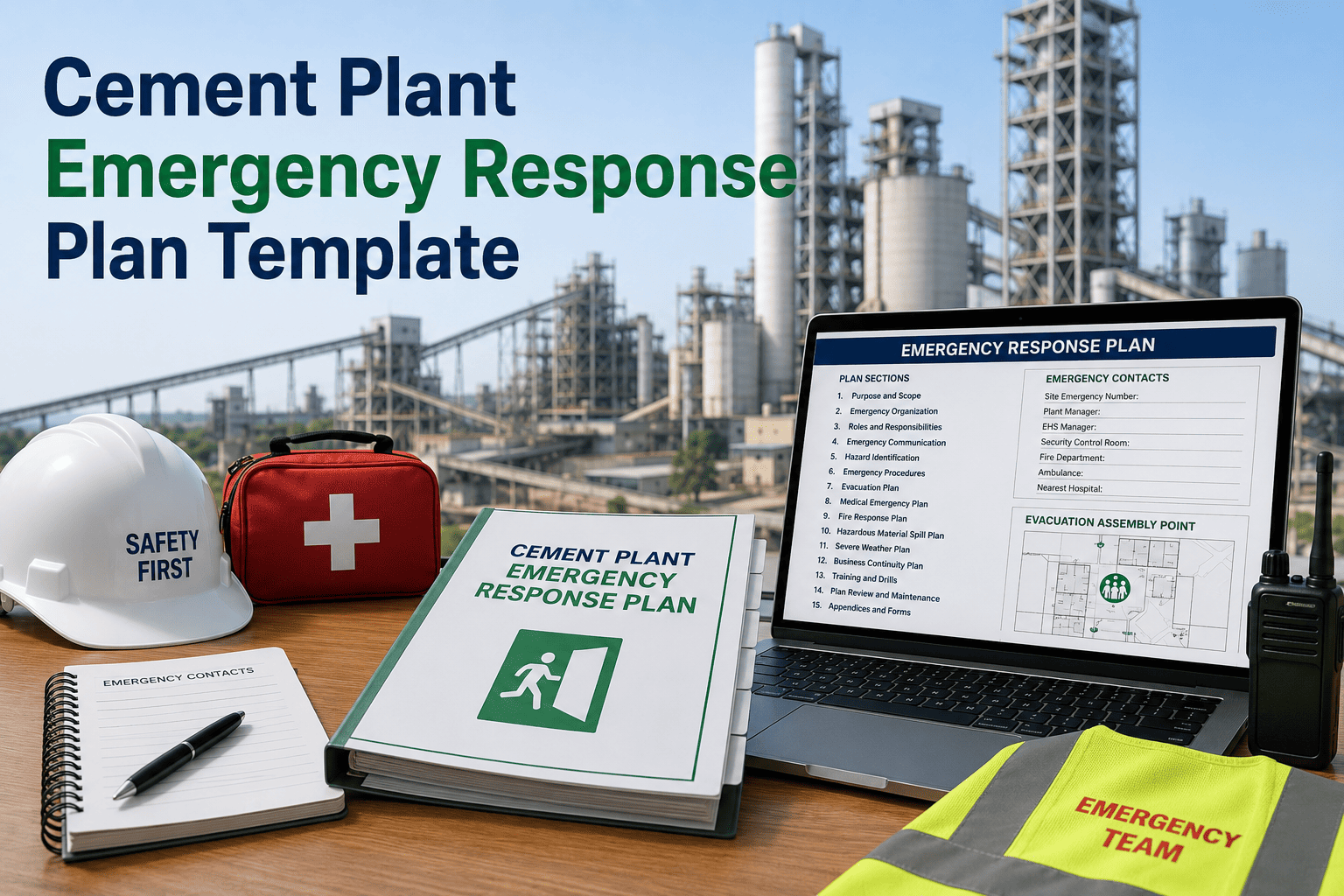
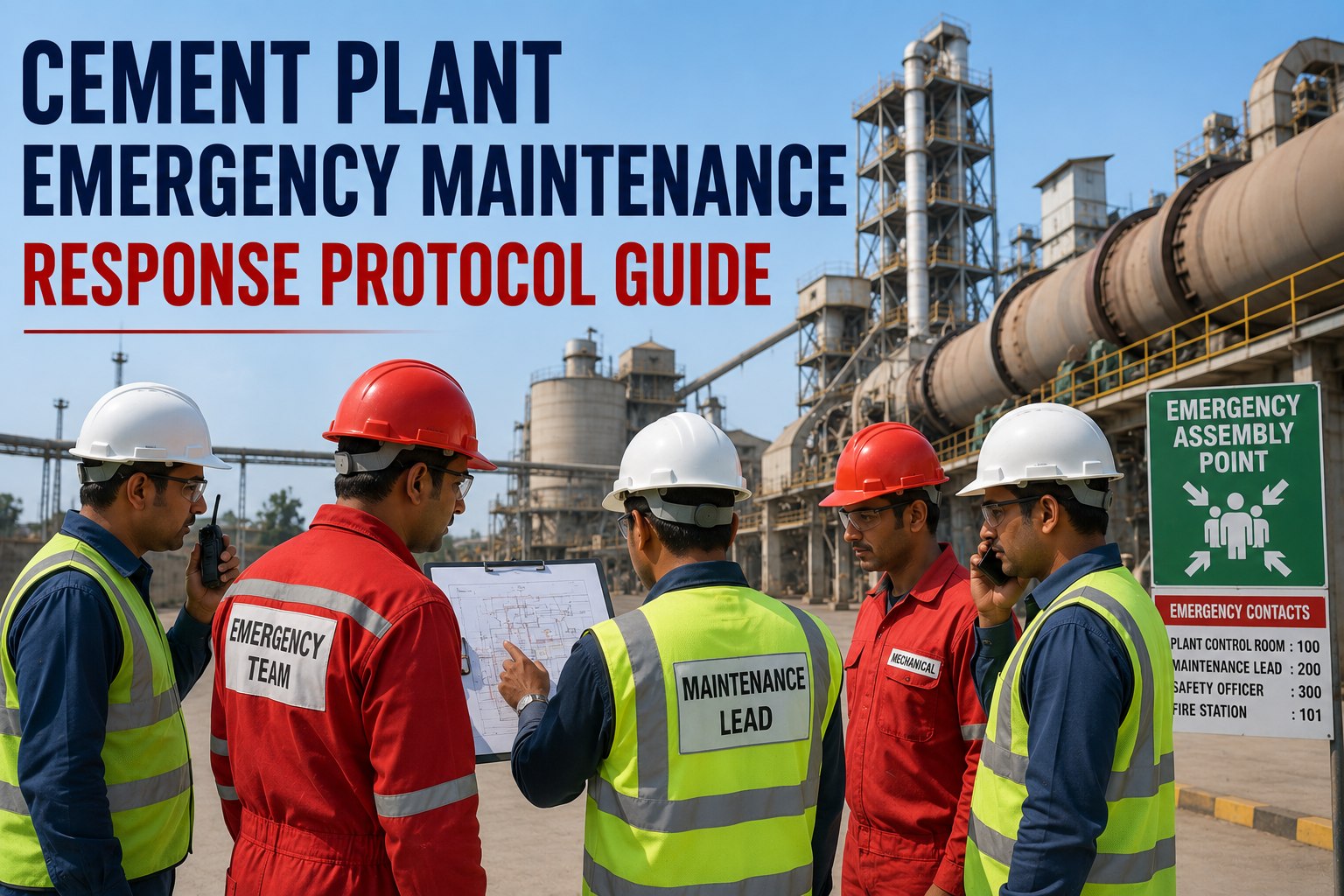
An emergency response plan is the document that gets read most carefully on the worst day of a plant's year and is otherwise forgotten in a binder on a shelf. Cement plants are unforgiving environments for that pattern. Coal handling systems and electrostatic precipitators account for the majority of cement-sector industrial fires; rotary kilns operate above 1,450°C; SNCR ammonia or urea storage adds a toxic-inhalation hazard at temperatures and pressures that demand a specific response sequence; preheater towers, silos, and cyclones create confined-space scenarios where atmospheric hazards compound with limited egress; and the quarry adds mobile-equipment, fall, and explosives risks layered onto everything happening inside the plant gate. A generic ERP template that does not name kiln stop, ammonia release, coal silo fire, confined-space rescue, mobile equipment incident, and mass evacuation as distinct, drilled, time-bounded scenarios is a binder that will fail under the pressure it was written for. This page gives you a structured cement plant ERP template covering all six scenarios with response timelines, ICS roles, drill cadence, and CMMS-linked evidence — book a demo to see how OxMaint tracks drills, equipment readiness, and corrective actions as a single auditable workflow.
Safety Toolkit · Cement CMMS · Emergency Response Plan
Cement Plant Emergency Response Plan Template — Six Scenarios, Drilled and CMMS-Tracked
A structured emergency response template built for the specific hazard profile of a cement plant. Covers kiln emergency stop, SNCR ammonia release, coal silo and ESP fire, confined-space rescue, mobile equipment incident, and full-site evacuation — with timelines, ICS roles, drill cadence, and corrective action workflow built in.
72 hrs
average global interval between significant fire incidents at a cement manufacturing facility
68%
share of cement plant industrial fires originating in coal handling and ESP systems
18 to 4 min
typical emergency response time improvement reported by plants with digital ERPs
6
distinct emergency scenarios every cement plant ERP must name and drill separately
The Six Scenarios
The Six Emergency Scenarios Every Cement Plant ERP Must Cover as Discrete, Drilled Procedures
A generic "emergency procedure" section is not enough. Each scenario below has a distinct trigger, distinct immediate response sequence, distinct evacuation logic, and distinct drill cadence. The cards below summarise what each one looks like inside a working cement plant ERP — with the parameters auditors and insurers expect to see named on paper.
Scenario 01
Kiln Emergency Stop
Trigger
Loss of kiln drive, refractory hot spot, ID fan trip, shell temperature breach, loss of cooling air
First action
Fuel cut, auxiliary drive engaged for slow rotation, ID fan damper sequence
Risk if mishandled
Hot meal runout, shell ovality damage, refractory loss, multi-week outage
Drill frequency
Quarterly tabletop, annual live simulation with control room
Scenario 02
SNCR Ammonia / Urea Release
Trigger
Tank, pump, or injection-line leak; transfer valve failure; tanker incident during unload
First action
Upwind muster, source isolation, water curtain or fog spray, SCBA-only entry
Risk if mishandled
Toxic inhalation injury; ammonia is NFPA Health 3 hazard; community shelter-in-place trigger
Drill frequency
Semi-annual joint drill with mutual-aid fire department
Scenario 03
Coal Mill, Silo, or ESP Fire
Trigger
CO spike in coal mill, hot-spot temperature alarm in silo, smouldering pile in ESP hopper
First action
Nitrogen inerting below 12% O2 LOC, fuel feed cut, CO2 deluge if installed
Risk if mishandled
Deflagration or explosion; reignition during fire department water application without inerting
Drill frequency
Annual scenario tabletop; weekly inerting system PM
Scenario 04
Confined Space Rescue
Trigger
Worker incapacitation inside silo, cyclone, kiln, ducting, or material bin
First action
Non-entry rescue with retrieval line; entry only by trained rescue team with SCBA
Risk if mishandled
Multiple-fatality event; the majority of confined-space fatalities are would-be rescuers
Drill frequency
Quarterly retrieval drill; annual full-rescue exercise with mutual aid
Scenario 05
Mobile Equipment Incident
Trigger
Quarry haul truck rollover, wheel loader strike, forklift incident at packing plant
First action
Site secured, traffic stopped, casualty extraction sequence, hospital notification
Risk if mishandled
Secondary incidents on haul road; MSHA reporting clock starts at incident moment
Drill frequency
Monthly traffic management exercise; quarterly extraction drill
Scenario 06
Full-Site Evacuation
Trigger
Toxic release, large fire, structural failure, bomb threat, severe weather
First action
Site alarm activated, named muster points, head count, accountability board update
Risk if mishandled
Unaccounted personnel during emergency operations; rescue resources mis-deployed
Drill frequency
Quarterly per shift; annual full-site live evacuation drill
The Incident Command Structure
Who Does What When the Alarm Sounds — A Named ICS Hierarchy Your ERP Must Specify
Every scenario above runs on the same chain of command. The hierarchy below is the named roles cement plant ERPs are expected to assign — each with a primary holder, a backup, and a deputy for shift coverage. Without named roles the plan collapses into improvisation in the first minute of a real incident.
Incident Commander
Plant Manager or designated deputy. Single point of strategic decision authority. All external communication routes through this role.
Safety Officer
EHS lead. Reviews every tactic for personnel risk. Authority to halt operations.
Operations Section
Production manager. Process isolation, fuel cut, kiln slow-roll, inerting activation.
Liaison Officer
Single point of contact for fire dept, EMS, MSHA, EPA, community liaison.
Fire Brigade Captain
On-site response team lead
Rescue Team Lead
Confined space & medical rescue
Muster & Accountability Lead
Head count, missing-person flagging
Control Room Operator
Process trips, isolations, sequence
From Binder ERP to CMMS-Linked Workflow
A Binder ERP Helps Once a Year — A CMMS-Linked ERP Runs Every Day
Emergency equipment requires PM. Drills require scheduling and attendance records. Corrective actions require named owners and verification. Insurance audits require evidence packs. OxMaint converts every line of your ERP into a tracked, scheduled, evidenced workflow — so the plan you wrote stays the plan you can actually run on the day you need it.
The Response Timeline
The First 60 Minutes — A Four-Phase Response Timeline Every Scenario Follows
Regardless of the trigger, the response curve has the same four phases. The timeline below specifies what is happening, who is acting, and what evidence is being captured in each phase. Drill performance is measured against these phase durations — a plant whose Detect-to-Notify phase consistently exceeds 60 seconds has a measurable, fixable problem.
0–60 sec
Detect
Sensor alarm, operator observation, or worker report. Automatic alarm forwarding to control room. CO, gas, temperature, or vibration thresholds trigger.
Evidence: timestamped alarm log, sensor history, operator radio recording
1–5 min
Notify
Site alarm activated, IC notified, fire brigade and rescue paged. External notification to fire dept, EMS, regulator if reportable threshold met.
Evidence: alarm activation log, communications timestamps, ICS roster
5–30 min
Contain
Process isolation, fuel cut, inerting active, evacuation in progress, head count under way, mutual aid arriving and being briefed at site entrance.
Evidence: control room action log, muster sheets, mutual-aid sign-in
30–60+ min
Recover
Casualties handed to EMS, incident scene secured, root-cause data preservation, regulatory notification clock managed, recovery planning begins.
Evidence: incident report, regulator notification record, photo log
Drill Cadence & Equipment Readiness
Drills, PMs, and Records — The Operational Backbone of an ERP That Actually Works
An ERP becomes real through scheduled drills and equipment PMs. The table below shows the cadence and CMMS-linked work order each scenario requires. Scroll horizontally on mobile to see all columns. OxMaint converts each row into a recurring scheduled work order with attendance, equipment-readiness, and evidence attachment built in.
Common ERP Gaps
Six Gaps That Show Up Repeatedly in Cement Plant Emergency Response Plans
When ERPs fail an audit, an insurance review, or a real incident, the underlying gap is rarely the absence of a procedure. It is one of the six structural gaps below — each one preventable if the template forces the right discipline up front.
Gap 01
Generic procedures instead of named scenarios
"Emergency procedure" is not a plan. Each of the six scenarios needs a distinct procedure with named triggers, named owners, named distances, and named drill cadence.
Gap 02
No backup for the Incident Commander
If the IC role only names the plant manager, the plan fails the moment the plant manager is on leave. Each role needs a primary, a backup, and a shift-deputy structure.
Gap 03
Drills logged but corrective actions not closed
Drills surface gaps. Gaps not converted into trackable corrective action work orders reappear in the next drill and ultimately during a real incident.
Gap 04
Mutual aid notified but not pre-briefed on plant layout
Fire departments and EMS arriving at a 50-hectare cement site need a pre-briefed plant map, hazardous material inventory, and named gate access. Annual site walk with mutual aid is non-negotiable.
Gap 05
Emergency equipment PMs disconnected from ERP
Extinguishers, SCBA, gas monitors, tripod rescue gear, and inerting systems must appear on the same CMMS calendar as the ERP itself, with readiness flagged on every drill.
Gap 06
No post-drill performance metrics
If a drill is not measured against time-to-notify, time-to-muster, head-count accuracy, and corrective-action closure rate, it does not produce improvement, just attendance.
Expert Perspective
What Cement Plant Safety, EHS, and Emergency Response Leaders Are Saying
Rated 5 / 5
The shift that changed our programme was naming the six scenarios explicitly and writing a discrete procedure for each one, instead of a generic "emergency procedure" section. Once the ammonia release procedure was separate from the coal fire procedure with separate drill cadences and separate mutual-aid relationships, our drill performance improved measurably inside two cycles. The mutual-aid fire department specifically noted that our team's hand-off at the gate was sharper than any other industrial site they covered.
DH
Daniel Hayes, CSP, NREMT-P
Plant EHS & Emergency Response Lead, Northeastern Integrated Cement Site · 19 yrs industrial fire brigade and rescue
Rated 5 / 5
Linking drills to a CMMS workflow turned our ERP from a binder into an operating system. Every drill is a scheduled work order. Every corrective action is a work order. Every piece of emergency equipment is an asset with a PM cycle. When the insurance carrier did their five-year recertification audit, we exported the entire evidence pack in one afternoon — calibration certificates, drill attendance, corrective-action closure, and equipment-readiness records, all aligned to the ERP version they were reviewing.
FA
Fatima Al-Mansouri, CFPS, NEBOSH IDip
Group Safety & Loss Prevention Manager, GCC Cement Operations · 17 yrs heavy-industry ERP design
Rated 4 / 5
Confined-space rescue is the scenario where having the procedure but not the readiness will hurt you. We had the tripod, we had the gas monitor, we had the SCBA. Then a quarterly drill found the gas monitor was out of calibration by two months and nobody had flagged it. Moving the calibration onto the same CMMS calendar as the drill itself was the fix. Now you cannot run the drill without confirming equipment readiness first — the workflow forces the discipline that humans drift away from over time.
RB
Rashid Bhattacharya, CMIOSH
Plant Safety Manager, South Asian Integrated Cement Producer · 21 yrs rescue and confined-space
Frequently Asked Questions
Cement Plant Emergency Response Plan — Common Questions Answered
Can the template be exported as Excel, Word, or PDF for our compliance binder?
Yes. The six-scenario structure, ICS hierarchy, 4-phase timeline, and drill cadence table on this page export cleanly into Excel tracking sheets, Word ERP documents, and PDF distribution copies.
Book a demo and we will share the editable working files.
How does OxMaint convert ERP drills and equipment into trackable work orders?
Each drill is scheduled as a recurring work order with attendance, evidence attachment, and corrective action capture built in. Every piece of emergency equipment is an asset with a PM cycle.
Start a free trial to see the full workflow.
Do plants without SNCR or SCR still need Scenario 02 in the ERP?
Plants without ammonia or urea systems can deactivate Scenario 02, but they should still review chemical storage on site — propane, fuel oil, alternative-fuel additives — and confirm whether a comparable toxic-release scenario applies in any other form.
How often should the entire ERP be reviewed and re-approved?
A full ERP review is best run annually, with revision after any significant process change, any major drill failure, any actual incident, and any mutual-aid relationship change. Version control and IC sign-off are part of the review work order.
How does the ERP align with MSHA, OSHA, and insurance carrier audit expectations?
The six-scenario structure maps directly to MSHA Part 56 emergency provisions, OSHA 1910.38 emergency action plan rules, and most carrier loss-control requirements.
Book a demo to walk through the alignment for your specific carrier and regulators.
Cement Plant Emergency Response Plan Template · OxMaint Safety Toolkit
Build an ERP That Survives Contact With the Worst Day — Six Scenarios, Named Roles, Drilled and CMMS-Tracked
The six-scenario template, ICS hierarchy, 4-phase response timeline, and drill cadence on this page give your safety team the structure. OxMaint provides the operational backbone — scheduled drills, equipment readiness PMs, corrective action work orders, and audit-ready evidence packs — that converts a paper plan into a programme you can run on the day you actually need it.