Buying a CMMS for a cement plant is not the same as buying a CMMS for a warehouse, a fleet workshop, or a hospital. The asset list runs from rotary kilns operating at 1,450°C to bag filters with 12% oxygen safety ceilings, the maintenance budget is measured in millions of dollars per year, and the cost of a wrong vendor decision is paid in unplanned kiln outages priced at $180,000 to $340,000 per event. Most CMMS RFP templates available online are written for generic facility maintenance — they ignore refractory campaign tracking, kiln shell scanning, pyro-process interlocks, and the SAP PM integration patterns that determine whether the system you buy will actually work in your control room. This 14-section RFP template is built specifically for cement plant procurement teams who need a structured, weighted, audit-defensible vendor selection process — and want to book a demo of the platform that already meets these requirements.
Procurement Toolkit · Cement Plant CMMS · 14-Section RFP
Cement Plant CMMS RFP Template — 14 Sections, Weighted Scoring, Vendor-Ready
A structured procurement template built for cement plant maintenance leaders. Covers scope definition, functional and technical requirements, vendor qualifications, integration architecture, weighted scoring rubric, implementation milestones, and final selection — written for the realities of rotary kilns, raw mills, preheater towers, and clinker coolers.
14
structured RFP sections covering scope, requirements, scoring, and selection
2,900+
CMMS evaluation criteria available across nine functional modules to choose from
8–14
months — typical payback period for a 1.5 million tonne cement plant CMMS
40%
higher project-failure rate when cost is weighted above 30% in vendor scoring
The Anatomy of the Template
14 Sections — What Each One Forces You to Decide Before You Issue the RFP
A CMMS RFP is not a feature list. It is a decision-forcing document that converts your maintenance pain points into measurable vendor criteria. Each of the 14 sections below corresponds to a decision your selection committee has to make before vendors see the document — skip a section and you will see ambiguity in the responses, and ambiguity in responses produces a wrong selection.
Stage 1 · Define
Set the boundaries of the procurement and what success looks like
01Project Overview & Background
Plant size, production tonnage, current maintenance system, why you are buying now, executive sponsor.
02Scope of Work & Success Criteria
In-scope assets, out-of-scope assets, success metrics (downtime, PM compliance, MTTR, audit findings).
03Organisation & Stakeholder Profile
Number of plants, technicians, planners, supervisors. Languages required. Shift pattern coverage.
Stage 2 · Specify
Translate cement plant operations into testable vendor requirements
04Functional Requirements
Work orders, PM scheduling, refractory campaign tracking, inspection rounds, mobile execution, permits-to-work.
05Asset Hierarchy & Cement-Specific Data Model
Pyro-line, raw mill, cement mill, packing plant hierarchy. Refractory zones. Kiln campaign data structure.
06Integration Architecture
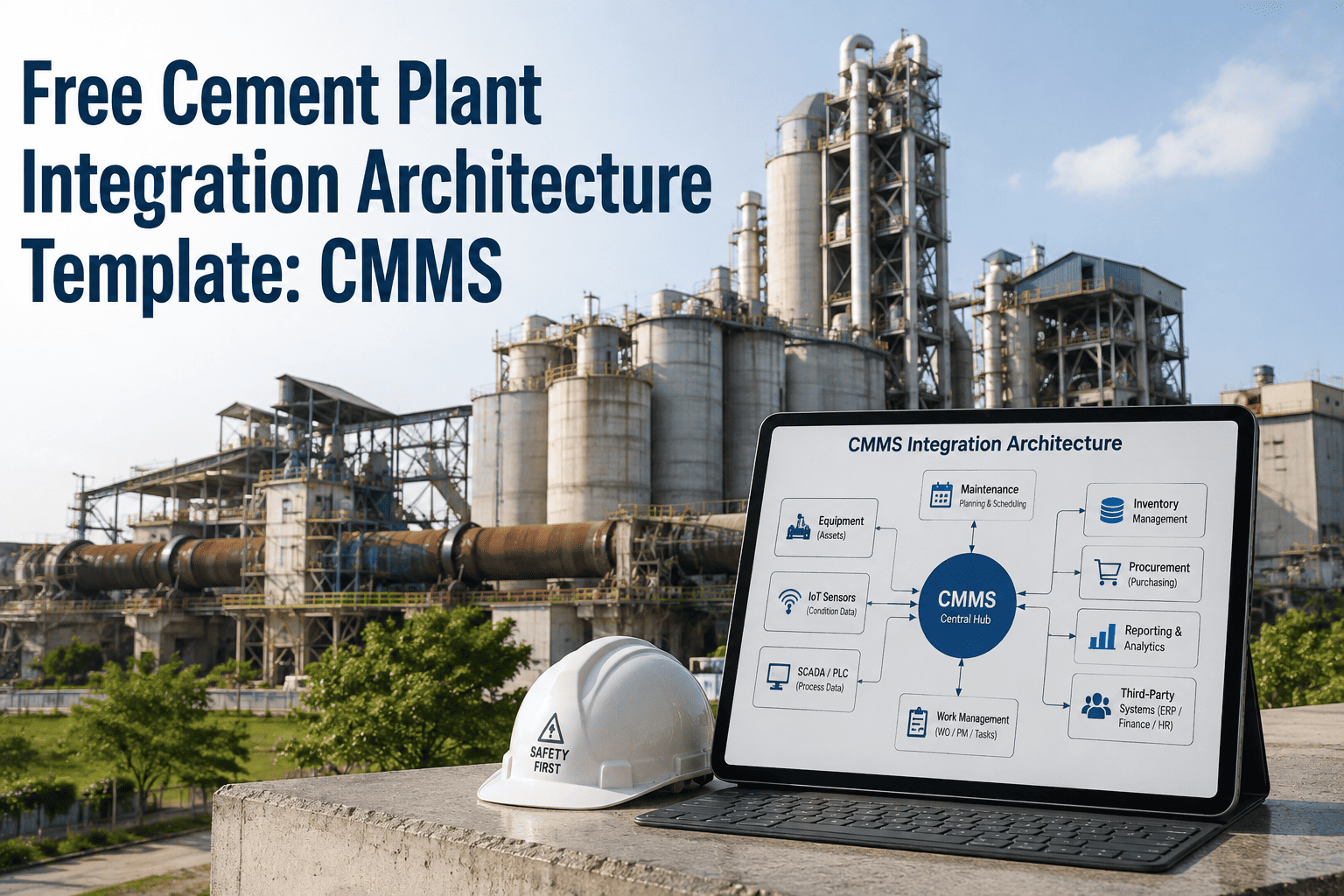
SAP PM / Oracle EAM, DCS / OPC-UA, vibration monitoring, kiln shell scanning, ERP procurement, identity provider.
07Reporting, Analytics & KPIs
Downtime by cause code, PM compliance, MTBF, MTTR, emergency vs planned ratio, cost per tonne maintenance.
08Technical & Security Requirements
Hosting model, data residency, SSO, audit logging, role-based access, backup and DR, OT segmentation.
Stage 3 · Qualify
Filter vendors on commercial fit and proven cement-sector experience
09Vendor Qualifications & Cement References
Years operating, cement plant customer count, named reference contacts, on-site visit capability.
10Implementation Approach & Timeline
Phased rollout, data migration plan, training delivery, change management, go-live support, hypercare window.
11Pricing, TCO & Commercial Model
Subscription, per-user, per-asset, implementation fees, ongoing support, year 1 through year 5 TCO.
Stage 4 · Decide
Score objectively and convert evaluation into a defensible decision
12Evaluation Criteria & Weighted Scoring Rubric
Pass/fail gates, weighted criteria, 1–5 scoring scale, evaluator scorecard format, calibration meeting.
13Submission Guidelines & Procurement Timeline
Format, page limits, Q&A window, demonstration agenda, proof-of-concept scope, contract negotiation window.
14Terms, Conditions & Selection Notice
Confidentiality, IP ownership, data return clauses, SLAs, exit assistance, scoring publication policy.
Why Generic Templates Fail Cement Plants
Five Things a Cement-Specific RFP Template Captures That a Generic One Does Not
Most off-the-shelf CMMS RFP templates are written for generic facility or fleet maintenance. They miss the operational realities that define whether a cement plant CMMS will be usable on day one or shelved within a year. Each item below should be a named, scored requirement in your RFP — not an afterthought.
01
Refractory Campaign Tracking
Heat count per kiln zone, temperature exposure time, condition score per inspection, remaining life per brick course. Generic CMMS treats refractory as a spare part — cement plants need it as a campaign data structure with multi-year history.
Kiln Shutdown Project Workflow
02
Major kiln shutdowns are 7 to 21 day project packages, not single work orders. The RFP must require nested task hierarchies, parts pre-staging verification, and PM-derived scope generation from the preceding campaign.
03
Permit-to-Work Integration
Hot work, confined space, electrical isolation, work-at-height permits must block work order start until active. Generic CMMS templates rarely make permit interlock a functional requirement — for cement plants this is a safety-critical control.
Pyro-Process Sensor Integration
04
Shell scanner, kiln tyre migration, mill drive vibration, cooler grate temperature, baghouse differential pressure — all feed condition-based work order creation. The RFP must specify OPC-UA, threshold logic, and alarm acknowledgement workflow.
05
Emissions & Regulatory Linkage
NOx, SOx, dust, and CO2 limits link directly to equipment condition. The CMMS must trigger investigation work orders before regulatory exceedances, and produce audit-ready evidence packs for environment agency inspections.
Multi-Plant Asset Taxonomy
06
A cement group runs identical asset classes across multiple plants. The RFP must require a shared asset taxonomy with site-level customisation, enabling cross-plant benchmarking and parts standardisation that single-site templates ignore.
Skip the Template Build — Walk the Live Platform
See How OxMaint Already Meets Every Cement-Specific RFP Requirement on This Page
The 14-section template above is the procurement framework. The platform that maps to it cleanly already exists. A 30-minute walkthrough is faster than scoring six proposals — and it tells you exactly which sections of your RFP need the most attention based on your plant's current pain points.
The Weighted Scoring Rubric
How to Weight the 14 Sections — A Defensible Scoring Model for Cement Plant CMMS Procurement
Weighted scoring is the difference between a defensible vendor selection and a contested one. The model below allocates 100 points across the four scoring blocks every cement plant procurement team needs. Cost is deliberately weighted at 20% — Deloitte's 2025 CPO survey found that weighting cost above 30% produces 40% more project failures on knowledge-driven implementations.
25%
Technical & Integration
Functional Fit · 35 pts
Work order & PM workflow — 10 pts
Refractory & kiln campaign — 8 pts
Mobile execution & offline — 7 pts
Inspections & permits — 5 pts
Reporting & KPIs — 5 pts
Technical & Integration · 25 pts
SAP / ERP integration — 8 pts
DCS / OPC-UA / sensors — 7 pts
Security & SSO — 5 pts
Data residency / hosting — 5 pts
Cost & TCO · 20 pts
Year 1 implementation cost — 6 pts
5-year subscription TCO — 8 pts
Hidden costs & change orders — 3 pts
Exit & data-return cost — 3 pts
Vendor & Delivery · 20 pts
Cement plant references — 6 pts
Implementation methodology — 6 pts
Training & change management — 4 pts
SLA, support, financial stability — 4 pts
Cement-Specific Functional Checklist
The Functional Requirements That Should Be Pass/Fail Gates in Section 4 of Your RFP
Pass/fail gates eliminate vendors who cannot meet your non-negotiables before scoring begins. The table below maps the cement-specific functional requirements that should be hard gates, with the test method your evaluators can use to verify each one during the demonstration phase.
Common RFP Mistakes
Six Mistakes That Make a Cement Plant CMMS RFP Choose the Wrong Vendor
Most failed CMMS implementations were predictable at the RFP stage. The six mistakes below repeat across cement plant procurement projects globally — each one is a structural flaw in the RFP document itself, not a vendor problem. Fix the RFP and the selection improves automatically.
Mistake 01
Treating cost as the dominant criterion
Weighting cost above 30% statistically produces 40% more failed implementations. Cap cost at 20% and let functional fit and delivery capability lead.
Mistake 02
Asking for features instead of outcomes
A 600-line feature checklist gets a 600-line yes-yes-yes response. Replace feature lists with scenario-based questions tied to your real cement plant pain points.
Mistake 03
No pass/fail gates before scoring
Without hard gates, weak vendors survive the scoring round on volume of mediocre answers. Define 6 to 10 non-negotiables that eliminate first, then score the remainder.
Mistake 04
Skipping live demonstrations
Written responses cannot distinguish a real refractory campaign workflow from a slide-deck claim. Reserve 25% of the score for a structured live demonstration on a prepared scenario.
Mistake 05
Ignoring exit and data-return clauses
The contract you sign should describe how you leave. If the vendor cannot detail data export format, exit assistance window, and migration support, that absence is a future captive cost.
Mistake 06
No calibration meeting before final scoring
Independent scoring without calibration produces wide variance from evaluator bias. A 60-minute calibration meeting after first-pass scoring tightens the final selection significantly.
The Procurement Timeline
From Section 1 Drafting to Vendor Selection — A Realistic 90-Day Procurement Calendar
A cement plant CMMS RFP run in under 60 days usually skips the steps that protect the decision. Run beyond 120 days and stakeholder fatigue produces a default-vendor choice. The 90-day calendar below balances rigour with momentum and mirrors the cadence used by mid-size cement procurement teams.
Days 1–14
Internal Discovery & RFP Drafting
Stakeholder interviews with maintenance, operations, IT, finance, HSE. Pain-point inventory. Draft of Sections 1 through 14. Internal sign-off on weightings and pass/fail gates.
Days 15–21
Long-List & RFP Issue
Long-list of 6 to 8 vendors confirmed. RFP issued with submission portal, Q&A window, and demonstration agenda template. Pre-RFP briefing call optional.
Days 22–45
Vendor Q&A & Response Window
Structured Q&A with all answers shared across all vendors. 3 to 4 week response window. Pass/fail gates verified on receipt. Short-list to 3 vendors.
Days 46–65
Live Demonstrations & Reference Calls
Scripted scenario demos. Sandbox access for evaluators. Two named reference calls per vendor. On-site visit to nearest cement reference if practical.
Days 66–80
Independent Scoring & Calibration
Evaluators score independently. Calibration meeting reconciles variance. Final weighted scorecard signed off by selection committee.
Days 81–90
Final Selection & Contract Negotiation
Preferred vendor confirmed. Commercial terms, SLAs, exit clauses negotiated. Unsuccessful vendors notified with scoring summary. Implementation kick-off scheduled.
Expert Perspective
What Cement Plant Procurement and Reliability Leaders Say About the RFP Process
Rated 5 / 5
The first CMMS RFP I ran for our group used a generic procurement template and we ended up with a system that could not track refractory campaigns at all. Three years later we ran the replacement RFP using a cement-specific 14-section structure with pass/fail gates on refractory, SAP integration, and shutdown project workflow. The shortlist collapsed from eight vendors to three immediately, and the final scoring was defensible to the audit committee in a way the first one never was.
SR
Sandeep Rao, MBA, CSCP
Group Procurement Manager, South Asian Cement Group · 18 yrs industrial procurement
Rated 5 / 5
Weighting matters more than anyone admits at the start. We almost selected the cheapest vendor on a cost-heavy scorecard until our reliability lead pointed out that the cheap vendor had no live cement plant reference. We rebuilt the rubric to cap cost at 20%, lift functional fit to 35%, and require named references as a pass/fail. The vendor we eventually chose was second cheapest but delivered measurable PM compliance improvement in the first six months of operation.
MK
Maria Kowalska, CMRP, MIAM
Plant Reliability Manager, European Integrated Cement Producer · 21 yrs reliability engineering
Rated 4 / 5
The single biggest improvement in our RFP discipline was the calibration meeting after independent scoring. Before we introduced it, the same vendor would receive a 4 from one evaluator and a 2 from another with no documented reason. After calibration became mandatory, the variance dropped sharply and the final selection took roughly half the contested follow-up time. The template is only as good as the scoring process that runs on top of it — both matter.
JO
James Owusu, IEng MIET
Maintenance Systems Lead, West African Cement Operations · 16 yrs CMMS deployment
Frequently Asked Questions
Cement Plant CMMS RFP Template — Common Questions Answered
Can I export the 14-section template into Excel, Word, or PDF format for our procurement portal?
Yes. The structure on this page maps directly to Excel scorecard tabs, Word RFP sections, and PDF distribution copies.
Book a demo and we will share the editable working files for your team to adapt to your plant.
How is OxMaint already aligned with the cement-specific pass/fail gates listed in Section 4?
OxMaint ships with refractory campaign tracking, kiln shutdown project workflow, permit-to-work interlocks, OPC-UA sensor inputs, and SAP integration as native capabilities — not custom add-ons.
Start a free trial to see them live.
What weighting model do you recommend for a multi-plant cement group running the RFP centrally?
Functional fit 35%, technical and integration 25%, cost and TCO 20%, vendor and delivery 20% — with multi-plant taxonomy, cross-site benchmarking, and group-level reporting added as pass/fail gates to filter single-site solutions out at the long-list stage.
How long should our cement plant CMMS RFP procurement realistically take end to end?
A 90-day window is realistic for a focused selection committee. Under 60 days usually skips reference calls or live demos. Beyond 120 days, momentum fades and stakeholder fatigue starts driving default-vendor selection rather than evidence-based selection.
Can the template be used for a single-plant procurement as well as a multi-plant group rollout?
Yes. Single-plant procurements use the same 14 sections with simplified weightings and shorter timelines. Group procurements add multi-plant taxonomy and centralised reporting as scored items.
Book a demo to discuss your specific configuration.
Cement Plant CMMS RFP Template · OxMaint Procurement Toolkit
Run a Defensible Cement Plant CMMS Procurement — Or Skip the Build and Walk the Platform First
The 14-section template above gives your procurement team a structured, audit-defensible, cement-specific RFP framework. The OxMaint platform already meets every pass/fail gate on this page — including refractory campaign tracking, kiln shutdown project workflow, SAP and OPC-UA integration, and permit-to-work interlocks. Walk the platform first, then build the RFP around what you have already seen working.