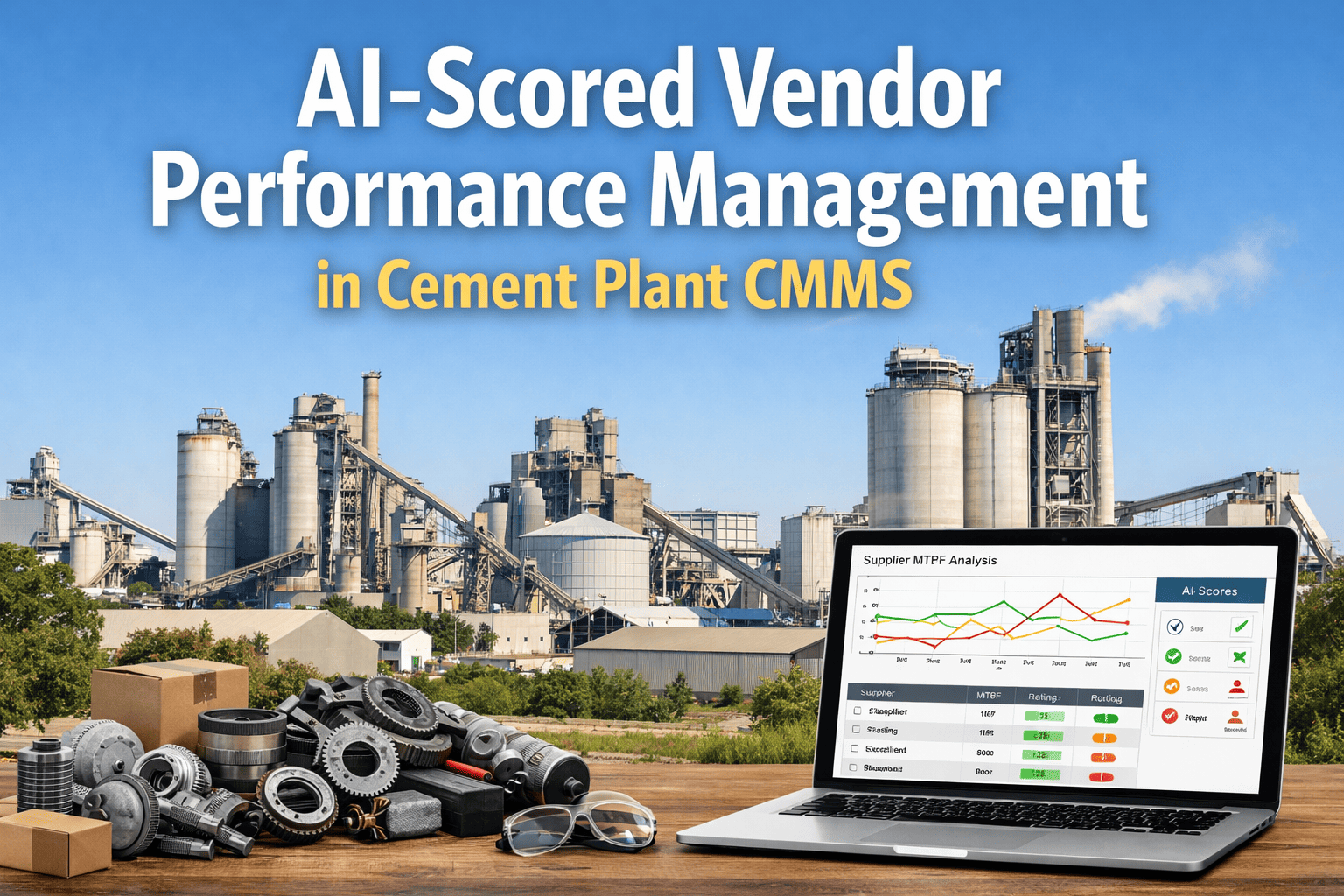
Cement plants spending $4–12M annually on MRO supplies are making procurement decisions that directly determine equipment reliability — yet fewer than 1 in 5 tracks part-level MTBF by supplier. Oxmaint's AI-scored vendor performance module links every part consumed in a work order back to its supplier, building a failure-rate profile that shows exactly which vendors are quietly inflating your maintenance costs — and which deliver components that last. Book a demo to see supplier MTBF scoring configured for your plant.
The Hidden Procurement Problem in Cement Maintenance
Most cement plants evaluate suppliers on price and delivery speed. Almost none measure what happens after the part is installed. A bearing that fails at 4,000 hours instead of the rated 12,000 hours costs three times more than its purchase price when you add unplanned labor, kiln downtime, and emergency logistics. Without part-level failure tracking tied to the supplying vendor, procurement continues rewarding the cheapest invoice — not the most reliable component.
How AI-Scored Vendor Performance Works in Oxmaint
Oxmaint connects your work order history, part consumption records, and failure events to build a continuous vendor performance score — updated automatically each time a part fails or reaches end of rated life. No manual scorecards. No end-of-year review meetings. The AI surfaces underperforming vendors before they cause the next kiln shutdown.
Every part consumed in a work order is linked to its purchase order and supplying vendor. Installation date, asset location, and operating zone (ambient, dusty, high-temperature) recorded automatically.
When the part fails or is replaced, the work order records actual operating hours. Oxmaint calculates part-level MTBF and compares it against manufacturer specifications and plant-average MTBF for that component class.
Each supplier accumulates a composite score across four dimensions: MTBF ratio vs specification, failure contribution rate, delivery performance, and quality rejection frequency. Score updates after every relevant work order close.
Suppliers whose MTBF ratio falls below threshold trigger automated procurement alerts. Purchasing sees the flagged vendor, the affected part categories, the estimated annualized downtime cost impact, and a recommended preferred-vendor switch.
Your Cheapest Supplier May Be Your Most Expensive One
Stop making procurement decisions on invoice price alone. Oxmaint's AI vendor scoring shows you which suppliers are costing you in downtime — before the next kiln stop. Book a demo and see supplier MTBF scoring live.
The Four Dimensions of AI Vendor Scoring
A single price metric cannot predict supplier risk. Oxmaint's AI aggregates four independently tracked dimensions into a composite vendor score — weighting each by its impact on total maintenance cost and equipment availability at cement plant operating conditions.
Actual operating hours to failure divided by manufacturer-rated MTBF. A ratio below 0.70 flags the vendor as a quality risk. Ratios calculated per part category and per asset class — a bearing supplier performing well on fans may be poor on kiln trunnions.
The percentage of unplanned failure work orders in a given part category attributable to parts from this vendor. Vendors supplying 15% of parts but contributing 40% of failures are immediately surfaced as high-risk regardless of their pricing advantage.
On-time delivery rate measured against promised lead time on every purchase order. Late deliveries that force emergency air-freight procurement are quantified in cost terms and attributed to the supplier — making the real cost of unreliable delivery visible.
Parts returned, rejected at goods receipt, or flagged by technicians as substandard at installation. Rejection incidents logged per vendor and part number — creating a rejection history that compounds into the composite score over time.
Vendor Risk Tiers: How Oxmaint Classifies Your Supplier Base
Oxmaint automatically segments your active vendor base into three risk tiers based on composite AI scores — giving procurement managers a clear action list rather than a data dump to interpret manually.
| Vendor Tier | Score Range | Typical Profile | Procurement Action | Review Frequency |
|---|---|---|---|---|
| Preferred | 85–100 | MTBF ratio above 0.90, failure contribution below 5%, on-time delivery above 95% | Consolidate volume. Issue blanket POs. Prioritize in stock allocation during critical shortage. | Annual strategic review |
| Conditional | 60–84 | MTBF ratio 0.70–0.89, or delivery reliability between 80–94%, one or more quality incidents in 12 months | Dual-source the affected part categories. Issue performance improvement notice. Re-evaluate in 90 days. | Quarterly review |
| At-Risk | Below 60 | MTBF ratio below 0.70, failure contribution above 15%, or two or more critical part failures in 6 months | Immediate sourcing alternative. Block from approved vendor list for flagged categories. Calculate downtime cost attribution. | Immediate action + monthly tracking |
Part-Level MTBF: What the Data Reveals in a Cement Plant
When Oxmaint's vendor scoring is applied to a mid-size cement plant's 12-month work order history, the MTBF data consistently reveals patterns invisible in procurement reports. These are the findings plant maintenance managers most frequently encounter:
MTBF analysis in kiln and mill bearing categories routinely reveals that one supplier's components fail at 35–45% of rated life while a second supplier reaches 95–105%. The price difference between the two suppliers is often less than 8% — the downtime cost difference is $140,000–$300,000 per year.
Zone-adjusted MTBF tracking reveals environment-specific performance failures. A seal supplier performing acceptably in ambient zones may be producing components with inadequate dust ratings — delivering rated life in the storeroom, but 40% shorter life in raw mill and crusher environments.
Delivery reliability scoring reveals that 70–80% of emergency procurement events — each costing $4,000–$18,000 in premium freight — trace to 2–3 vendors with chronic lead time failures. The aggregate annual cost typically exceeds the annual price saving that justified selecting those vendors.
Generic or "OEM-equivalent" parts vary significantly in actual performance. MTBF tracking by part number and supplier distinguishes which aftermarket sources genuinely match OEM specifications and which are priced to win the purchase order but not designed to last.
Know Exactly Which Vendors Are Costing You in Downtime
Oxmaint's AI vendor scoring builds from your actual work order and purchase order history — no surveys, no manual data entry. Start your free trial and see your vendor risk profile in the first 30 days.
Results: Cement Plants Using Oxmaint Vendor Scoring
Frequently Asked Questions
Turn Your MRO Spend Into a Reliability Advantage
AI-scored vendor performance tracking, part-level MTBF analysis, and automated procurement alerts — deployed from your existing work order and purchase order history in 4 weeks. No new sensors. No ERP replacement. No consulting fees.