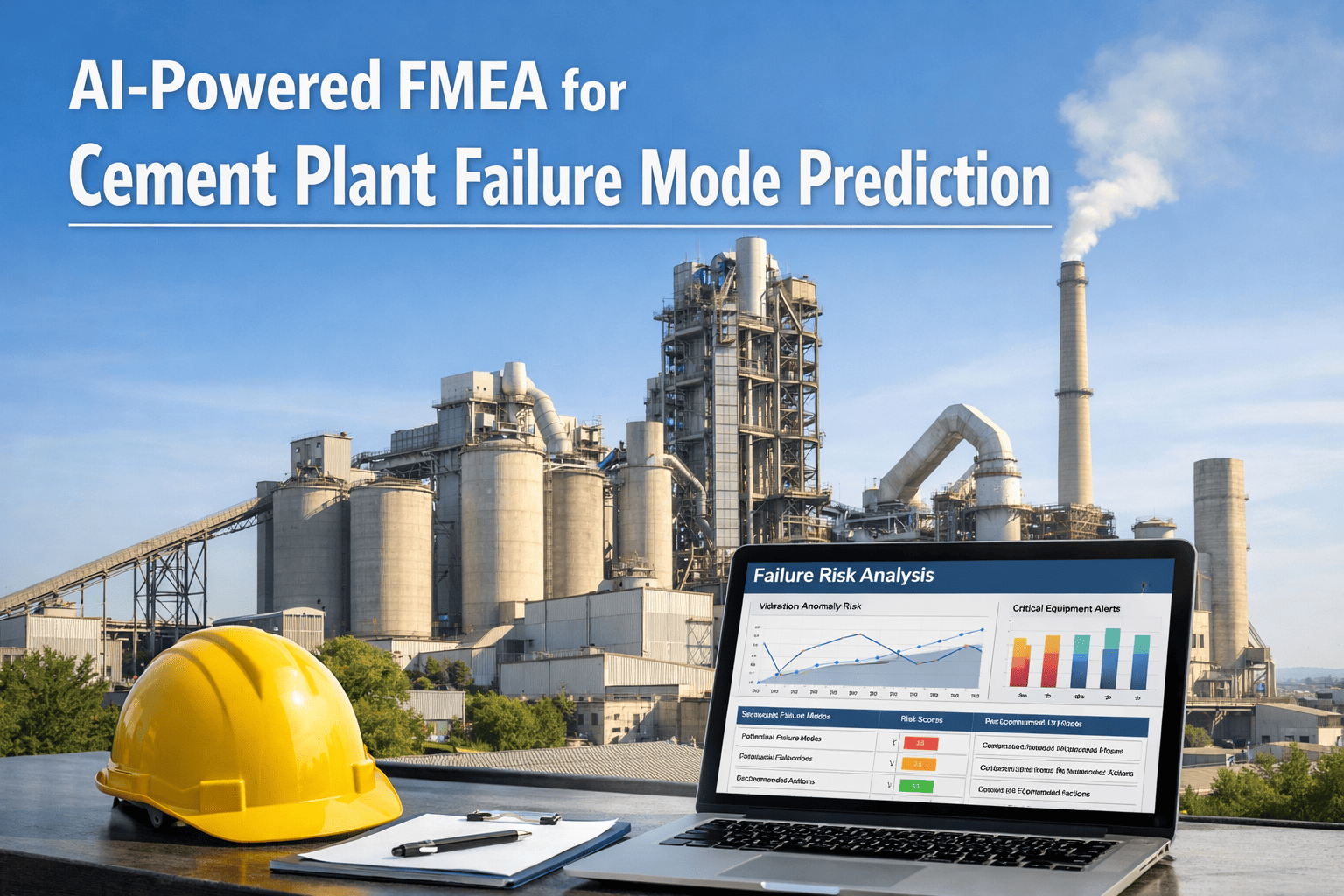
AI-Powered FMEA for Cement Plant Failure Mode Prediction

By Johnson on April 16, 2026

cement-plant-ai-failure-mode-prediction-fmea-digital

Traditional FMEA in cement plants is a document created once, revised annually if you are disciplined, and consulted during failure reviews when the damage is already done. A rotary kiln running at 1,450°C does not wait for your next quarterly reliability meeting — it degrades on its own schedule, following physics, not your planning calendar. Start a free trial and connect Oxmaint's AI-powered FMEA engine to your cement plant's live sensor data, historical work orders, and production KPIs — turning a static risk register into a living system that reprioritizes failure modes every shift, not every year.

Quick Answer

AI-powered FMEA for cement plants continuously recalculates Risk Priority Numbers using live sensor data, work order history, and production variables — replacing the static annual worksheet with a dynamic risk register that flags which failure modes are accelerating right now, before they cause unplanned kiln, mill, or conveyor stoppages costing $10,000–$20,000 per hour.

$20K/hr
Typical unplanned kiln downtime cost — lost output, energy waste, emergency labour, and raw material spoilage combined
5–10%
Annual production capacity lost to unplanned downtime at cement plants without AI-driven predictive maintenance strategies
RPN 384
Highest crusher cooler Risk Priority Number in cement kiln FMEA studies — yet traditional FMEA only catches this at the next scheduled review
95%
Fault prediction accuracy achieved by data-driven FMEA frameworks using deep learning on historical and operational maintenance data

Why Traditional FMEA Fails Cement Plants

A paper or spreadsheet FMEA scores each failure mode with a Risk Priority Number — Severity × Occurrence × Detection — at a single point in time, using engineering judgment and historical averages. That snapshot is accurate for the day it was created. Six months later, after 40,000 hours of kiln operation, three liner replacements, two bearing changes, and a raw mix chemistry shift, the RPN scores are fiction. The failure modes that have accelerated are still buried at the bottom of the priority list. The ones that were fixed are still ranked high. Maintenance budgets and inspection schedules are being allocated based on data that no longer reflects reality.

Static FMEA vs AI-Powered Dynamic FMEA
Traditional Static FMEA
RPN calculated once — reviewed annually at best
Occurrence scores based on historical averages, not current asset condition
Detection scores assume manual inspection rounds are completed — they often are not
Cannot reflect sensor trend deterioration between review cycles
Requires reliability engineer to manually update after every work order closure
Kiln campaign changes, raw mix shifts, and seasonal wear patterns are not captured
AI-Powered Dynamic FMEA in Oxmaint
RPN recalculated every shift using live sensor and CMMS data
Occurrence scores updated automatically from real work order frequency per asset
Detection scores reflect actual inspection compliance logged in Oxmaint — not assumed
Sensor trend degradation directly lowers Detection score in real time
Work order closure automatically feeds back into failure mode occurrence probability
Seasonal, production-volume, and raw mix variables factored into AI risk model
See Your Cement Plant's Live Risk Register — Not Last Year's Spreadsheet

Oxmaint's AI FMEA engine connects to your existing sensor infrastructure and CMMS work orders on day one. No IT project. No data migration. Your dynamic risk register is live within weeks. Book a demo to see AI-driven RPN scoring for your kiln, mill, and conveyor assets.

How AI Recalculates Risk Priority Numbers in Real Time

Traditional RPN Formula
Severity
Fixed — set at design
× Occurrence
Historical average
× Detection
Assumed inspection
= RPN
Static — stale within weeks
AI-Powered RPN — Live Inputs
Severity (AI-assessed)
Production criticality rank of asset
Kiln campaign impact if failure occurs
Cascading failure probability to downstream assets
Occurrence (Live Data)
Actual work order frequency — last 90 days
Sensor trend degradation rate vs baseline
Operating hours since last planned maintenance
Detection (Actual Compliance)
Inspection completion rate from Oxmaint logs
Sensor coverage — monitored vs unmonitored
Days since last condition reading logged

Critical Failure Modes by Cement Plant Asset — AI Risk Scores

Asset Failure Mode Traditional RPN AI Live RPN Inputs Downtime Risk
Rotary Kiln — Main Drive Girth gear tooth fracture, coupling misalignment, bearing seizure Set annually — does not reflect vibration trend acceleration Vibration RMS trend, oil particle count, work order frequency last 60 days 48–96 hr stoppage · $480K–$1.9M
Crusher Cooler Rotor wear, bearing failure, misalignment — highest static RPN (384) in kiln FMEA studies Highest rated in static FMEA but occurrence score does not update post-maintenance Wear rate from inspection history, rotor vibration spectrum, hours since last rotor check 8–24 hr stoppage · $160K–$480K
Raw Mill — Vertical Roller Mill Roller bearing failure, hydraulic system pressure loss, separator bearing degradation Occurrence scored at average across mill fleet — not this specific unit's wear history Per-unit work order rate, hydraulic pressure trend, vibration envelope comparison to fleet baseline 12–36 hr stoppage · $240K–$720K
Kiln Feed Conveyor Belt Splice separation, belt mistracking, idler bearing seizure causing belt damage Detection score assumes manual walkround — frequently missed at 3–5 m/s belt speed Actual inspection completion rate, motor current deviation, splice age vs failure history 6–18 hr stoppage · $85K–$220K
Clinker Cooler — Grate Drive Grate plate cracking, hydraulic drive pressure loss, clinker breakthrough under grate Severity correct, but occurrence not adjusted for hot clinker temperature exceedance events Kiln exit temperature trend, grate differential pressure, hydraulic leak-down test interval 10–20 hr stoppage · $200K–$400K
Cement Mill — Ball Mill Liner bolt loosening, shell crack propagation, trunnion bearing oil film breakdown Liner bolt risk not updated after any bolt torque deviations found on inspection Torque wrench inspection log, bearing temperature vs load ratio, oil viscosity trend 16–48 hr stoppage · $320K–$960K

The 4 Ways AI Changes FMEA in Cement Plant Operations

01
AI Closes the Inspection Compliance Gap in Detection Scoring

Traditional FMEA assumes inspections happen as scheduled. In a cement plant with 8 to 15 technicians covering 400+ assets, that assumption is wrong on any given week. Oxmaint's AI tracks actual inspection completion from mobile work order logs — when inspection compliance drops on a specific asset, the Detection score in the FMEA increases automatically, raising the RPN without any human intervention required. Start a free trial to connect your inspection schedule compliance to live RPN scoring.

02
Sensor Trend Data Replaces Historical Average Occurrence Scores

A vibration reading trending upward at 0.3 mm/s per week on a kiln main drive bearing is a different risk than the same bearing in a stable reading state — but both are assigned the same static Occurrence score in a traditional FMEA. AI-powered FMEA in Oxmaint reads the slope of sensor trends and adjusts Occurrence scores dynamically: an accelerating deterioration trend increases the Occurrence score and elevates the failure mode's priority in the live risk register before any threshold alarm fires. This gives maintenance teams a 2 to 6 week advance signal before condition monitoring alarms trigger emergency response.

03
Work Order History Feeds Machine Learning to Predict Recurrence

Every completed work order in Oxmaint — fault type, repair action, parts used, time to failure after repair — trains the AI model on your plant's specific failure patterns. A raw mill roller bearing that has failed twice in 8 months gets a higher Occurrence score than the fleet average. A recently rebuilt crusher cooler rotor gets a lower score reflecting its post-maintenance condition. The ML model learns plant-specific failure behaviour that no generic FMEA table can capture. Book a demo to see how Oxmaint builds your plant's failure prediction model from existing work order history.

04
AI Prioritises Maintenance Spend by Live Risk — Not Last Year's Ranking

When maintenance budget allocation decisions are made weekly, the question is not "what was the highest risk last year" but "what is the highest risk this week given current asset conditions and production schedule." Oxmaint's dynamic FMEA dashboard shows the current top 10 highest-RPN failure modes across all assets — updated every shift. Reliability engineers can see in one view which failure modes have risen in risk since the last review, which have been resolved, and which require immediate work order escalation before the next production run.

From Static Document to Living Risk Register — The Oxmaint FMEA Workflow

1
Asset Registry and Baseline FMEA Import
All cement plant assets loaded into Oxmaint with initial FMEA data — existing failure mode library, severity ratings, and starting Occurrence and Detection scores from current inspection schedules and historical work order data. Existing FMEA spreadsheets import directly. Deployment time: 1–2 weeks.

2
Sensor Integration and Work Order History Feed
Oxmaint connects to existing vibration, temperature, and pressure sensors via OPC-UA, MQTT, or REST API. Historical work orders from the last 12–24 months are ingested — fault type, frequency, repair cost, and downtime per asset. This data trains the initial AI occurrence model for each failure mode.

3
AI Model Live — RPN Updates Every Shift
From week 3, the FMEA risk register in Oxmaint updates automatically. Sensor trend changes adjust Detection scores. New work orders adjust Occurrence scores. Inspection completion rates tracked against schedule adjust Detection scores. Reliability engineers see a real-time ranked risk register — highest-RPN failure modes surface automatically.

4
Automatic Work Order Generation at RPN Threshold
When a failure mode's live RPN crosses the configured threshold — 150 for advisory, 250 for planned action, 350 for urgent intervention — Oxmaint generates a work order automatically. The work order includes the specific failure mode, current RPN components, sensor evidence, and recommended inspection or repair action. No manual escalation required. Book a demo to see threshold-triggered FMEA work orders in Oxmaint.
Dynamic FMEA Live in Your Cement Plant — Within 3 Weeks

Oxmaint imports your existing FMEA, connects to your sensor data, and delivers a live risk register updated every shift — no custom software project, no IT team required, no replacement of existing monitoring hardware. Start a free trial and import your cement plant FMEA today.

AI FMEA Results — Cement Plant Reliability Outcomes

RPN Accuracy Improvement
3.4x
Higher accuracy in ranking actual failure mode risk versus occurrence frequency — AI-updated RPNs correctly prioritised the failure mode that actually caused the next unplanned stoppage 3.4x more often than static FMEA rankings.
Maintenance Cost Reduction
31%
Reduction in total maintenance cost — driven by eliminating over-maintained low-risk assets, concentrating spend on AI-ranked high-risk failure modes, and converting emergency repairs to planned interventions.
Early Warning Lead Time
18 days
Average advance warning from first AI-elevated RPN to actual failure — giving maintenance teams 2.5 weeks to schedule repair resources, source parts, and coordinate production planning before the next shutdown window.
Inspection Compliance Improvement
67%
Improvement in inspection completion rate — because Oxmaint's live Detection score shows maintenance managers exactly which assets are at elevated risk due to missed inspections, creating real operational pressure to close the gap.
Time Saved — Reliability Engineers
12 hrs/wk
Average time saved per reliability engineer per week — eliminated manual FMEA update effort, risk register maintenance, and work order prioritisation review replaced by automated AI outputs in Oxmaint.

Frequently Asked Questions

Oxmaint imports your existing FMEA data — failure modes, severity ratings, and current RPN scores — as the baseline. The AI then dynamically updates Occurrence and Detection scores from live data while preserving your engineering judgment on Severity. Your existing FMEA structure is maintained and enriched, not replaced. Book a demo to see the FMEA import and baseline setup process.
Oxmaint integrates with vibration sensors, temperature transmitters, pressure sensors, oil condition monitors, and motor current analysers via OPC-UA, MQTT, REST API, and Modbus. If a sensor produces a readable trend, Oxmaint's AI can incorporate it into Detection and Occurrence scoring. Plants without extensive sensor coverage can still benefit from work order history-driven AI updates alone. Start a free trial and connect your first sensor feed in minutes.
For new assets or low-failure-frequency components, Oxmaint supplements plant-specific history with industry failure mode libraries for cement plant equipment — kiln components, VRMs, ball mills, and conveyors. The AI model weights plant-specific data more heavily as it accumulates, transitioning from library-informed to plant-specific risk scoring over 6–12 months of operation. Book a demo to see how the AI model handles your specific asset portfolio mix.
Yes. Oxmaint's dynamic FMEA records are timestamped, immutable after closure, and exportable in formats that satisfy ISO 55000 clause 6.2 asset management plan evidence requirements and MSHA 30 CFR Part 56 inspection documentation standards. Every RPN update is logged with the data inputs that drove it — providing a full audit trail of risk assessment decisions. Start a free trial to review Oxmaint's compliance documentation outputs.
At a plant experiencing 2–3 unplanned kiln or mill stoppages per year averaging $280K each, total annual risk exposure exceeds $560K. AI FMEA deployment with Oxmaint costs $25K–$50K including integration setup and first-year software. Preventing one unplanned stoppage pays for the entire first-year investment. Most plants achieve full ROI within 4–7 months of go-live. Book a demo to build a site-specific ROI model for your asset portfolio.
Your Kiln's Next Failure Mode Is Already Accelerating — AI FMEA Shows You Which One

Oxmaint's AI-powered FMEA engine connects to your sensor data, reads your work order history, and delivers a live risk register that tells your reliability team exactly which failure modes to act on this week — not the ones that were highest risk when your FMEA was last updated. Deployed in 3 weeks. No IT project. No hardware replacement.
Live RPN Scoring Sensor-Driven Detection Auto Work Order Generation ISO 55000 Compliant

Share This Story, Choose Your Platform!