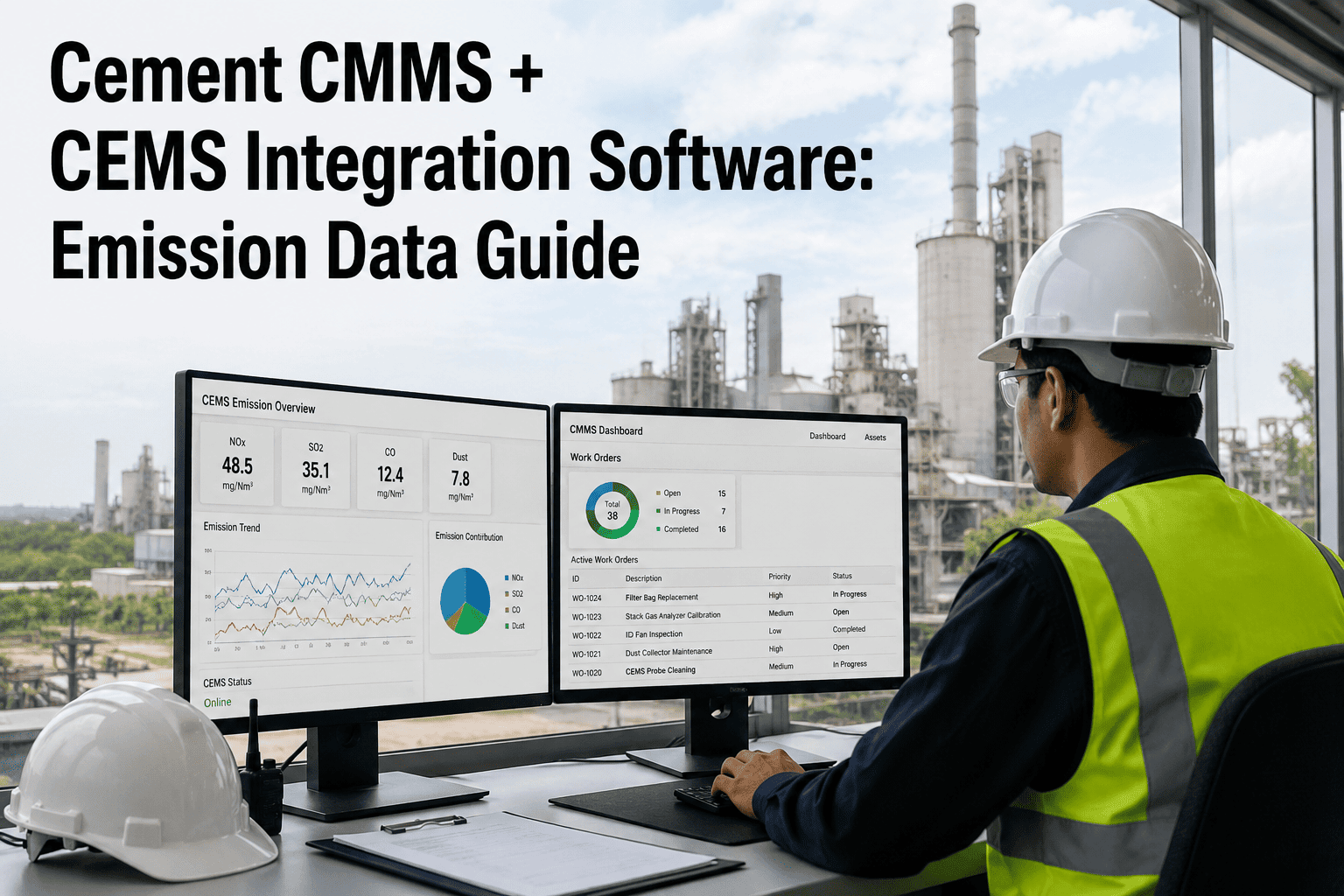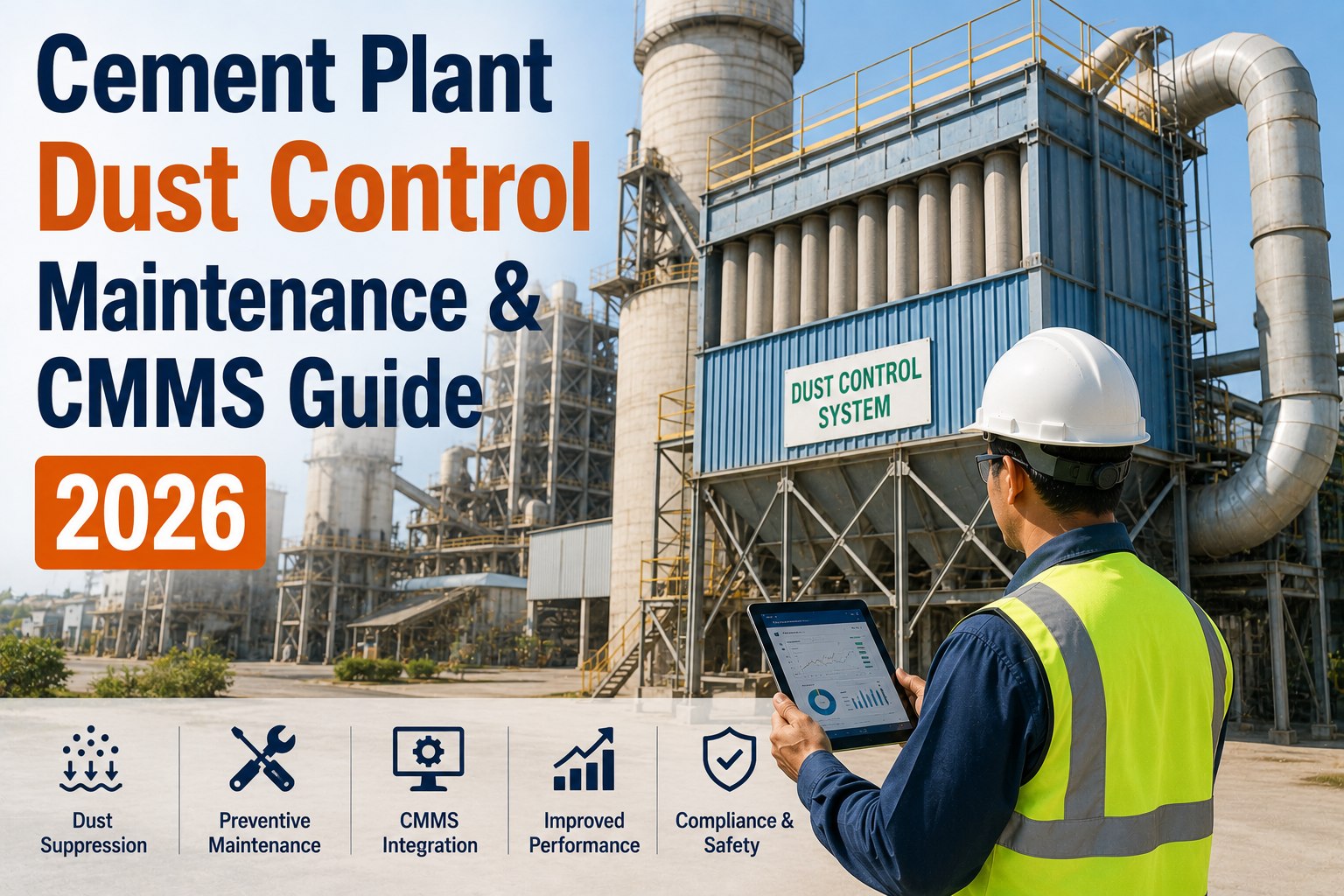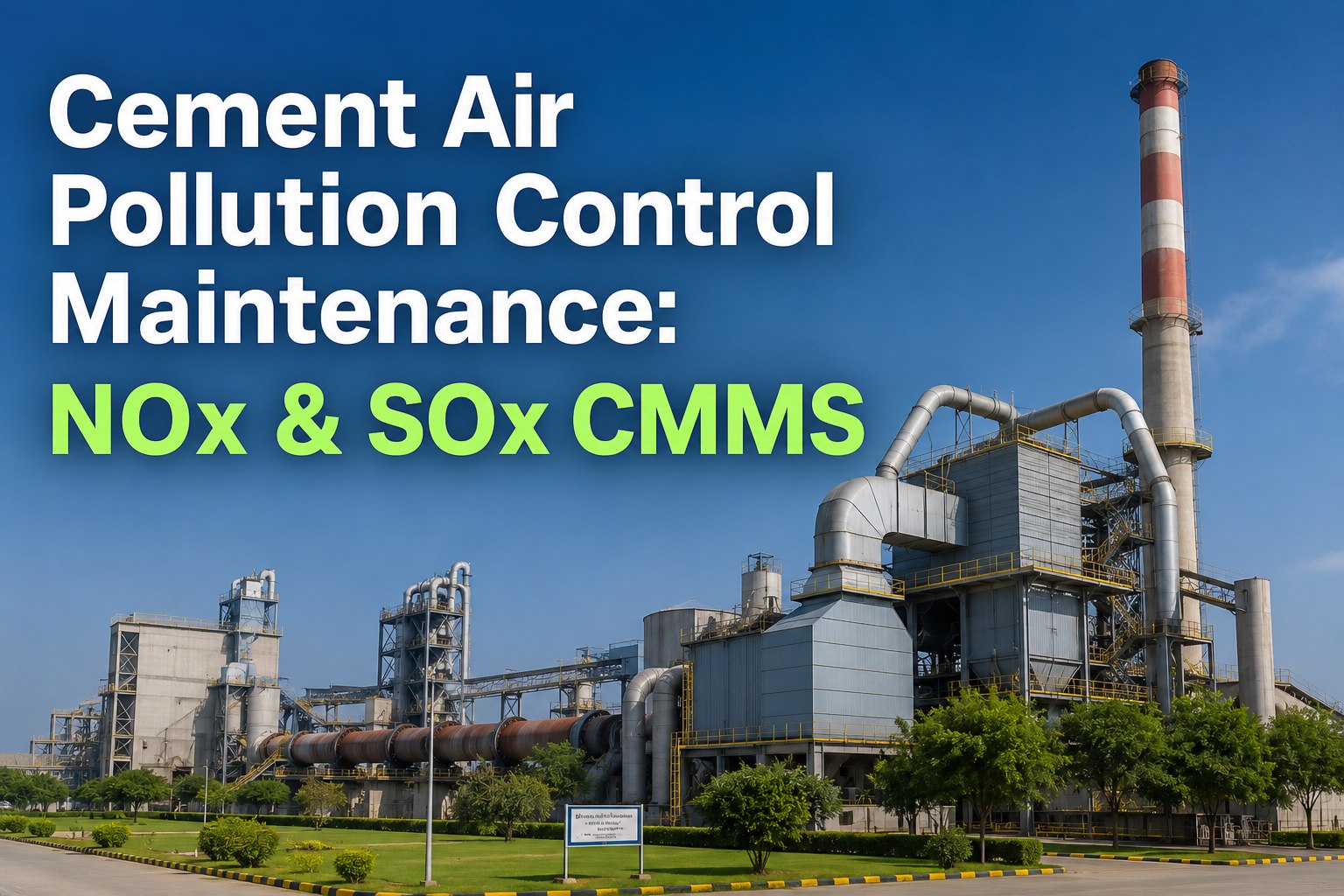
Cement manufacturing runs hot, fast, and under a microscope — every kiln, preheater, and raw-mill exhaust stack is measured continuously for NOx, SOx, particulate, and mercury. When an SNCR ammonia lance cokes, an SCR catalyst bed deactivates, or a CEMS drifts out of calibration, the plant does not just risk a notice of violation; it risks production curtailment, permit review, and six-figure monthly penalties. A CMMS built for emission-critical asset care turns reactive scramble into defensible, time-stamped compliance. Modern cement air pollution control maintenance programs now pair condition-based PM with continuous monitoring data so NOx and SOx limits stay inside permit bands 24/7. You can Start Free Trial to stand up the workflow in days, not quarters.
Can your cement plant prove compliance at 3 a.m. on a Saturday?
SNCR reliability, SCR catalyst health, scrubber chemistry, and CEMS calibration define whether your stack stays inside permit limits — or triggers a rolling 30-day emission exceedance. A CMMS-driven air pollution control program turns every PM, work order, and calibration into a defensible, audit-ready record.
Four control systems, one CMMS backbone
A mid-size 1.8 MTPY cement plant typically runs four parallel air-pollution-control trains. Each has different failure modes, PM cadences, and regulatory signatures — but all feed the same CEMS and the same permit.
SNCR — NOx Reduction
Ammonia or urea injection at 850–1,050°C in the preheater. Targets 30–50% NOx reduction. Failure mode: lance coking, nozzle plugging, NH₃ slip.
SCR — Catalytic NOx
TiO₂/V₂O₅ catalyst beds delivering 70–90% NOx removal. Failure mode: catalyst poisoning by alkali metals, blinding, pressure-drop creep.
SOx Scrubber
Wet or semi-dry lime/limestone absorption targeting 90–95% SO₂ removal. Failure mode: scaling, reagent feed drift, mist eliminator fouling.
CEMS — Monitoring
Continuous stack analyzers for NOx, SO₂, CO, O₂, opacity. Failure mode: drift, sample-line condensation, calibration gas expiry.
SNCR, SCR & scrubber PM tasks that keep NOx and SOx inside permit
Each task below should live as a triggered work order inside the CMMS — not a paper checklist taped to a control-room wall. Tie every completion record to a CEMS reading and you have an audit-defensible chain.
- Inspect and clean ammonia/urea injection lances — remove coking deposits
- Verify nozzle spray pattern at full flow; log atomization pressure
- Check NH₃ slip at stack — trend above 10 ppm triggers reagent tuning
- Calibrate flow meters on reagent delivery skid
- Measure pressure drop across each catalyst layer — flag +15% over baseline
- Pull core sample for activity test — target >80% of design DeNOx activity
- Inspect ammonia injection grid (AIG) for plugging and maldistribution
- Soot-blow or sonic-horn clean upstream of bed to reduce blinding
- Log scrubber inlet/outlet SO₂ delta — confirm ≥90% removal efficiency
- Inspect mist eliminator blades for scaling and carryover
- Test slurry pH, density, and reagent feed rate against setpoint
- Open and descale spray header nozzles — document flow uniformity
- Run daily zero/span calibration on all gas analyzers — log drift <2.5%
- Check sample line heat trace for cold spots causing condensation
- Verify activated-carbon or brominated-PAC injection for Hg control
- Confirm CGA audit (quarterly) and RATA (semi-annual) are scheduled
A 1.8 MTPY kiln, four lances, and a $214K near-miss
Consider a 5-stage preheater kiln rated at 2,800 t/day. At full load, NOx leaving the preheater is ~1,100 mg/Nm³. The SNCR system must hold stack output under 500 mg/Nm³ to satisfy the plant's PSD permit.
In this scenario, two of four injection lances had been slowly coking for 11 days. The CMMS PM was paper-based and overdue. NOx climbed to 540 mg/Nm³ for 3 hours and 50 minutes — ten minutes short of a reportable exceedance. The plant estimated $214K in avoided penalty, but only because operations caught it during a shift handover. With a CMMS triggering lance inspection at the 14-day mark and auto-correlating CEMS trend data, the drift would have been flagged at day 7.
| Metric | Paper-Based PM | CMMS-Driven PM | Delta |
|---|---|---|---|
| Lance inspection compliance | 62% on-time | 97% on-time | +35 pts |
| Avg. NH₃ slip detection lag | 6–9 days | <24 hours | −85% |
| CEMS drift incidents per year | 14 | 4 | −71% |
| Audit prep time (annual) | 120 hrs | 22 hrs | −82% |
| Estimated annual penalty exposure | $185K | $28K | −85% |
Five building blocks of a defensible emissions-control program
A CMMS does not replace your environmental engineer — it multiplies them. These five modules, working together, convert continuous monitoring data into triggered maintenance action.
CEMS-Triggered Work Orders
When NOx, SO₂, or opacity deviates beyond a configurable band for a defined duration, the CMMS auto-generates a corrective work order against the responsible asset — SNCR skid, SCR layer, or scrubber — with the CEMS tag, timestamp, and deviation magnitude embedded.
Meter-Based & Calendar PM
Lance cleaning every 14 days, catalyst sampling every 90 days, scrubber descale every 30 days — each tied to kiln operating hours or calendar trigger, with auto-escalation if a PM is missed by more than 10% of its interval.
Reagent & Spare Tracking
Ammonia, urea, lime, limestone, PAC, and calibration gases are tracked as critical spares with min/max levels. The CMMS flags low stock against upcoming PM demand so a reagent shortage never causes an uncontrolled emission event.
Audit-Ready Record Chain
Every work order, calibration, inspection, and corrective action is time-stamped, technician-attributed, and linked to the CEMS data point that triggered it. Export a permit-specific report in under 60 seconds for any date range.
Predictive Catalyst & Lance Health
Trend pressure drop, activity test results, and NH₃ slip over time to forecast SCR catalyst replacement 6–12 months ahead and lance replacement before failure — eliminating the surprise shutdown that costs $40K–$90K per day in lost clinker.
The regulatory pressure behind every work order
Cement plants operate under overlapping federal, state, and permit-specific limits. A CMMS that maps each PM and work order to the relevant regulation makes compliance demonstrable rather than aspirational.
NESHAP for Portland Cement
Limits PM, mercury, total hydrocarbons, and HCl. Mercury cap: 43 µg/dscm. Requires continuous monitoring and monthly performance testing for affected sources.
NSPS for Cement Plants
NOx limit: 1.50 lb/ton of clinker. SO₂ limit: 0.40 lb/ton. Plants commissioned after 2008 must demonstrate continuous compliance via CEMS with quarterly CGA and semiannual RATA.
Plant-Specific Emission Caps
Many states impose tighter rolling 30-day or 24-hour limits. PSD permits often set BACT requirements for NOx and SOx that mandate specific control technology — SNCR, SCR, or both — and define allowable downtime.
CEMS QA Requirements
Defines calibration drift limits (≤2.5% of span), relative accuracy test audit thresholds (≤10% or ≤7.5% depending on standard), and recordkeeping for 3-year retention. Non-compliant CEMS data can invalidate a full compliance quarter.
Stop spending shift handovers chasing emission drift
Deploy a CMMS that turns CEMS data, PM schedules, and audit records into one closed loop — so NOx and SOx compliance is provable in minutes, not weeks.
Cement air pollution control maintenance, answered
How does a CMMS specifically reduce NOx exceedance risk at a cement plant?
A CMMS auto-triggers SNCR lance cleaning, reagent skid calibration, and AIG inspection at meter- or calendar-based intervals — so ammonia injection stays within design distribution. It also correlates CEMS NOx trends with PM completion, flagging when a missed lance clean coincides with a 5–8% drift in stack NOx. Plants using this closed loop report 60–80% fewer near-exceedance events in the first year. You can Start Free Trial to configure these triggers against your permit limits.
What is the typical PM interval for SCR catalyst inspection in cement?
Most cement SCR systems require a pressure-drop reading every 30 days, a visual layer inspection every 90 days, and a core-sample activity test every 12–18 months. The CMMS should escalate replacement planning when measured activity falls below 80% of design or pressure drop rises 15% above baseline — typically 18,000–24,000 operating hours for a high-dust cement SCR.
Can the CMMS handle both wet and semi-dry SOx scrubber maintenance?
Yes. The CMMS stores asset-specific PM templates for each scrubber type — slurry pH and density checks for wet lime systems, moisture-content and reagent-feed audits for semi-dry circuits. Both share common failure-mode triggers: mist eliminator fouling, nozzle plugging, and reagent feed drift. Each task links to the CEMS SO₂ delta so removal efficiency is verifiable per work order.
How long does it take to deploy a CMMS for an existing air pollution control program?
A focused deployment — SNCR, SCR, scrubber, and CEMS assets with PM templates, spare-parts min/max, and permit-limit triggers — typically takes 3–6 weeks. The fastest path is a 30-minute scoping call to map your current PM calendar, CEMS tag list, and permit limits. Book a Demo to start that mapping this week.
What happens if CEMS drift invalidates a compliance quarter?
Under 40 CFR 60 Appendix B, excessive calibration drift (beyond 2.5% of span for gas analyzers) can trigger a data-invalidity period — during which the plant must use substitute data, often the most conservative permitted value. A CMMS that schedules daily zero/span checks, tracks drift trends, and alerts when drift exceeds 1.5% prevents the slow degradation that leads to a failed CGA or invalidated quarter.
Your next permit audit should take an afternoon, not a month
Configure SNCR, SCR, scrubber, CEMS, and mercury-control PM in one CMMS — with every work order, calibration, and deviation linked to a defensible, time-stamped record.
Free 14-day trial · No credit card