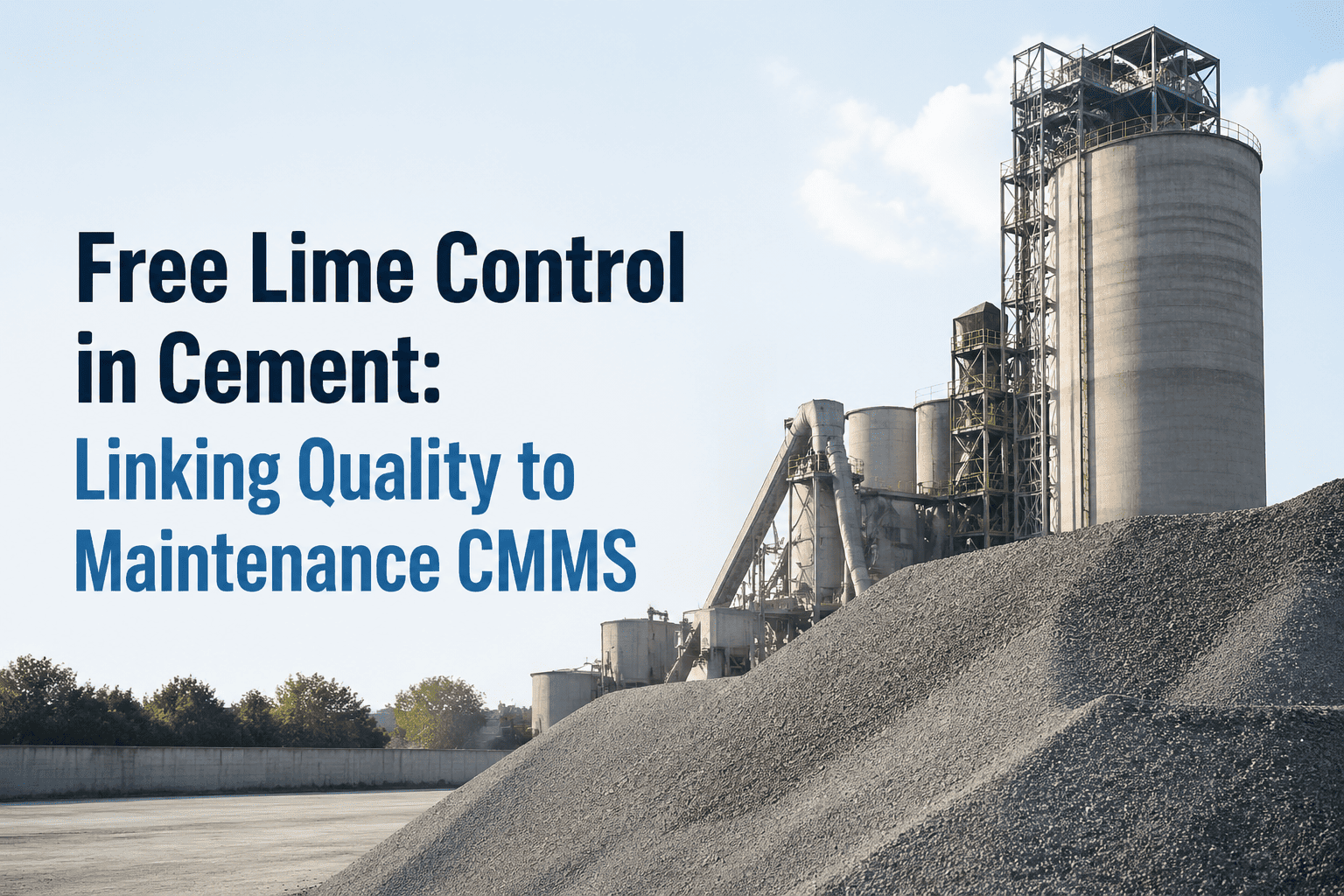
The lab posts the 6:00 AM clinker sample: free lime at 3.4% — well above the 1.5% target, soundness at risk, customer rejection looming. The control room blames the kiln operator. The operator blames the fuel quality. The fuel team blames the raw mix. The raw mix team blames the lab. By 9:00 AM, three meetings have been called, two reports drafted, and zero corrective actions taken — because nobody is looking at the right place. The actual cause sits 50 metres upstream: a worn raw meal weigh feeder belt that has been silently drifting 1.8% for the last 11 days, shifting effective Lime Saturation Factor by 0.9 points, and pushing free lime out of spec on every clinker batch. The maintenance department has the answer in its work order history — but nobody connected the lab data to the equipment record. Free lime variability is almost never a chemistry problem. It is a maintenance problem wearing a chemistry costume. Sign in to OxMaint to link your quality lab data with your maintenance records, or book a demo to see how the integration surfaces real root causes.
$480K–$920K
Annual loss on a 5,000 TPD kiln from a single drifting raw meal weigh feeder — excess fuel, rejected clinker, strength downgrade
2% drift
Raw meal feeder error that shifts LSF by 0.8–1.2 points — pushes free lime from 1.2% into the 2.5–3.5% danger zone
11 days
Typical delay between equipment-induced feed variability starting and the lab catching the resulting free lime excursion
68%
Of cement plant free lime excursions traced to upstream maintenance issues rather than process operator error or raw material variability
The Diagnostic Misdirection Map — Where Cement Plants Look for Free Lime Causes vs Where They Actually Live
Every cement plant has a familiar pattern when free lime excursions happen. Investigators look in the obvious places. The actual cause almost always sits in the place nobody thought to check — the maintenance record of an upstream feed component.
Where Investigators Usually Look
1
Kiln Operator Adjustments
Burner momentum, kiln speed, fuel rate — operator decisions in the last shift
2
Coal & Fuel Quality
Calorific value, ash content, moisture in current fuel batch
3
Raw Material Sampling
Quarry chemistry, additive ratios, recent stockpile changes
4
Lab Method Reproducibility
Sample preparation error, titration variability, instrument calibration
Where Root Cause Actually Lives
1
Weigh Feeder Drift
Load cell zero shift, belt stretch, tacho slip — invisible in SCADA
2
Discharge Valve Wear
Worn rotary feeder vanes pulsing material into kiln in uneven slugs
3
Kiln Drive & Speed Control
Drive variance changing residence time and burning-zone consistency
4
Fuel Metering Faults
Coal mill rotary feeder wear, pulverised fuel pulse delivery to kiln
The Mechanical-to-Chemical Causation Chain — How Worn Equipment Becomes a Free Lime Excursion
A bearing wears. A belt stretches. A valve loses its tolerance. None of these sound like a quality problem — yet each one ends up as elevated free lime in next morning's clinker sample. Here is the unbroken five-step chain that connects mechanical wear to chemical failure.
Step 1
Equipment Wear Begins
A rotary feeder vane wears down. A weigh feeder belt stretches over its first 400 hours. A load cell zero drifts after thermal cycling. Mechanical signatures look normal. SCADA shows no fault. Maintenance has no work order open.
Step 2
Feed Rate Becomes Inconsistent
The component reports the wrong weight or pulses material in slugs instead of streams. A 1% drift on a 5,000 TPD kiln delivers 50 unaccounted tonnes of material to the preheater every day — yet the controller's trend line looks perfectly steady.
Step 3
Kiln Feed Chemistry Shifts
Limestone, clay, and iron corrector ratios diverge from commanded targets. Effective Lime Saturation Factor moves 0.5 to 1.2 points away from setpoint. Burning zone needs more fuel to compensate, but the underlying ratio imbalance does not correct itself.
Step 4
Calcination Becomes Incomplete
CaO that should have combined with silica and alumina to form C₃S and C₂S remains uncombined. The clinker leaves the burning zone with elevated free CaO. The cooler quench freezes the chemistry where it stands — no further reaction is possible.
Step 5
Lab Report Surfaces the Damage
Free lime tests at 2.5% to 3.5%. Soundness at risk. Cement strength drops. The lab call goes to operations — but the cause has been wearing in the maintenance department's blind spot for two weeks. By the time it surfaces, weeks of clinker may need re-blending or rejection.
Step 6
Investigation Misfires
Operations checks fuel quality, raw mix, kiln operator log — finds nothing actionable. The equipment record is never opened because nobody links the lab data to the maintenance system. The drift continues. Free lime stays elevated until the next planned outage forces a calibration check.
OxMaint · Quality–Maintenance Integration
Stop investigating free lime excursions in the lab. The answer is in your maintenance record. OxMaint links work orders, calibration history, and lab data so root causes surface in hours — not weeks.
Six Maintenance Failures That Cause Most Free Lime Excursions in Cement Plants
These are the upstream equipment problems that produce the largest share of free lime variability — and the maintenance work orders that catch them before the lab does.
01 · Raw Meal Weigh Feeder Drift
A 1% to 2% feeder drift moves effective LSF by 0.8 to 1.2 points without showing up in the daily mass balance. Load cell zero shift, belt stretch, and tacho slip are the most common drift sources.
CMMS Workflow
Calibration scheduled by drift rate per feeder, not calendar. Material test runs logged. Belt tension and load cell zero verified after every shutdown. Drift trend visible per feeder against lab LSF results.
02 · Worn Discharge Valve Vanes
Rotary discharge valves at silo bottoms wear unevenly, allowing material to pulse through in slugs rather than steady streams. The kiln receives bursts of feed instead of consistent flow — burning zone temperature swings and free lime climbs.
CMMS Workflow
Vane inspection per planned outage. Wear measurement logged with photo evidence. Replacement scheduled before clearance exceeds spec. Linked to clinker free lime trend for correlation analysis.
03 · Coal Mill Feeder & Fuel Flow
Worn coal mill rotary feeders pulse pulverised fuel to the kiln burner. The flame temperature oscillates between fuel-rich and fuel-lean conditions. Burning zone never stabilises — partial combustion drives elevated free CaO at the discharge.
CMMS Workflow
Coal feeder calibration tied to fuel batch changes. Vibration analysis on rotary feeders monthly. Fuel flow stability index logged hourly and correlated to free lime lab results.
04 · Kiln Drive Speed Variation
Drive gearbox wear and motor current irregularities cause kiln rotation speed micro-variations. Material residence time becomes inconsistent — some clinker gets enough burning time, some does not. Free lime variability follows kiln speed variability with a 30-minute lag.
CMMS Workflow
Kiln drive vibration monitored continuously. Motor current profile logged per shift. Speed variance tracked alongside hourly free lime lab samples to expose timing relationships.
05 · Raw Mill Separator Wear
A worn separator allows coarse raw meal particles to pass through. Coarser feed needs more burning time to fully calcinate. The kiln cannot compensate beyond its thermal limit, so unburnt CaO leaves the burning zone as free lime.
CMMS Workflow
Separator efficiency measured monthly via Blaine fineness sampling. Wear inspection at planned outages. Fineness trend correlated with free lime — coarser feed correlates directly with higher free lime.
06 · Kiln Seal & False Air Ingress
Worn inlet and outlet seals allow false air to enter the kiln. Combustion control becomes erratic, oxygen levels swing, and flame intensity drops. Burning zone temperature falls below the threshold for complete CaO combination — free lime rises by 0.3 to 0.8 points within hours.
CMMS Workflow
Seal inspection scheduled at every planned stop. False air measured via O₂ profile across kiln. Seal replacement triggered when O₂ delta exceeds threshold rather than waiting for failure.
The CMMS–Lab Integration Loop — How Quality Data and Maintenance Data Become One Diagnostic System
Lab data alone cannot diagnose free lime variability. Maintenance data alone cannot either. The diagnostic power emerges when both feeds correlate in the same system — and OxMaint structures the loop so root causes surface in real time.
A
Lab Free Lime Logged
Every clinker free lime test from the QC lab — typically every 2 hours — flows into OxMaint as a tagged quality data point with timestamp, sample location, and operator ID.
B
Equipment Records Aligned
For each free lime data point, the system pulls maintenance status of upstream equipment over the preceding 12 to 48 hours — calibration overdue, vibration trending, work orders open, recent component changes.
C
Correlation Detected
When free lime trends out of spec while a specific maintenance condition is active, the system flags the correlation. Process engineer and maintenance manager both see the same alert with both data feeds attached.
D
Root Cause Logged
The work order that resolves the equipment issue is logged with its quality impact attached — free lime returned to spec within X hours of the repair. Pattern building begins for predictive prevention next time.
Free Lime Symptom Decoder — Pattern of Excursion Reveals the Mechanical Source
Free lime does not just spike or stay flat — it follows distinct patterns depending on which upstream component is at fault. Reading the pattern points directly to the maintenance work order that should be opened.
| Free Lime Pattern |
Behaviour |
Likely Mechanical Source |
CMMS Action Triggered |
| Slow Linear Rise |
Free lime climbs 0.1–0.2% per day over 1–2 weeks |
Weigh feeder load cell drift or belt stretch |
Calibration work order, belt tension check |
| Step Change Up |
Free lime jumps 0.5–1.0% in a single shift, then steady |
Impact weigher failure, valve vane breakage, sudden component change |
Emergency inspection, post-event verification |
| Oscillating Pattern |
Free lime swings 0.4–0.8% every 30–60 minutes |
Tacho slip, kiln drive variance, rotary feeder wear |
Vibration analysis, drive inspection |
| Shift-Boundary Spikes |
Free lime spikes at every shift change, recovers within 2 hours |
Operator-driven feed adjustment masking equipment fault |
Cross-shift consistency review with maintenance |
| Post-Outage Drift |
Free lime climbs gradually after every planned shutdown |
Recalibration not performed, restart-induced zero shift |
Post-outage calibration checklist enforcement |
| Fuel-Linked Variability |
Free lime varies with coal feed rate but not with kiln conditions |
Coal mill feeder wear, fuel flow inconsistency |
Coal feeder calibration, vibration check |
Scroll horizontally to view all columns on smaller screens
The Cost of Treating Free Lime as a Process Problem When It Is a Maintenance Problem
When the wrong department investigates the wrong cause, the costs compound — fuel waste, rejected clinker, customer credits, and reputational damage. These are the cost categories that disappear when CMMS and lab data are linked.
+8%
Fuel Cost Increase
Operators compensate for poor calcination by raising fuel rate. The underlying feed problem is not corrected, so the higher fuel rate becomes the new normal — until the next investigation.
15–25%
Clinker Re-Blend Volume
High free lime clinker has to be blended with low free lime stockpiles to meet shipping spec. Re-handling cost, silo capacity loss, and dispatch delays all stack up against margin.
3–6 MPa
Compressive Strength Drop
Cement made from elevated free lime clinker tests lower at 2-day and 7-day strength benchmarks. Customer rejection or grade downgrade drops the realised price per tonne.
11 days
Diagnosis Lag
Average delay between an upstream maintenance issue starting and the lab raising the alarm. Linked CMMS-lab systems shorten this to under 24 hours by surfacing equipment-quality correlations early.
OxMaint · Cement Plant Quality CMMS
Your maintenance team and your QC lab are working on the same problem from opposite ends. OxMaint connects both sides into one diagnostic loop — so free lime root causes are clear in hours, not after weeks of finger-pointing.
Frequently Asked Questions — Free Lime Quality Control via CMMS-Lab Integration
OxMaint · Free Lime Control · Cement Quality CMMS Integration
Free lime variability is the symptom. Equipment drift is almost always the cause. OxMaint connects your QC lab data with your maintenance records to surface the real root cause before another batch is rejected.
Lab data and work order alignment. Drift pattern detection. Predictive feed equipment calibration. Cross-team diagnostic alerts. All built into OxMaint's quality-integrated CMMS for cement plants.