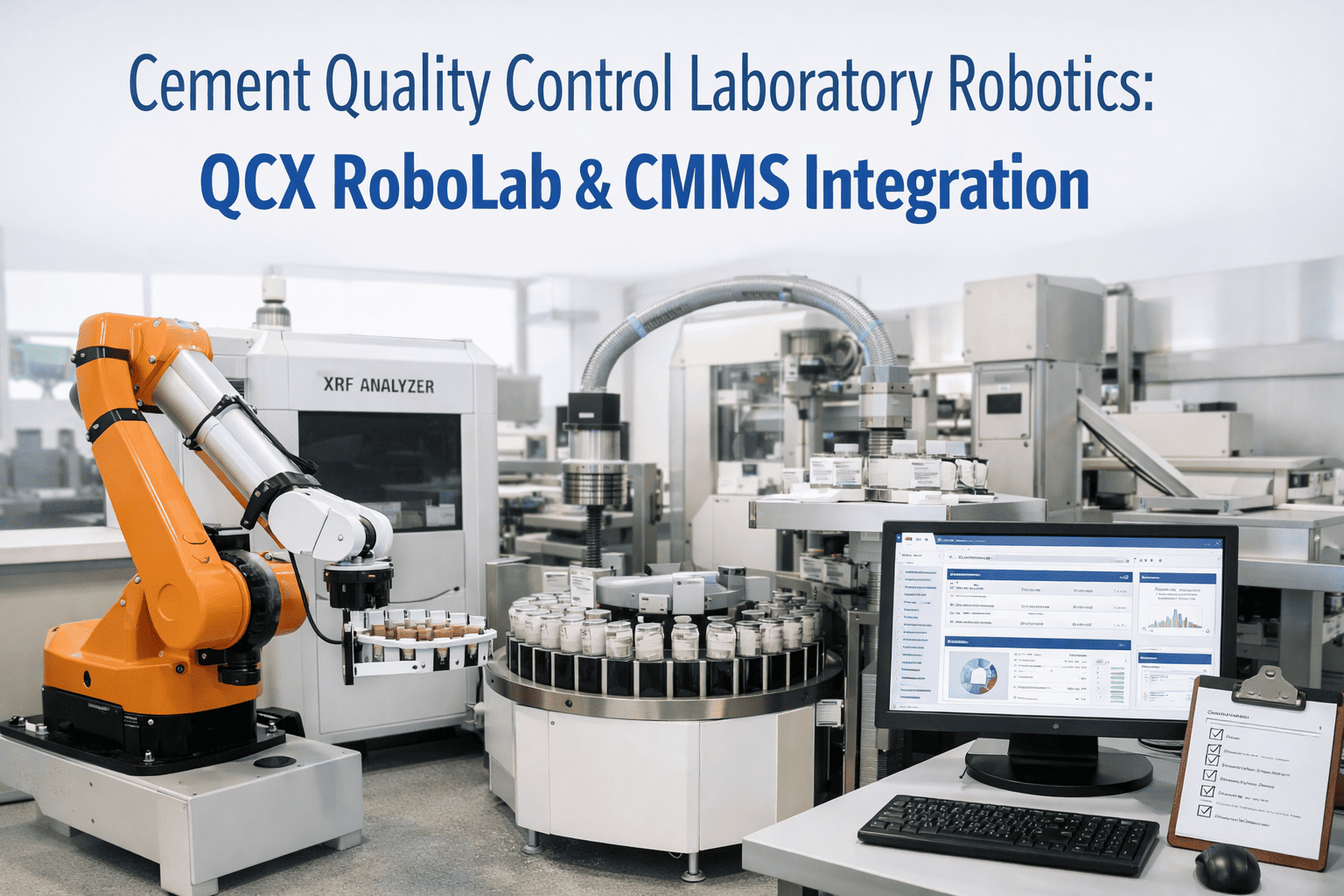
A single batch of off-spec cement can destroy months of customer trust. When 500 tonnes of OPC shipped to a ready-mix plant fails the 28-day strength test by just 2 MPa, the consequences cascade—rejected loads, rush replacement shipments, contractual penalties, and a customer who quietly shifts their next order to a competitor. Yet the production data that would have caught the problem existed the entire time: a subtle shift in clinker C₃S content that went unnoticed because the lab result sat in a spreadsheet while the kiln operator worked from a separate system. The cost of quality failure in cement isn't just the rejected batch—it's the invisible erosion of market share. Plants integrating real-time quality monitoring with their CMMS close this gap by connecting every lab result, process parameter, and equipment condition reading into a single system that catches deviations before cement leaves the plant.
2–5%
Of production is off-spec
Industry average without real-time QC
$150K+
Per quality incident
Avg. cost including reshipment & penalties
85%
Catch rate improvement
With real-time parameter monitoring
4–8 hrs
Lab result delay
Average gap without integration
Closing the loop between quality data and operational response is where CMMS integration transforms quality control from a reporting function into a prevention system. Start your free OXmaint trial to connect quality parameters with maintenance work orders and catch deviations in real time.
The Cement Production Quality Chain
Quality isn't made at the end of the process—it's built at every stage. Each checkpoint below represents a point where parameters must be monitored, controlled, and linked back to equipment condition through your CMMS.
CRITICAL
Limestone CaCO₃ content
≥76%
IMPORTANT
Clay SiO₂ / Al₂O₃ ratio
2.5–3.5
IMPORTANT
Moisture content
<8%
Incoming material variation is the #1 source of quality inconsistency. XRF sampling at intake prevents problems downstream.
CRITICAL
Raw meal LSF (Lime Saturation Factor)
93–97
CRITICAL
Raw meal SM (Silica Modulus)
2.2–2.8
IMPORTANT
Fineness (90μm residue)
<14%
Online analyzer (PGNAA/PFTNA) enables real-time raw mix adjustment. Blending silo homogeneity directly determines clinker quality consistency.
CRITICAL
Clinker free lime (f-CaO)
0.5–1.5%
CRITICAL
Clinker C₃S content
55–65%
IMPORTANT
Litre weight
1,250–1,400 g/L
Kiln burning conditions directly determine clinker mineralogy and cement strength potential. Equipment issues (burner wear, refractory loss) show up here first as quality shifts.
CRITICAL
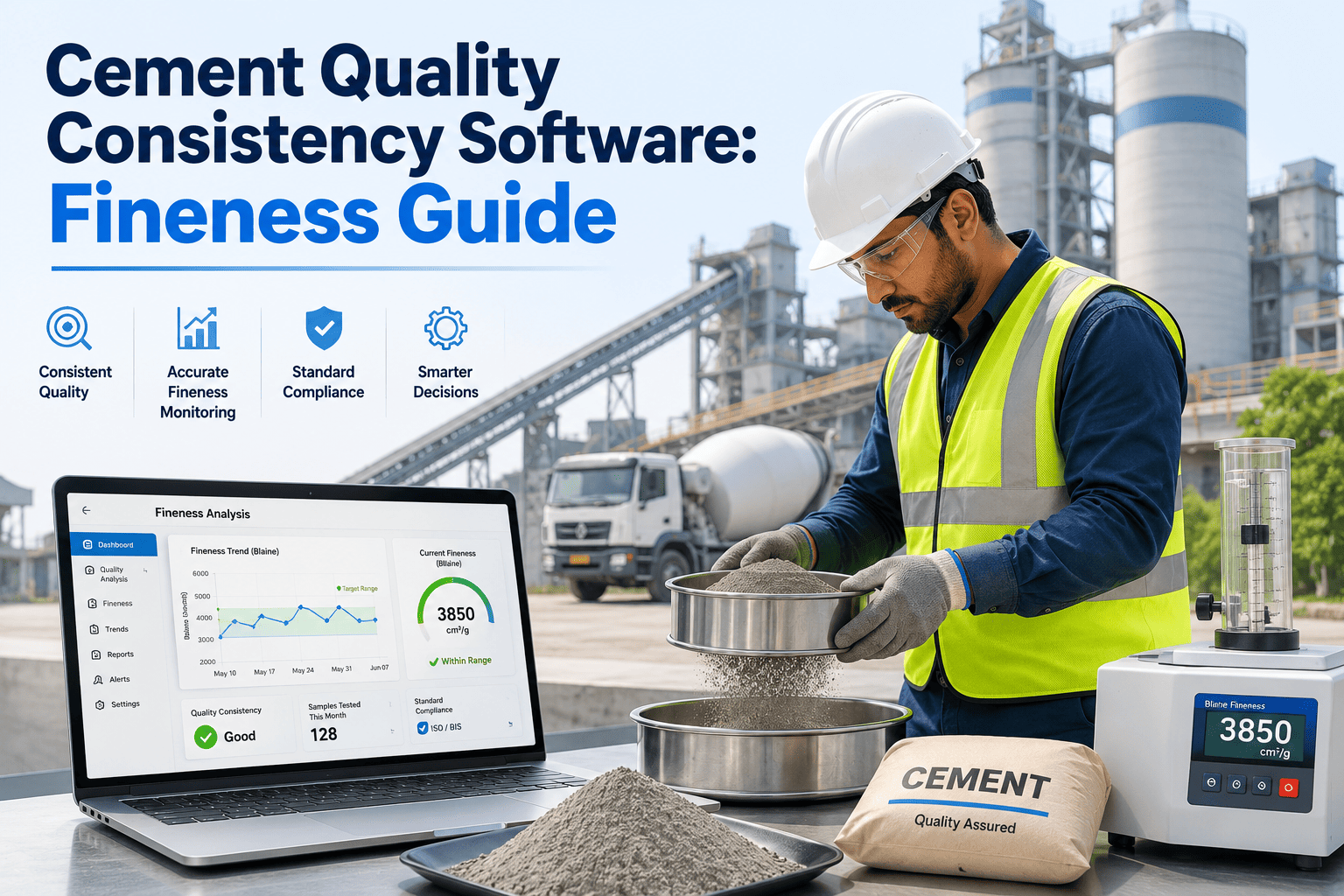
Blaine fineness
280–340 m²/kg (OPC)
CRITICAL
SO₃ content (gypsum dosage)
2.0–3.5%
IMPORTANT
45μm residue
3–8%
Separator efficiency, grinding media condition, and gypsum feeder calibration all affect final product. Worn mill liners change particle size distribution even at the same Blaine.
CRITICAL
Compressive strength (28-day)
≥42.5 MPa (OPC 42.5)
CRITICAL
Setting time (initial)
≥45 min (OPC)
IMPORTANT
Soundness (Le Chatelier)
≤10 mm
28-day results arrive too late to prevent shipment. Early strength (1-day, 3-day) and physical tests serve as predictive indicators when correlated with process data.
Digitize Your Quality Checkpoints
Link every QC parameter to equipment condition and maintenance history—catch quality drift before it reaches the customer
Cement Grade Specification Matrix
Different grades require different process targets. Managing multiple grades on the same kiln system demands precise parameter control—and the ability to switch quality targets rapidly in your monitoring system.
Catching Quality Deviations: The Early Warning System
Quality failures don't happen suddenly—they develop through a predictable sequence of parameter drift. The key is detecting deviation at Level 1 or 2, long before off-spec product reaches a silo.
LEVEL 1 — Trend Drift
Parameter moving within spec but trending toward limit. Example: Blaine rising from 310 to 330 m²/kg over 8 hours while target is 280–340.
Automated Response
CMMS logs trend alert → Notification to shift QC engineer → Operator checks separator settings and mill feed rate → No work order unless trend persists >4 hours
LEVEL 2 — Parameter Excursion
Parameter breaches spec limit. Example: Free lime jumps from 1.2% to 2.1% (spec ≤1.5%). Clinker is still usable but quality margin is eroding.
Automated Response
CMMS creates priority work order → QC and production leads notified → Root cause investigation triggered → Affected silo flagged for additional testing before dispatch
LEVEL 3 — Quality Hold
Multiple parameters out of spec or single critical failure. Example: 28-day predicted strength below grade minimum based on early strength correlation.
Automated Response
CMMS locks dispatch from affected silo → Plant manager & quality head alerted → Emergency investigation work order → Material held until confirmation testing or regrading decision
The 4-hour rule: In cement production, there is typically a 4–8 hour lag between when a process deviation occurs and when lab results confirm it. Plants with real-time process monitoring close this gap to under 30 minutes—catching issues while they're still correctable rather than after 200+ tonnes of off-spec material has been produced.
When Equipment Problems Become Quality Problems
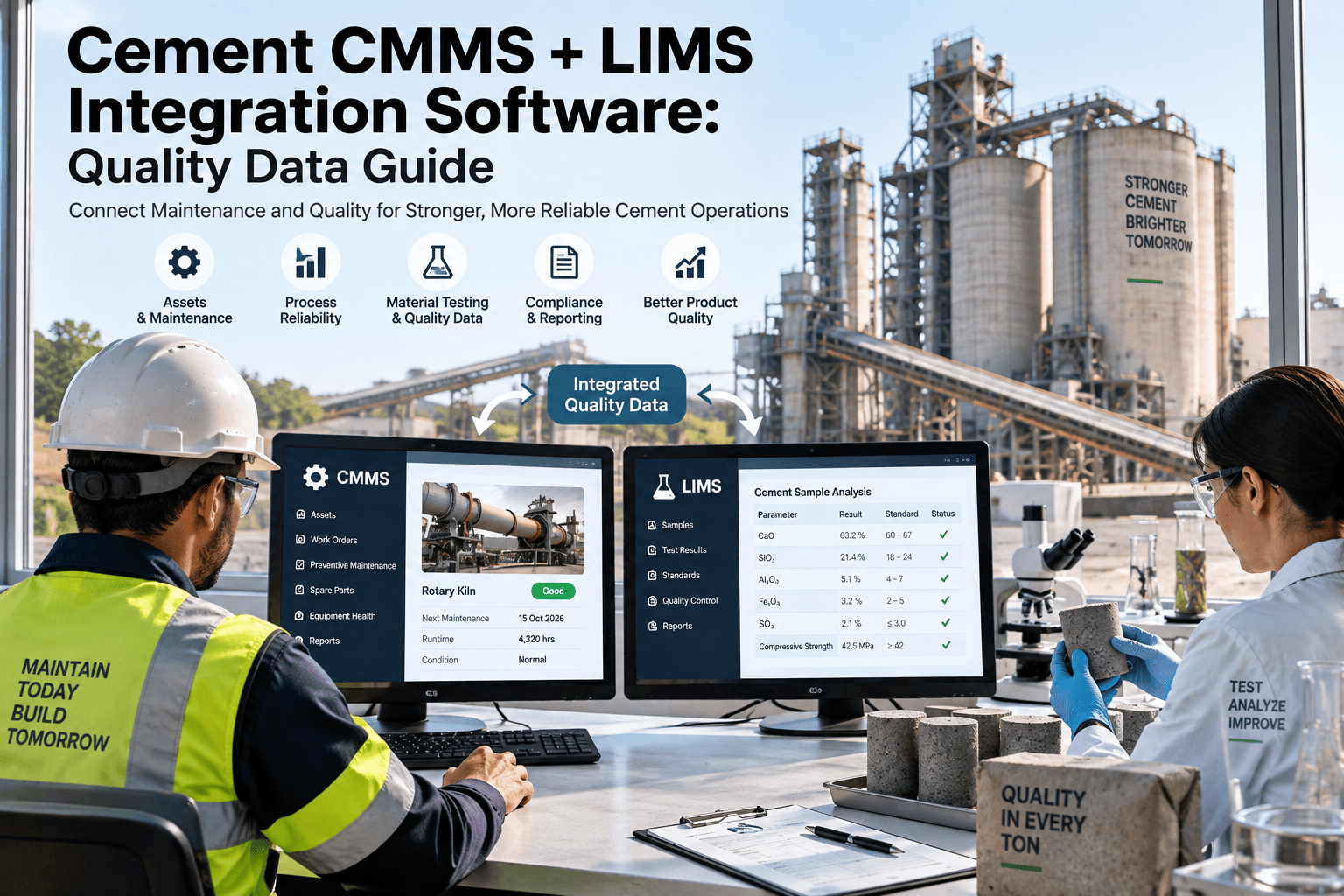
Every quality deviation has a root cause, and that root cause is almost always an equipment condition or process setting that maintenance should have caught. This is where CMMS-QC integration delivers its highest value.
Raw Mill Separator
Worn vanes / incorrect speed
Raw meal fineness drift
Coarser particles → incomplete calcination → higher free lime → lower 28-day strength
Kiln Burner
Worn tip / misaligned nozzle
Clinker C₃S inconsistency
Poor flame shape → uneven burning → variable mineralogy → unpredictable strength development
Gypsum Feeder
Calibration drift / belt slip
SO₃ out of range
Under-dosing → flash set risk. Over-dosing → false set → customer complaints about workability
Cement Mill Internals
Worn liners / depleted grinding media
Particle size distribution shift
Broader PSD → lower early strength → may meet Blaine spec but fail strength test at 3/7 days
Blending Silo Aeration
Failed air slides / plugged nozzles
Raw meal homogeneity failure
Unmixed layers → batch-to-batch chemistry variation → erratic clinker quality → inconsistent cement
Online Analyzer (PGNAA)
Detector degradation / calibration drift
False confidence in raw mix control
Analyzer shows on-spec while actual chemistry drifts → silent quality erosion detected only at clinker stage
Plants that track equipment condition and quality data in the same CMMS can automatically correlate maintenance events with quality shifts—building an institutional knowledge base that prevents repeat failures. Sign up for free to start linking your quality data to equipment health today.
Connect Quality Data to Equipment Health
Auto-generate work orders from quality deviations, track root causes, prevent repeat failures—no credit card required
Quality KPIs That Drive Continuous Improvement
Cpk (Process Capability Index)
Target: ≥1.33
Measures how well the process stays within spec limits. Cpk <1.0 means the process regularly produces out-of-spec material. Track per parameter, per grade.
Statistical measure of defect rate. Most cement plants operate at 3σ (6.7% defect rate). World-class operates at 4σ+ (<0.6%). Track for 28-day strength results.
Quality Incident Rate
Target: <2/month
Count of events where product was held, downgraded, or rejected. Each incident should generate a CMMS root cause investigation linked to equipment history.
Strength Margin Over Spec
Target: 3–5 MPa
Average 28-day strength minus grade minimum. Too low (<2 MPa) risks failures. Too high (>8 MPa) means over-burning and wasting fuel/clinker for unnecessary quality.
Lab-to-Action Response Time
Target: <30 min
Time from deviation detection to corrective action initiation. Best plants close this loop in real time via automated CMMS alerts. Industry average is 4–8 hours.
First-Pass Quality Rate
Target: ≥98%
Percentage of production that meets spec without rework, blending correction, or regrading. The ultimate measure of quality system effectiveness.
Building the QC–CMMS Integration Architecture
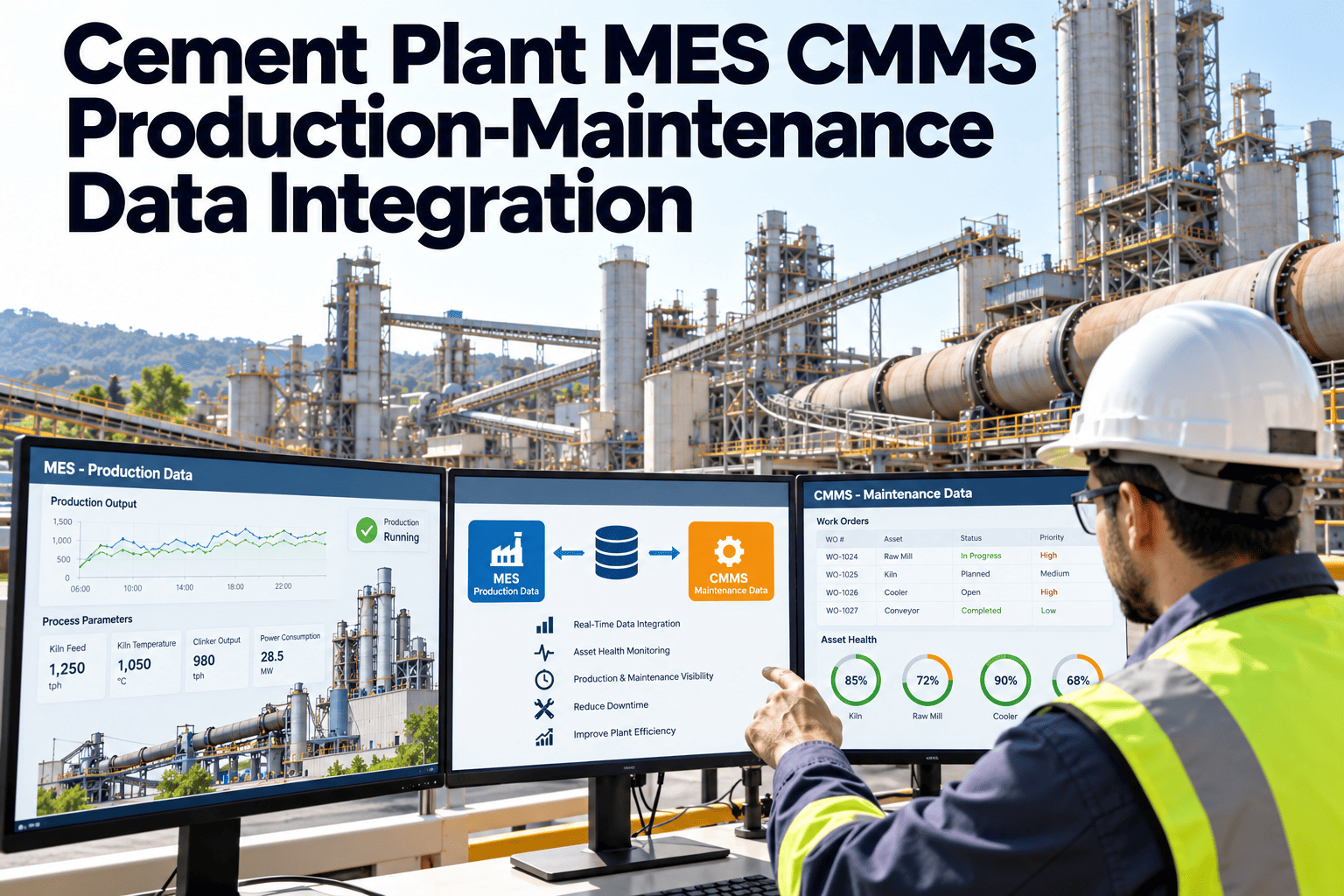
The most common failure in quality management isn't a testing gap—it's a data gap. Lab systems, process historians, and maintenance platforms operate in silos, making root cause analysis manual and slow.
Data Sources
Online Analyzers
(XRF, PGNAA)
Lab Results
(LIMS)
Process Data
(DCS / PLC)
Equipment Sensors
(Vibration, Temp)
Integration Hub
CMMS Platform (OXmaint)
Asset health tracking
Work order automation
Quality parameter logging
Root cause analysis
Trend analytics
Automated Outputs
Deviation Alerts
Real-time notifications
Auto Work Orders
Linked to quality events
Quality Reports
SPC charts & dashboards
Implementation priority: Start with the highest-value connection first—link clinker free lime results to kiln maintenance records. This single integration typically reveals 60% of the equipment-quality relationships in a cement plant. Add mill quality parameters next, then expand to raw material intake.
Frequently Asked Questions
What is the most important quality parameter to monitor in real time?
Clinker free lime (f-CaO) is the single most important real-time indicator because it reflects burning conditions in the kiln and directly predicts 28-day cement strength. Free lime above 1.5% signals under-burning, while consistently below 0.5% indicates over-burning and wasted fuel. Online XRD analyzers can provide free lime readings every 10–15 minutes.
How does equipment condition affect cement quality?
Equipment degradation is a hidden driver of quality variation. Worn cement mill liners change particle size distribution even when Blaine fineness appears stable. A drifting gypsum feeder causes SO₃ excursions that affect setting time. Degraded burner tips create uneven burning that varies clinker mineralogy. Integrating equipment health data with quality results in a single CMMS reveals these cause-and-effect relationships.
What is an acceptable strength margin over specification?
A 3–5 MPa margin above the grade minimum provides a safety buffer against normal process variation while avoiding excess cost. Margins below 2 MPa risk customer failures from batch-to-batch variation. Margins above 8 MPa indicate over-burning or over-grinding—wasting fuel and grinding energy to produce unnecessary quality that customers don't pay for.
How long does it take to detect a quality problem without real-time monitoring?
Without real-time integration, the typical detection timeline is 4–8 hours for lab-tested parameters and up to 28 days for strength results. During that delay, a cement plant producing 200 tonnes/hour can generate 800–1,600 tonnes of potentially off-spec material. Real-time process monitoring with automated alerts reduces detection to under 30 minutes.
What is Cpk and why does it matter for cement quality?
Cpk (Process Capability Index) measures how well your production process stays within specification limits, accounting for both the process spread and its centering. A Cpk of 1.0 means the process barely fits within spec; 1.33 provides a reasonable safety margin; and 1.67+ represents excellent control. Tracking Cpk for key cement parameters tells you whether your process is capable of consistent quality or just getting lucky.
How does a CMMS integrate with quality management?
A CMMS integrates with quality management by linking equipment maintenance records to quality outcomes. When a quality deviation occurs, the CMMS can automatically generate an investigation work order, pull up recent maintenance history for the relevant equipment, and correlate the deviation with any recent equipment changes. Over time, this builds a database that predicts which maintenance issues cause which quality problems—enabling preventive action.
Ready to Build a Zero-Defect Quality System?
Get started in under 10 minutes. Free forever for small teams.