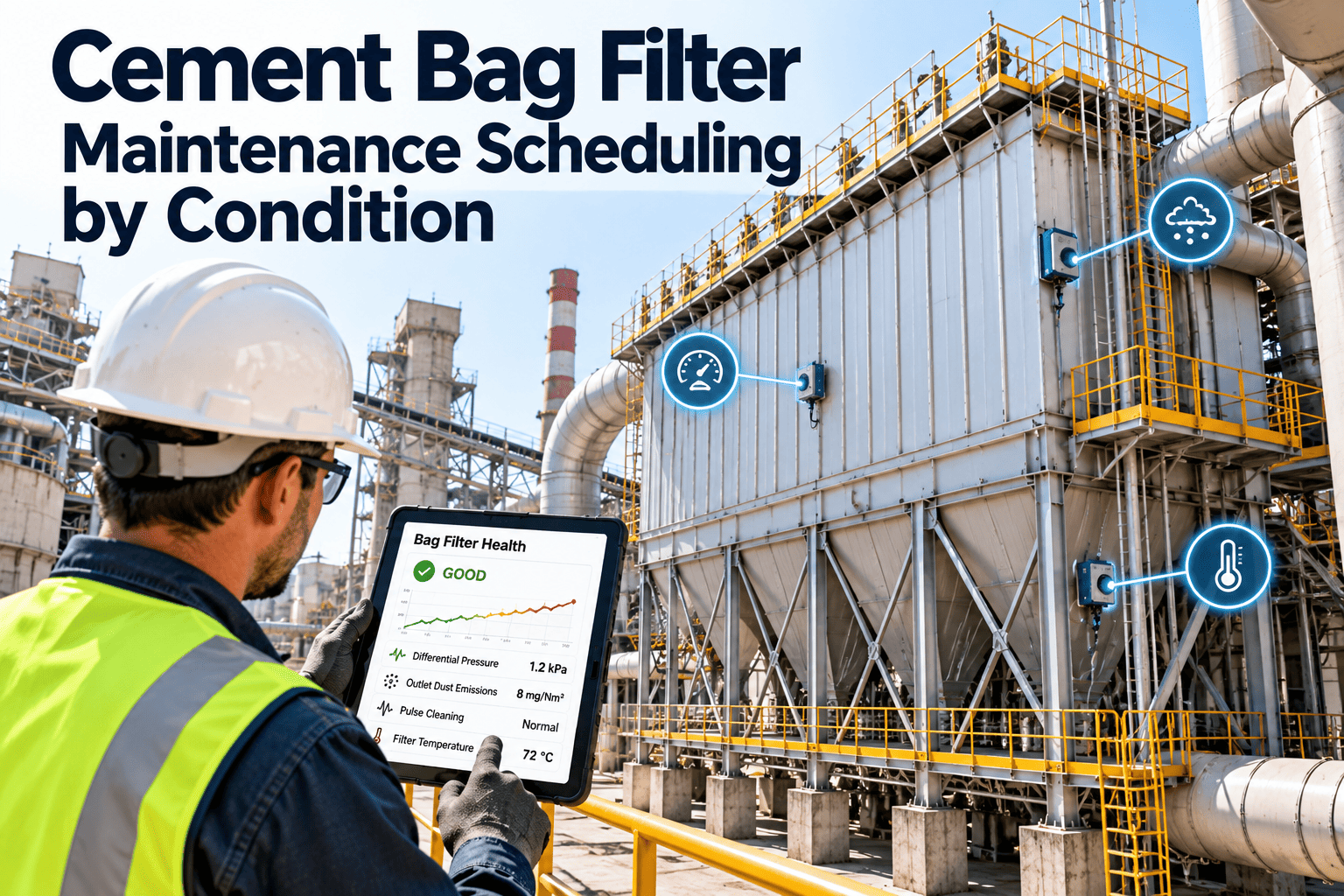
Bag filters control dust at kiln lines, mills, coolers, silos and transfer points, and their maintenance is often locked to a calendar. Bags are changed on a fixed date even when they still perform, or left too long because the date has not arrived while pressure drop and stack readings already point to trouble. Condition-based scheduling replaces the calendar with evidence from the filter itself. This guide shows which signals to watch, how to turn them into triggers and work orders, and how Oxmaint can keep the whole sequence organized.
Cement Bag Filter Maintenance Scheduling by Condition
Dust collectors: let differential pressure, pulse behavior and emissions drive the job list
Move from fixed bag change dates to triggers based on how each filter is actually performing.
Read signal
then
Compare to trigger
then
Raise work order
then
Confirm result
Time-based versus condition-based filter care
Calendar schedule
- Bags replaced at a set age or interval
- Healthy bags removed too early at some units
- Fast-wearing units fail before the date
- Little link to emissions results
vs
Condition triggers
- Work raised when readings cross defined limits
- Bag life reflects real dust load and temperature
- Early leaks found from trend changes
- Maintenance evidence tied to emission records
Signals that tell you what the filter needs
| Signal | What a change may mean | Typical trigger action |
|---|---|---|
| Differential pressure rising over time | Bags blinding, dust cake not releasing, moisture or fines | Inspect cleaning system, review bag condition |
| Differential pressure falling unexpectedly | Torn or detached bags, leaking seals | Leak check and bag inspection |
| Pulse valve cycle count or timing | Failed valve, diaphragm wear or controller fault | Test valves, replace diaphragms |
| Compressed air pressure | Weak cleaning pulse, moisture in lines | Check receiver, dryer and drains |
| Stack opacity or dust monitor | Bag leaks reaching the stack | Find the leaking compartment |
| Inlet gas temperature | Overheating or dew point risk for the bag material | Review process conditions and protection |
| Hopper and screw conveyor condition | Blocked discharge, bridging, dust re-entrainment | Clear and inspect discharge system |
A trigger ladder you can configure
Watch
Reading drifts from baseline. Increase check frequency and note operating changes.
Plan
Reading stays outside the planned band. Create a work order and reserve bags, valves and diaphragms.
Act
Limit crossed or stack reading rises. Schedule the first safe window and isolate the compartment.
Set bands from the supplier guidance, your permit conditions and your own history. Thresholds differ by filter size, bag material and process.
Planning the compartment-level job
1
Isolate and confirm
Use lockout and confirm the compartment is safe before entry.
2
Locate the leak or fault
Inspect tube sheets, cages, seals and bags, recording what was found.
3
Replace and reseat
Fit matching bags and cages and check seating carefully.
4
Verify performance
Confirm differential pressure and stack reading return to normal.
Schedule filter work from real readings
Oxmaint supports condition-based tasks, work orders, inspections and spare parts tracking for dust collection equipment.
Records that support environmental compliance
Keep per filter
- Bag type, installed date and compartment history
- Differential pressure and stack reading trends
- Leak findings and corrective actions
- Pulse valve and compressed air checks
Why it matters
- Permits typically require proof that controls are maintained.
- Repeat failures reveal bag material, temperature or moisture issues.
- Shows regulators and auditors a managed program.
KPIs for bag filter performance
Bag life by unit
Run hours or months before replacement, compared across filters.
Time to repair a leak
Hours from alert to verified fix.
Emergency versus planned filter jobs
Share of work that was triggered early.
Pulse system faults
Valve and controller failures per period.
Why cement bag filters wear differently from unit to unit
Process conditions
- Kiln and clinker cooler filters see high gas temperatures and fluctuations that stress fabric.
- Raw mill and coal mill filters deal with moisture, fine dust and, for coal, fire and explosion risk.
- Cement mill and silo filters handle very fine product that can blind the cloth.
- Transfer point filters run in lower temperatures, but carry abrasive dust from crushers and conveyors.
What that means for scheduling
- A single bag life figure for the whole plant hides real differences between units.
- Triggers and bands should be set per filter, using its own history.
- Process changes such as a new fuel, a lower kiln feed or wet weather alter filter behavior and should be recorded alongside the readings.
Common bag filter failure modes and the signals that reveal them
| Failure mode | Early evidence | Typical root cause | Preventive control |
|---|---|---|---|
| Bag blinding | Differential pressure creeping up with weaker airflow | Moisture, fine dust, weak cleaning pulse | Dew point control, cleaning system checks, dry compressed air |
| Bag abrasion or tears | Differential pressure drop and stack opacity rise | Dust jets from inlet, cages with sharp edges, over-cleaning | Inlet baffles, cage inspection, pulse tuning |
| Thermal damage | Brittle or shrunken fabric and rising leak rate | Temperature excursions above fabric rating | Temperature alarms, bypass or cooling, correct fabric choice |
| Seal and gasket leaks | Visible dust at doors and tube sheet | Hardened gaskets and loose clamps | Periodic seal inspection and replacement |
| Pulse valve failure | Uneven cleaning across rows, local pressure rise | Diaphragm wear, solenoid fault, dirty air | Valve testing and diaphragm replacement by cycle count |
| Hopper bridging | High level alarms and dust re-entrainment | Moisture, poor hopper heating or vibration | Heating, vibrators and discharge checks |
Building trigger bands filter by filter
1
Collect a clean baseline
After a bag change, record differential pressure at normal load, compressed air pressure and stack readings for several weeks.
2
Account for load and season
Differential pressure rises with airflow and humidity. Compare readings at similar kiln or mill load, or you may chase false alarms.
3
Set watch, plan and act bands
Use supplier limits, permit conditions and your history, then review the bands after each bag change.
4
Review false alarms
If a trigger fires too often without a finding, adjust it. If a failure occurs without a trigger, add the missing signal.
Routine inspections that complement the data
Every shift
Check differential pressure, compressed air pressure, hopper levels, screw conveyor operation and any visible dust at the stack or around the unit.
Weekly
Listen to the pulse valves, drain moisture from air receivers and traps, and check the rotary valves and screw conveyors for wear or blockage.
Monthly or per cycle count
Inspect door seals, test a sample of pulse valves, review stack data and look at the clean air side for dust traces that indicate a leaking bag.
Use a leak location method
When stack readings rise, isolate compartments one at a time and watch the response, or use a tracer powder or a light inspection on the clean side. Recording which compartment leaked, and which row or position, shows whether the problem is random or tied to a specific location such as the inlet side.
Safety and permit considerations
Before entry
- Isolate and lock out the fan, rotary valves and pulse system
- Confirm confined space and work-at-height permits
- Cool the compartment and ventilate it
- Control dust exposure with suitable protection
then
After the job
- Check cages, bags and seals are correctly seated
- Restore pulse sequence and test cleaning
- Confirm differential pressure and stack reading
- Record work, parts and results
Coal mill and some fuel handling filters carry fire and explosion risks. Follow your site procedures, protection systems and applicable standards for those units.
Spare parts and stock for condition-based work
Keep on hand
- A set of bags and cages for the most critical filters
- Pulse valve diaphragms, solenoids and controller cards
- Door gaskets, clamps and seals
- Rotary valve wear parts and shear pins
Why condition-based work needs stock discipline
A trigger that raises a work order is only useful if the crew can do the job. If bags are not in stores, the trigger turns into a waiting list. Link spares to each filter in the maintenance system, set reorder levels from consumption, and reserve parts as soon as a work order is planned.
More KPIs to review monthly
Filter availability
Time each filter was fully in service, excluding planned stops.
Cleaning air consumption
Changes may indicate leaking valves or over-cleaning.
Repeat leak locations
Compartments or positions with recurring problems.
Triggers with findings
Share of triggered work orders where a real defect was found.
How Oxmaint supports the routine
A CMMS can keep each filter, compartment and valve as an asset, schedule shift and weekly checks, and turn recorded readings into corrective work orders. Parts, photos and sign-offs stay with the work order, which makes permit reviews and root cause discussions much quicker.
A worked example of a condition-based decision
Day 1
Differential pressure on a cement mill filter starts rising slowly at the same mill load. The operator logs it and the system marks the filter as on watch.
Day 3
The reading stays high. A technician checks the compressed air receiver, finds water in the drain and records low pulse pressure on two rows.
Day 4
A work order is raised for the dryer and diaphragms on the affected rows. Parts are reserved and the job is planned for the next stop.
After the job
Differential pressure returns to its baseline band. The finding is logged as a compressed air moisture cause, so the dryer gets a recurring check.
The example is illustrative. The aim is to show that the fix addressed the cause, which was cleaning air quality, rather than replacing bags that were not yet worn out.
Ways teams misuse condition triggers
Treating one reading as proof
A single high differential pressure value can come from a load change, a wet day or a faulty transmitter. Confirm with a trend and a second signal before ordering a bag change.
Ignoring sensor health
Pressure transmitters and impulse lines clog with dust. A flat reading or a sudden step may be an instrument problem. Include sensor checks and calibration in the preventive plan.
Replacing bags to fix a cleaning problem
New bags will not cure weak pulses, wet compressed air or a blocked hopper. Find out why differential pressure is high before replacing media.
Skipping the verification step
Closing a work order without confirming differential pressure and stack readings means you never learn whether the fix worked.
Rolling out condition-based scheduling in stages
A
Pick pilot filters
Start with filters that have high consequence, such as the kiln or main mill filters, and with signals that are already measured.
B
Run both schedules
Keep the calendar tasks while you test condition triggers, and compare which approach found real problems first.
C
Adjust and extend
Tune the bands, remove calendar tasks that triggers made redundant and add further filters.
D
Report the results
Show bag life, emergency jobs avoided and emission stability to operations and environmental teams.
What to put in the weekly filter review
- Filters on watch, plan or act status, with the reason and the owner of each action.
- Stack readings or opacity trends for the week, and any excursions above permit levels.
- Work orders raised from triggers, how many found a real defect and how long they took to close.
- Parts reserved for the next stop and any shortage that could delay a planned job.
Keep the evidence together
Every trigger, inspection and repair should leave a record that links the reading, the finding, the parts used and the verification result. When an environmental inspector or auditor asks how a filter is maintained, a clear history shows a managed program and shortens the review.
Frequently asked questions
What is condition-based bag filter maintenance?
It schedules work from filter data, such as differential pressure and emissions readings, instead of fixed dates alone.
Should we drop calendar tasks entirely?
No. Keep calendar checks for items such as safety inspections and use conditions to adjust bag and valve work.
Which reading is most useful?
Differential pressure trend is a common starting point, combined with stack monitoring and pulse system checks.
Can a CMMS raise work from readings?
Yes, when readings are captured and linked. Oxmaint supports tasks and work orders for this.
How do we start?
Pick your three most critical filters and book a demo to map triggers.
Replace calendar guesswork with filter evidence
Plan bag filter work from condition data with Oxmaint.