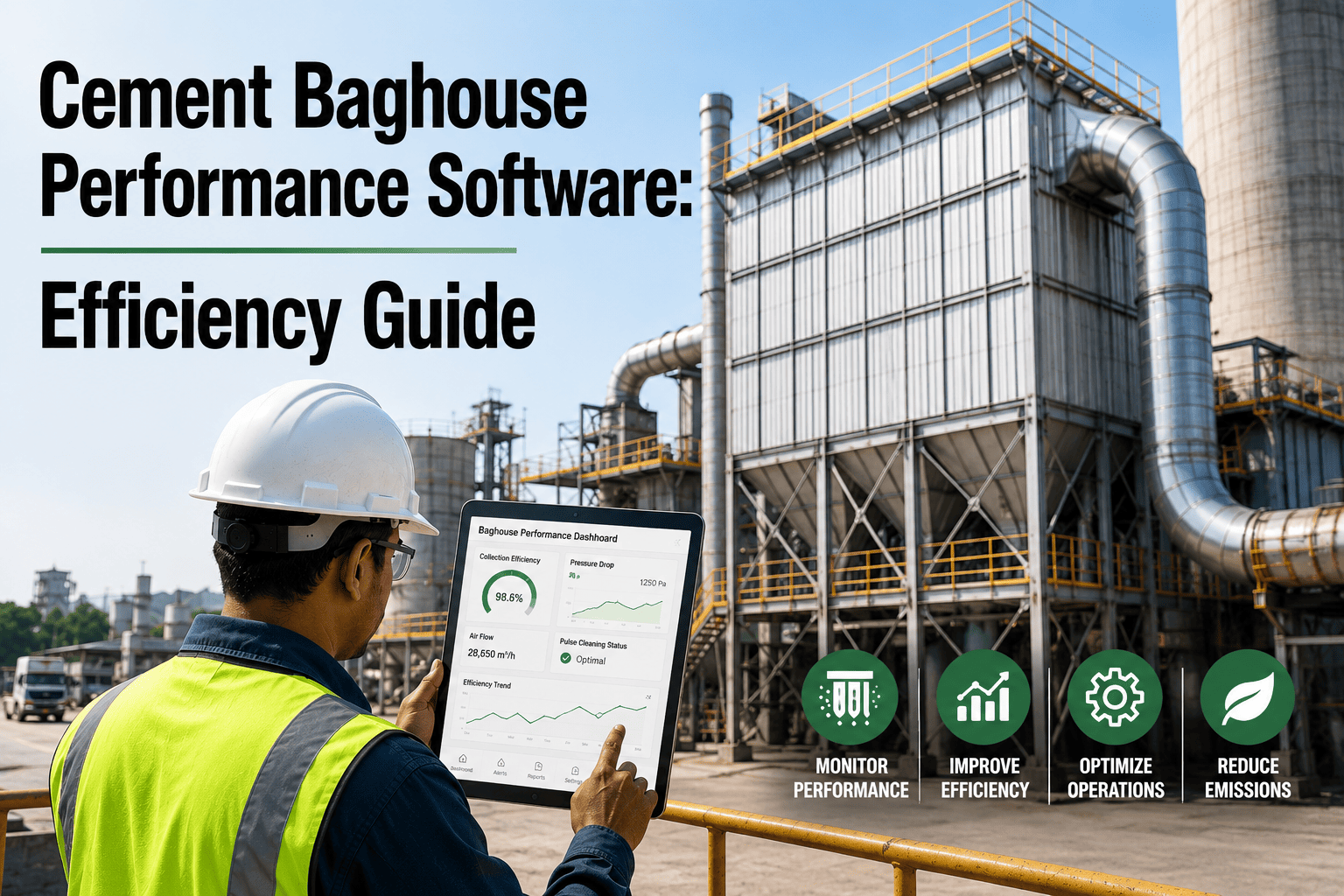
Cement plant baghouses run continuously behind every kiln, raw mill, cement mill, and clinker cooler, and differential pressure is the one number that tells you whether that system is protecting your emissions permit or quietly heading toward a stack test failure. Most maintenance teams still track DP on a clipboard, catch bag blinding only after a compartment has gone offline, and discover a failed pulse valve when the opacity monitor spikes on the control room screen. A baghouse that is not watched continuously does not fail gradually — it fails on the worst possible shift, usually during a production push when nobody has time to open an access door. This guide breaks down how differential pressure behaves across a healthy baghouse, what the warning patterns actually mean, and how baghouse performance software turns raw DP readings into scheduled work instead of emergency response. See how Oxmaint tracks baghouse performance in real time before your next stack test puts it to the real test.
Baghouse Performance
Emissions Compliance
Predictive Maintenance
Cement Baghouse Performance Software: Turn DP Readings Into a Compliance Advantage
Track bag life, differential pressure trends, pulse cleaning health, and hopper discharge across every compartment — from one CMMS dashboard that keeps your stack emissions permit defensible on every inspection.
Why Baghouse Performance Cannot Be Left to a Clipboard
$48K
Average cost of a single unplanned baghouse event — downtime, bags, labor, and disposal combined
60%
Of unscheduled baghouse shutdowns trace back to bag degradation or a pulse valve fault
72 Hrs
Typical window between the first sign of DP drift and a detectable bag failure
20%+
Rise in fan energy consumption once differential pressure climbs unchecked
The Core Problem
Differential Pressure Is the Single Number That Decides Baghouse Health
Every baghouse failure mode in a cement plant — blinding, cleaning system faults, hopper bridging, bag rupture — shows up first as a change in differential pressure. Plants that watch DP continuously catch the problem while it is still a scheduled job. Plants that check it once a shift usually find out from the opacity monitor instead.
01
Under-Cleaning and Rising DP
When pulse cleaning cannot keep pace with dust loading, the filter cake thickens and DP climbs steadily across a compartment. Left unchecked, this restricts gas flow through the kiln or mill it serves, forcing operators to push fan speed harder for the same draft — burning energy without solving the underlying blinding problem.
02
Over-Cleaning and Fabric Wear
A controller stuck on aggressive pulsing looks like good housekeeping but is not. Constant pulsing strips protective dust cake too early, exposes bags to raw gas abrasion, wastes compressed air, and shortens bag life. It also creates unstable filtration during the exact seconds after each pulse fires.
03
Chemical Blinding at Kiln Exit
At kiln-exit temperatures and alkali loadings, calcium sulphate deposits can harden onto the fabric surface within roughly 72 hours to a point where pulse cleaning no longer restores permeability. This is the failure mode that most often forces an emergency compartment isolation rather than a planned bag change.
Reading The Curve
What Your DP Trend Line Is Actually Telling You
A pulse-jet baghouse in good condition typically holds in a normal operating band, fluctuating gently with the cleaning cycle. The table below maps common DP patterns to the most likely cause, so a technician can prioritise investigation before ever opening an access door.
| DP Reading Pattern |
Most Likely Cause |
Recommended Response |
| 100–150 mm WC, stable |
Healthy compartment, cleaning cycle matched to dust load |
Continue normal monitoring rhythm |
| Rising more than 15% above the 30-day average within 48 hours |
Early-stage blinding or a weakening pulse valve |
Schedule inspection before the next round, not after it |
| Sustained above 200 mm WC for a full shift |
Advanced blinding, hardened dust cake, or hopper bridging |
Take the compartment offline for manual cleaning or bag inspection |
| Sudden sharp drop in a previously high compartment |
Possible bag rupture rather than a cleaning improvement |
Investigate immediately — do not assume the problem resolved itself |
| Erratic swings between pulses |
Failed solenoid, low compressed-air pressure, or moisture in the air supply |
Verify air pressure at the manifold, then inspect the pulse valve bank |
Stop Reading DP Off a Clipboard Once a Shift
Oxmaint logs differential pressure continuously against each compartment's asset record, flags any reading that breaks its normal band, and automatically opens the inspection work order before the bag fails — not after the opacity monitor tells you it already did.
Inside the Platform
Six Ways Oxmaint Turns Baghouse Data Into Scheduled Work
A baghouse performance platform is only useful if it converts sensor data and inspection notes into action automatically. Here is what that looks like across a full compartment lifecycle, from a new bag installation to the day it comes out.
DP-Triggered Work Orders
Every compartment carries its own rolling DP baseline. The moment a reading breaks the normal band, Oxmaint opens an inspection work order automatically — assigned, timestamped, and linked to the exact compartment, no manual escalation required.
Bag Life and Compartment History
Install date, fabric type, cumulative run hours, and every prior DP exceedance are recorded against the compartment — so a bag change decision is based on evidence, not on how long it has felt like since the last one.
Pulse System Health Tracking
Solenoid response, compressed-air pressure at the manifold, and pulse timer performance are logged at every check. A weakening valve shows up as a pattern days before it causes a blinding cascade across neighbouring bags.
Hopper Level and Discharge Monitoring
Bridging in the hopper backs dust up into the bag chamber and mimics a blinding event on the DP trend. Oxmaint tracks discharge screw runtime and hopper level readings alongside DP, so the two failure modes are never confused mid-shift.
Compliance and Stack Test Archive
Every DP reading, corrective work order, and bag replacement is stored against the asset — producing a defensible, exportable record the moment an inspector or auditor asks for baghouse performance history.
Mobile Rounds at the Compartment
Technicians log readings, photos, and findings on a phone at the access door, not from memory back at a desk hours later — closing the gap between what was observed and what actually gets recorded.
Before vs After
What Changes When Baghouse Monitoring Moves Into a CMMS
The comparison below reflects the practical difference reported by cement plants that moved from manual DP logging and reactive bag changes to a structured, CMMS-driven baghouse program.
Manual DP Logging
DP checked once a shift, sometimes skipped during production pushes
Bag changes decided by rough calendar guesswork instead of condition data
Pulse valve faults discovered only after neighbouring bags start blinding
Compliance records assembled manually before every stack test or audit
Fan energy climbs quietly for weeks before anyone notices the DP trend
Oxmaint Baghouse Program
DP logged continuously and compared against each compartment's own baseline
Bag changes scheduled from run hours, exceedance history, and inspection data
Pulse valve degradation flagged from timer and pressure trends before it cascades
Compliance history exportable in minutes, organised by compartment and date
DP threshold alerts catch drift within 48 hours, before fan energy spikes
Where The Savings Come From
The Operational Impact of Structured Baghouse Monitoring
Baghouse performance software does not just prevent emergencies — it changes how the maintenance team spends its time every week. The table below breaks down where a structured program typically pays for itself.
| Monitoring Lever |
What It Prevents |
Typical Impact |
| Continuous DP threshold alerts |
Late discovery of blinding compartments |
Drift caught within 48 hours instead of at the next scheduled round |
| Pulse valve pressure logging |
Cascading blinding from one failed solenoid |
A single failed valve loses 10 to 15% of cleaning force within hours if unnoticed |
| Compartment-level bag history |
Premature bag changes and unplanned mid-campaign failures |
Replacement timing based on condition data rather than a fixed calendar |
| Hopper discharge tracking |
Bridging mistaken for bag blinding |
Correct root cause identified before the compartment is opened unnecessarily |
| Mobile inspection logging |
Incomplete or memory-based inspection records |
Documentation completeness rises sharply once logging happens at the access door |
FAQ
Frequently Asked Questions on Cement Baghouse Performance Software
What is a normal differential pressure range for a cement plant baghouse?
A correctly pulsed pulse-jet compartment typically holds between 100 and 150 mm WC. Readings creeping above 150 mm WC despite adequate pulse pressure call for a visual inspection, and sustained readings above 200 mm WC across a full shift mean the compartment should come offline for cleaning or bag review.
How often should baghouse differential pressure actually be checked?
Manual rounds once a shift miss the early warning window. Continuous monitoring is what lets a team catch a 15% rise over the rolling average within 48 hours, while there is still time to schedule a planned fix.
Book a demo to see how Oxmaint configures these thresholds per compartment.
What usually causes a sudden spike in baghouse differential pressure?
The most common causes are a failed pulse-jet solenoid, moisture in the compressed-air supply, inlet gas temperatures running below the acid dew point, or hopper bridging pushing dust back into the bag chamber. Each leaves a distinct DP signature once you know what to look for.
Can software actually predict a bag failure before it happens?
Not with certainty, but the DP trend gives a genuine early-warning window — typically around 72 hours between the first sign of drift and a detectable failure. That is enough time to schedule a planned filter swap during a shift change instead of an emergency shutdown.
How does a CMMS help during an emissions stack test or audit?
Every DP reading, exceedance, corrective work order, and bag replacement is stored against the compartment automatically, so pulling a defensible performance history takes minutes instead of days of searching paper logs.
Start free to see your compliance archive build automatically from day one.
Give Your Baghouse the Same Attention You Give the Kiln
Oxmaint tracks differential pressure, bag life, pulse valve health, and hopper discharge across every compartment — turning routine baghouse data into scheduled work before it becomes a compliance problem.