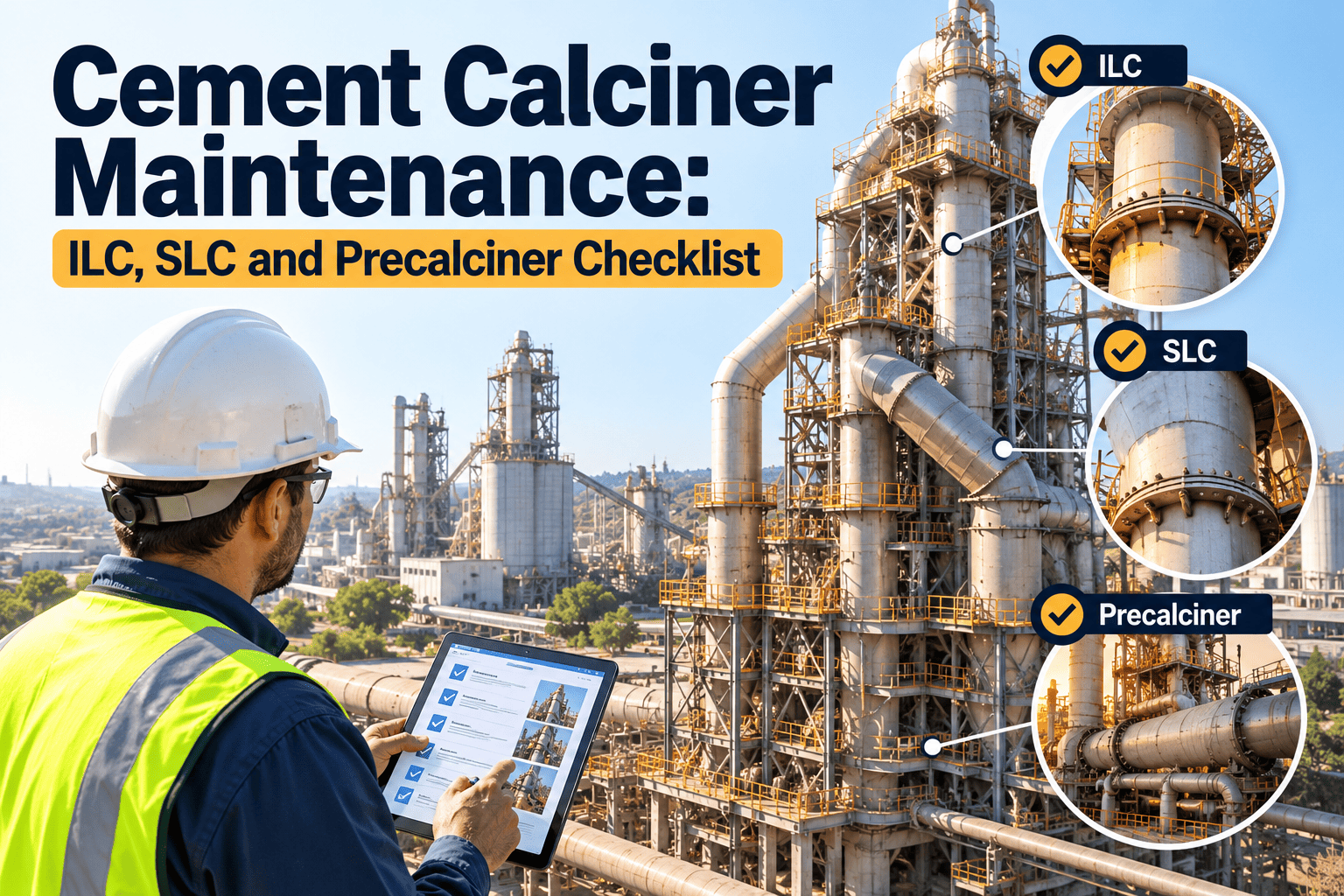
The calciner does most of the heavy chemical work in a modern dry-process cement line, so its reliability sets the pace for the whole kiln system. Build-up, refractory damage, burner wear, and blocked pressure taps rarely arrive alone, and each can limit feed rate or force an unplanned stop. This checklist covers in-line calciners (ILC), separate-line calciners (SLC), and general precalciner designs, with checks grouped by component and frequency, ready to schedule in Oxmaint CMMS software.
Cement Calciner Maintenance: ILC, SLC and Precalciner Checklist
Component-by-component checks for cement plant calciners, covering build-up, refractory, burners, tertiary air, and cyclone outlets, with escalation rules that keep problems from reaching the kiln.
Calciner Inspection Checklist
Use the same checklist for ILC, SLC, and general precalciner layouts, and mark items that do not apply to your design as not applicable.
Burners and fuel feed
Refractory and shell
Tertiary air duct and dampers
Cyclones, flaps, and outlets
Cleaning devices and instruments
Inspection sign-off
Why Calciner Reliability Drives the Whole Line
In a preheater-precalciner system, a large share of the limestone decomposition takes place in the calciner rather than in the kiln. When the calciner runs steady, the kiln sees consistent feed and can be run for clinker quality. When it does not, the kiln has to compensate.
ILC Versus SLC: What Changes for Maintenance
| Maintenance point | In-line calciner (ILC) | Separate-line calciner (SLC) |
|---|---|---|
| Gas path | Kiln gas passes through the calciner | Tertiary air path is separate from kiln gas |
| Typical focus | Kiln inlet, riser duct, and build-up control | Tertiary air duct, damper, and burner zone |
| Influence of kiln upsets | Kiln gas changes reach the calciner directly | Calciner is more independent but needs balanced air split |
| Common build-up areas | Riser duct, kiln inlet, and calciner transition | Calciner cone, outlet duct, and tertiary air entry |
| Key control point | Kiln gas oxygen and temperature profile | Tertiary air damper position and air split |
Reading the table in the field
- Always follow the OEM design for your calciner, since layouts vary between suppliers.
- Use these differences only to decide where to focus inspection time.
- Where the plant has a hybrid design, combine both checklists and note which one applies to each zone.
Build-Up: The Most Persistent Calciner Problem
Before a build-up routine
- Cleaning starts after a pressure alarm
- Crews enter a tight window with limited preparation
- Cause is rarely recorded
- Same location blocks again
With a build-up routine
- Differential pressure trends reviewed every shift
- Poke holes and air cannons inspected on a schedule
- Location, size, and likely cause recorded each time
- Repeat locations feed a root cause review
Typical contributors to build-up
- High circulating volatiles such as chlorine, sulfur, and alkalis in the raw meal and fuel mix.
- Local temperature excursions that make meal sticky.
- Uneven fuel or meal distribution at the calciner inlet.
- Air leakage at doors and poke holes that cools gas locally.
- Inadequate cleaning access or blocked air cannons.
Component Checklist for the Calciner Zone
Burners and fuel feed
- Burner tip condition and cooling
- Fuel feed line for blockage or wear
- Alternative fuel dosing and airlocks
- Flame stability and position
Refractory and shell
- Shell hot spots, scanned by thermal camera
- Lining thickness records at shutdown
- Anchor and castable condition
- Expansion joint condition
Tertiary air and dampers
- Damper movement and position feedback
- Duct wall condition and dust build-up
- Actuator, linkage, and seals
- Air split trend against setpoint
Cyclones and outlets
- Dip tubes and outlet ducts
- Flap valves and pendulum flaps
- Meal chute and splash box
- Differential pressure across each stage
Cleaning and instruments
- Air cannons, tanks, and valves
- Pressure taps kept open
- Thermocouples and gas analysers
- Poke hole doors and seals
Risk Matrix for Calciner Findings
| Finding | Likelihood to worsen | Impact if ignored | Suggested response |
|---|---|---|---|
| Rising stage differential pressure | High | Blockage and reduced feed | Inspect cleaning devices and plan cleaning |
| Shell hot spot at calciner wall | Medium | Lining failure and steel damage | Scan again, grade, plan repair at next stop |
| Damper not following command | Medium | Air split instability | Check actuator and feedback, raise a work order |
| Burner tip wear | High | Poor flame shape and uneven heating | Replace at the next opportunity |
| Blocked pressure tap | High | False readings and wrong control action | Clear and verify against a reference reading |
| Flap valve not sealing | Medium | Gas short circuit and instability | Inspect counterweight and plate, repair |
Alternative Fuels and the Calciner
Many plants burn a share of alternative fuels in the calciner because of its residence time and temperature. That brings extra maintenance work.
- Feeding systems, airlocks, and chutes need regular wear and blockage checks.
- Variable fuel quality can change flame behaviour and build-up tendency.
- Moisture swings in fuel may require watching calciner outlet temperature more closely.
- Chlorine and other volatiles in fuel can add to build-up risk.
Escalation Path From Field to Management
- 1
Operator records the observation
Pressure rise, hot spot, damper fault, or burner alarm is logged with time and location.
- 2
Technician verifies the condition
The finding is checked on site with a second measurement and graded.
- 3
Supervisor decides the action
Options are monitor, clean, schedule repair, or recommend a controlled stop.
- 4
Reliability team reviews patterns
Repeat locations and recurring causes are examined for design or process changes.
Shutdown Planning for the Calciner
KPIs That Show Calciner Health
Refractory Management in the Calciner
Track the lining by zone
Calciner cone, riser, outlet, and cyclone cones wear at different rates. Record lining type, thickness, and install date for each zone so decisions are not based on memory.
Use thermal scans between stops
A shell temperature scan on a fixed route, with the same viewing angle each time, makes changes easy to compare from week to week.
Record the cause of damage
Thermal shock, chemical attack from volatiles, mechanical damage during cleaning, and anchor failure leave different patterns. Naming the cause helps pick a better material next time.
Plan material and curing early
Castables and bricks have lead times and drying schedules. Late ordering often forces a shorter repair than the lining really needs.
Burner and Flame Checks
Tertiary Air Duct and Damper Reliability
| Check | What to look for | Why it matters |
|---|---|---|
| Damper blade and shaft | Wear, deformation, jammed movement | A stuck damper changes the air split and calciner temperature |
| Actuator and linkage | Backlash, loose joints, delayed response | Commanded position may not match actual position |
| Position feedback | Signal against visible position | Control may act on wrong information |
| Duct interior | Dust deposits, lining damage | Restricts flow and adds pressure drop |
| Duct supports and expansion joints | Cracks, leaks, movement | Leakage cools gas and wastes energy |
Instrument and Sampling Reliability
Calciner control depends on temperature, pressure, and gas readings. When a tap blocks or a thermocouple drifts, operators may react to a problem that does not exist, or miss one that does.
- Keep pressure taps clear with scheduled cleaning, and verify against a reference reading.
- Calibrate or replace thermocouples on a defined interval, and keep the calibration record.
- Check gas sampling probes and filters, since fouled probes give delayed or low readings.
- Compare redundant signals, and flag any pair that drifts apart.
Common Calciner Maintenance Mistakes
Frequent habits
- Cleaning blockages without recording where and why they formed
- Treating every pressure rise as a cleaning task, not a trend
- Delaying hot spot repair until the next long stop
- Relying on one person to know where problem areas are
Stronger habits
- Log every cleaning event with location and cause
- Review differential pressure trends for patterns by stage
- Grade hot spots and set a repair deadline by grade
- Store problem locations as asset notes shared across all shifts
Cleaning Devices: Air Cannons, Poke Holes, and Access
Condition Triggers That Call for Action
Questions for the weekly reliability review
Records to Keep for Every Calciner Task
How Oxmaint Supports Calciner Maintenance
- Preventive maintenance schedules for burners, dampers, air cannons, and instruments.
- Inspection checklists on mobile devices, with photo evidence and shell temperature readings.
- Work orders raised directly from findings, with owners and due dates.
- Asset records that hold lining history, repair dates, and parts used.
- Inventory visibility for burner parts, castable, anchors, and spare actuators.
- Reports on repeat failures, overdue tasks, and planned-versus-emergency ratio.
Frequently Asked Questions
Do ILC and SLC calciners need different checklists?
Core checks are similar, but focus areas differ. Follow your OEM design and adjust zones accordingly.
How can build-up be spotted early?
Watch stage differential pressure trends and inspect cleaning devices. Track those checks in Oxmaint to keep a clear history.
When is a shell hot spot an emergency?
When it grows quickly or shows glow, follow site procedure and involve process and maintenance leads immediately.
How does alternative fuel change maintenance?
Feed systems, airlocks, and build-up risk need closer inspection. Moisture and quality swings add process variability.
Can calciner inspections run on mobile devices?
Yes. Crews can log readings and photos on site. Schedule a demo to see the workflow.