Carbon capture, utilisation, and storage (CCUS) is the only available technology that can address the process CO2 released during limestone calcination — a reaction that accounts for roughly 60% of total cement plant emissions and cannot be eliminated by fuel switching or efficiency improvements alone. With the EU Emissions Trading System beginning its phase-out of free allowances from 2026 through 2030, the financial stakes of inaction are rising sharply for every cement producer in regulated markets. Four primary capture technologies — amine scrubbing, oxy-fuel combustion, calcium looping, and direct capture — are at different stages of commercial readiness, each with distinct equipment requirements, energy penalties, and maintenance profiles that plant engineers must plan for today. The IEA and GCCA both identify CCS and CCUS as essential to achieving the industry's net zero 2050 commitment, with deployment at scale expected before 2040. Understanding which technology fits your plant's configuration, and what your CMMS must track to keep that technology operating reliably, is not a 2035 question — it is a 2025 planning requirement. OxMaint's maintenance management platform helps cement engineers register, schedule, and audit every CCUS asset — from absorber columns to CO2 compressors — with a full maintenance and compliance record from commissioning onward.
Cement · Carbon Capture · CCUS Operations
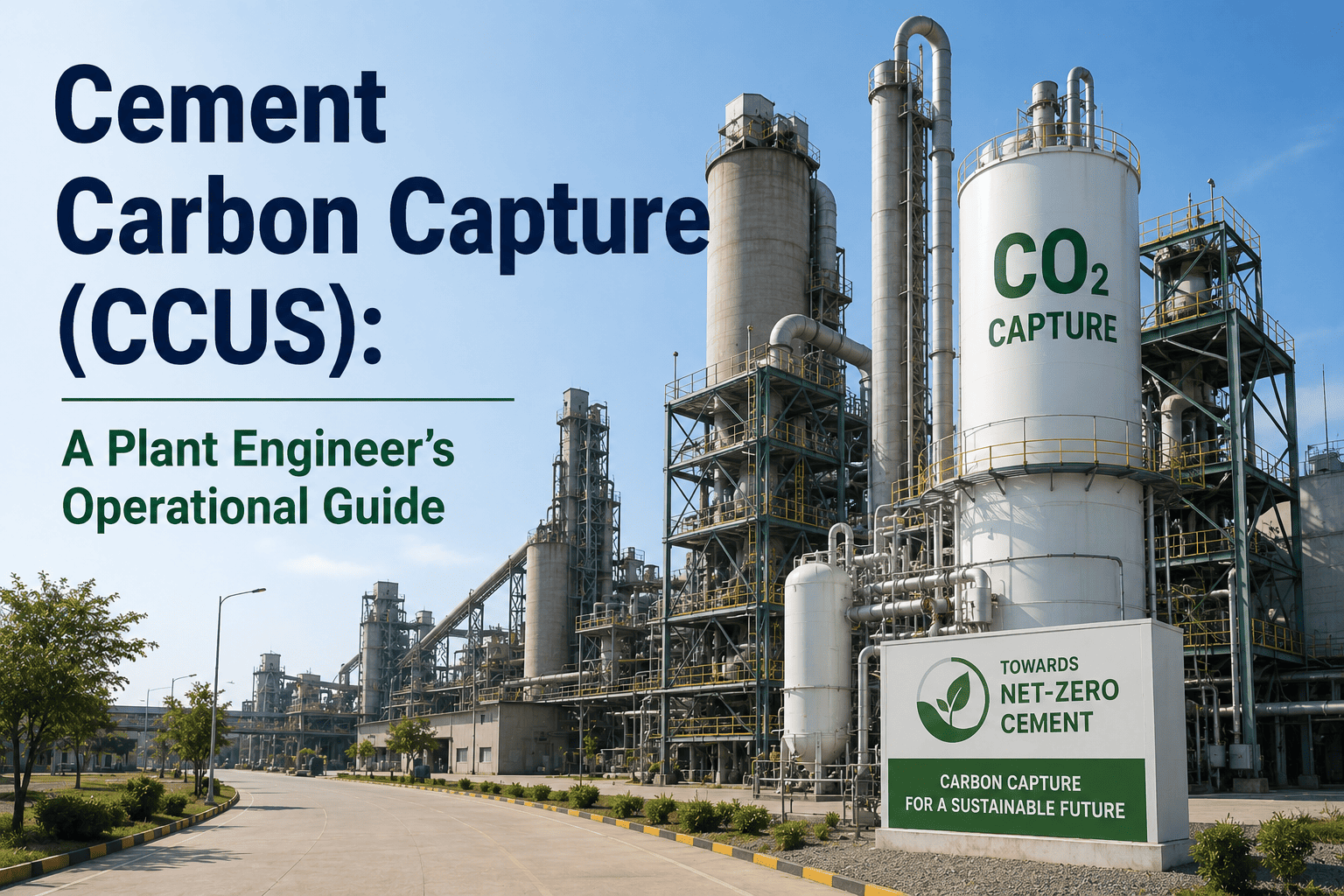
Cement Carbon Capture (CCUS): A Plant Engineer's Operational Guide
Amine · Oxy-Fuel · Calcium Looping · Compressor PM · CMMS Asset Records
Why CCUS Is Non-Negotiable for Cement
~60%
of cement CO2 comes from limestone calcination — a chemical process, not combustion
7%
of global CO2 emissions attributed to cement and concrete production
2026
EU-ETS begins phase-out of free carbon allowances for cement manufacturers
2040
Target year for large-scale commercial CCUS deployment across major cement plants
The Four CCUS Technologies: How They Work and What They Demand
Post-combustion capture using monoethanolamine (MEA) or similar solvents to absorb CO2 from flue gas. Among the most commercially mature technologies, with extensive use in power plants and nearing demonstration scale for cement.
TRL Level6 — Pilot demonstrated in relevant environment
Capture RateUp to 90% of flue gas CO2
Energy PenaltyHigh — solvent regeneration requires significant heat
Key AssetsAbsorber column, stripper, heat exchangers, solvent pumps
Critical Maintenance Points
Absorber packing inspection — fouling reduces CO2 absorption efficiency significantly
Solvent degradation monitoring — amine quality testing prevents corrosion and performance loss
Heat exchanger fouling — thermal efficiency directly impacts regeneration energy cost
Combustion takes place in near-pure oxygen rather than air, producing a flue gas that is predominantly CO2 and water vapour — which is then easily separated. Requires an air separation unit (ASU) and significant plant modification.
TRL Level4–6 — Full oxy-fuel at TRL 4, partial at TRL 6
Capture Rate85–95% of total plant CO2
Energy PenaltyVery high — ASU power demand is substantial
Key AssetsAir separation unit, modified kiln burner, CO2 purification unit
Critical Maintenance Points
ASU cold box inspection — oxygen purity must remain above 95% for effective capture
Burner tip condition — oxy-fuel flames operate at higher temperatures, accelerating tip wear
CO2 purification unit — compressor and dryer PM determine product CO2 quality for storage
Uses CaO (lime) as a sorbent that cycles between a carbonator and calciner, capturing CO2 in the carbonator and releasing it as concentrated CO2 in the calciner. The CaO purge can substitute for limestone feed — directly integrated into cement chemistry.
TRL Level6 — Pilot demonstrated in relevant environment
Capture RateAbove 85% demonstrated in pilot testing over 7+ hours
Energy PenaltyModerate — integration with cement process reduces penalty
Key AssetsCarbonator reactor, calciner, sorbent handling system
Critical Maintenance Points
Sorbent activity monitoring — CaO capture efficiency degrades with cycling; makeup flow must compensate
Cyclone and separator wear — sorbent particle attrition increases over operating cycles
Refractory condition in calciner — operating at high temperatures accelerates lining wear
Emerging technology that captures CO2 directly from process streams using solid sorbents or membranes without the intermediate steps of conventional post-combustion capture. At early development stage for cement applications.
TRL Level4–5 — Component validation at lab/relevant scale
Capture RateTarget 90%+ — not yet demonstrated at plant scale
Energy PenaltyPotentially lower than amine — research ongoing
Key AssetsSorbent beds, regeneration modules, compression train
Planning Consideration
Not yet commercially available for cement plants — suitable for site assessment and long-range roadmap planning only
Register Every CCUS Asset Before Your First Tonne Is Captured
OxMaint lets your team create a full asset register for absorbers, compressors, ASUs, calciners, and cooling systems — with PM schedules, commissioning baselines, and compliance records from day one of CCS operation.
CO2 Compressor PM: The Critical Asset in Every CCUS Train
Whatever capture technology a plant uses, the CO2 compressor train is the final step before transport or utilisation — and the single most failure-critical asset in the entire CCUS system. Compressor failure stops the entire capture chain. A structured PM programme is essential from the first day of operation.
| PM Activity |
Frequency |
What It Prevents |
CMMS Record Type |
| Vibration signature measurement |
Weekly |
Bearing failure, rotor imbalance — undetected vibration is the leading cause of compressor unplanned downtime |
Vibration trend log, baseline comparison |
| Seal system inspection |
Monthly |
CO2 leakage — both an emissions compliance failure and a safety hazard in confined spaces |
Seal condition record, leak rate measurement |
| Lube oil analysis |
Monthly |
Bearing wear, metal contamination — oil degradation accelerates when CO2 contacts lubricant under pressure |
Oil analysis certificate, change record |
| Intercooler performance check |
Monthly |
Fouling reduces cooling efficiency, forcing higher compression temperatures and accelerating valve wear |
Temperature differential log, fouling assessment |
| Valve inspection and replacement |
6-monthly |
Valve failure is the most common cause of compressor performance degradation in reciprocating units |
Valve condition record, replacement history |
| Full overhaul |
Per OEM schedule |
Accumulated wear across all components — overhaul data informs remaining useful life forecasting |
Overhaul report, performance baseline re-measurement |
CCUS Compliance: What Your Records Must Prove
A
Capture Rate Verification
Regulatory frameworks and carbon credit mechanisms require documented evidence of actual CO2 captured per tonne of cement produced. Flow meters, CO2 analysers, and capture efficiency logs must be continuous and linked to production records.
B
Equipment Integrity Records
Pressure vessel inspection certificates, pipeline integrity tests, and valve maintenance records prove that the capture system is operating safely within design parameters — required by both environmental permits and insurance underwriters.
C
CO2 Purity Documentation
For geological storage, CO2 stream composition must stay within specification. For utilisation applications, product quality certificates link to both the capture system performance and the compressor and dryer PM records.
D
Leakage Monitoring and Reporting
Any CO2 leakage from the capture system reduces net emissions reduction and may trigger permit non-compliance. Continuous monitoring records and corrective maintenance logs demonstrate that leakage is detected and addressed systematically.
Frequently Asked Questions
Which CCUS technology is most suitable for a cement plant retrofit?
Amine scrubbing and partial oxy-fuel combustion are currently the most developed for cement, both at TRL 6 with pilot demonstrations. Calcium looping offers the advantage of integration with cement chemistry, reducing energy penalty. The best choice depends on your plant configuration, energy costs, and CO2 utilisation or storage options — a site-specific assessment is essential before capital commitment.
What is the energy penalty of adding CCUS to a cement plant?
Amine scrubbing typically increases plant energy consumption by 15–25%, depending on heat integration. Oxy-fuel adds significant electrical load through the air separation unit. Calcium looping's integration with the cement kiln process can reduce its net energy penalty compared to standalone post-combustion systems. Managing energy penalty through maintenance of heat exchangers and compression efficiency is a key operational task.
How does a CMMS help manage CCUS equipment specifically?
CCUS introduces an entirely new asset class — absorbers, compressors, ASUs, calciners — with different failure modes from conventional cement plant equipment. A CMMS like
OxMaint creates a dedicated register for these assets, attaches OEM-based PM schedules from commissioning, and generates the compliance records needed to demonstrate capture system integrity to regulators and carbon credit verifiers.
When does CCUS investment become financially justified for cement plants?
Analysis from S&P Global and IHS Markit shows that oxy-fuel, calcium looping, and amine scrubbing investments in European plants could offset EU-ETS emission costs beyond 2035 as free allowances phase out. Plants that invest early also benefit from first-mover advantage on carbon credit revenues and green procurement premiums from infrastructure clients.
What makes CO2 compressor maintenance critical in a CCUS system?
The CO2 compressor is the throughput bottleneck of the entire capture chain. If it fails, captured CO2 cannot be conditioned for transport or use — stopping the financial benefit of the capture system entirely. CO2 at high pressures also accelerates corrosion and seal wear at rates different from conventional gas compressors, requiring dedicated PM protocols tracked by
a CMMS system rather than generic schedules.
OxMaint CMMS for Cement CCUS
Build Your CCUS Asset Register and PM Programme Before Capture Begins
From absorber commissioning records to compressor vibration trends and compliance audit trails — OxMaint connects every CCUS asset to a maintenance programme that keeps your capture system running and your carbon credits verifiable.